The Shenzhou-23 spacecraft's seamless connection with China's Tiangong (Heavenly Palace) space station owes much to a key piece of homegrown technology: the laser rendezvous and docking radar.
Honed through generations of iteration, this indigenous equipment has become indispensable for executing the delicate orbital maneuver known as "space needle-threading".
The Shenzhou-23 spaceship, atop a Long March-2F carrier rocket, blasted off from the Jiuquan Satellite Launch Center in northwest China at 23:08 Beijing Time (15:08 GMT) on Sunday, and successfully docked with the radial port of the Tianhe core module of the Tiangong space station at 02:45, with the docking process taking about 3.5 hours.
The Shenzhou-23 crew consists of commander Zhu Yangzhu and fellow astronauts Zhang Zhiyuan and Lai Ka-ying, who is the first astronaut from China's Hong Kong Special Administrative Region.
In the early days of China's space program, the field of space rendezvous and docking measurement was virtually an uncharted territory. There were no mature products, no reference standards, and zero on-orbit operational experience.
Undeterred, Chinese research teams embarked on a determined quest to develop the country's first laser rendezvous and docking radar. Through rigorous principle verification, ground simulations, and extreme-environment testing, they overcame one technical barrier after another, laying the foundation for today's precision docking capability.
"The real challenge was the gap between Earth and space. When we started, our team traveled to places like Qinghai and Yunnan Provinces to find environments as close as possible to space conditions. Combined with simulations and modeling, we could calculate how far our radar could detect on the ground versus in orbit," said Li Lei, chief designer of the laser radar project at the 27th Research Institute of China Electronics Technology Group Corporation (CETC).
The technology achieved its first major success in 2011, when the Shenzhou-8 spacecraft completed a rigid connection with the Tiangong-1 space lab, forming China's first space combination.
A decade later, in 2021, the Shenzhou-13 crewed mission accomplished a new challenge: the first radial rendezvous and docking with the space station's Tianhe core module.
By 2023, the upgraded system successfully guided the radial docking of the Shenzhou-16 manned spaceship with the space station core module, supporting the first crewed mission during the application and development phase of China's space station.
"During the Tiangong-1 and Tiangong-2 space labs era, there was essentially only one docking port. With the space station, we now have requirements for rear, forward, and radial docking, alongside fly-around maneuvers. These demands kept evolving. Through continuous software updates, we have fulfilled all these requirements," explained Zhao Mingfu, deputy chief designer of the laser radar project.
The Tiangong space station is the successor to China's Tiangong-1 and Tiangong-2 space labs. Launched in 2011 and 2016 respectively, these precursor missions were designed to validate critical technologies and on-orbit assembly techniques, paving the way for the construction of the country's orbital outpost.
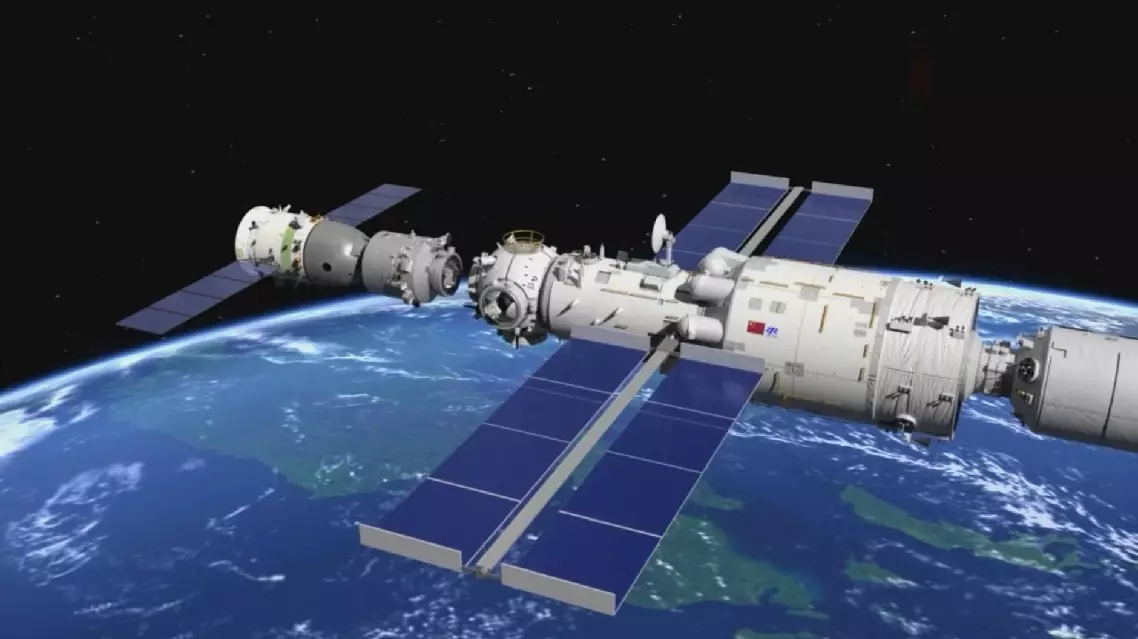
Upgraded laser radar guides Shenzhou-23 to flawlessly dock with China's space station