|
- The third run of InsureXpo® 2026 convened the entire insurance ecosystem to empower individuals to become financially fit and future-ready.
- Latest joint study by CIMB Singapore and Nanyang Technological University unveils Singapore residents' shifting definition of financial independence.
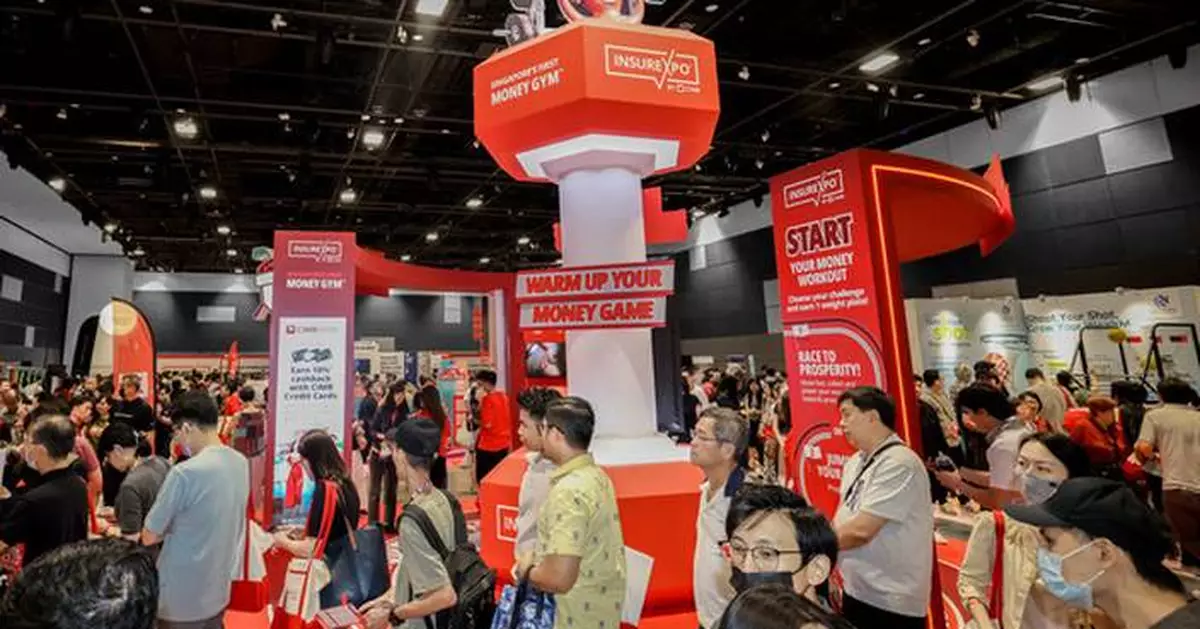
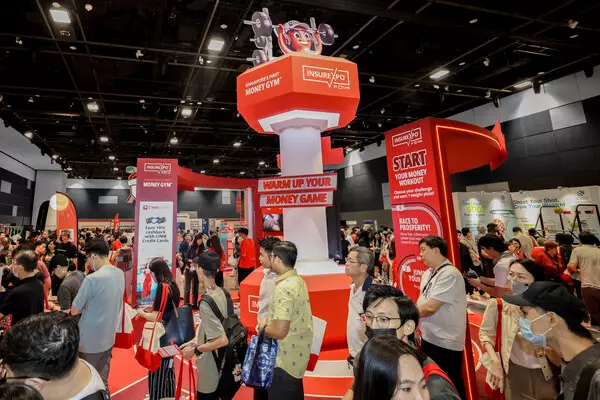
SINGAPORE, May 26, 2026 /PRNewswire/ -- InsureXpo® by CIMB 2026 successfully concluded its third edition on 23 May at Suntec Convention Centre. Anchored on a "Money Gym" concept, the event united Singapore's insurance ecosystem – including leading insurers such as Singlife, AIA, FWD, and Income – alongside policymakers, academics, and industry experts. Together, they empowered Singapore residents to strengthen their financial fitness through interactive stations designed to build financial stamina and resilience.
Study Findings: Rising Wealth Ambition, Earlier Retirement Timelines
At the event, CIMB Singapore released a report revealing that financial independence is taking on a new meaning as Singapore residents raise both their wealth ambitions and their timelines.
Jointly conducted by CIMB Singapore and Nanyang Technological University, the second edition of the "Attitudes and Beliefs towards Financial Independence Report" surveyed over 1,000 Singapore residents aged 18 to 60 on their views about financial independence in 2026.
The research found a shift in how Singapore residents define and pursue financial independence. Once centered on the qualitative notion of "freedom from financial concerns", independence is now increasingly quantified, with 56.3% aspiring to accumulate over S$1 million, up from 52.3% in 2025, with 35.8% identifying S$1-2.5 million as the "sweet spot" for financial independence.
This rising wealth ambition is matched by an accelerated timeline: where retirement in the 50s was the norm just a year ago, today's benchmark has moved into the 40s. Gen Z is pushing boundaries even further, envisioning financial freedom in their 30s, or in some cases, their 20s.
Financial Independence: Aspirational Yet Challenging
While many Singapore residents believe financial independence is achievable, confidence remains mixed and anxiety persists. While 78.0% believe that financial independence is achievable, most (36.0%) describe themselves as only "moderately confident", and 34.6% report frequent or constant anxiety about their financial future.
Generational differences stand out: Gen Z reports the highest anxiety at 41.2%, Millennial emerges as the most confident with 51.8% expressing strong confidence, and Gen X falls in between, with 38.3% experiencing frequent anxiety and 30.5% feeling strongly confident.
The Gap between Ambition and Action
The drive for financial independence remains strong, but many struggle to translate intent into action. Key barriers include high living costs (70.7%), low income (54.0%), and family responsibilities (53.4%), with growing concerns around market volatility (32.8%), limited financial education (28.2%), and lifestyle pressures such as shopping temptations (22.8%).
Yet, fewer than half (46.4%) have begun retirement planning, often delayed by competing priorities (42.2%), uncertainty about how to start (34.4%), and the belief that it is too early (31.9%).
These findings highlight a clear disconnect – while independence is widely seen as achievable, confidence is tempered by anxiety, and retirement planning remains deferred, underscoring the persistent gap between ambition and action.
"Our study shows that financial independence in Singapore is no longer defined by a single dollar figure, but by freedom from financial stress. While respondents expressed moderate confidence in achieving this goal, many Singaporeans still face gaps in retirement preparedness," said Professor Sharon Ng, Deputy Dean at Nanyang Business School and Founding Director of the Nanyang Centre for Marketing and Technology.
Generational Priorities and The Sandwich Generation Effect
A clear difference in financial priorities emerges across generations. While all aspire to achieve freedom from financial concerns, each group is driven by distinct motivations: Gen Z places the highest value on autonomy and control over income and spending (25.7%), Millennial focuses on building wealth (27.0%), and Gen X emphasizes living debt-free (20.1%).
The sandwich generation, balancing the dual responsibilities of caring for both parents and children, demonstrates notably higher financial ambitions. Nearly two-thirds (64.4%) aim to accumulate at least S$1 million, compared with 51.7% of non-sandwich respondents, reflecting the capital needed to sustain multiple generations. This group also stands out for its proactive approach: 91.2% already have a financial independence plan, 60.9% are open to professional advice, and 62.8% view insurance as an investment tool.
Advice and Action as Game‑Changers
Access to financial advice and decisive action are pivotal in improving financial well-being. Those open to professional guidance report far lower anxiety and higher confidence – only 25.4% experience frequent financial anxiety, compared with 42.2% among those who do not seek advice. Confidence more than doubles for individuals who engage a financial planner, rising to 65.8% versus 28.2% for those who do not.
Taking action further amplifies these benefits. Only 30.8% of those with a financial plan report frequent anxiety, compared with 51.9% without one. Confidence in achieving independence stands at 52.3% among planners, four times higher than the 13.0% recorded among non‑planners.
Perceptions of insurance are also shifting. Increasingly, it is seen not only as protection but as an enabler of independence, with 52.6% of residents sharing this view, up from 45.0% last year.
"Financial confidence doesn't come from chance; it comes from choice. Seeking advice, taking action, and rethinking insurance as empowerment are the drivers that can transform anxiety into financial independence," said Raymond Tan, Head of Wealth Management and Deposits at CIMB Singapore.
Bridging the Gap between Ambition and Action
The report underscores that financial independence is not a single milestone, but an ongoing journey of resilience across life stages. Financial institutions have a unique opportunity to provide integrated support by reframing savings, insurance, retirement, and wealth advisory services as interconnected elements of one holistic financial journey.
"Even amid global uncertainty, Singapore residents remain anchored in their financial values. Their measured confidence reflects a pragmatic mindset and continued trust in Singapore's stability and institutions. Guided by our belief in providing one advisory with access to seven insurers, CIMB Singapore offers customers with balanced, needs-based guidance through a single touchpoint, helping them make more informed choices with greater confidence," said Merlyn Tsai, Regional Head of Group Consumer Banking Digital Strategy & Head of Consumer Banking and Digital Singapore.
"InsureXpo® reflects CIMB's purpose of advancing customers and society by empowering individuals with clarity, confidence, and choice in their financial planning journey. Now in its third year, the event underscores our continued commitment to helping customers safeguard their financial futures, while reinforcing our role as a trusted partner in building long-term financial resilience for the community," she added.
View the infographics and concise deck, or explore the full report for deeper insights.
Note to editors:
About CIMB
CIMB is one of ASEAN's leading banking groups and Malaysia's second largest financial services provider, by assets. Listed on Bursa Malaysia via CIMB Group Holdings Berhad, it had a market capitalisation of approximately RM89.0 billion as at 31 December 2025. It offers consumer banking, commercial banking, wholesale banking, transaction banking, Islamic banking and asset management products and services. Headquartered in Kuala Lumpur, the Group is present across ASEAN in Malaysia, Indonesia, Singapore, Thailand, Cambodia, Vietnam and Philippines. Singapore is one of its key markets with approximately 1,000 employees serving clients across consumer, commercial, wholesale and transaction banking products and services.
Beyond ASEAN, the Group has market presence in Mainland China, Hong Kong SAR and UK. CIMB has one of the most extensive retail branch networks in ASEAN with 576 branches and over 33,000 employees as at 31 December 2025. CIMB's investment banking arm is one of the largest Asia Pacific-based investment banks, which together with its award-winning treasury & markets and corporate banking units comprise the Group's leading wholesale banking franchise. CIMB is also the 91.45% shareholder of Bank CIMB Niaga in Indonesia, and 94.83% shareholder of CIMB Thai in Thailand.
Sustainability is a core pillar of CIMB's Forward30 strategy and 2030 roadmap. The Group is guided by its Green, Social, Sustainable Impact Products and Services ("GSSIPS") framework, an internal taxonomy designed to deliver impactful sustainable finance. Since launching its sustainable finance framework in 2021, CIMB has progressively raised its ambitions, increasing its initial RM30 billion target to RM100 billion for 2021–2024. The Group now targets RM300 billion in sustainable finance by 2030, reinforcing its commitment to enabling a lower-carbon and more inclusive economy across the region.
- The third run of InsureXpo® 2026 convened the entire insurance ecosystem to empower individuals to become financially fit and future-ready.
- Latest joint study by CIMB Singapore and Nanyang Technological University unveils Singapore residents' shifting definition of financial independence.
SINGAPORE, May 26, 2026 /PRNewswire/ -- InsureXpo® by CIMB 2026 successfully concluded its third edition on 23 May at Suntec Convention Centre. Anchored on a "Money Gym" concept, the event united Singapore's insurance ecosystem – including leading insurers such as Singlife, AIA, FWD, and Income – alongside policymakers, academics, and industry experts. Together, they empowered Singapore residents to strengthen their financial fitness through interactive stations designed to build financial stamina and resilience.
Study Findings: Rising Wealth Ambition, Earlier Retirement Timelines
At the event, CIMB Singapore released a report revealing that financial independence is taking on a new meaning as Singapore residents raise both their wealth ambitions and their timelines.
Jointly conducted by CIMB Singapore and Nanyang Technological University, the second edition of the "Attitudes and Beliefs towards Financial Independence Report" surveyed over 1,000 Singapore residents aged 18 to 60 on their views about financial independence in 2026.
The research found a shift in how Singapore residents define and pursue financial independence. Once centered on the qualitative notion of "freedom from financial concerns", independence is now increasingly quantified, with 56.3% aspiring to accumulate over S$1 million, up from 52.3% in 2025, with 35.8% identifying S$1-2.5 million as the "sweet spot" for financial independence.
This rising wealth ambition is matched by an accelerated timeline: where retirement in the 50s was the norm just a year ago, today's benchmark has moved into the 40s. Gen Z is pushing boundaries even further, envisioning financial freedom in their 30s, or in some cases, their 20s.
Financial Independence: Aspirational Yet Challenging
While many Singapore residents believe financial independence is achievable, confidence remains mixed and anxiety persists. While 78.0% believe that financial independence is achievable, most (36.0%) describe themselves as only "moderately confident", and 34.6% report frequent or constant anxiety about their financial future.
Generational differences stand out: Gen Z reports the highest anxiety at 41.2%, Millennial emerges as the most confident with 51.8% expressing strong confidence, and Gen X falls in between, with 38.3% experiencing frequent anxiety and 30.5% feeling strongly confident.
The Gap between Ambition and Action
The drive for financial independence remains strong, but many struggle to translate intent into action. Key barriers include high living costs (70.7%), low income (54.0%), and family responsibilities (53.4%), with growing concerns around market volatility (32.8%), limited financial education (28.2%), and lifestyle pressures such as shopping temptations (22.8%).
Yet, fewer than half (46.4%) have begun retirement planning, often delayed by competing priorities (42.2%), uncertainty about how to start (34.4%), and the belief that it is too early (31.9%).
These findings highlight a clear disconnect – while independence is widely seen as achievable, confidence is tempered by anxiety, and retirement planning remains deferred, underscoring the persistent gap between ambition and action.
"Our study shows that financial independence in Singapore is no longer defined by a single dollar figure, but by freedom from financial stress. While respondents expressed moderate confidence in achieving this goal, many Singaporeans still face gaps in retirement preparedness," said Professor Sharon Ng, Deputy Dean at Nanyang Business School and Founding Director of the Nanyang Centre for Marketing and Technology.
Generational Priorities and The Sandwich Generation Effect
A clear difference in financial priorities emerges across generations. While all aspire to achieve freedom from financial concerns, each group is driven by distinct motivations: Gen Z places the highest value on autonomy and control over income and spending (25.7%), Millennial focuses on building wealth (27.0%), and Gen X emphasizes living debt-free (20.1%).
The sandwich generation, balancing the dual responsibilities of caring for both parents and children, demonstrates notably higher financial ambitions. Nearly two-thirds (64.4%) aim to accumulate at least S$1 million, compared with 51.7% of non-sandwich respondents, reflecting the capital needed to sustain multiple generations. This group also stands out for its proactive approach: 91.2% already have a financial independence plan, 60.9% are open to professional advice, and 62.8% view insurance as an investment tool.
Advice and Action as Game‑Changers
Access to financial advice and decisive action are pivotal in improving financial well-being. Those open to professional guidance report far lower anxiety and higher confidence – only 25.4% experience frequent financial anxiety, compared with 42.2% among those who do not seek advice. Confidence more than doubles for individuals who engage a financial planner, rising to 65.8% versus 28.2% for those who do not.
Taking action further amplifies these benefits. Only 30.8% of those with a financial plan report frequent anxiety, compared with 51.9% without one. Confidence in achieving independence stands at 52.3% among planners, four times higher than the 13.0% recorded among non‑planners.
Perceptions of insurance are also shifting. Increasingly, it is seen not only as protection but as an enabler of independence, with 52.6% of residents sharing this view, up from 45.0% last year.
"Financial confidence doesn't come from chance; it comes from choice. Seeking advice, taking action, and rethinking insurance as empowerment are the drivers that can transform anxiety into financial independence," said Raymond Tan, Head of Wealth Management and Deposits at CIMB Singapore.
Bridging the Gap between Ambition and Action
The report underscores that financial independence is not a single milestone, but an ongoing journey of resilience across life stages. Financial institutions have a unique opportunity to provide integrated support by reframing savings, insurance, retirement, and wealth advisory services as interconnected elements of one holistic financial journey.
"Even amid global uncertainty, Singapore residents remain anchored in their financial values. Their measured confidence reflects a pragmatic mindset and continued trust in Singapore's stability and institutions. Guided by our belief in providing one advisory with access to seven insurers, CIMB Singapore offers customers with balanced, needs-based guidance through a single touchpoint, helping them make more informed choices with greater confidence," said Merlyn Tsai, Regional Head of Group Consumer Banking Digital Strategy & Head of Consumer Banking and Digital Singapore.
"InsureXpo® reflects CIMB's purpose of advancing customers and society by empowering individuals with clarity, confidence, and choice in their financial planning journey. Now in its third year, the event underscores our continued commitment to helping customers safeguard their financial futures, while reinforcing our role as a trusted partner in building long-term financial resilience for the community," she added.
View the infographics and concise deck, or explore the full report for deeper insights.
Note to editors:
About CIMB
CIMB is one of ASEAN's leading banking groups and Malaysia's second largest financial services provider, by assets. Listed on Bursa Malaysia via CIMB Group Holdings Berhad, it had a market capitalisation of approximately RM89.0 billion as at 31 December 2025. It offers consumer banking, commercial banking, wholesale banking, transaction banking, Islamic banking and asset management products and services. Headquartered in Kuala Lumpur, the Group is present across ASEAN in Malaysia, Indonesia, Singapore, Thailand, Cambodia, Vietnam and Philippines. Singapore is one of its key markets with approximately 1,000 employees serving clients across consumer, commercial, wholesale and transaction banking products and services.
Beyond ASEAN, the Group has market presence in Mainland China, Hong Kong SAR and UK. CIMB has one of the most extensive retail branch networks in ASEAN with 576 branches and over 33,000 employees as at 31 December 2025. CIMB's investment banking arm is one of the largest Asia Pacific-based investment banks, which together with its award-winning treasury & markets and corporate banking units comprise the Group's leading wholesale banking franchise. CIMB is also the 91.45% shareholder of Bank CIMB Niaga in Indonesia, and 94.83% shareholder of CIMB Thai in Thailand.
Sustainability is a core pillar of CIMB's Forward30 strategy and 2030 roadmap. The Group is guided by its Green, Social, Sustainable Impact Products and Services ("GSSIPS") framework, an internal taxonomy designed to deliver impactful sustainable finance. Since launching its sustainable finance framework in 2021, CIMB has progressively raised its ambitions, increasing its initial RM30 billion target to RM100 billion for 2021–2024. The Group now targets RM300 billion in sustainable finance by 2030, reinforcing its commitment to enabling a lower-carbon and more inclusive economy across the region.
** This press release is distributed by PR Newswire through automated distribution system, for which the client assumes full responsibility. **
CIMB's InsureXpo® 2026 Reveals New Financial Independence Benchmark: More Singapore Residents Target S$1M+ and Retirement in Their 40s
|
Effective 25 May 2026, clients gain access to high-impact opportunities spanning artificial intelligence, semiconductor infrastructure, clean energy, the space economy, institutional digital assets, and macro-thematic ETFs.
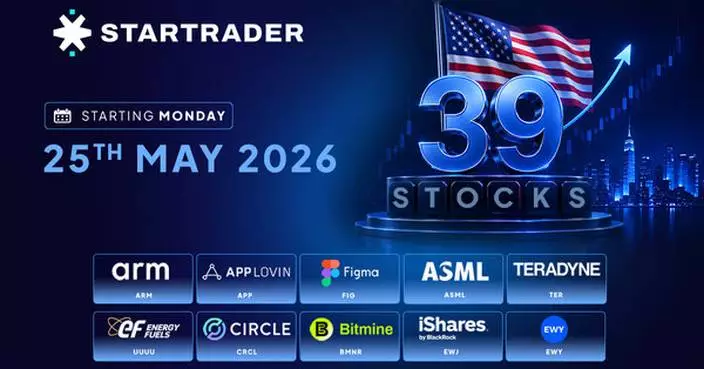
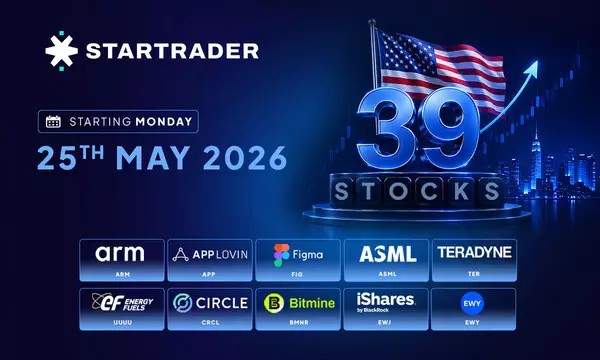
DUBAI, UAE, May 26, 2026 /PRNewswire/ -- STARTRADER has announced the addition of 39 US stocks and ETFs to its trading platform, available from Monday, 25 May 2026. Spanning ten sectors, the launch provides clients with structured exposure to the industries attracting the strongest institutional capital flows across global markets.
Today's market environment is shaped by a set of interconnected structural themes: the AI infrastructure buildout, the energy demand it creates, the semiconductor and optical hardware it relies on, the institutional maturation of digital assets, and the commercialisation of the space economy. This expansion has been strategically built around that ecosystem.
Artificial intelligence anchors the launch, with products including ARM, APP, FIG, CLS, and CRDO covering AI hardware, CPU architecture, and software infrastructure. Underpinning that layer, semiconductor and optical communication companies — ASML, LITE, COHR, TER, ONTO, and KEYS — support the advanced chip production and high-speed data transfer capabilities that large-scale AI environments demand.
As AI adoption accelerates, so does demand across energy and utility systems. GEV, OKLO, CCJ, CEG, TLN, UUUU, and UNG capture the power generation, grid modernization, and clean energy transition required to sustain next-generation computing environments. The expansion further adds space economy exposure through ASTS, RKLB, IRDM, and SATS, targeting satellite communications and low-Earth orbit networks as institutional capital continues flowing into the sector.
On digital assets, CRCL, CLSK, GLXY, BLSH, SBET, and BMNR reflect the growing convergence between traditional finance and regulated crypto infrastructure, while KTOS adds exposure to autonomous defense and drone technologies. Rounding out the launch, INSM, STRL, and TME cover infrastructure and application opportunities, alongside six regional thematic ETFs — Japan (EWJ), South Korea (EWY), Brazil (EWZ), India (INDA), China (MCHI), and leveraged technology (TQQQ) — as well as TLT, providing a yield anchor during interest rate transitions.
"This launch is not about adding products — it is about building access to the interconnected system of industries driving the next phase of global capital. AI, energy, semiconductors, space, and institutional digital assets are not parallel themes; they are structurally linked. Our clients deserve exposure to all of it, with the breadth and relevance that today's markets demand." — Peter Karsten, Chief Executive Officer, STARTRADER
All 39 products are available across STARTRADER's trading ecosystem from Monday, 25 May 2026, giving clients broader access to emerging global market themes through a more strategically diversified product offering. Clients are encouraged to review the full product specifications for detailed contract information and trading parameters.
About STARTRADER
STARTRADER is a global multi-asset broker empowering retail and institutional partners to access global markets through a range of platforms, including MetaTrader, STAR-APP, and STAR-COPY.
Regulated in five jurisdictions (CMA, ASIC, FSCA, FSA, and FSC), STARTRADER combines strong governance with a client-first approach, serving both retail clients and partners with a commitment to transparency, reliability, and long-term growth.
Effective 25 May 2026, clients gain access to high-impact opportunities spanning artificial intelligence, semiconductor infrastructure, clean energy, the space economy, institutional digital assets, and macro-thematic ETFs.
DUBAI, UAE, May 26, 2026 /PRNewswire/ -- STARTRADER has announced the addition of 39 US stocks and ETFs to its trading platform, available from Monday, 25 May 2026. Spanning ten sectors, the launch provides clients with structured exposure to the industries attracting the strongest institutional capital flows across global markets.
Today's market environment is shaped by a set of interconnected structural themes: the AI infrastructure buildout, the energy demand it creates, the semiconductor and optical hardware it relies on, the institutional maturation of digital assets, and the commercialisation of the space economy. This expansion has been strategically built around that ecosystem.
Artificial intelligence anchors the launch, with products including ARM, APP, FIG, CLS, and CRDO covering AI hardware, CPU architecture, and software infrastructure. Underpinning that layer, semiconductor and optical communication companies — ASML, LITE, COHR, TER, ONTO, and KEYS — support the advanced chip production and high-speed data transfer capabilities that large-scale AI environments demand.
As AI adoption accelerates, so does demand across energy and utility systems. GEV, OKLO, CCJ, CEG, TLN, UUUU, and UNG capture the power generation, grid modernization, and clean energy transition required to sustain next-generation computing environments. The expansion further adds space economy exposure through ASTS, RKLB, IRDM, and SATS, targeting satellite communications and low-Earth orbit networks as institutional capital continues flowing into the sector.
On digital assets, CRCL, CLSK, GLXY, BLSH, SBET, and BMNR reflect the growing convergence between traditional finance and regulated crypto infrastructure, while KTOS adds exposure to autonomous defense and drone technologies. Rounding out the launch, INSM, STRL, and TME cover infrastructure and application opportunities, alongside six regional thematic ETFs — Japan (EWJ), South Korea (EWY), Brazil (EWZ), India (INDA), China (MCHI), and leveraged technology (TQQQ) — as well as TLT, providing a yield anchor during interest rate transitions.
"This launch is not about adding products — it is about building access to the interconnected system of industries driving the next phase of global capital. AI, energy, semiconductors, space, and institutional digital assets are not parallel themes; they are structurally linked. Our clients deserve exposure to all of it, with the breadth and relevance that today's markets demand." — Peter Karsten, Chief Executive Officer, STARTRADER
All 39 products are available across STARTRADER's trading ecosystem from Monday, 25 May 2026, giving clients broader access to emerging global market themes through a more strategically diversified product offering. Clients are encouraged to review the full product specifications for detailed contract information and trading parameters.
About STARTRADER
STARTRADER is a global multi-asset broker empowering retail and institutional partners to access global markets through a range of platforms, including MetaTrader, STAR-APP, and STAR-COPY.
Regulated in five jurisdictions (CMA, ASIC, FSCA, FSA, and FSC), STARTRADER combines strong governance with a client-first approach, serving both retail clients and partners with a commitment to transparency, reliability, and long-term growth.
** This press release is distributed by PR Newswire through automated distribution system, for which the client assumes full responsibility. **
STARTRADER Launches 39 New US Stocks and ETFs Across the Sectors Shaping the Future of Global Markets