Skip to Content Facebook Feature Image

China, Serbia issue joint statement on continuously building community with shared future

China

China

China

China, Serbia issue joint statement on continuously building community with shared future

2026-05-26 17:33 Last Updated At:05-27 13:45

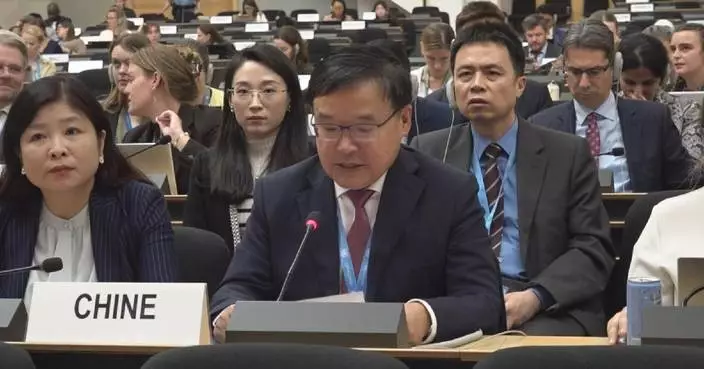
China and Serbia have issued a joint statement on continuously promoting the building of a China-Serbia community with a shared future in the new era.

The joint statement was released as Serbian President Aleksandar Vucic is on a state visit to China from Sunday to Thursday at the invitation of Chinese President Xi Jinping.

The two heads of state reaffirmed their consensus reached in a joint statement on elevating bilateral ties in May 2024.

They agreed that the building of a community with a shared future in the new era is a common strategic choice made by both sides based on each other's development paths and the will of the people.

They also vowed to continue to leverage the strategic guiding role of head-of-state diplomacy, fully implement the important consensus reached by the two leaders, and maintain close high-level exchanges through various forms.

The two countries reaffirmed firm support for each other in safeguarding national sovereignty, territorial integrity, and national dignity. Serbia stressed its adherence to the one-China principle.

Both sides agreed to establish an inter-governmental cooperation committee to guide and promote bilateral cooperation in various fields.

They also vowed to promote the alignment of China's 15th Five-Year Plan with Serbia's 2030 development strategy.

They promised to enhance exchanges in such sectors as media, think tanks, film, radio and television.

China, Serbia issue joint statement on continuously building community with shared future
China, Serbia issue joint statement on continuously building community with shared future

The Republic of Korea (ROK)'s consumer price inflation eased in July, breaking a multi-month accelerating trend amid stabilizing energy prices and lower farm goods prices, statistical ministry data showed Tuesday.

The consumer price index (CPI) rose 2.8 percent in July from a year earlier, falling below 3.0 percent in three months, according to the Ministry of Data and Statistics.

It marked a noticeable deceleration from 3.2 percent in June, after accelerating from 2.0 percent in February to 2.2 percent in March, 2.6 percent in April and 3.1 percent in May.

Headline inflation, however, stayed above the central bank's mid-term inflation target of 2 percent for 11 straight months since September 2025.

The Bank of Korea raised its benchmark interest rate by 25 basis points to 2.75 percent in July, turning toward monetary tightening in about three and a half years since January 2023.

Oil products price gained 15.5 percent last month, after spiking 24.7 percent in the previous month. The price lifted overall inflation by 0.60 percentage points.

Price for gasoline and diesel jumped 12.6 percent and 21.5 percent each, while computer price shot up 25.1 percent amid soaring semiconductor price. Price for industrial products, including oil products and processed food, advanced 3.7 percent in July compared to the same month last year, slower than an expansion of 4.4 percent in the previous month.

Processed food price added 1.0 percent in July from a year earlier, faster than a growth of 0.9 percent in the previous month.

Price for agricultural, livestock and fishery products climbed 0.9 percent in July from a year earlier, after picking up 3.2 percent in June.

Agricultural products price slipped 2.2 percent last month, turning downward from an increase of 1.1 percent in the prior month. Those for livestock and fishery products swelled 4.4 percent and 3.9 percent each.

Rice price mounted 7.9 percent, but those for napa cabbage, watermelon, spinach, cucumber and zucchini retreated in double figures. Those for beef, imported beef, pork, egg and mackerel increased in single digits.

Price for electricity, natural gas and tap water was up 0.4 percent in July on a yearly basis.

City gas charge and waterworks fee added in single digits, but heating cost dipped 0.2 percent.

Services price surged 2.6 percent last month, hiking up the headline inflation by 1.46 percentage points.

Public service price rose 1.4 percent, while private service price, including eating-out costs, expanded 3.5 percent.

The eating-out expense gained 2.6 percent, and the private service price excluding the dining-out cost jumped 4.1 percent.

Affected by a spike in fuel surcharges from rising oil prices, international airfares soared 21.7 percent last month.

Housing rent, including Jeonse and monthly rent, was up 1.1 percent in July from a year earlier.

Jeonse is the country's unique contract between two households where a landlord grants two-year residential rights to a tenant, who in turn lends a certain amount of money, or a deposit, to the landlord.

The livelihood items index, which gauges prices for daily necessities, climbed 2.5 percent, while the fresh food index, which measures prices for fish, shellfish, fruit and vegetables, declined 2.3 percent.

Demand-side inflationary pressure lingered. Core consumer price index, which excludes volatile agricultural and oil products, appreciated 2.5 percent last month.

The OECD-method core price, excluding volatile food and energy costs, went up 2.6 percent in the cited month.

ROK's consumer price inflation eases to 2.8 pct in July

ROK's consumer price inflation eases to 2.8 pct in July

Recommended Articles