Skip to Content Facebook Feature Image

US has deported thousands of Cubans and Venezuelans to danger in Mexico, Human Rights Watch says

News

US has deported thousands of Cubans and Venezuelans to danger in Mexico, Human Rights Watch says
News

News

US has deported thousands of Cubans and Venezuelans to danger in Mexico, Human Rights Watch says

2026-05-27 14:08 Last Updated At:14:20

MEXICO CITY (AP) — The Trump administration has deported nearly 13,000 Cubans, Venezuelans and other nationals to Mexico, where they are vulnerable to cartel violence in an unfamiliar country, a report by Human Rights Watch released Wednesday said.

While Mexico has accepted these types of deportations for years, the deportees under the Trump administration are older and have lived in the U.S. for longer than in the past, making it more difficult for them to find work and increasing the urgency of the need for medical care.

The report, which is based on more than 50 interviews in the southern Mexican cities Tapachula and Villahermosa, comes as U.S. President Donald Trump has expanded immigration enforcement to carry out his mass deportation plan.

This has meant that immigrants who were not previously targeted, such as Cubans with years or decades living in the U.S., have been caught up in the immigration dragnet. Some countries, such as Cuba and Venezuela, limit deportation flights or don’t accept deportees at all, so they are instead sent to Mexico or other countries with which the U.S. has struck deals.

“Imagine being 60 or 70 years old, uprooted from your life overnight and sent to a country you don’t know, where authorities leave you out to dry without access to even the most basic services — shelter, healthcare. Imagine being dropped in dangerous cities with nothing but the clothes on your back,” said Alcira Hava, Leonard H. Sandler Fellow at Human Rights Watch, who worked on the report.

“That’s the reality for many Cubans deported to Mexico,” Hava said.

Cubans represent the largest group sent to Mexico, according to the report, with more than 4,300 deported. More than half the 41 Cubans interviewed had lived in the U.S. since the 1980s or 1990s, arriving during the Mariel boatlift or lottery program in the 1990s. Most had a green card but had lost it.

More than half the Cubans deported had a criminal record, but only 16% were for violent crimes, according to the researchers. One-fourth had no criminal history.

Most were detained at routine check-ins with Immigration and Customs Enforcement, but some were detained at their workplace or in public spaces. None were taken before a judge to contest their deportation to Mexico, even when they expressed fear for their safety.

The Cuban diaspora, with access to a fast-tracked pathway to residency and citizenship through the Cuban Adjustment Act, has been shocked by the extent of Trump's immigration crackdown.

Once in Mexico, these deportees are sent to southern cities with few job opportunities, limited access to medical care and where cartels prey on them. They face a complicated logistical process to receive refugee status in Mexico, if they even qualify.

A shelter in Villahermosa has received Cuban deportees as old as 83 in the past year, a departure from the young men and families it usually receives, according to shelter worker Josué Leal.

“The U.S. discards them. Cuba discards them,” Leal said, calling it a form of “double punishment.”

How the third country deportations are being carried out is unclear, since neither the U.S. or Mexico has made the agreement public. HRW called for both countries to publish the agreement and to ensure that due process and international law is respected in these cases.

It called on Mexico to ensure access to medical treatment and a pathway to legalize immigration status for those who can’t return to their home countries. It called on the U.S. to suspend these deportations, barring these guarantees.

Follow AP’s Latin America coverage at https://apnews.com/hub/latin-america

FILE -Mexican President Claudia Sheinbaum, right, speaks as President Donald Trump, left, stands on stage during the draw for the 2026 soccer World Cup at the Kennedy Center in Washington, Dec. 5, 2025. (AP Photo/Evan Vucci, File)

FILE -Mexican President Claudia Sheinbaum, right, speaks as President Donald Trump, left, stands on stage during the draw for the 2026 soccer World Cup at the Kennedy Center in Washington, Dec. 5, 2025. (AP Photo/Evan Vucci, File)

WASHINGTON (AP) — The Supreme Court on Thursday ruled for a Black death row inmate from Mississippi who claims there was racial bias in the makeup of the jury that convicted him.

By a 5-4 vote, the justices sided with Terry Pitchford, who was sentenced to death for his role in the killing of a grocery store owner.

“In this case, whether due to confusion, oversight, an overly hurried jury selection process, or some other cause, things broke down,” Justice Brett Kavanaugh wrote for the court. Chief Justice John Roberts and the court’s three liberal justices joined with Kavanaugh.

There were 11 white jurors and one Black juror in a trial with similarities to that of another Black man on Mississippi’s death row, whose conviction the high court overturned seven years ago.

It’s unclear what happens next in Pitchford's case. Justice Neil Gorsuch, who dissented, suggested the state still could argue Pitchford’s conviction should be sustained. If his conviction is overturned, the state could seek to retry him.

Doug Evans, a now-retired prosecutor with a history of dismissing Black jurors for discriminatory reasons, had excused four other Black people at Pitchford's trial. Black people make up more than 37% of Mississippi’s population.

The Supreme Court ruled 40 years ago in Batson v. Kentucky that jurors could not be excused from service because of their race and set up a system by which trial judges could evaluate claims of discrimination and the race-neutral explanations by prosecutors.

Pitchford’s case focused on whether his lawyers did enough to object to Judge Joseph Loper’s rulings and whether the state Supreme Court acted reasonably in ruling they had not.

Pitchford’s lawyers made the necessary arguments and the state high court acted unreasonably, Kavanaugh wrote.

In dissent, Gorsuch wrote that Pitchford had to show that no fair-minded judge could rule as the Mississippi court did and that the record in the case was crystal-clear in his favor.

“As I see things, Mr. Pitchford has failed to satisfy either of these standards,” Gorsuch wrote, joined by Justices Samuel Alito, Amy Coney Barrett and Clarence Thomas.

In 2019, the Supreme Court overturned the death sentence and conviction of Curtis Flowers, because of what Kavanaugh then described as a “relentless, determined effort to rid the jury of Black individuals.” Evans was the prosecutor in that case, and Loper presided over the final two of Flowers’ six trials.

Pitchford, now 40, was 18 when he and a friend decided to rob the Crossroads Grocery, just outside Grenada in northern Mississippi. The friend shot store owner Reuben Britt three times, fatally wounding him, but was ineligible for the death penalty because he was younger than 18. Pitchford was tried for capital murder and was sentenced to death.

The case has been making its way through the court system for 20 years. In 2023, U.S District Judge Michael P. Mills overturned Pitchford’s conviction, holding that the trial judge did not give Pitchford’s lawyers enough of a chance to argue that the prosecution was improperly dismissing Black jurors.

Mills wrote that his ruling was partially motivated by Evans’ actions in prior cases. A unanimous panel of the 5th U.S. Circuit Court of Appeals reversed the ruling.

Evans did not respond to The Associated Press' attempt to reach him for comment when he retired.

Follow the AP's coverage of the U.S. Supreme Court at https://apnews.com/hub/us-supreme-court.

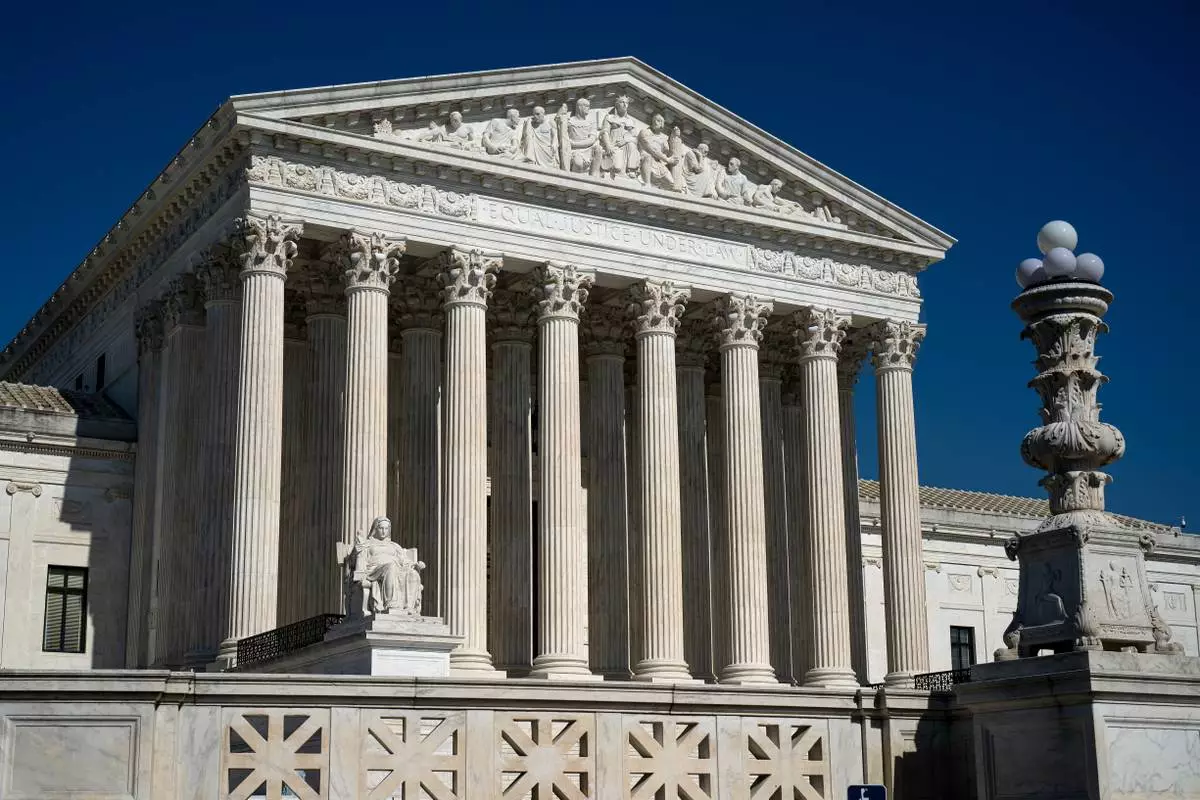
The Supreme Court is seen in Washington, Monday, May 18, 2026. (AP Photo/J. Scott Applewhite)

The Supreme Court is seen in Washington, Monday, May 18, 2026. (AP Photo/J. Scott Applewhite)

Recommended Articles