TORONTO--(BUSINESS WIRE)--May 27, 2026--
RPX Gold Inc. (“RPX Gold” or the “Company”) (TSXV: RPX. OTCQB: RDEXF) is pleased to announce gold assay results from its 2025-2026 drilling program at its Wawa Gold Project, Ontario. The drilling program was designed to confirm the continuity of, and potentially extend, near surface gold mineralization in the area of the open pits defined in the 2026 Preliminary Economic Assessment ( “2026 PEA” ). These new assay results will be included in the updated mineral resource estimate ( “MRE” ) planned for later this year and will be reflected in the prefeasibility study ( “PFS” ) targeted for H1 2027.
This press release features multimedia. View the full release here: https://www.businesswire.com/news/home/20260527340219/en/
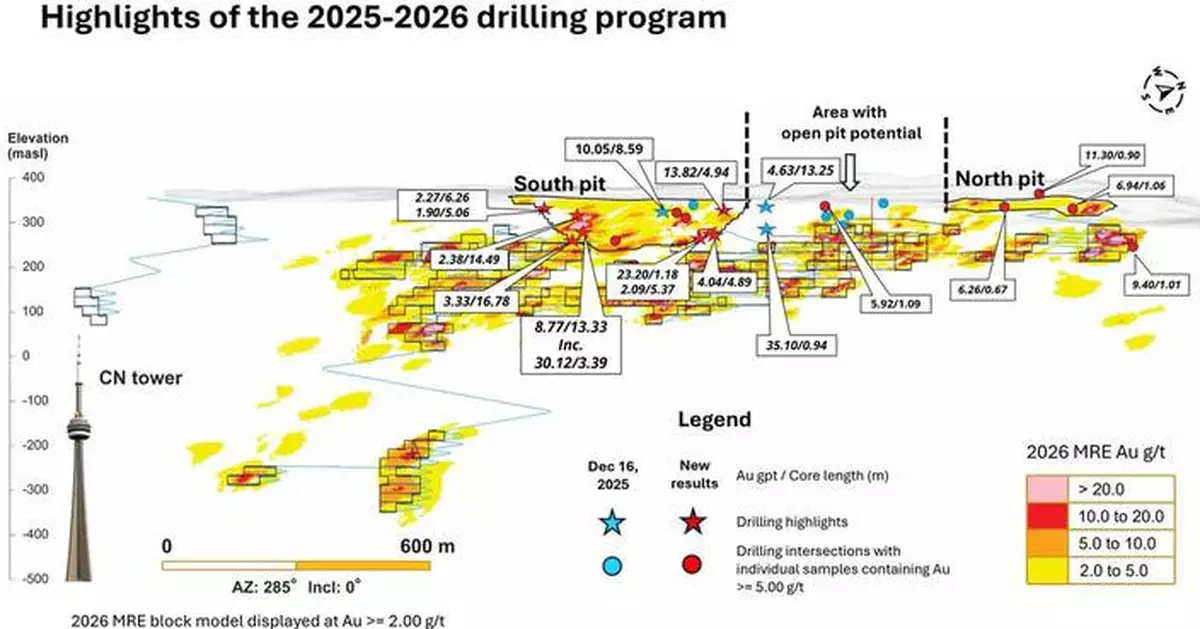
Highlights (See Figure 1 and Table 2):
Michael Michaud, President and CEO of RPX Gold, commented “The recent results from the drilling program continue to demonstrate the continuity of gold mineralization in the Jubilee deposit and further increase our confidence in the updated MRE we plan to complete later this year in advance of the PFS.
We are also excited by the drilling completed outside of the open pits defined in the recent 2026 PEA, which has extended the gold mineralization beyond the current mineral resources by over 100 m. In particular, drilling completed between the North and South open pits have confirmed the continuity of gold mineralization and have further validated our geological interpretation of the deposit. The high-grade intercepts from the corridor between the North and South open pits returned 13.82 g/t Au over 4.94 m and 8.77 g/t Au over 13.33 m, confirming that meaningful gold mineralization persists along strike in an area that was previously undrilled at this density. We are especially encouraged to see strong grades and broad mineralized intervals extending along strike in areas that were not incorporated into the 2026 PEA. These results support the potential for future open pit expansion and present the opportunity to further evaluate the connection of the two open pits as drilling continues. It is rewarding for the technical team to see the drilling confirm our internal geological models while continuing to identify opportunities to enhance the scale and development potential of the Wawa Gold Project.
We will continue to test the near surface strike extension of the deposit between the two open pits as well as test the deeper resources part of the underground mine outlined in the 2026 PEA. We also plan to test several of the exploration targets identified in the 2025-2026 drilling program later this year.
Our focus remains to advance the PFS to completion which is anticipated in H1 2027. The activities to advance the PFS represent a de-risking of the Wawa Gold Project, which we believe will add value at every step along the way.”
Results from the 2025-2026 Drilling Program
The 2025-2026 drilling program targeted gold mineralization in areas of open-pit potential along the Jubilee Shear. The results announced today demonstrate that gold mineralization in the Jubilee Shear extends to surface in the crown pillars of the historical mines and that significant zones of mineralization remain to be discovered in areas that were either sparsely tested or untested in historical drilling programs.
In the Jubilee mine area, drilling within and near the edges of the South Pit extended and uncovered new areas of high-grade gold mineralization (Figure 1 and Table 2). These new drilling intersections, particularly in SD-25-616 which intersected 10.05 g/t Au over 8.59 m including 82.80 g/t Au over 0.92 m (see press release of December 16, 2025), SD-26-626 and SD-26-639, could increase the inventory of high-grade gold mineralization in the South Pit area.
In the gap between the South and North pits, near-surface drilling extended gold mineralization with open-pit potential to surface (Figure 1 and Table 2). This includes the significant intersection in SD-25-593 which intersected 4.63 g/t Au over 13.25 m, including 18.60 g/t Au over 1.47 m (see press release of December 16, 2025).
The drilling program has also validated historical drilling results in targeted areas which improves our confidence in the block model supporting the 2026 PEA.
New 2026 Drilling Program
RPX recently initiated a diamond drilling program to confirm, and potentially extend, gold mineralization in the areas with open-pit and underground potential along the Jubilee Shear that are being evaluated in the ongoing work being done to complete the PFS (see press release of May 20, 2026).
Quality Assurance/Quality Control ("QA/QC") Measures
Individual drill core samples are labelled and sawn in half along a pre-marked cutting line. A consistent half-core sample is then placed in an individual numbered plastic sample bag that is sealed. The remaining half-core samples are kept at the Company’s core storage facility located on the Wawa Gold project. Quarter-core duplicates are taken from certain samples to define the variability of gold distribution. Groups of samples are then placed into durable rice bags sealed with security seals to be transported by commercial carrier for analysis at Activation Laboratories Ltd. (Actlabs), Ancaster, Ontario. NQ core assays are obtained by 50-gram fire-assay with an AA finish or by 1-kilogram metallic screen fire assay. The 1-kilogram metallic screen assay method is selected for samples anticipated to contain coarse gold and when the original fire-assay returns results greater or equal to 2.25 g/t Au. The residual coarse reject portions of the samples remain in storage for a minimum 90-day period if further work or verification is needed.
As part of its QA/QC program, RPX Gold inserts external gold standards (low- to high-grade) and blanks every 20 samples and routinely inserts blanks immediately after samples with visible gold. Quarter core duplicates are routinely inserted to evaluate the natural variability of gold mineralization. Assay certificates are sent to at least three members of the senior management team, and they are directly accessible from the WebLIMS portal of Actlabs. Approximately 5% of the pulps and coarse rejects analyzed at Actlabs are sent to Agat Laboratories in Thunder Bay for umpire testing.
Table 1 – Drill hole location details
QUALIFIED PERSON
Jean-François Montreuil, P.Geo., Vice President, Exploration at RPX Gold, and a Qualified Person as defined under National Instrument 43-101, has reviewed and approved the scientific and technical information in this press release.
MARKET MAKER
RPX GOLD INC. is pleased to announce that it has engaged the services of ICP Securities Inc. (“ ICP ”) to provide automated market making services, including use of its proprietary algorithm, ICP Premium™, in compliance with the policies and guidelines of the TSX Exchange and other applicable legislation. ICP will be paid a monthly fee of C$7,500, plus applicable taxes. The agreement between the Company and ICP was signed with a start date of June 1, 2026, and is for four (4) months (the “ Initial Term ”) and shall be automatically renewed for subsequent one (1) month terms (each month called an “ Additional Term ”) unless either party provides at least thirty (30) days written notice prior to the end of the Initial Term or an Additional Term, as applicable. There are no performance factors contained in the agreement and no stock options or other compensation is being provided in connection with the engagement. ICP and its clients may acquire an interest in the securities of the Company in the future.
ICP is an arm’s length party to the Company. ICP’s market making services are primarily to correct temporary imbalances in the supply and demand of the Company’s shares. ICP will be responsible for the costs it incurs in buying and selling the Company’s shares, and no third party will be providing funds or securities for the market making services.
ABOUT ICP SECURITIES INC.
ICP Securities Inc. is a Toronto based CIRO dealer-member that specializes in automated market making and liquidity provision, as well as having a proprietary market making algorithm, ICP Premium™, that enhances liquidity and quote health. Established in 2023, with a focus on market structure, execution, and trading, ICP has leveraged its own proprietary technology to deliver high quality liquidity provision and execution services to a broad array of public issuers and institutional investors.
ABOUT RPX GOLD INC.
RPX Gold Inc. (formerly Red Pine Exploration Inc.) is a Toronto-based gold exploration company. The Company's shares trade on the TSX Venture Exchange under the symbol "RPX" and on the OTCQB Markets under the symbol “RDEXF”.
The Company’s flagship asset, the Wawa Gold Project, is located in northwestern Ontario, in the Michipicoten Greenstone Belt of Ontario, adjacent to several established gold-producing operations, including those operated by Wesdome Gold Mines Ltd., Alamos Gold Inc. and Hemlo Mining Corp. The Wawa Gold Project benefits from strong local infrastructure and excess regional mill capacity.
The Company is evaluating open-pit operations designed to generate early cash flow to help fund the advancement of the underground operation. This phased approach is aimed at de-risking development, accelerating the time to revenue and minimizing shareholder dilution. The approach is subject to the completion of a number of milestones before a production decision can be made, such as continued drilling and mineral resource definition, conducting additional metallurgical test work, completing a pre-feasibility study, continuing baseline studies as well as additional permitting and Indigenous consultations, among other factors.
The Wawa Gold Project currently hosts mineral resources from two mineral deposits, namely the Jubilee Shear and the Minto Mine. The mineral resources include an indicated mineral resource of 22.909 million (“ M ”) tonnes grading 1.69 g/t Au containing 1,244,000 ounces Au and an inferred mineral resource of 9.951 M tonnes grading 1.59 g/t Au containing 509,000 ounces Au, with both open-pit and underground mining potential. Gold mineralization extends to surface on a historic mining property, which supports the Company’s phased development strategy. Please refer to the technical report entitled “Preliminary Economic Assessment: Wawa Gold Project” with an effective date of February 18, 2026 which is available on www.SEDARPLUS.ca under the Company’s profile for more information.
For material information about the Company, visithttp://www.rpxgold.com
Neither TSX Venture Exchange nor its Regulation Services Provider (as that term is defined in policies of the TSX Venture Exchange) accepts responsibility for the adequacy or accuracy of this release.
CAUTIONARY NOTE REGARDING FORWARD-LOOKING INFORMATION
This news release contains statements which constitute “forward-looking information” within the meaning of applicable securities laws, including statements regarding the plans, intentions, beliefs and current expectations of the Company with respect to future business activities and operating performance.
Forward-looking information is often identified by the words “may”, “would”, “could”, “should”, “will”, “intend”, “plan”, “anticipate”, “believe”, “estimate”, “expect” or similar expressions. Forward-looking information contained in this news release includes, but may not be limited to: statements regarding the assay results being included in the updated MRE planned for later this year and reflected in the prefeasibility study PFS targeted for H1 2027; the possibility of joining the North and South pits evaluated in the 2026 PEA; the Company continuing to test the near surface strike extension of the deposit between the two open pits as well as test the deeper resources part of the underground mine outlined in the 2026 PEA; the Company’s plans to test several exploration targets identified in the 2025-2026 drilling program later this year; the Company evaluating open-pit operations designed to generate early cash flow to help fund the advancement of the underground operation; and the completion of a number of milestones before a production decision can be made; the ability to execute the Company’s plans relating to the Wawa Gold Project as set out in the PEA; the ability to realize on the mineral resource estimates or delineating additional mineral resources; generating cash flow for further exploration and development of a larger mineral resource; the Project funding ongoing underground development, exploration, and future optimization to minimize reliance on repeated equity financings and shareholder dilution; the ability to negotiate and execute toll milling arrangements on satisfactory terms or at all; continuing collaboration with First Nations partners as part of an inclusive and responsible development process; and advancing the PFS. Investors are cautioned that forward-looking information is not based on historical facts but instead reflects management’s expectations, estimates or projections concerning future results or events based on the opinions, assumptions and estimates of management considered reasonable at the date the statements are made. Such opinions, assumptions and estimates are inherently subject to a variety of risks and uncertainties that could cause actual events or results to differ materially from those projected and undue reliance should not be placed on such information, as unknown or unpredictable factors could have material adverse effects on future results, performance or achievements. Among the key factors that could cause actual results to differ materially from those projected in the forward-looking information are: the Company's expectations in connection with the projects and exploration programs being met, the impact of general business and economic conditions, global liquidity and credit availability on the timing of cash flows and the values of assets and liabilities based on projected future conditions, fluctuating gold prices, currency exchange rates (such as the Canadian dollar versus the United States Dollar), variations in material grade or recovery rates, changes in accounting policies, changes in the Company's mineral reserves and resources, changes in Project parameters as plans continue to be refined, changes in Project development, construction, production and commissioning time frames, the possibility of Project cost overruns or unanticipated costs and expenses, higher prices for fuel, power, labour and other consumables contributing to higher costs and general risks of the mining industry, failure of plant, equipment or processes to operate as anticipated, unexpected changes in mine life, seasonality and weather, costs and timing of the development of new deposits, success of exploration activities, permitting time lines, government regulation of mining operations, environmental risks, unanticipated reclamation expenses, title disputes or claims, and limitations on insurance.
This information contained in this news release is qualified in its entirety by cautionary statements and risk factor disclosure contained in filings made by the Company, including the Company’s financial statements and related MD&A for the year ended July 31, 2025, and the interim financial report and related MD&A for the periods ended October 31, 2025 and January 31, 2026, filed with the securities regulatory authorities in certain provinces of Canada and available at www.sedarplus.ca.
Should one or more of these risks or uncertainties materialize, or should assumptions underlying the forward-looking information prove incorrect, actual results may vary materially from those described herein as intended, planned, anticipated, believed, estimated or expected. Although the Company has attempted to identify important risks, uncertainties and factors which could cause actual results to differ materially, there may be others that cause results not to be as anticipated, estimated or intended. The Company does not intend, and does not assume any obligation, to update this forward-looking information except as otherwise required by applicable law.
Table 2- Assays Results from Pit Area Drilling
Intercepts are calculated using a 0.40 g/t Au cut-off and a maximum of 6.0 m of internal dilution with no capping applied and are reported over core lengths. True widths are estimated to vary between 50 to 95% of the reported core length in the Jubilee Shear.
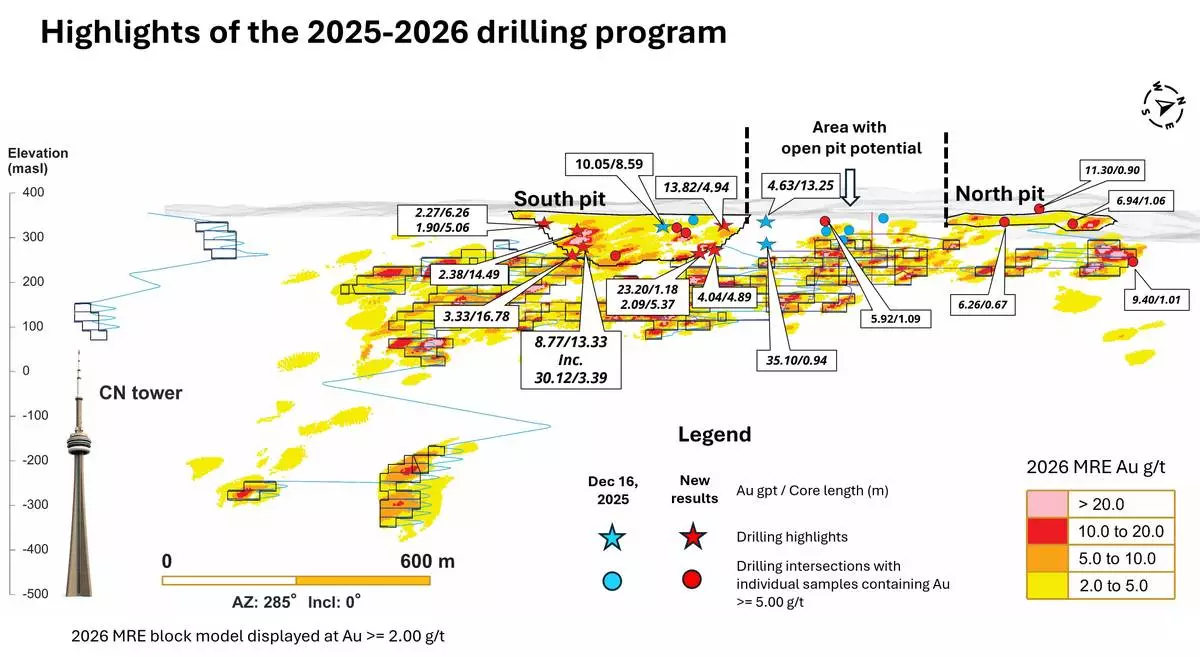
Figure 1- Drilling Highlights from Open-pit area drilling