Both the Japanese and South Korean stock markets rose on Wednesday, driven by gains in memory chip stocks.
The benchmark Nikkei stock index finished near flat after briefly touching a record intraday high above the 66,000 mark, as profit-taking offset earlier gains in heavyweight technology shares.
The 225-issue Nikkei Stock Average ended up 3.32 points, or 0.01 percent, from Tuesday at 64,999.41. The broader Topix index, meanwhile, finished 20.45 points, or 0.52 percent, lower at 3,918.01.
On the top-tier Prime Market, the main gainers were precision instrument and farm and fishery issues, while nonferrous metal and consumer credit shares were notable decliners.
The Nikkei surged at the open, breaching 66,000 for the first time and briefly climbing more than 2 percent to an intraday peak of 66,428.81 shortly after trading began.
The Topix index also hit a fresh intraday record of 3,971.77, driven by heavyweight technology shares tracking Wall Street's overnight gains.
South Korea's benchmark KOSPI rose by 2.25 percent to close at 8,228.70. The index reached a maximum increase of 5 percent during the session, also setting a new intraday record high.
Memory chip gains drive up Japanese, South Korean stocks
Serbian President Aleksandar Vucic on Tuesday described China as a "gravity center of stability" in global affairs, contrasting its consistent foreign policy with what he called the unpredictable behavior of other major powers.
At the invitation of Chinese President Xi Jinping, Vucic is on his first state visit to China from May 24 to 28. Before the visit, Vucic described it as the most important state visit of his political career.
On the sidelines of the trip, Vucic told China Media Group (CMG) that his remarks reflect the current global climate, stressing that China's steady foreign policy offers rare predictability and responsible responses in a time of uncertainty.
"Why was I saying this? Because of timeline. This is a very particular moment in which you see many other big powers acting in a way that you cannot predict. You cannot foresee what they are going to do tomorrow, not to mention what they are going to do within a month or within a year. And it brings us to a first conclusion -- China, in the meantime, became even more important as a gravity center of stability, not only for this region, not only for this part of Asia, but for the entire world, because all over the world, there are peoples, there are nations and countries that are waiting for President Xi's opinion. And they know that there would be no big surprises, they know that they can rely on Chinese foreign policy, they can rely on responsible messages and responsible answers to whatever might happen in the world, which is a very rare case today," Vucic said.
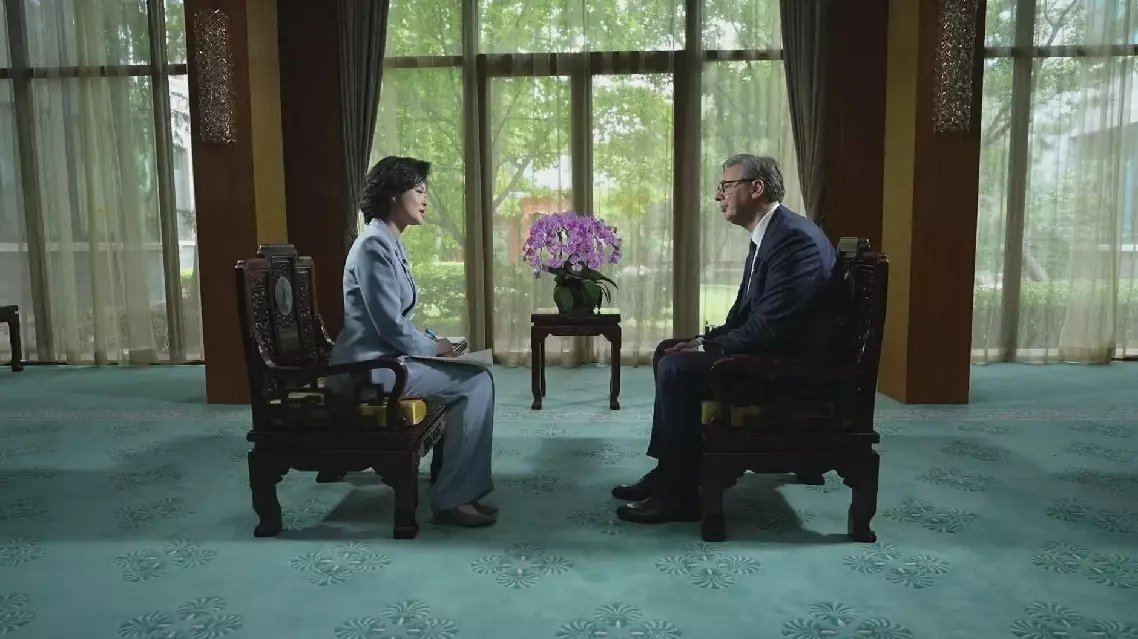
Serbian president calls China "gravity center of stability"