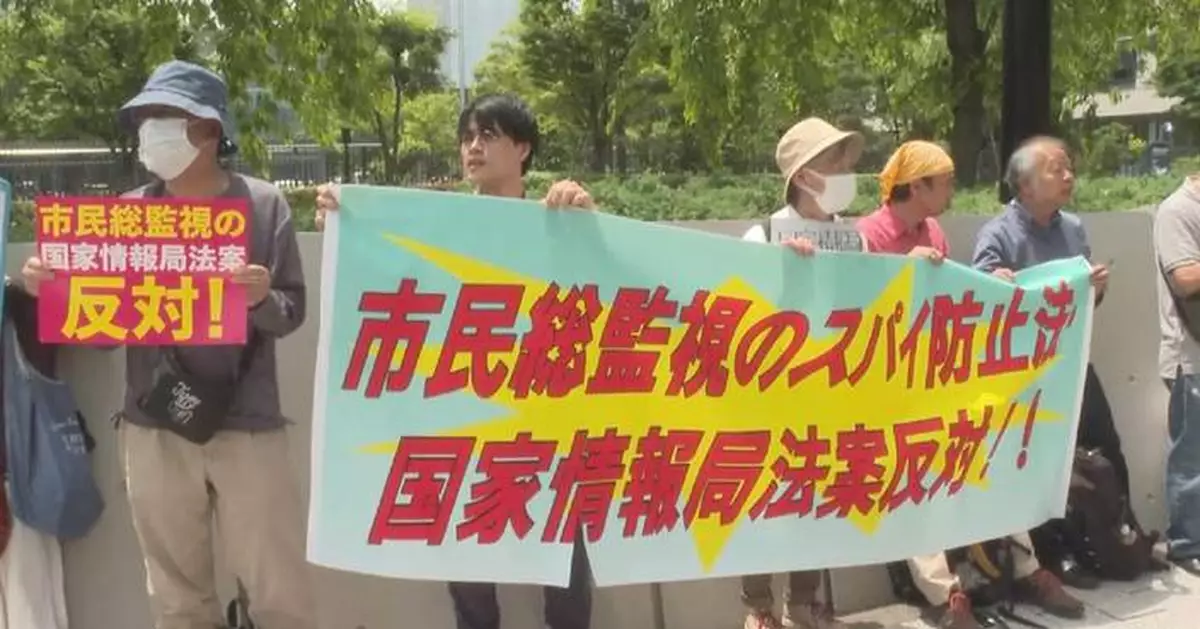
A group of protesters gathered outside the National Diet in Tokyo on Wednesday to denounce the establishment of a national intelligence council, saying the move will lead Japan to war.
The Japanese parliament enacted a law on Wednesday to establish a national intelligence council. The legislation came as Prime Minister Sanae Takaichi aims to centralize and strengthen the country's intelligence capabilities.
According to the new law, the national intelligence council will be chaired by the prime minister and composed of relevant cabinet members, including the chief cabinet secretary and foreign minister. The council will coordinate intelligence activities in areas including national security and espionage.
A national intelligence bureau will serve as the council's operational arm, and coordinate intelligence work across government ministries and agencies.
The government could establish the council and bureau as early as July, according to media reports.
Some opponents of the new national intelligence council say it is aimed at promoting a "remilitarization" strategy favored by those on the right-wing of the country's politics.
"Since we are the ones who elected them, we bear responsibility for the actions of those politicians. When they try to pass problematic laws like this one, if we, as those responsible for the election, believe such laws should not be enacted, we must speak out in opposition," said one protester.
"This is how it was before Japan waged its war of aggression in the past. Before World War II, laws such as the Peace Preservation Law indeed ushered in a far worse era. The same applies to the national intelligence council. If such developments continue to advance, I think Japan will head toward war in the near future," said another protester.
The legislation, which cleared the House of Councillors on Wednesday and the House of Representatives in April, has continued to draw concern, with regular protests against it.
Demonstrators said they denounce the government's use of "fighting espionage" as a pretext to expand social surveillance, and call for the protection of personal privacy and their fundamental rights guaranteed by the Constitution, including the freedom of expression.
"The bill on the establishment of the national intelligence council has already been passed. I'm truly outraged. Truly outraged. Such a law must never be allowed to pass. During the questioning, I truly felt that they will collect vast amounts of information, but they have not specified what information may be collected and what information may not. This is not an 'anti-espionage law.' It is a law that will centralize vast amounts of information on countless citizens -- ordinary people -- from various administrative agencies into a single body. This is a citizen surveillance law, which is already quite obvious," said Fukushima Mizuho, a member of the House of Councillors.
"I believe this is the first step toward war. First of all, it will suppress anti-war voices. By suppression, I mean it will make it impossible for people to hold anti-war demonstrations like they do now. Even if people do hold demonstrations, they will be labeled as 'spies' or the like and be unjustly accused or even arrested," said a female protester,
"When people are silenced and no one dares to say a word against wars, there will be no one left to oppose policies such as missile deployment. The society will gradually become like it was during World War II, with the people being treated as mere resources and sent to other countries to kill," she added.
"Some say this law is very similar to the Peace Preservation Law from before the [second world] war. I fear that it will ultimately lead Japan step by step toward [another] war," said another protester, referring to the law enacted in 1925.
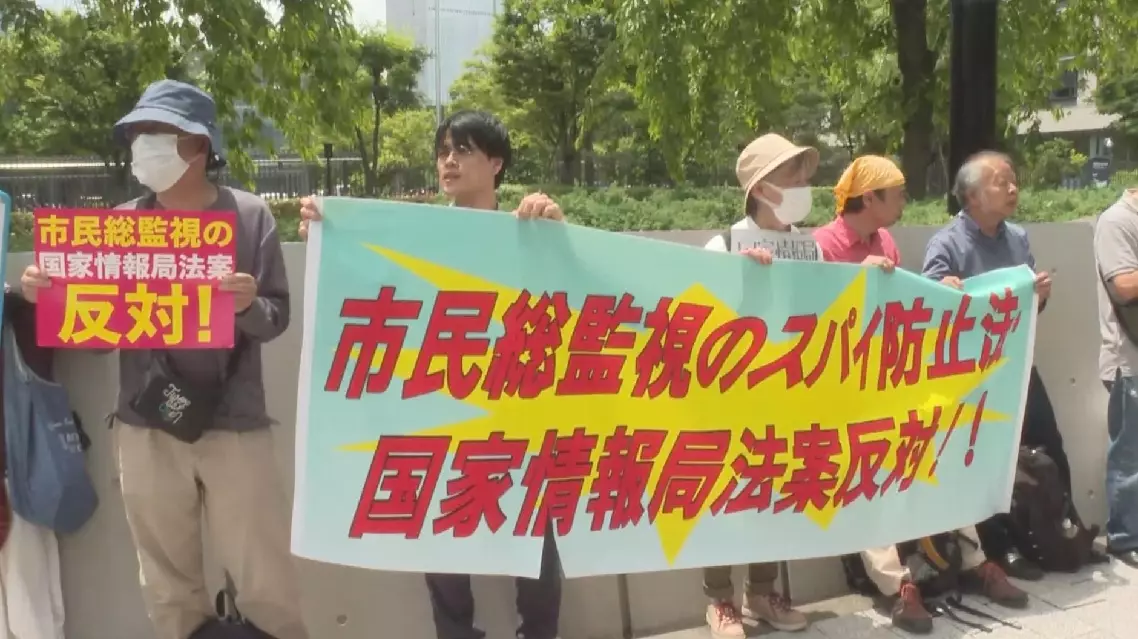
Japanese rally against establishment of national intelligence council