OAKLAND, Calif.--(BUSINESS WIRE)--May 27, 2026--
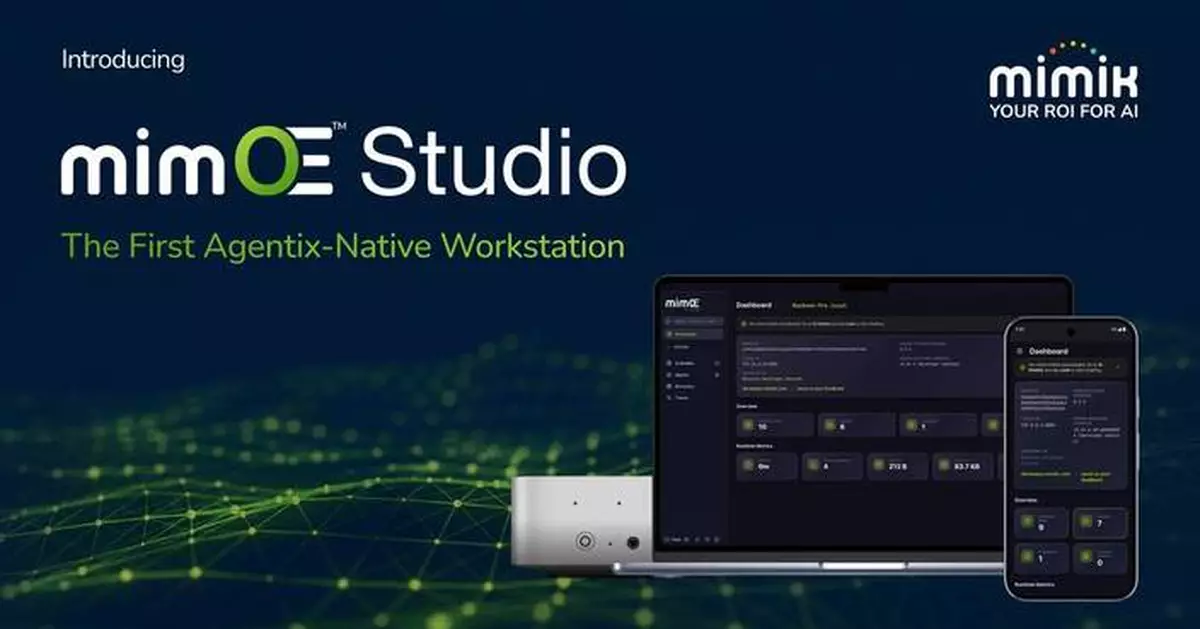
mimik today announced the general availability of mimOE™ Studio, the first Agentix-Native Workstation, powered by mimik’s mimOE, Agentix Operating Engine. Together they enable Agentix-Native systems (aka Agentic AI) to scale agents across any hardware form factor, OS, cloud and combination of AI models. This allows developers, operators and enterprises to execute, operate and scale with certainty.
This press release features multimedia. View the full release here: https://www.businesswire.com/news/home/20260527048436/en/
Any IDE. No rewrite. No central orchestrator. No token cost.
Today, intelligence, compute, and code generators are mature. The bottleneck is operationalization at scale: running working agents reliably across heterogeneous hardware, intermittent networks, and real-world environments. While the market chases edge AI versus cloud AI, Agentix-Native systems require both, operating seamlessly across Device-First Continuum AI and Compute. By industry estimates, 95% of AI pilots never reach production. mimOE is the answer, and mimOE Studio is the visual interface.
“In the SaaS era, businesses adapted to the services they subscribed to. Agentix-Native systems invert that. They adapt to the business. But for enterprises to trust that inversion at production scale, AI has to deliver three things SaaS never did: experimentation with controlled spend, unit economics that hold up from pilot to production, and a future-proof path to scale with full flexibility, without ripping out what’s already there,” said Fay Arjomandi, founder and CEO of mimik. “That’s what mimik delivers. We built it for ourselves first. Now every enterprise can accelerate its Agentix-Native rollout to grow the business with certainty and cost control.”
What is mimOE Studio
mimOE Studio supports the enterprise agentic AI journey from experiment to production. Developers download Studio and have a live Agentix-Native infrastructure on or across their machines in under five minutes, with no cloud account, no setup cost, and no token cost. This is a sandbox with limits on spend and risk. Studio gives a live view of every model, agent, image, trace and routing decision across the continuum, so teams see what's running, the baseline, and what each outcome costs before scaling. Agents, models, and policies validated in Studio roll out to production on mimOE across the Device-First Continuum, with no rewrite.
What is mimOE
mimOE is a purpose-built, cross-platform Agentix-Native operating engine that enables agents to compute, network, and execute intelligently with zero-touch configuration. It runs across Linux, Windows, macOS, Android, iOS, QNX, and cloud environments, optimized for all major GPU stacks (CUDA, ROCm, Vulkan, SYCL). Built-in API and MCP gateways with three AI runtimes execute any combination of generative and predictive AI models, intelligently distributing workload between CPU and GPU, online or offline.
Installed on a device, mimOE turns it into a first-class node in an Agentix-Native infrastructure: resilient by architecture, governed by policy, and discoverable across the mesh. Built-in Zero-Trust security and Sovereignty in Execution across five dimensions let every workload run under the organization's own authority.
By decoupling Agentix-Native system logic from the underlying heterogeneous environment, mimOE delivers its operational guarantee: Build, Execute, Operate and Scale with Certainty.
Availability and Pricing
mimOE Studio and mimOE are available today at developer.mimik.com. A free developer tier includes foundation package, documentation, and GitHub examples. Enterprise plans with onboarding, dedicated environments, and SLAs are available on request at alliances@mimik.com.
About mimik
mimik is an Agentix-Native company, a pioneer in Device-First Continuum AI and Compute. mimik's software platform is the operating engine for enterprises and developers to scale Agentix-Native systems with certainty, with full flexibility, on their own terms. The company has partnered with major chip vendors, device OEMs, cloud providers, and system integrators, working closely with them to enable fast-track, scaled delivery of AI to organizations in manufacturing, healthcare, transportation, retail, smart buildings, and Physical AI more broadly. The outcome is business efficiency across multiple dimensions.
mimOE, mimOE Studio, Agentix Operating Engine, and Device-First Continuum AI are trademarks of mimik Technology Inc. All other trademarks are the property of their respective owners.
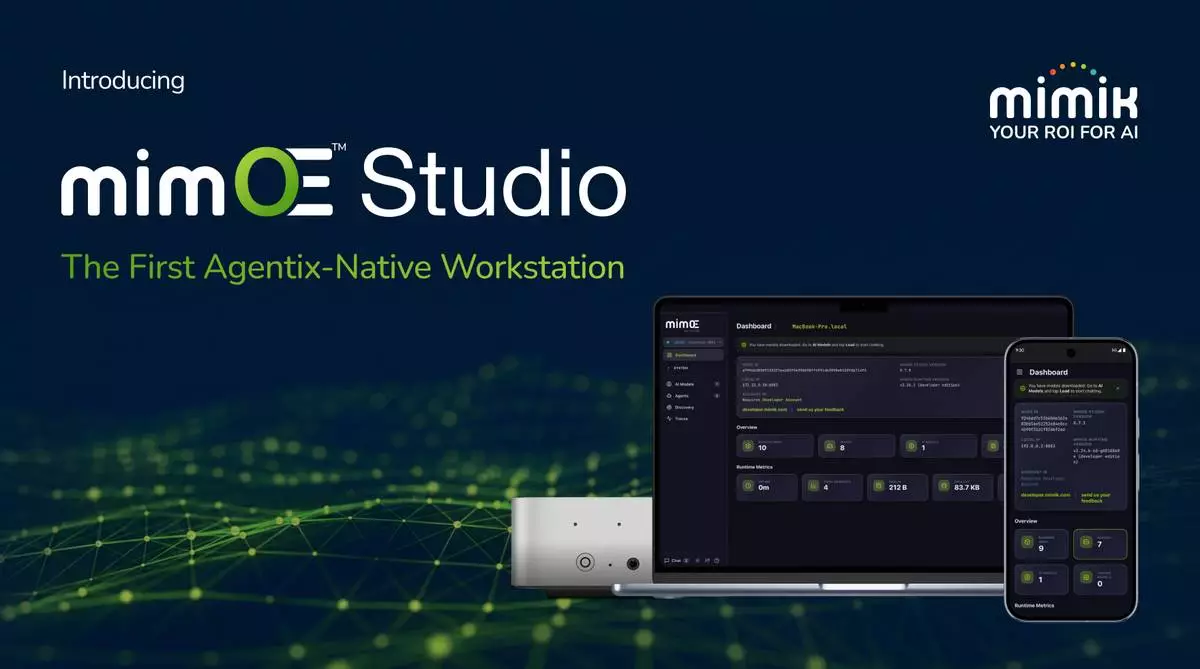
mimOE Studio is Live. Cross-Platform Agentix-Native Systems, Operationalized at Scale with Certainty.