China is set to test its capabilities in supporting its astronauts for longer stays in space by piloting a one-year in-orbit stay by a member of the Shenzhou-23 crew, according to a Chinese space expert.
The Shenzhou-21 crew spent seven months in space, setting a new record for the longest in-orbit stay by a Chinese astronaut crew.
Meanwhile, one member of the Shenzhou-23 crew will attempt to extend that record to one year.
Assigning one astronaut to conduct a one-year in-orbit stay experiment is by no means a simple summation of two six-month missions.
The one-year space mission is expected to achieve three goals.
First, it will implement China's first human space research program to comprehensively collect data on astronauts during longer-duration flights and enrich mission experience.
Second, it will verify the capability to ensure astronauts' health during long-duration flights and improve the in-orbit medical and protective systems.
Third, it will provide opportunities for more sustained and continuous research for scientific projects and related technology verification.
Dong Nengli, an engineer of China Manned Space Agency, said the longer stay will verify China's supporting capacity.
"As we all know, our core module was launched into orbit on April 29, 2021, and has now been in operation for over five years. Our three-module space station combination has also been in operation for over three years. We have already established the capability to support astronaut stays of up to six months on the space station. After multiple assessments, we have indeed mastered the related technologies and possess this capability. Now, can our astronauts stay longer? Do we have the capability to support a one-year mission in space? Do we possess the necessary support technologies? Through the arrangement where a single astronaut will undergo a one-year assessment spanning the Shenzhou-23 and Shenzhou-24 missions, we aim to verify whether we truly have the capability to ensure astronauts live a healthy life and work efficiently while in orbit. If we possess this capability, it will provide greater flexibility for planning future missions," he said.
According to the plan, the Shenzhou-23 crew will undertake more than 100 new scientific and applied programs during their stay in orbit, focusing on in-depth research and verification of cutting-edge scientific and technological issues in fields such as space life sciences, space materials science, microgravity fluid physics, space medicine, and new space technologies.
In the field of space life sciences, the crew will use zebrafish embryos, mouse embryos, and artificial embryos constructed from stem cells to explore the establishment of a space embryo research system spanning from lower vertebrates to higher mammals, thereby steadily advancing systematic research on scientific issues related to space life generation.
In the field of space materials science, they will conduct research on methods for the in-space fabrication and performance regulation of various advanced materials, including the production of novel materials such as high-performance rare-earth permanent magnet alloys and lightweight high-entropy alloys.
In the field of space medicine, the one-year mission will be fully utilized to explore the adaptive characteristics and capability limits of astronauts during longer-duration flights, with the potential to obtain multi-system, multi-omics space human atlases of astronauts during long-term missions.
In the field of space technology, the astronauts will conduct in-orbit verification of new space energy storage batteries, with the results expected to be applied to future functional upgrades of the space station.
These in-orbit experiments and long-term residency explorations will continue to solidify the foundation of human spaceflight technology, accumulating sufficient capabilities for China to advance toward deeper space missions such as crewed lunar landings.
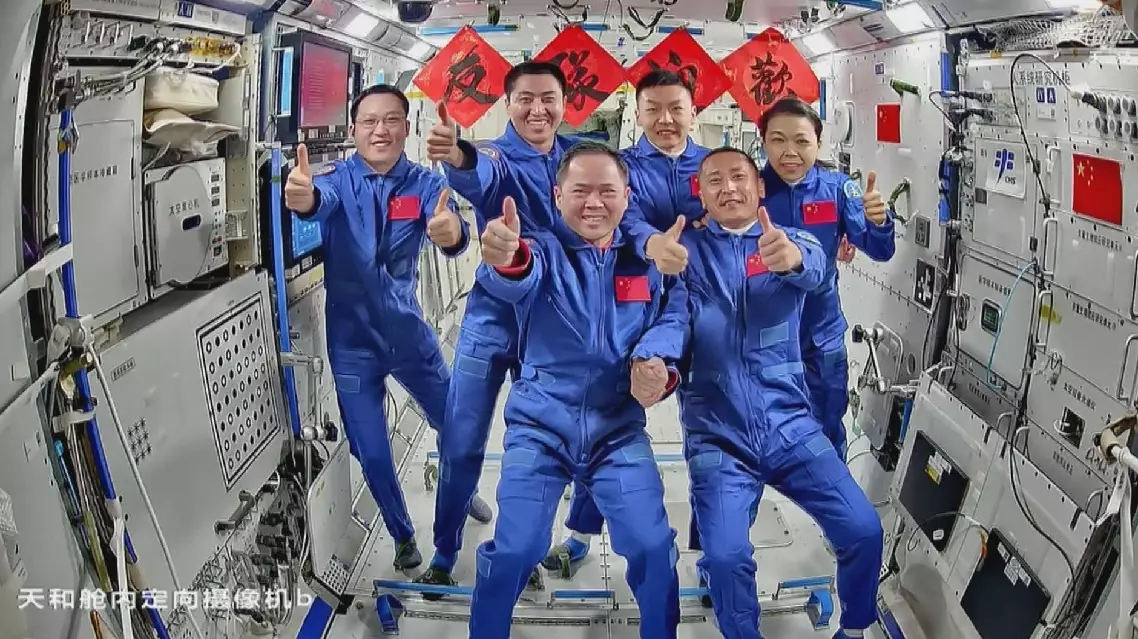
China to test ability for longer human stays in space: engineer