The 23rd Shangri-La Dialogue concluded in Singapore on Sunday, with participants from over 40 countries and regions calling for stronger communication and coordinated efforts to manage differences and build consensus through dialogue.
As Asia's premier defense and security summit, the three-day event opened on Friday against a backdrop of mounting geopolitical uncertainties.
Speaking at the dialogue, Major General Meng Xiangqing, head of the Chinese People's Liberation Army expert delegation, warned that the international community is confronting multiple security challenges and urged nations to guard against attempts to subvert the victorious outcomes of World War II and the post-war international order. He noted that the Global Security Initiative and the Global Governance Initiative proposed by China offer Chinese wisdom and solutions to help the world navigate today's profound changes.
The recent meeting between the Chinese and U.S. leaders, along with the important consensus they reached, captured widespread international attention. Experts noted that the steadiness of this bilateral relationship bears directly on the well-being of both peoples and, more broadly, on the peace and security of the wider world.
"The framework of 'constructive strategic stability' reflects an important shared recognition between the two powers: that their strategic competition needs not foreclose cooperation on issues of common interests and must not be allowed to slide into conflict or rupture. For ASEAN, this really matters," Kao Kim Hourn, Secretary-General of ASEAN, said in his keynote speech.
"The officials from both sides followed the tone set. I think this is a good basis for taking the relationship forward," said Chan Chun Sing, Minister of Defense of Singapore.
The Middle East situation also emerged as a key topic of discussion at the dialogue. In the face of heightened regional tensions, a broad consensus called for bridging differences through dialogue, and for advancing political solutions within the United Nations framework.
On the theme of regional security cooperation, delegates advocated a fairer and more equitable international order to promote lasting peace and shared development across the region.

Shangri-La Dialogue closes with delegates calling for communication, coordination
At the invitation of Russian Federation Council Speaker Valentina Matviyenko and Chairman of the Russian State Duma Vyacheslav Volodin, China's top legislator Zhao Leji paid an official goodwill visit to Russia from Wednesday to Saturday.
During the visit, Zhao, chairman of China's National People's Congress (NPC) Standing Committee, held talks with Matviyenko and Volodin, respectively, and attended the 11th meeting of the China-Russia committee for parliamentary cooperation in Moscow.
In his talks with Matviyenko and Volodin, Zhao said that under the strategic guidance of the two heads of state, the China-Russia relationship has entered a new stage of greater achievements and faster development.
China is willing to work with Russia to fully implement the important consensus reached by the two heads of state, and to carry forward China-Russia traditional friendship, enhance mutual strategic trust, deepen mutually beneficial cooperation and integration of interests, and promote higher-quality development of bilateral relations, said Zhao.
Zhao said that legislative bodies of China and Russia, based on their respective functions and responsibilities, maintain the positive momentum of multi-level and multi-sector exchanges, enhance mutual understanding and trust, strengthen communication and mutual learning so as to better serve the development of bilateral ties.
The two sides should exchange legislative experience in such areas as national security, ecological and environmental protection, artificial intelligence, and foreign-related rule of law.
For her part, Matviyenko said the two heads of state have led the Russia-China relationship to the best in history, adding that the Russian Federation Council is willing to strengthen exchanges with China's NPC to provide legal support for promoting practical cooperation in areas including economy and trade, investment, energy, culture, transportation and regional affairs.
Volodin expressed willingness to work with China to enhance exchanges and mutual learning between legislative bodies in fields such as artificial intelligence. Russia firmly adheres to the one-China principle and is ready to strengthen multilateral cooperation with China to jointly defend the victorious outcome of World War II, he said.
At the 11th meeting of the China-Russia committee for parliamentary cooperation on Thursday, Zhao said the legislative bodies of both countries should keep implementing the important consensus reached by the two heads of state, cooperation documents and major projects.
He said both sides should promptly approve and supervise the implementation of legal documents conducive to bilateral cooperation, and protect the legitimate rights and interests of enterprises.
Zhao also called on both sides to actively participate in activities such as the China-Russia Years of Education to deepen cultural exchanges, leverage the active role of local legislative bodies to expand local cooperation, and enhance coordination within multilateral frameworks to promote international fairness and justice.
During the visit, Zhao toured a photo exhibition commemorating the 25th anniversary of the signing of the China-Russia Treaty of Good-Neighborliness and Friendly Cooperation, and an exhibition on the site of the 6th National Congress of the Communist Party of China in Moscow.
Zhao also laid a wreath at the Tomb of the Unknown Soldier in Moscow.
He also visited Irkutsk, where he met with Igor Kobzev, governor of Russia's Irkutsk region, and Aleksandr Vedernikov, chairman of the Legislative Assembly of the Irkutsk region.
Zhao underscored strengthening practical cooperation at the local level and enhancing people-to-people friendship, so as to inject vigorous vitality into bilateral ties.
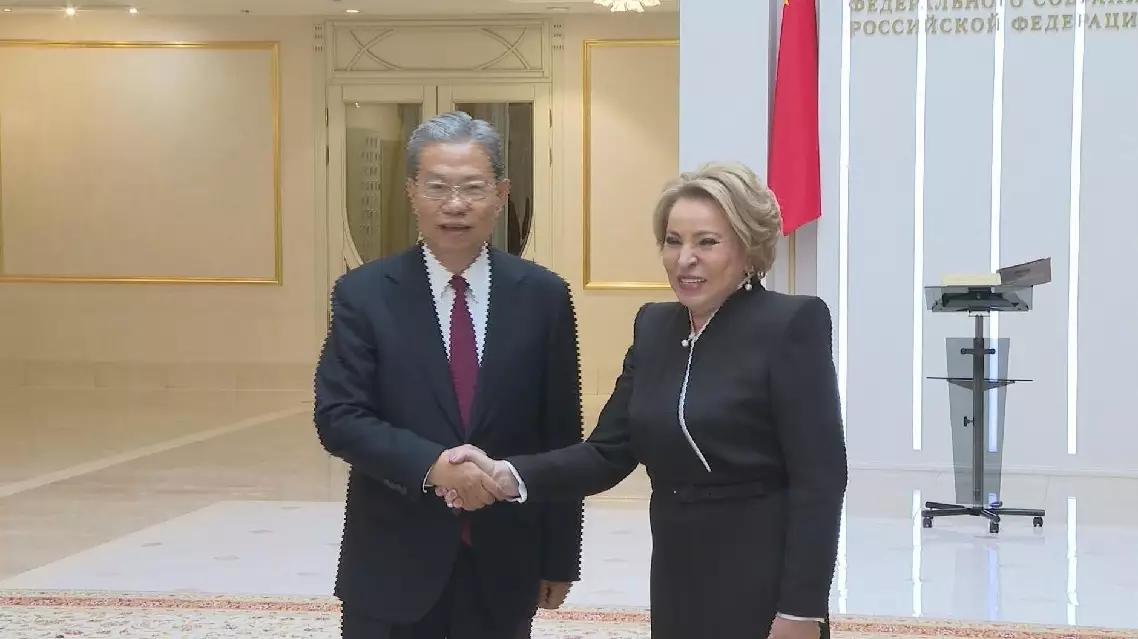
Chinese, Russian top legislators meet for enhancing parliamentary cooperation