
Skip to Content Facebook Feature Image

Ohio suspends data center tax break as tech firms face pressure to pay the cost to power AI

TECH

Ohio suspends data center tax break as tech firms face pressure to pay the cost to power AI
TECH

TECH

Ohio suspends data center tax break as tech firms face pressure to pay the cost to power AI

2026-05-29 09:12 Last Updated At:11:38

Ohio, one of the nation’s data center destination hot spots, is suspending a tax break that has been critical to its competition with other states to attract the massive new facilities that power and train artificial intelligence chatbots.

The move Wednesday by Republican Gov. Mike DeWine comes as tax breaks for energy-hungry AI data centers are increasingly playing a role in state budgets and the industry is under pressure to pay the full costs of the vast network of its computing warehouses needed to power AI.

The size of Ohio's tax break skyrocketed, dwarfing previous projections, as opposition to data centers is sweeping through cities, suburbs and towns there and prompting lawmakers to form a committee to study the impact.

In the meantime, residents are trying to bypass the GOP-controlled Legislature and get a referendum on November's midterm election ballot that's designed to permanently ban hyperscale data centers, likely the strictest such statewide ban under consideration in the U.S.

DeWine's office cited the rising utilization of the tax break and the state Legislature's new research undertaking to declare a “pause” in granting it to new applicants.

"The governor felt it was the right time to let the citizens know, let businesses know that we're going to pause on new offers of this tax incentive while that process plays out," DeWine's spokesperson, Dan Tierney, said Thursday.

DeWine stressed that he supports data centers — calling them a critical component in today’s economy — and that the roughly $37 billion in data center-related investment in 2024 and 2025 in Ohio has been worthwhile. Meanwhile, business groups — including the state Chamber of Commerce — and labor unions warned that pausing the tax break put Ohio at risk of losing tech-sector investments to other states.

The state, in 2024, had used previous history in projecting that the exemption would total $136 million in fiscal 2025 and $142 million in fiscal 2026. It was $554 million in 2024 and nearly $1.6 billion in 2025, the state reported.

The resumption of Ohio's tax break — should it resume — could happen under a new governor: DeWine is term-limited and the race is on to replace him. The Republican nominee, Republican Vivek Ramaswamy — an Ivy League-educated biotech billionaire — likes to talk about turning the Ohio River Valley into the next Silicon Valley.

However, Ramaswamy and Democratic nominee Amy Acton could share the midterm ballot in November with the citizen-led drive to ban the new construction of large data centers across Ohio. It faces a July 1 deadline to gather more than 400,000 voter signatures.

State tax breaks for the massive data center industry are facing growing criticism by governors and lawmakers.

The cost is likely rising as data center and AI-related investments drive higher consumer spending in the U.S. and tech giants keep boosting their spending commitment to hyperscale data centers.

In Virginia, budget negotiations have been hung up for months on a bid by Senate Democrats to eliminate the roughly $1.6 billion annual tax break.

Thirty-eight states have some form of a sales tax break for data centers, according to the National Conference of State Legislatures.

Many were approved when data centers were a small, but growing part of the economy, and well before the late 2022 debut of OpenAI’s ChatGPT launched an intensifying buildout of increasingly large data centers.

Ohio's exemption is fairly broad, applying not only to construction materials, but to the expensive equipment — such as server racks and cooling systems — used in data centers. Operators might buy new server racks every couple of years as the technology improves.

DeWine's order was a surprise.

Dorsey Hager, executive secretary-treasurer of the Columbus/Central Ohio Building and Construction Trades Council, where union members spend much of their time on data center projects, said he was upset with DeWine and trying to understand the governor's reasons.

He worried, he said, that developers that were in the midst of trying to finalize plans or permits for a project might have second thoughts.

Lawmakers acknowledged the opposition in announcing their joint data center committee on May 13, and said their mission was to ensure that Ohioans have accurate information about the economic, environmental and security impact of data center development.

“We’re well aware of initiatives to limit Ohio data center development during this critical point in America’s history,” state Rep. Adam Holmes told a news conference. “This public concern has become a priority issue for us and could have dramatic impact on Ohio and American’s future.”

Follow Marc Levy at http://twitter.com/timelywriter
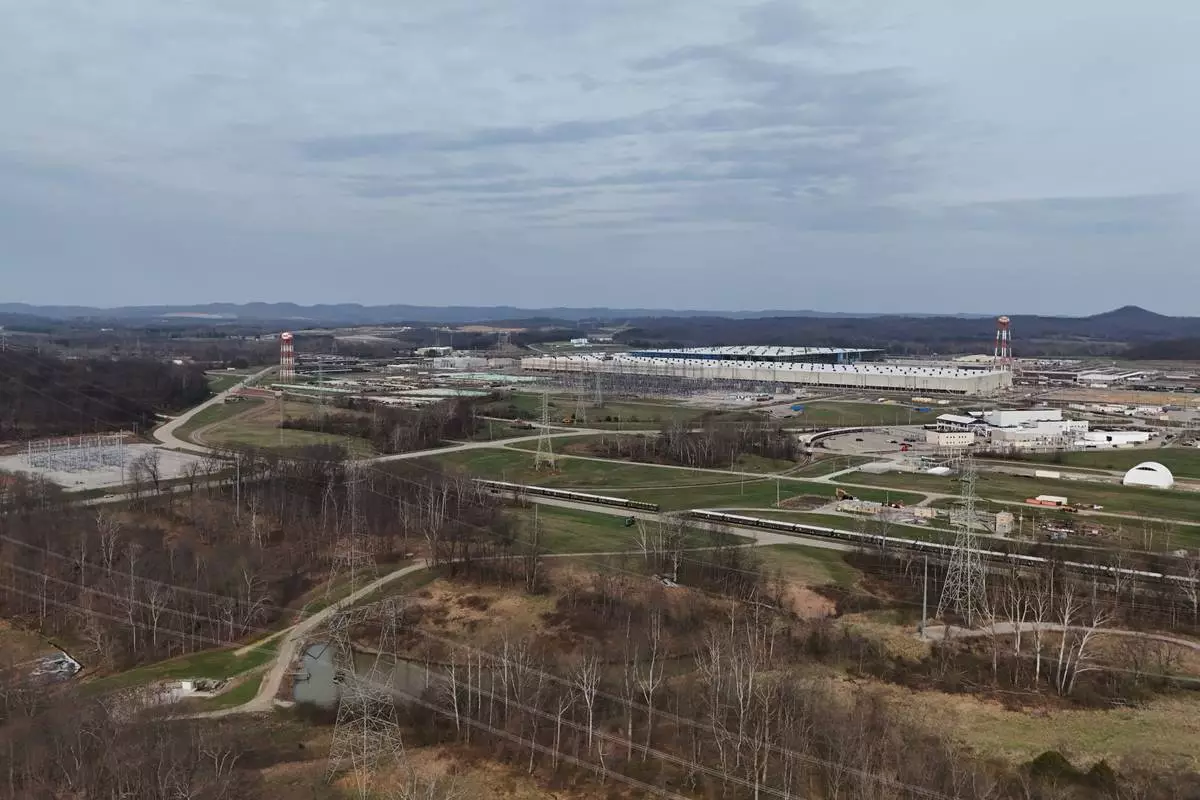
FILE - The Portsmouth Gaseous Diffusion Plant, a decommissioned uranium enrichment plant, is visible after the U.S. Department of Energy announced a new data center at the site March 20, 2026, in Piketon, Ohio. (AP Photo/Joshua A. Bickel, File)

FILE - The Portsmouth Gaseous Diffusion Plant, a decommissioned uranium enrichment plant, is visible after the U.S. Department of Energy announced a new data center at the site March 20, 2026, in Piketon, Ohio. (AP Photo/Joshua A. Bickel, File)

FILE - Gov. Mike DeWine, R-Ohio, arrives to an event at the National Governors Association Winter Meeting on Feb. 19, 2026, in Washington. (AP Photo/Allison Robbert, File)


FILE - Gov. Mike DeWine, R-Ohio, arrives to an event at the National Governors Association Winter Meeting on Feb. 19, 2026, in Washington. (AP Photo/Allison Robbert, File)

KYIV, Ukraine (AP) — Ukraine denied Moscow's claims on Sunday that a Ukrainian drone struck the Russian-controlled Zaporizhzhia nuclear plant, as Kyiv launched fresh strikes overnight on Russian energy sites.

Ukraine’s General Staff on Sunday said Ukrainian drones had struck the Saratov oil refinery in southwestern Russia, causing a “large-scale fire.” It said the extent of the damage was being clarified, and claimed the refinery has been supplying Moscow’s war effort.

The refinery belongs to Russia’s state oil enterprise, Rosneft, and produces diesel and gasoline among other types of fuel. The Russian local governor, Roman Busargin, said Ukrainian drones had damaged “civilian infrastructure”, but did not immediately give details. Astra, an independent Russian news channel, said an oil refinery was on fire in the city of Saratov.

Ukraine has stepped up its attacks on Russia’s oil and gas facilities in recent months, arguing the energy sector both funds and directly fuels Moscow’s more than 4-year-old invasion.

Drone debris also set fire to a fuel depot in Russia’s southwestern Rostov region, which borders Russian-occupied eastern Ukraine, local Gov. Yuriy Slyusar reported on Telegram on Sunday. He said residents of nearby homes were evacuated.

Ukraine's General Staff on Sunday confirmed its forces were behind the strike on the facility in the town of Matveev Kurgan. Local authorities said a drone strike on the depot had caused a large-scale fire across a wide area.

According to its General Staff, Ukraine ​also struck the Lazarevo pumping station in Russia's Kirov region northeast of Moscow, more than 1,200 kilometers (745 miles) from Ukrainian-controlled land. The station helps ship Russian oil ​from Siberia to Belarus.

Local Gov. Alexander Sokolov said drones had hit ​a facility in the Kirov region, without giving further details.

Kyiv denied a Russian claim that a Ukrainian drone struck the Zaporizhzhia nuclear plant, Europe’s largest.

Russia’s state nuclear energy company, Rosatom, said on Saturday that the drone exploded after tearing a hole in the wall of a turbine hall. Rosatom’s CEO Alexei Likhachev accused Ukraine of a “deliberate” attack.

“This afternoon, a Ukrainian kamikaze combat drone struck the turbine hall building of Power Unit No. 6, resulting in a detonation,” Likhachev said. He added there was no damage to main equipment.

Ukraine’s military said it did not target or strike the plant, and described the Russian claim as “yet another propaganda ploy.” A military statement said that it adheres to international humanitarian law and is aware of the "consequences of any actions targeting nuclear facilities.”

“Along the relevant section of the front line, there was no active fighting at the time of the incident, and no weapons were used,” it added.

Rafael Grossi, head of the International Atomic Energy Agency, voiced “serious concern” in a post on X following the incident.

The IAEA said in an online statement on Sunday that its inspectors “observed damage to the exterior of a turbine building” that was “consistent with the impact of the drone.” It gave no details of where the drone may have come from, but said radiation levels at the site remained normal.

“During a site walk down, the team saw damage to a metal access hatch located several levels up in the building, as well as a few pieces of debris and burned optical fiber remains on the ground," the agency said in a post on X. It added its inspectors had requested access to the inside of the turbine hall, “for further examination.”

Russian forces captured the Zaporizhzhia plant in the early weeks of the war, and it remains close to the front lines in the southern Zaporizhzhia region, one of four Russia has formally annexed despite lacking full military control or international recognition for its actions.

The nuclear plant has repeatedly come under fire since Russia's full-scale invasion in February 2022, sparking fears of a nuclear accident. Moscow and Kyiv have blamed each other for targeting the plant.

Elsewhere, Ukraine’s air force said Sunday that it had shot down 212 of 299 drones launched by Russia overnight. It said 14 drones had reached their targets, while drone debris fell in five locations.

A truck driver died early on Sunday as drones hit a parking lot in Ukraine's northern Chernihiv region, according to local administration head Vyacheslav Chaus.

Russian drones struck the city of Dnipro and an oil refinery in Ukraine’s Rivne region, causing fires, authorities said. No one was injured in either location, Ukrainian officials later reported.

Follow the AP’s coverage of the war in Ukraine at https://apnews.com/hub/russia-ukraine

Servicemen of Ukraine's defense intelligence set up the Peklo (Hell) missile drone against Russian in an undisclosed location in Ukraine late Thursday, May 28, 2026. (AP Photo/Efrem Lukatsky)

Servicemen of Ukraine's defense intelligence set up the Peklo (Hell) missile drone against Russian in an undisclosed location in Ukraine late Thursday, May 28, 2026. (AP Photo/Efrem Lukatsky)

Servicemen of Ukraine's defense intelligence set up drones against Russian in an undisclosed location in Ukraine late Thursday, May 28, 2026. (AP Photo/Efrem Lukatsky)

Servicemen of Ukraine's defense intelligence set up drones against Russian in an undisclosed location in Ukraine late Thursday, May 28, 2026. (AP Photo/Efrem Lukatsky)

Recommended Articles