China's Ministry of National Defense has urged the United States to approach the Taiwan question with utmost prudence.
Ministry spokesperson Jiang Bin made the call at a press briefing on Thursday in response to a media query about the U.S. pausing a 14-billion-U.S.-dollar arms sale to Taiwan, while including 1 billion U.S. dollars in the so-called "Taiwan Security Cooperation Initiative" in the National Defense Authorization Act for Fiscal Year 2027.
"China's opposition to U.S. arms sales to China's Taiwan region is consistent and clear. The U.S. side should abide by the one-China principle and the provisions of the three China-U.S. joint communiques, especially the August 17 Communique, and implement the important consensus reached at the meeting between the two heads of state. The U.S. side should honor the commitments and statements it has made to China, approach the Taiwan question with utmost prudence, and take concrete actions to safeguard the stable, sound and sustainable development of China-U.S. relations and military-to-military ties," he said.
In the August 17 Communique signed in 1982, the U.S. government declared it "does not seek to carry out a long-term policy of arms sales to Taiwan," and that "it intends gradually to reduce its sale of arms to Taiwan, leading, over a period of time, to a final resolution."

China urges utmost prudence in U.S. approach to Taiwan question
U.S. economic growth in the first quarter was significantly slower than initially estimated, while consumer inflation remained elevated in April, official data showed Thursday.
GDP expanded at an annual rate of just 1.6 percent in the first quarter, according to a revised reading from the U.S. Department of Commerce's Bureau of Economic Analysis (BEA). The figure represents a sharp downgrade from the initial estimate of 2.0 percent, missing market consensus expectations that the earlier estimate would hold.
Meanwhile, inflation continued to hit consumer wallets. The personal consumption expenditures price index, which serves as the Federal Reserve's preferred inflation gauge, increased by a seasonally adjusted 0.4 percent in April month on month. This puts the 12-month inflation rate at 3.8 percent, the department reported.
When excluding volatile food and energy costs, the core PCE price index rose 0.2 percent for the month and 3.3 percent annually. The monthly figure came in slightly below economists' estimate of 0.3 percent.
Despite the softer GDP reading and persistent inflation, U.S. consumer spending increased by 0.5 percent in April, meeting market forecasts. However, personal income remained flat, missing estimates for a 0.4 percent rise and signaling continued strain on household finances.
The fresh pricing data is expected to keep the Fed on the sidelines until the current wave of inflation subsides. Traders currently expect the central bank to remain on hold until at least late 2026, with markets pricing in the likelihood that the Fed's next policy move will be an interest rate increase, possibly in early 2027.
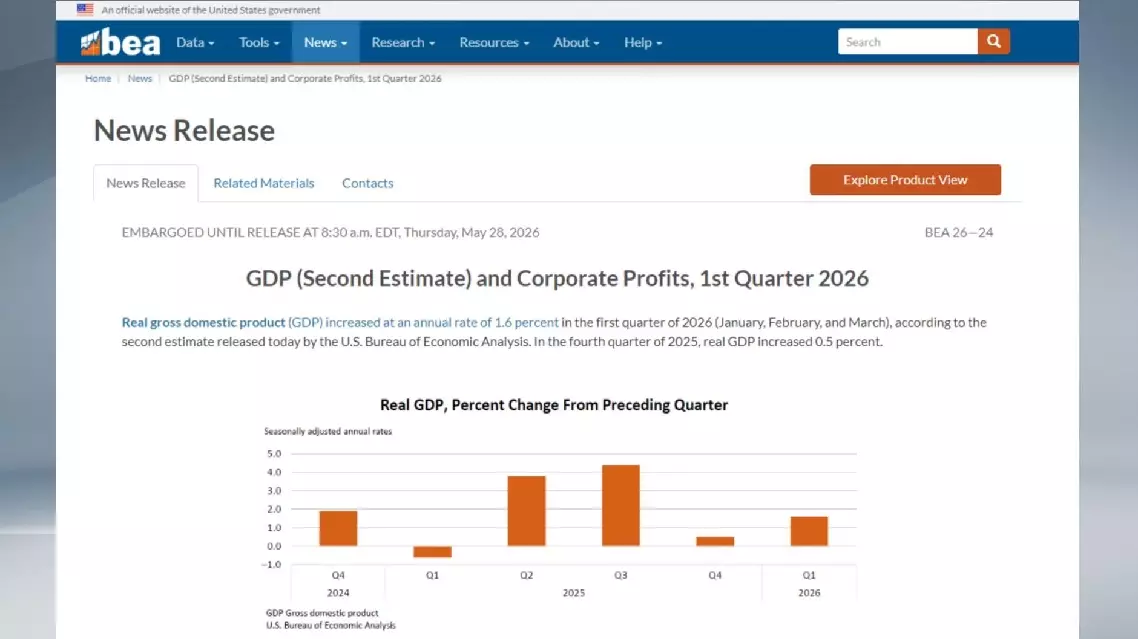
U.S. first-quarter GDP growth revised down to 1.6 pct annual rate