U.S. President Donald Trump on Friday outlined conditions for a possible agreement with Iran, but Iranian sources said Tehran had yet to make a final decision and disputed key parts of his account, dismissing the remarks as "a mixture of truths and lies."
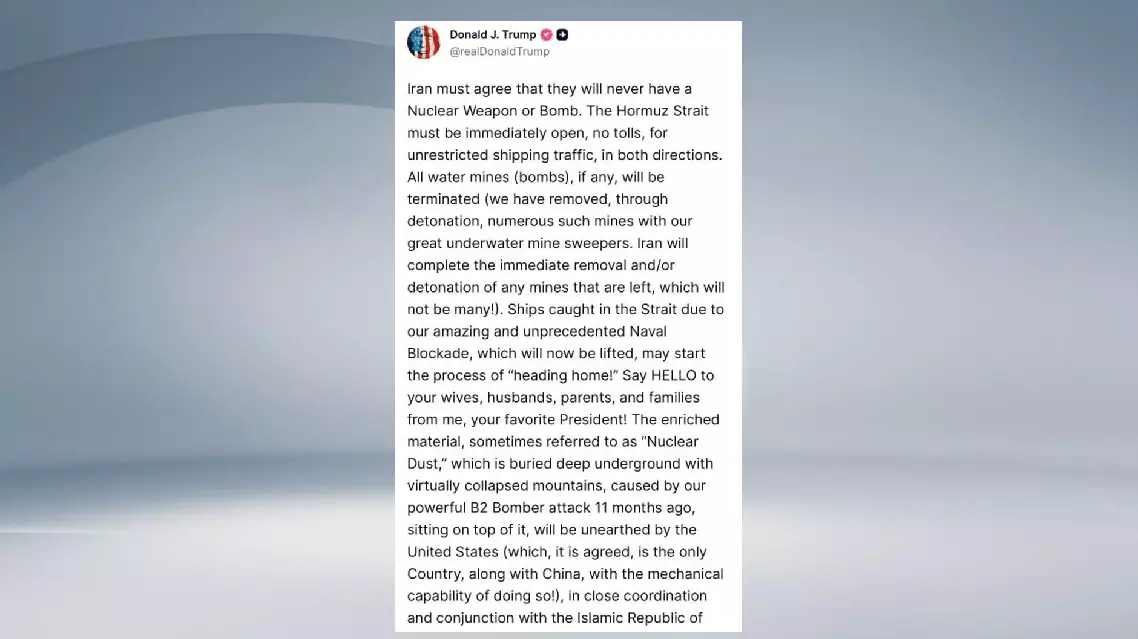
"Iran must agree that they will never have a Nuclear Weapon or Bomb. The Hormuz Strait must be immediately open, no tolls, for unrestricted shipping traffic, in both directions. All water mines (bombs), if any, will be terminated," Trump wrote in a social media post.
The U.S. Naval blockade "will now be lifted," Trump said, adding that ships stranded in the Strait may start "heading home."
He said that Iran's enriched uranium stockpiles will be unearthed by the United States in close coordination and conjunction with Iran and the International Atomic Energy Agency and destroyed.
In terms of the financial compensation for the war demanded by Iran and the idea of investments suggested by the White House, Trump said "no money will be exchanged, until further notice."
Trump also said he would be meeting his national security team at the White House "to make a final determination" on Friday.
In response, Iran's semi-official Fars news agency, citing informed sources, said the draft of the potential agreement was in the final stages of being approved by Iran but that no definitive decision has been made yet.
It dismissed Trump's remarks about a possible agreement with Iran as "a mixture of truths and lies," saying he was attempting to portray a fabricated victory.
Almost everyone now understands that such claims lack credibility, it said.
It clarified that neither Trump's demand for Iran to keep the Strait of Hormuz open toll-free nor any requirement to eliminate or destroy Iran's nuclear materials appears in the agreement's text.
The most important part of the agreement to which Trump has not pointed is Iran's insistence on the release of 12 billion U.S. dollars of its frozen assets, it said, adding that Tehran would not enter any further phase of negotiations until the money is released.
It also said Trump had made no mention of a full ceasefire in Lebanon in line with Hezbollah's position.
Fars said Iran would only move to the next stage of talks on sanctions relief and nuclear issues after those conditions were met and within the framework of the country's stated red lines.
Also on Friday, Ebrahim Rezaei, spokesman for the Iranian parliament's National Security and Foreign Policy Committee, said in a social media post that Iran's control over the Strait of Hormuz was a globally recognized fact.
Countries could secure passage for their vessels by obtaining permission, paying the required fees and sailing under the guidance of Iran's Islamic Revolution Guard Corps (IRGC) Navy, he added.
Iran, the United States and Israel reached a ceasefire on April 8 after 40 days of fighting. Over the past few weeks, the two sides have exchanged proposals via Pakistani mediation. In recent days, they have been working to finalize a memorandum of understanding to halt the war.
Trump outlines Iran deal terms, Iran says no decision made yet, disputes part of his account