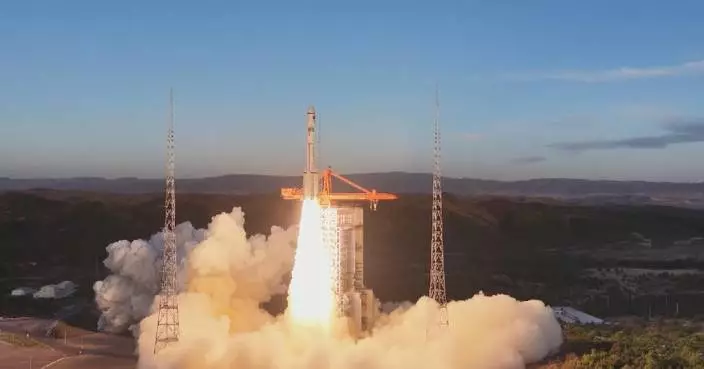
The latest batch of scientific samples from China's space station, totaling approximately 41 kilograms, was brought back to Earth aboard the Shenzhou-22 return capsule, according to the Technology and Engineering Center for Space Utilization (CSU) under the Chinese Academy of Sciences (CAS).
Marking the 10th transfer of materials from the orbiting laboratory, the samples came from 23 experiments in space life sciences, materials science and combustion research, including nine types of biological samples, 12 material samples and two combustion samples.
Among the most notable findings, scientists observed that zebrafish embryos had successfully hatched into tiny fishes aboard the space station.
"Life science experiments in orbit were highly demanding. Cell development happens very quickly, so we had to constantly refocus and take photos to track changes in the biological samples. When we saw that the zebrafish embryos had hatched into small fishes and started swimming, the whole team was thrilled. Notably, our experiment on 'artificial embryos' (stem cell-derived artificial human embryos) was fully recorded in orbit, and the embryos are in very good condition," said Sun Yuanyuan, a senior engineer at the CSU.
The artificial embryo experiment is among the most anticipated. Researchers will use transcriptome sequencing and proteomic analysis to understand how the space environment affects early human embryo development and stem cell behavior. The studies will also explore the effects of microgravity on kidney organoid development and fibrosis, as well as the molecular mechanisms behind bone metabolism imbalance and cardiovascular dysfunction under weightless conditions.
Another experiment focuses on chirality, the property of molecules that are mirror images but not identical, similar to left and right hands.
"Chirality is a project we sent to the space station on a previous Shenzhou-21 mission. It explores the chiral characteristics that appear during the formation of amino acids in living organisms. As we know, humans have a left hand and a right hand. They are mirror images, but they don't perfectly overlap. Many chemical molecules in nature share this mirror-symmetry property. That phenomenon is called chirality. In this experiment, we focus on how small biological molecules select their chiral partners, so that we can understand how chirality selection differs between Earth and space environments," said Liu Wei, another senior engineer at the center.
These findings will help scientists understand how living organisms adapt to space environments, providing critical theoretical knowledge for long-term human space habitation and deep-space exploration.
For the returned materials science samples, including new titanium alloys, high-strength steel and relaxor ferroelectric single crystals, researchers will examine their microstructures, chemical composition and elemental distribution, the CSU said. These analyses will clarify how gravity influences material growth, composition segregation, solidification defects and overall performance.
Combustion experiment samples, including burners and soot collection plates, will be analyzed to study semiconductor nanomaterial synthesis, soot formation and nanocarbon particle characteristics. The results are expected to advance aerospace technology, high-end equipment manufacturing, new energy systems and space fire safety.
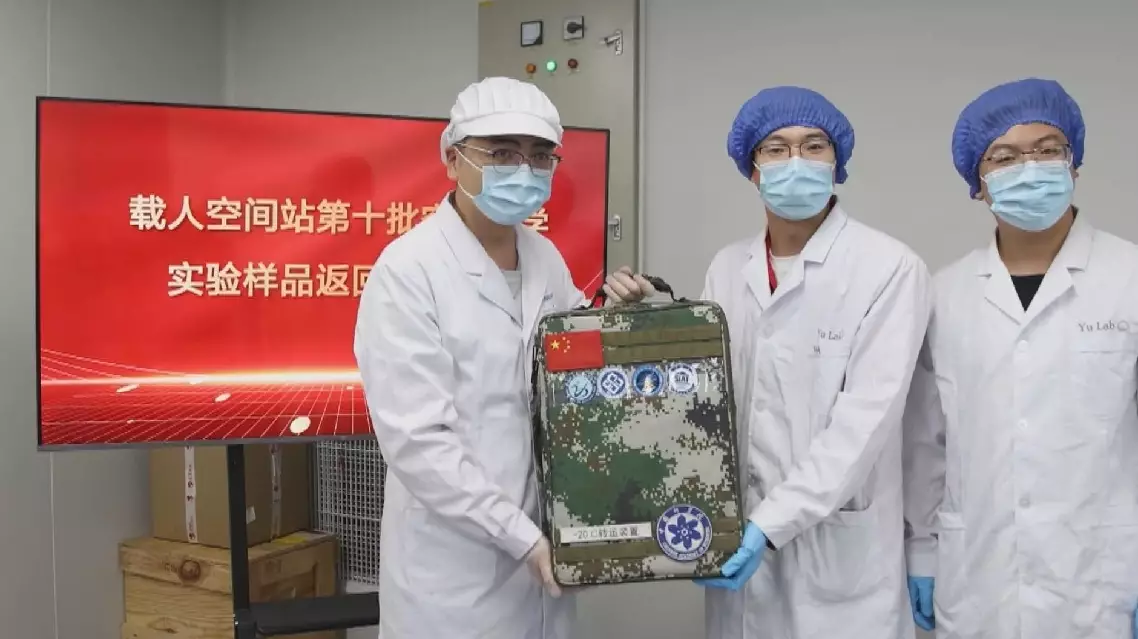
China's space station delivers fresh batch of samples for research