German entrepreneurs voiced strong optimism about expanding bilateral trade and industrial cooperation across emerging sectors at the China-Germany economic roundtable held in Guangzhou, capital of south China's Guangdong Province, on Thursday.
The roundtable was attended by German Economy and Energy Minister Katherina Reiche and Ling Ji, Vice Minister of China's Ministry of Commerce and Deputy International Trade Representative, along with dozens of business representatives from both countries.
Vice Minister Ling noted at the conference that China-Germany trade has maintained a high level of over 200 billion U.S. dollars for the past five years, with the number of German enterprises investing in China reaching 13,000.
German industry leaders widely recognize the Guangdong-Hong Kong-Macao Greater Bay Area (GBA) as a global innovation powerhouse. Many said they foresee sectors like new materials, green energy and robotics becoming key areas of cooperation.
Moritz Berrenberg, CEO of MAXMORE Technology Group, highlighted the unparalleled advantages of the GBA in product development and supply chain integration.
"I think Guangdong province, or the Greater Bay Area (GBA), [including] Dongguan, Shenzhen and Guangzhou, I think this is the innovation hub of China, actually the world. I think there's no other place in the world where you can develop products with this speed and this supply chain so close by. I think there's no place like the GBA anywhere," he said.
Minister Reiche noted that China remains Germany's most important trading partner, with bilateral trade already reaching 220 billion euros. She expressed hope that such exchanges would further enhance economic ties, a sentiment echoed by German business leaders who have already outlined concrete investment plans in China.
Sabine Nitzsche, CFO of TÜV SÜD AG, shared her company's long-term commitment to the Chinese market.
"We have a company in Guangzhou. We are building a new lab, especially for the new battery and new energy systems, and we continue to invest into China, for sure. So we have 40 locations in China, we have more than 4,500 experts working here, and we continued our journey since 1991," she said.
Dr. Karl Bitzer, Managing Director of DELO Industrial Adhesives, outlined two key strategic priorities for his company's expansion in China.
"What we are doing at the moment, the first one is we are expanding our activities in our Shanghai office, and then the second one is, which we explained a little bit earlier, to create more partnerships and strategic partnerships on the raw material side. As I mentioned earlier, we are the innovative guys and that fit together with new raw materials, which can create exactly for the photonics industry or for the AI, which we all need," he said.
Against a backdrop of global economic uncertainty, German industry leaders are deepening their engagement with China. Reiche's visit sends a clear message that both countries choose cooperation over confrontation, and the future of China-Germany relations lies not in protectionism, but in deeper industrial collaboration that benefits both economies.
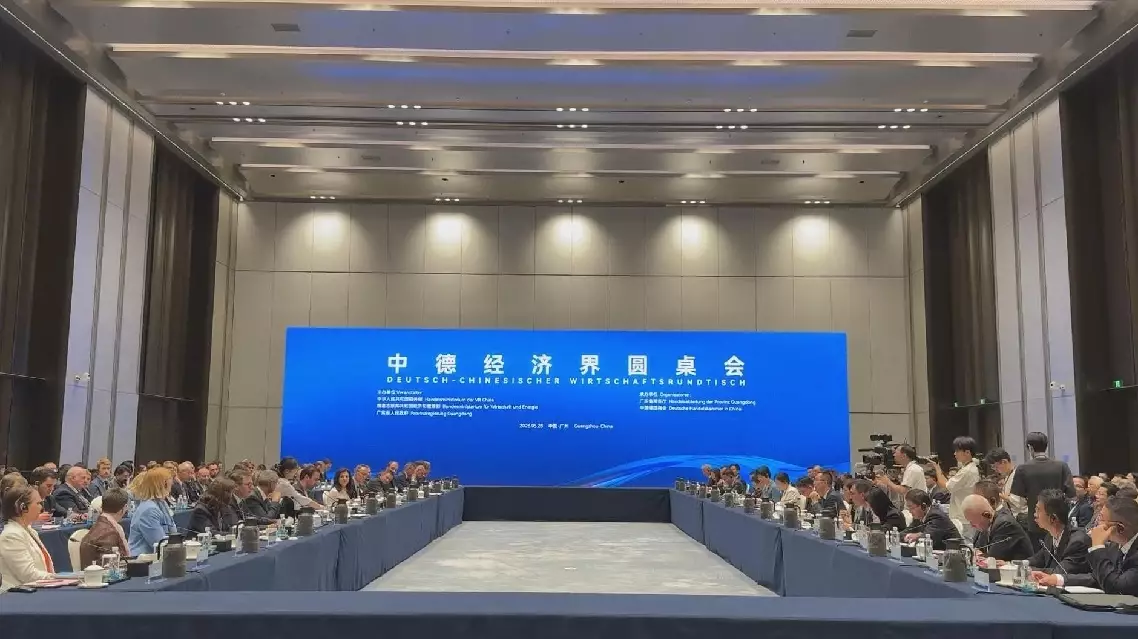
German industry leaders expect deeper economic ties amid minister's visit