BOGOTA (AP) — Colombia’s government on Saturday rejected a move by Ecuador’s President Daniel Noboa to eliminate tariffs on Colombian imports because of a tariff commitment made to an opposition candidate, calling it “deliberate interference” in the ongoing electoral process.
Noboa said Friday after talks with Colombian presidential candidate Abelardo de la Espriella that he was committed to jointly fight narcoterrorism and would eliminate a security tax on June 1.
Colombia’s Foreign Ministry responded on Saturday by saying the repeal of tariffs imposed by Ecuador on bilateral trade stems from a resolution issued by the Andean Community of Nations and rejected its portrayal as “a goodwill gesture by the Ecuadorian leader.”
The ministry also described Noboa’s remarks as “deliberate interference in the electoral process” and as “intrusion by a foreign leader” that constitutes a “flagrant violation of the principle of non-intervention in internal affairs.”
Colombians go to the polls on Sunday to elect the successor to President Gustavo Petro.
De la Espriella, who represents the political movement Defenders of the Homeland, is among the frontrunners in the polls.
Noboa did not clarify whether he would maintain his decision should the ruling party candidate, Iván Cepeda, win.
The trade war between Ecuador and Colombia began in January when the Ecuadorian president imposed a so-called security tax on Colombian imports, alleging a lack of control on that side of the border and complaining of a trade deficit of at least $1 billion.
The tariff began at 30%, gradually increased to 50%, and then reached 100%. Just days before the recent announcement, Noboa had said it would be reduced to 75% starting June 1st.
The Petro administration, which has denied any alleged neglect of the shared border, responded with reciprocal measures: it imposed tariffs of up to 75% on Ecuadorian products and prohibited energy sales to Ecuador.
The ongoing tensions led to the summoning of the ambassadors from both countries.
The Andean Community of Nations found earlier this month that the reciprocal tariffs must be eliminated because they hinder free trade and gave both countries a deadline to do so. The group is currently reviewing appeals opposing the resolution.

A man walks through a voting center in preparation for Sunday's presidential election in Bogota, Colombia, Friday, May 29, 2026. (AP Photo/Matias Delacroix)
WASHINGTON (AP) — The U.S. military has stopped another merchant vessel trying to break through the American blockade of Iranian ports, a U.S. official with knowledge of the situation told The Associated Press on Saturday.
The Gambia-flagged bulk carrier Lian Star ignored multiple warnings from U.S. forces overnight as it tried to enter an Iranian port, the official, who spoke on condition of anonymity to discuss military operations, said. The ship was disabled by U.S. aircraft in the Gulf of Oman and remains adrift there, the official said, adding that U.S. forces have not boarded it.
With the latest action, U.S. military has stopped six ships trying to breach the blockade. One was allowed to proceed.
The U.S. launched the blockade on April 17 in response to Iran effectively closing the strait after the war began with U.S. and Israeli strikes on Feb. 28. A fragile ceasefire has held since April 7. Now the region and wider world await word on whether a deal is being reached to extend it by 60 days while new talks would be held on Iran’s disputed nuclear program.
Events in the Strait of Hormuz between Iran and Oman have shaken the global economy, with shipments of significant amounts of oil, natural gas and related supplies like fertilizer largely stranded, increasing the strain on consumers and food producers.
The U.S. blockade seeks to limit Iran’s own shipments and further weaken its access to cash, creating more pain for its long-weakened economy.
U.S. President Donald Trump met with advisers on Friday but has yet to decide on whether to move ahead with a deal to extend the ceasefire and reopen the strait. Iran has said the deal had not been finalized.
Commercial traffic has quietly continued to flow through the strait, despite Iran's assertions that it must approve any transits, though at a much lower volume than before the conflict.
“Any violation of these regulations will place the security of their passage at serious risk,” Iran's joint military command said Saturday in a statement carried by state TV, warning that any military vessels trying to interfere with that would be targeted.
Iran has even charged tolls for transit as high as $2 million, which experts have called a violation of a principle of international maritime trade: freedom of peaceful navigation.
Qatar's deputy prime minister, Sheikh Saoud bin Abdulrahman bin Hassan bin Ali Al Thani, on Saturday said the Gulf nation opposes charging fees to transit, “but for certain times when they say they are going to use it for mine clearing or some usage of the fees for a temporary time, this is something that is negotiable, and it could be something that will help the transit of the Strait of Hormuz to be back to normal stage.”
The U.S. official previously told the AP that the U.S. has not found or destroyed any mines in the strait.
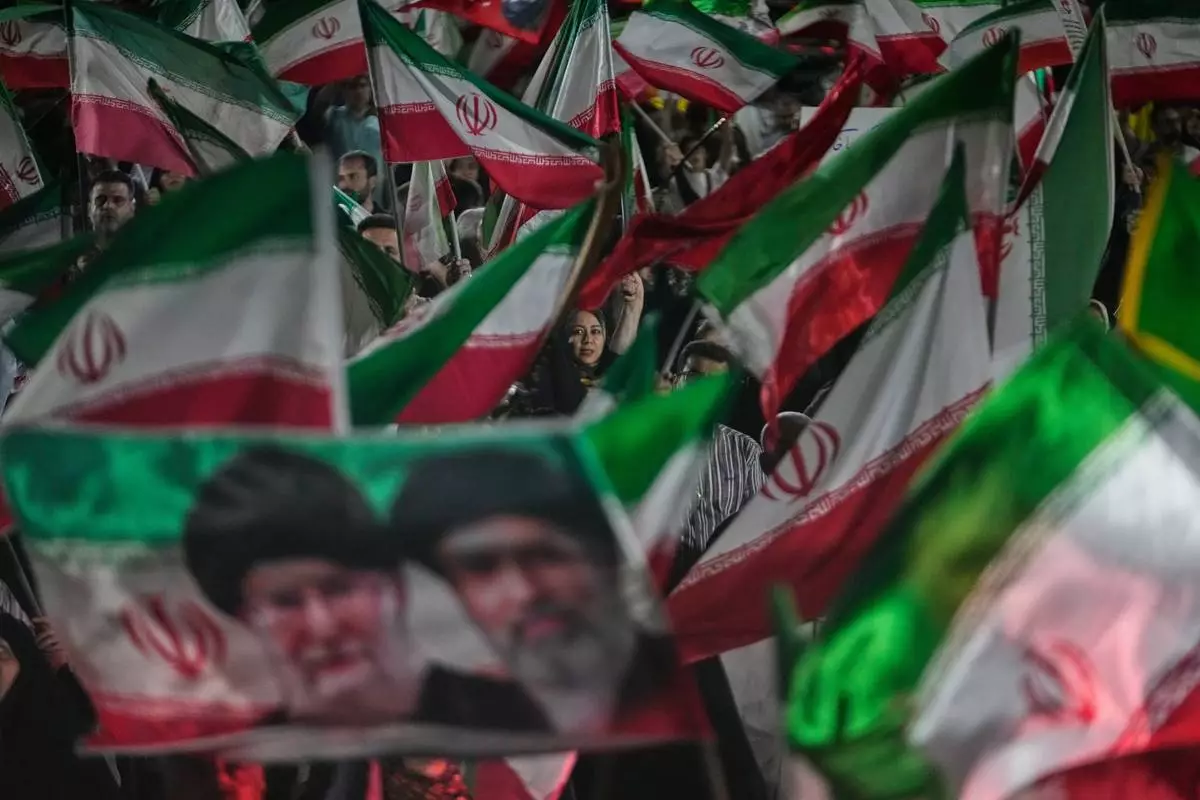
Pro-government Iranian demonstrators wave Iranian flags and a portrait of the Supreme Leader Ayatollah Mojtaba Khamenei, right, and his slain father Ayatollah Ali Khamenei in a gathering at a square in Tehran, Iran, Friday, May 29, 2026. (AP Photo/Vahid Salemi)