BERLIN (AP) — The memories of two successive World Cup group-stage exits weigh heavily on the Germany team before another attempt at restoring lost pride.
Surely it couldn’t happen again?
Germany, the four-time world champion, has been on a quest for redemption since its ignoble exit from the 2022 World Cup in Qatar marked a new low for the national team. Hansi Flick, the Germany coach at the time, held on for six more games before making way after three straight defeats.
Julian Nagelsmann took over in time for the 2024 European Championship and marked a new beginning with young, exciting players. Germany, the host, lost to eventual champion Spain in the quarterfinals, when Nagelsmann said there had been little between the teams and bullishly lamented having to wait two years before becoming world champion.
Nagelsmann has maintained that stance and repeated it again Thursday, even if his late decision to recall veteran goalkeeper Manual Neuer from two years of international retirement indicates a lack of conviction in Oliver Baumann, whom he’d previously indicated would be the No. 1 in goal after solid performances in qualifying.
Neuer is the only remaining member of the World Cup-winning team from 2014 in the Germany squad.
Nagelsmann acknowledged that Neuer’s return is “a blow” for Baumann, a team player who is unlikely to grumble in public about the decision. But the 40-year-old Neuer’s experience over 124 games for Germany could be a boon for the squad in what will be the goalkeeper’s fifth World Cup tournament.
“Everyone knows what kind of aura he possesses and the quality he brings to a team,” Nagelsmann said. “We don’t have a goalkeeper problem.”
Neuer is just over two years older than the 38-year-old Nagelsmann – who will be at his first World Cup.
His inclusion lifts the average age of the squad to 27.98 years, the oldest since the 2002 World Cup under Rudi Völler, Kicker magazine reported.
Neuer’s teammate at Bayern Munich, Joshua Kimmich, will captain the side.
The only concerns are Neuer’s recurring injuries. Neuer was to miss Bayern Munich’s German Cup final against Stuttgart because of a calf injury.
Germany’s problems at the last two World Cups started with opening defeats to Mexico and Japan in Russia and Qatar, respectively.
Tournament newcomer Curaçao is unlikely to spring a surprise when they meet for their Group E opener in Houston on June 14.
Germany next faces Ivory Coast and Ecuador, potentially more difficult rivals, but Germany should still have enough firepower to advance from the group – particularly because FIFA’s expanded version of the tournament means 32 of the 48 participating teams will reach the knockout stage.
Germany had few problems in World Cup qualifying but has struggled against other European heavyweights like France, Portugal and Spain, suggesting it still has some way to go before it can compete against its main rivals.
Defensive stability is Nagelsmann’s biggest worry as Germany conceded four goals in two friendly wins over Switzerland (4-3) and Ghana (1-0) in March.
Jonathan Tah and Nico Schlotterbeck formed the central defensive partnerships for both games, with Kimmich – who plays in midfield for Bayern – at right back with David Raum or Nathaniel Brown on the left.
Serge Gnabry’s absence through injury is a blow, but Germany has enough attacking talent in Bayern’s Jamal Musiala and Liverpool’s Florian Wirtz for Nagelsmann to resist calls to bring Cologne teenager Said El Mala.
Bayern’s Lennart Karl, the youngest member of the squad at 18, is Nagelsmann’s wild card after recovering from a hamstring injury in time to feature.
AP World Cup coverage: https://apnews.com/hub/fifa-world-cup

Germany's head coach Julian Nagelsmann, announces the squad for the 2026 FIFA World Cup during a news conference at the German Football Association, DFB, headquarters in Frankfurt, Germany, Thursday, May 21, 2026. (AP Photo/Michael Probst)
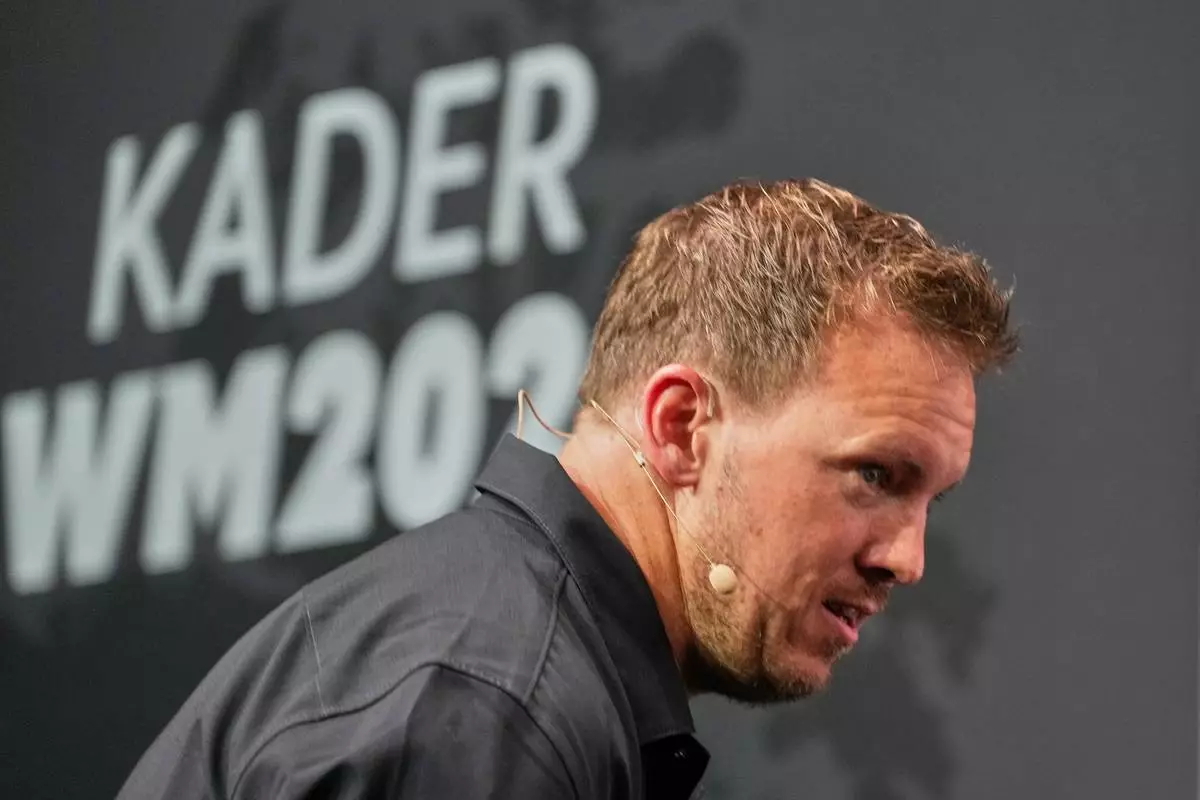
Germany's head coach Julian Nagelsmann, announces the squad for the 2026 FIFA World Cup during a news conference at the German Football Association, DFB, headquarters in Frankfurt, Germany, Thursday, May 21, 2026. (AP Photo/Michael Probst)
KUALA LUMPUR, Malaysia (AP) — Malaysia on Monday began enforcing rules barring millions of children younger than 16 from having social media accounts, joining a global effort to tighten online safety protections for young users.
The rules require social media platforms with at least 8 million users including Facebook, Instagram, TikTok and YouTube, to implement age-verification systems and block users under 16 from creating accounts.
Malaysia’s Communications and Multimedia Commission said Monday that age verification for existing users will be rolled out progressively over the next six months.
Users identified as under 16 will have a month to download or transfer their data, including photos and videos, before any restrictions, suspensions, or other actions are applied, it said in a statement.
Companies that fail to comply could face penalties of up to 10 million ringgit ($2.5 million). But parents whose children manage to bypass the law will not be penalized.
The government said the measures are aimed at protecting children from harmful content, cyberbullying and platform features designed to encourage excessive use.
Other countries including Australia,Brazil and Indonesia have introduced or announced age-based restrictions or requirements for children’s access to social media. Countries including Britain, France, Spain, Denmark, Thailand and South Korea are also studying or developing similar approaches.
The regulator said the rules are not intended to prevent children from accessing digital technology.
“These measures help strengthen the protection of children in the online environment, while providing added reassurance to parents in navigating increasingly complex digital risks," it has said.
Platforms are required to improve user safety, discourage excessive use and take action against underage accounts and harmful content.
Technology companies have yet to detail how they will comply with Malaysia’s new requirements.
Clara Koh, Meta’s director of public policy for Southeast Asia, had cautioned in April that Malaysia's blanket under-16 ban could backfire by driving teenagers away from protected apps and into unregulated corners of the internet.
She said Meta has launched “teen accounts” for those under 18 that limits contact, screen time and exposure to inappropriate content.
Malaysia's curbs come as governments face growing pressure to address concerns about social media’s impact on children’s mental health and online safety.
In March, a U.S. jury ordered Meta and YouTube to pay millions of dollars in damages in a case alleging that platform design features contributed to harm suffered by a young user.
Kuala Lumpur parents Saravanan Ganasan and Jayaradha Veerasamy — whose children are 12 and 15 — approve of the changes. They already banned their kids from using social media, believing minors lack the psychological capacity to cope with it.
The couple ban unsupervised scrolling on TikTok and Instagram. Devices are kept out of bedrooms, screen time is limited to common areas, and their son is not allowed to lock his phone with a password.
“Exposure is what we fear,” Saravanan said. “The wrong kind of exposure will do damage to the mind.”
Aadhavan Saravanan, 15, said he believes he would be addicted to social media if allowed full freedom. “Social media is like, a luxury and it’s not a necessity,” he said
The couple said the restrictions have forced their children to develop offline life skills. Instead of scrolling, Aadhavan reads books in a backyard mango tree and repairs broken household appliances, while their daughter cooks and does crafts.
“A lot of parents are very scared that children get bored,” the kids' mother, Jayaradha, said. “But boredom is actually very good because they start thinking out of the box.”
But Shaun Hew, who lives in the Kuala Lumpur suburb of Cheras, feels the new restrictions go too far.
Hew believes social media offers an outlet for his kids to spend time productively, as long as there is proper adult oversight. His 11-year-old son uses platforms to learn cooking and his daughter, 14, uses YouTube for exam revision.
He worries a sudden cutoff could cause teenagers to rebel and find unregulated ways to bypass internet blocks.
Some critics contend that Malaysia’s move could increase the risks of data privacy breaches and expand state surveillance.
“It is very much following the trend but in a way that is raising alarms due to requiring a government ID for age verification,” said Benjamin Loh, social science lecturer at Monash University in Malaysia.
Loh also said experiences elsewhere suggest age-based restrictions have yet to prove consistently effective. Without penalties on parents, families can easily bypass the law by creating accounts for their children, he said.
“This is a major gap that unless regulators are willing to fix, will result in the law having little effect in stopping children from using social media,” he added.
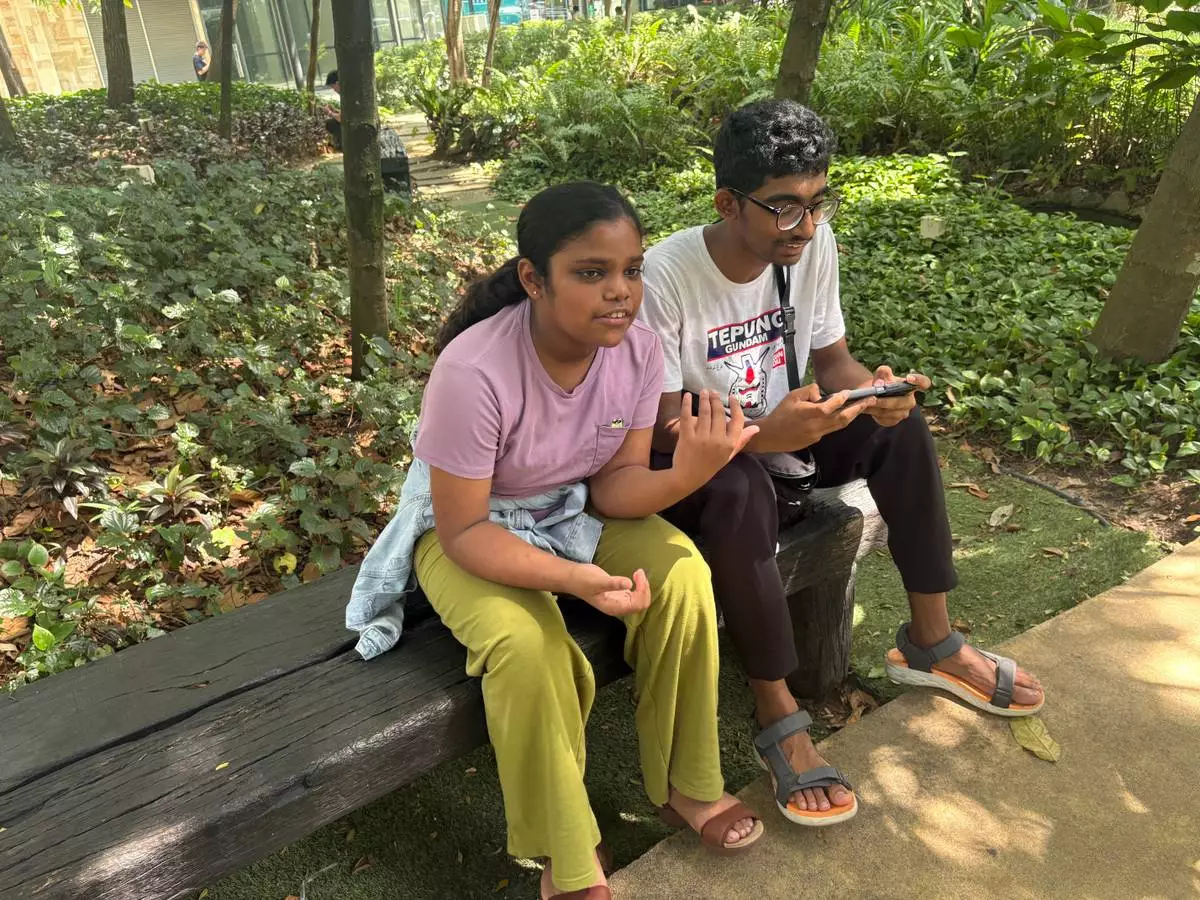
Siblings Saaradha Saravanan, 12, left, and Aadhavan Saravanan, 15, sit in a park in Petaling Jaya, near Kuala Lumpur Malaysia Monday, June 1, 2026. (AP Photo/Eileen Ng)

Jayaradha Veerasamy, right, and Saravanan Ganasan, second left, stand with their 12 years-old daughter Saaradha Saravanan, left, and their 15 year-old son Aadhavan Saravanan at a park in Petaling Jaya, near Kuala Lumpur, Malaysia Monday, June 1, 2026. (AP Photo/Eileen Ng)

FILE - A view of the TikTok app logo, in Tokyo, Japan, Sept. 28, 2020. (AP Photo/Kiichiro Sato, File)