|
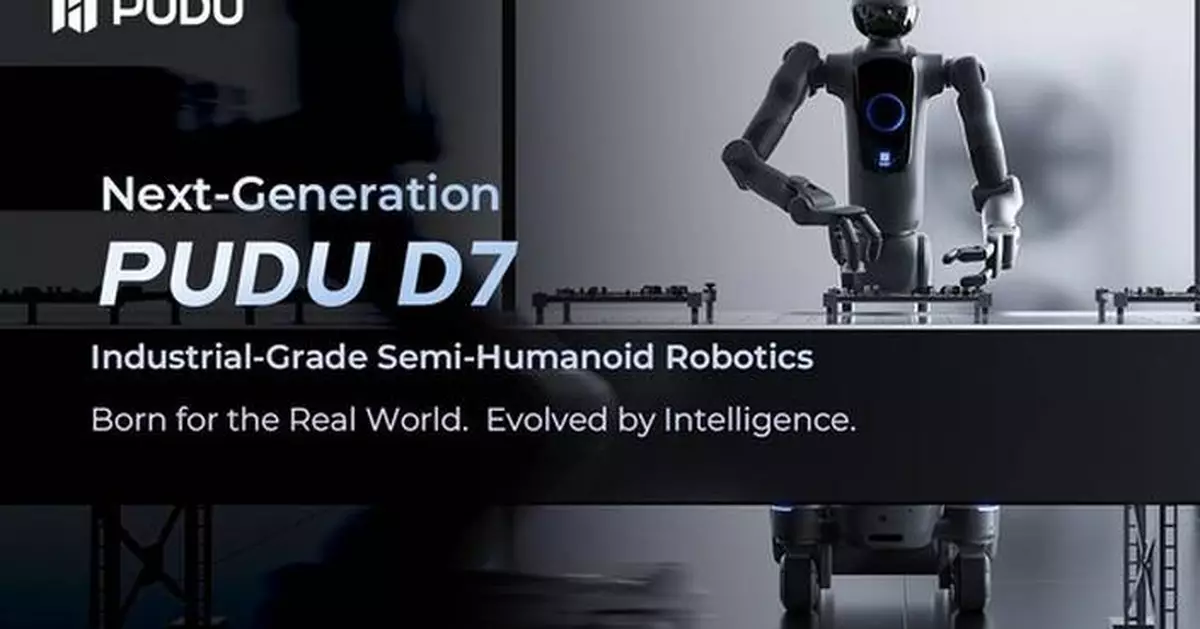
SHENZHEN, China, June 1, 2026 /PRNewswire/ -- Pudu Robotics, a global leader in service robotics, today announced the launch of its new PUDU D7, its next-generation industrial semi-humanoid robot designed for manufacturing and industrial environments.
PUDU D7 integrates industrial-grade hardware with embodied AI to tackle complex operational challenges across factory workflows. Built on PuduFM 1.0, Pudu Robotics' embodied intelligence foundation model, the robot integrates scenario-driven intelligence, large-model reasoning, and practical business value to help industrial automation evolve toward intelligent, continuously learning systems.
Unlike conventional industrial robots that rely on predefined programs and fixed workflows, PUDU D7 can understand tasks, learn from experience, and continuously optimize its behavior in real-world environments. This marks a significant shift from simply executing tasks to understanding them.
"An industrial-grade evolvable semi-humanoid robot—born from real-world scenarios and evolved through foundation models." This philosophy defines PUDU D7 and reflects Pudu Robotics' vision for the future of industrial robotics in the era of embodied intelligence.
Comprehensive Data Collection: Building the Foundation for Industrial Embodied Intelligence
The complexity of industrial environments demands robots capable of continuous learning and ongoing evolution.
To support this, PUDU D7 features an integrated end-to-end data collection architecture capable of rapidly capturing and consolidating operational data across diverse industrial workflows. With low-latency transmission and highly synchronized data processing, the system provides a robust foundation for model training and continuous improvement.
Powered by this large-scale real-world data loop, PuduFM 1.0 continuously learns operational procedures, spatial relationships, and manufacturing processes from industrial environments, steadily improving decision-making and task adaptability over time.
Unlike traditional robots whose capabilities remain fixed after deployment, PUDU D7 continuously evolves through every navigation, manipulation, interaction, and operational task it performs.
Dual-Arm Dexterity: Enhancing Warehouse and Material Handling Efficiency
In inventory storage and warehouse environments, PUDU D7 can autonomously perform high-frequency tasks such as material handling, shelf picking, inventory replenishment, and intralogistics transportation.
The robot supports a payload capacity of up to 14 kg (30.9 lbs) and can operate at heights of up to 2 meters (6.6 ft), enabling efficient interaction with high-rack storage systems.
Leveraging precision force-control technology in its dual-arm system, PUDU D7 can handle heavy objects with exceptional care, minimizing the risk of product damage during transport and manipulation. PUDU D7 can also autonomously push carts and transport materials across facilities, helping improve warehouse productivity and operational efficiency.
Powered by PuduFM 1.0, PUDU D7 moves beyond the traditional separation between navigation and manipulation. Instead, it integrates mobility, approach planning, grasping, and dynamic adjustment into a unified action framework, enabling seamless coordination between movement and operation.
For manufacturers, this enables the automation of more complex, multi-step tasks while reducing manual intervention and system integration costs.
Tactile Intelligence: Millimeter-Level Precision Control
For high-precision industrial applications such as dispensing, assembly, and fine manipulation, PUDU D7 is equipped with advanced tactile sensors capable of detecting contact force and pressure feedback in real time.
The system delivers millimeter-level force-control accuracy, dynamically adjusting applied force based on material properties and task requirements. Whether performing delicate grasping, controlled pressing, or precision force application, PUDU D7 maintains stable and consistent operation while minimizing the risk of component damage.
Combined with the physical-world understanding capabilities of PuduFM 1.0, the robot can continuously optimize its manipulation strategies based on environmental conditions and task objectives, enabling greater adaptability in complex industrial settings.
360° Environmental Awareness: Adapting to Dynamic Industrial Environments
To operate reliably in complex factory settings, PUDU D7 is equipped with dual front-and-rear LiDAR systems and a comprehensive perception system.
The robot continuously captures surrounding spatial information, accurately identifying obstacles, route changes, and environmental conditions in real time. By dynamically analyzing changing operational conditions, PUDU D7 can proactively avoid risks and navigate confidently through highly dynamic, mixed-operation industrial environments. This significantly improves both mobility safety and operational stability.
As a result, manufacturers can deploy the robot with minimal modifications to existing facilities, reducing implementation complexity and accelerating adoption.
Autonomous Battery Swapping: Enabling 24/7 Operations
To meet the demands of around-the-clock industrial operations, PUDU D7 supports fully autonomous battery swapping.
The robot can independently remove, replace, and recharge batteries without human intervention, minimizing downtime and ensuring continuous productivity. This self-sustaining power management system enables 24/7 operation while improving equipment utilization and overall operational efficiency.
Industrial Design Reimagined: A New Aesthetic for Intelligent Machines
Beyond its technological advancements, PUDU D7 introduces a refined industrial design that balances functionality, reliability, and visual appeal.
The robot adopts a design language that combines robust industrial form factors with softer contours, creating a visual identity that conveys both strength and approachability.
The head design draws inspiration from industrial safety helmets, enhanced by gradient diamond-pattern textures that reinforce safety recognition while conveying a futuristic visual identity. The leg architecture utilizes open-frame structures to reduce visual bulk and create a lighter, more agile appearance. Meanwhile, the chassis incorporates design cues inspired by off-road vehicles, emphasizing its mobility and adaptability across challenging terrain.
Finished in dark matte materials with distinctive high-visibility signal-light elements, PUDU D7 projects a professional, dependable, and technologically advanced industrial presence through its clean and streamlined silhouette.
From Automation Tool to Industrial Intelligent Agent
As industrial intelligence continues to evolve, robots are no longer limited to executing predefined workflows.
PUDU D7 represents a new generation of embodied AI robots capable of continuously learning, evolving, and truly understanding industrial environments.
Through the integration of PuduFM 1.0, a real-world data loop, and deep industrial deployment, Pudu Robotics is accelerating the transition from traditional automation to intelligent industrial agents.
Looking ahead, the company is further exploring the future of embodied AI through PuduAgent, a general-purpose embodied agent architecture.
If PuduFM 1.0 enables robots to understand how to perform tasks, PuduAgent serves as the robot's cognitive task engine. It can understand user objectives, autonomously decompose complex workflows, dynamically orchestrate navigation, manipulation, and perception capabilities, and coordinate multiple robots to complete long-horizon tasks spanning different locations and processes.
This vision extends robotics beyond isolated task execution toward intelligent systems capable of planning, decision-making, and autonomous collaboration.
For Pudu Robotics, the value of embodied intelligence lies not only in automating repetitive work, but also in enabling robots to integrate seamlessly into real-world production and everyday life.
"Born Intelligent. Transforming Industries. Reimagining Life." reflects Pudu Robotics' long-term vision: creating robots that continuously understand their environments, learn from experience, evolve collaboratively, and generate greater value across industrial, commercial, and everyday applications.
About Pudu Robotics
Pudu Robotics, a global leader in the commercial service robotics sector, is dedicated to empowering easier work and better lives through AI and robotics, with a vision of building a global intelligent robotics infrastructure that serves 10 billion people worldwide.
Pudu Robotics has achieved full-stack proprietary R&D in core technologies, including navigation algorithms, multi-robot scheduling, swarm control, motion controllers, and integrated joint modules.
Built on three core technologies—Embodied Navigation, Embodied Manipulation, and Embodied Interaction—Pudu Robotics has pioneered an "One Brain, Multiple Embodiments" architecture, establishing a comprehensive product portfolio that includes specialized, semi-humanoid, and humanoid robots.
Currently, Pudu offers four major product lines: service delivery, commercial cleaning, industrial delivery and general embodied AI. Its solutions are widely deployed across industries such as retail, hospitality, manufacturing, real estate and property services, healthcare, entertainment and sport, education, and public services.
To date, Pudu Robotics has shipped over 130,000 units globally, with a presence in more than 85 countries and regions.
SHENZHEN, China, June 1, 2026 /PRNewswire/ -- Pudu Robotics, a global leader in service robotics, today announced the launch of its new PUDU D7, its next-generation industrial semi-humanoid robot designed for manufacturing and industrial environments.
PUDU D7 integrates industrial-grade hardware with embodied AI to tackle complex operational challenges across factory workflows. Built on PuduFM 1.0, Pudu Robotics' embodied intelligence foundation model, the robot integrates scenario-driven intelligence, large-model reasoning, and practical business value to help industrial automation evolve toward intelligent, continuously learning systems.
Unlike conventional industrial robots that rely on predefined programs and fixed workflows, PUDU D7 can understand tasks, learn from experience, and continuously optimize its behavior in real-world environments. This marks a significant shift from simply executing tasks to understanding them.
"An industrial-grade evolvable semi-humanoid robot—born from real-world scenarios and evolved through foundation models." This philosophy defines PUDU D7 and reflects Pudu Robotics' vision for the future of industrial robotics in the era of embodied intelligence.
Comprehensive Data Collection: Building the Foundation for Industrial Embodied Intelligence
The complexity of industrial environments demands robots capable of continuous learning and ongoing evolution.
To support this, PUDU D7 features an integrated end-to-end data collection architecture capable of rapidly capturing and consolidating operational data across diverse industrial workflows. With low-latency transmission and highly synchronized data processing, the system provides a robust foundation for model training and continuous improvement.
Powered by this large-scale real-world data loop, PuduFM 1.0 continuously learns operational procedures, spatial relationships, and manufacturing processes from industrial environments, steadily improving decision-making and task adaptability over time.
Unlike traditional robots whose capabilities remain fixed after deployment, PUDU D7 continuously evolves through every navigation, manipulation, interaction, and operational task it performs.
Dual-Arm Dexterity: Enhancing Warehouse and Material Handling Efficiency
In inventory storage and warehouse environments, PUDU D7 can autonomously perform high-frequency tasks such as material handling, shelf picking, inventory replenishment, and intralogistics transportation.
The robot supports a payload capacity of up to 14 kg (30.9 lbs) and can operate at heights of up to 2 meters (6.6 ft), enabling efficient interaction with high-rack storage systems.
Leveraging precision force-control technology in its dual-arm system, PUDU D7 can handle heavy objects with exceptional care, minimizing the risk of product damage during transport and manipulation. PUDU D7 can also autonomously push carts and transport materials across facilities, helping improve warehouse productivity and operational efficiency.
Powered by PuduFM 1.0, PUDU D7 moves beyond the traditional separation between navigation and manipulation. Instead, it integrates mobility, approach planning, grasping, and dynamic adjustment into a unified action framework, enabling seamless coordination between movement and operation.
For manufacturers, this enables the automation of more complex, multi-step tasks while reducing manual intervention and system integration costs.
Tactile Intelligence: Millimeter-Level Precision Control
For high-precision industrial applications such as dispensing, assembly, and fine manipulation, PUDU D7 is equipped with advanced tactile sensors capable of detecting contact force and pressure feedback in real time.
The system delivers millimeter-level force-control accuracy, dynamically adjusting applied force based on material properties and task requirements. Whether performing delicate grasping, controlled pressing, or precision force application, PUDU D7 maintains stable and consistent operation while minimizing the risk of component damage.
Combined with the physical-world understanding capabilities of PuduFM 1.0, the robot can continuously optimize its manipulation strategies based on environmental conditions and task objectives, enabling greater adaptability in complex industrial settings.
360° Environmental Awareness: Adapting to Dynamic Industrial Environments
To operate reliably in complex factory settings, PUDU D7 is equipped with dual front-and-rear LiDAR systems and a comprehensive perception system.
The robot continuously captures surrounding spatial information, accurately identifying obstacles, route changes, and environmental conditions in real time. By dynamically analyzing changing operational conditions, PUDU D7 can proactively avoid risks and navigate confidently through highly dynamic, mixed-operation industrial environments. This significantly improves both mobility safety and operational stability.
As a result, manufacturers can deploy the robot with minimal modifications to existing facilities, reducing implementation complexity and accelerating adoption.
Autonomous Battery Swapping: Enabling 24/7 Operations
To meet the demands of around-the-clock industrial operations, PUDU D7 supports fully autonomous battery swapping.
The robot can independently remove, replace, and recharge batteries without human intervention, minimizing downtime and ensuring continuous productivity. This self-sustaining power management system enables 24/7 operation while improving equipment utilization and overall operational efficiency.
Industrial Design Reimagined: A New Aesthetic for Intelligent Machines
Beyond its technological advancements, PUDU D7 introduces a refined industrial design that balances functionality, reliability, and visual appeal.
The robot adopts a design language that combines robust industrial form factors with softer contours, creating a visual identity that conveys both strength and approachability.
The head design draws inspiration from industrial safety helmets, enhanced by gradient diamond-pattern textures that reinforce safety recognition while conveying a futuristic visual identity. The leg architecture utilizes open-frame structures to reduce visual bulk and create a lighter, more agile appearance. Meanwhile, the chassis incorporates design cues inspired by off-road vehicles, emphasizing its mobility and adaptability across challenging terrain.
Finished in dark matte materials with distinctive high-visibility signal-light elements, PUDU D7 projects a professional, dependable, and technologically advanced industrial presence through its clean and streamlined silhouette.
From Automation Tool to Industrial Intelligent Agent
As industrial intelligence continues to evolve, robots are no longer limited to executing predefined workflows.
PUDU D7 represents a new generation of embodied AI robots capable of continuously learning, evolving, and truly understanding industrial environments.
Through the integration of PuduFM 1.0, a real-world data loop, and deep industrial deployment, Pudu Robotics is accelerating the transition from traditional automation to intelligent industrial agents.
Looking ahead, the company is further exploring the future of embodied AI through PuduAgent, a general-purpose embodied agent architecture.
If PuduFM 1.0 enables robots to understand how to perform tasks, PuduAgent serves as the robot's cognitive task engine. It can understand user objectives, autonomously decompose complex workflows, dynamically orchestrate navigation, manipulation, and perception capabilities, and coordinate multiple robots to complete long-horizon tasks spanning different locations and processes.
This vision extends robotics beyond isolated task execution toward intelligent systems capable of planning, decision-making, and autonomous collaboration.
For Pudu Robotics, the value of embodied intelligence lies not only in automating repetitive work, but also in enabling robots to integrate seamlessly into real-world production and everyday life.
"Born Intelligent. Transforming Industries. Reimagining Life." reflects Pudu Robotics' long-term vision: creating robots that continuously understand their environments, learn from experience, evolve collaboratively, and generate greater value across industrial, commercial, and everyday applications.
About Pudu Robotics
Pudu Robotics, a global leader in the commercial service robotics sector, is dedicated to empowering easier work and better lives through AI and robotics, with a vision of building a global intelligent robotics infrastructure that serves 10 billion people worldwide.
Pudu Robotics has achieved full-stack proprietary R&D in core technologies, including navigation algorithms, multi-robot scheduling, swarm control, motion controllers, and integrated joint modules.
Built on three core technologies—Embodied Navigation, Embodied Manipulation, and Embodied Interaction—Pudu Robotics has pioneered an "One Brain, Multiple Embodiments" architecture, establishing a comprehensive product portfolio that includes specialized, semi-humanoid, and humanoid robots.
Currently, Pudu offers four major product lines: service delivery, commercial cleaning, industrial delivery and general embodied AI. Its solutions are widely deployed across industries such as retail, hospitality, manufacturing, real estate and property services, healthcare, entertainment and sport, education, and public services.
To date, Pudu Robotics has shipped over 130,000 units globally, with a presence in more than 85 countries and regions.
** This press release is distributed by PR Newswire through automated distribution system, for which the client assumes full responsibility. **
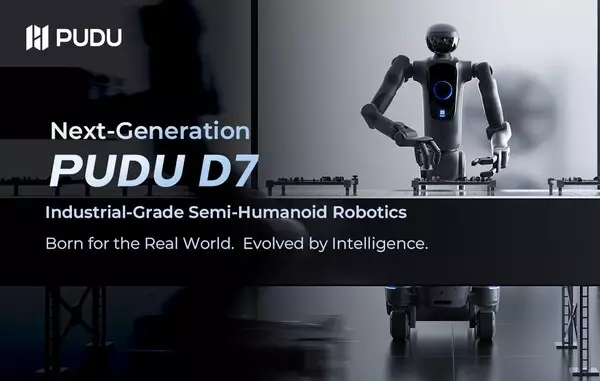
PUDU Embodied Unveils the Next-Generation PUDU D7: Opening a New Chapter for Industrial Semi-Humanoid Robotics
SHANGHAI, June 1, 2026 /PRNewswire/ -- Envision Energy, a global leader in green technology, has signed a strategic partnership with Impact Electrons Siam (IES), one of Southeast Asia's leading renewable energy developers, to jointly advance the landmark cross-border Monsoon Wind Power Project in Laos. The collaboration is expected to add significant wind power, solar, and energy storage capacity, creating Southeast Asia's largest Future Energy System, an AI-powered energy infrastructure that integrates energy systems with intelligent systems, and substantially expanding the region's integrated clean energy capacity.
The signing ceremony was attended by Malaythong Kommasith, Minister of Industry and Commerce (MOIC) of Lao PDR, Edward Hou, Senior Vice President & President of Asia-Pacific Region at Envision Energy; and Peck Khamkanist, Executive Chairman of Impact Electrons Siam. The project marks a significant step in Laos' transformation from a hydro-dominated power exporter toward a regional hub for diversified clean energy development, setting a benchmark for integrated renewable energy development across ASEAN.
Leveraging its global expertise in its pioneer future energy systems and net zero industrial parks, Envision Energy will provide advanced AI-powered future energy system to enable intelligent coordination and optimization across wind, solar, and storage operations. The green power generated will not only meet rapidly growing local electricity demand, but also provide critical support for next-generation sustainable infrastructure and industries such as smart cities, green data centers, green mining, and advanced manufacturing, accelerating Laos' energy transition. The parties will also study the potential role of green hydrogen in enhancing energy stability and supporting future green industrial park development in Laos. The project is expected to demonstrate how system-level integration and intelligent operations can improve renewable energy reliability, efficiency, and long-term resilience, creating a scalable model for clean energy development across Southeast Asia.
Edward Hou, Senior Vice President & President of Asia-Pacific Region at Envision Energy, said: "The future of renewable energy is shifting from competition among individual technologies to system-level integration and intelligent operations. By integrating wind, solar, and energy storage at scale, this project will further optimize Laos' energy mix, enhance grid stability and flexibility, and improve the cost competitiveness of clean electricity. It will further strengthen energy resilience across Southeast Asia and serve as a replicable model for building a more stable, efficient, and sustainable regional energy system."
"This collaboration represents an important milestone in Laos' ongoing energy transition and its ambition to evolve from a traditional power exporter into a diversified clean energy economy," added Peck Khamkanist, Executive Chairman of Impact Electrons Siam, "In partnership with Envision Energy, the project brings together global expertise in integrated energy systems to support more advanced and efficient clean power development in the region. Beyond its generation capacity, it is expected to create broader socio-economic value by supporting infrastructure modernization and enhancing Laos' role in regional energy cooperation."
Envision Energy has been gaining strong momentum across Southeast Asia. The company has partnered with Electricité du Cambodge (EDC) on a landmark 300MWh Battery Energy Storage System (BESS) project in Cambodia. Beyond enabling the efficient operation of the facility, Envision's AI-powered Future Energy System also acts as the "digital brain" of Cambodia's national grid under EDC. It supports the country's transition by delivering grid-level intelligence, enhanced stability, and seamless power management, helping to shape a more integrated and resilient energy landscape across ASEAN.
** This press release is distributed by PR Newswire through automated distribution system, for which the client assumes full responsibility. **
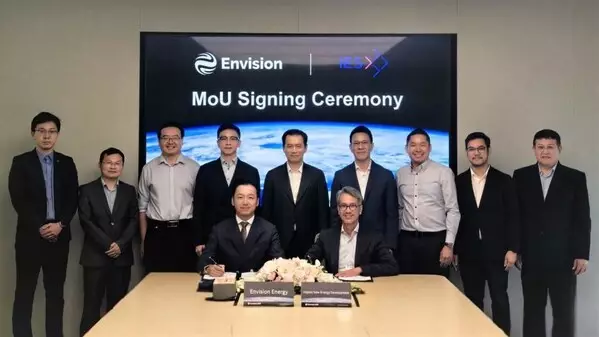
Envision Energy Partners with Impact Electrons Siam to Develop Southeast Asia's Largest Future Energy System in Laos