DALLAS--(BUSINESS WIRE)--Jun 1, 2026--
Oldcastle BuildingEnvelope, Inc. ( OBE ), a leading supplier of architectural glass, metal, and hardware, announces Reliance™-TC SS ( Thermal Control Screw Spline ), a new high-thermal screw-spline curtain wall system built on OBE’s trusted Reliance curtain wall system and engineered to support the evolving performance needs of today’s building projects. Designed to meet increasing energy-efficiency requirements, the Reliance-TC SS combines advanced thermal performance with fabrication efficiency and facade flexibility, supporting both design intent and project execution.
This press release features multimedia. View the full release here: https://www.businesswire.com/news/home/20260601085256/en/
The Reliance-TC SS is engineered to meet the demanding code requirements in IECC Climate Zones 4-8, as well as evolving stretch codes. The system achieves U-factors as low as 0.19 using thin triple insulating glass units (IGUs) without increasing overall system depth, helping projects meet stringent energy standards without compromising design or installation efficiency.
Built on a screw-spline assembly, Reliance-TC SS helps streamline shop fabrication and support efficient field installation using familiar methods. The system supports multiple glazing configurations and accommodates both 1" IGUs and premium 1" thin triple IGUs, allowing performance to scale within the same system. In addition, OBE’s single-source offering of both glass and framing helps simplify coordination and improve compatibility from specification through installation.
“The Reliance-TC SS reflects how curtain wall projects are evolving,” said Julie Schessler, Product Manager, Oldcastle BuildingEnvelope. “It brings high-thermal performance and screw-spline efficiency together in one system, helping teams meet rising performance demands without adding unnecessary complexity.”
Key Reliance-TC SS features include:
About Oldcastle BuildingEnvelope, Inc.
Oldcastle BuildingEnvelope, Inc. (OBE) is North America’s leading vertically integrated manufacturer, fabricator, and distributor of architectural hardware, glass, and glazing systems. As a single-source provider of industry-defining brands, including CRL, the premier manufacturer of hardware and supplies, and Graham Architectural Products, a leader in high-performance window systems, OBE delivers a comprehensive portfolio of building solutions. Headquartered in Dallas, Texas, OBE operates a world-class network that supports architects, glaziers, and developers across every major market in the U.S., Canada, Europe and Australia. By combining the specialized expertise of its award-winning brands with massive international scale, OBE provides the technical excellence and integrated supply chain required for the most complex residential and commercial construction projects. For more information, visit www.obe.com.

The new Reliance-TC SS high-thermal screw-spline curtain wall system from Oldcastle BuildingEnvelope combines advanced thermal performance with fabrication efficiency and facade flexibility, supporting the evolving performance needs of today’s building projects. The system achieves U-factors as low as 0.19 using thin triple insulating glass units (IGUs) without increasing overall system depth, and meets the demanding code requirements in IECC Climate Zones 4-8, as well as evolving stretch codes.
DUBAI, United Arab Emirates (AP) — The United States said Monday that it bombed radar and drone sites in Iran after Tehran shot down an American drone over the weekend. Iran then said it targeted American soldiers in Kuwait with missiles, which the U.S. says it shot down.
The nominal ceasefire between Iran and the U.S. has been repeatedly tested with such back-and-forth attacks, even as officials from both countries try to negotiate an end to the war. It’s not clear how close they are to a deal — and there is always the risk that an attack could derail those talks.
In the meantime, Iran has maintained its chokehold on the Strait of Hormuz, disrupting global energy supplies and driving up the price of fuel around the world, with far-reaching consequences. A cargo ship came under attack off Iraq Monday afternoon, the British military said.
Fighting has also escalated between Israel and the Lebanese militant group Hezbollah, despite their nominal ceasefire. Israel has extended its occupation deep into Lebanon, and Hezbollah — which joined the war in support of its main backer, Iran — continues to launch drones into Israel.
The U.S. military’s Central Command said it carried out the strikes in Iran on Saturday and Sunday around the city of Geruk and on Qeshm Island, hitting air defenses, a ground control station and two attack drones it said threatened ships in the region.
“The measured and deliberate strikes occurred ... in response to aggressive Iranian actions that included the shootdown of a U.S. MQ-1 drone that was operating over international waters,” Central Command said.
Traffic through the Strait of Hormuz is at a trickle compared to before the war, with ship owners deterred by the risk of an Iranian attack. Only 36 ships transited the waterway in the seven days leading up to to Friday, a third of them carrying crude oil or petroleum products, according to Lloyd’s List Intelligence. That compares to an average of more than 130 ships per day before the war began.
Kuwait said its air defenses opened fire early Monday morning to intercept incoming drone and missile fire.
Around the same time, Iran’s paramilitary Revolutionary Guard said it responded to an American attack without saying where, likely referring to the attack on Kuwait. In a statement carried by the state-run IRNA news agency, the Guard said that U.S. forces had targeted a telecommunications tower.
Kuwait is home to U.S. Army Central, the Mideast forward command for the Army.
Iranian state television shared footage of the ballistic missile launch, including a close-up showing a sticker on its body depicting a bruised U.S. President Donald Trump overlaid on a “closed” Strait of Hormuz with the caption: “Until the last American soldier leaves the region.”
Central Command said U.S. forces shot down two ballistic missiles Iran launched toward bases home to American troops. No Americans were hurt, it added.
The attacks represent the latest escalation between the U.S. and Iran. Over the weekend, the U.S. fired a missile into the engine room of a Gambia-flagged cargo ship trying to break its blockade of Iranian ports.
On Monday, a cargo ship off Umm Qasr, Iraq, was struck by a projectile that caused a “large explosion,” the British military said. It offered no other details and no one claimed the attack, though Iran previously has attacked ships off Iraq.
A trickle of ships has made it out of the strait, through which a fifth of all traded oil and natural gas once passed, but pressure continues on global energy supplies, as well as on chemical fertilizer. That has led to fears of food shortages. The Gulf region produces 30% of globally traded chemical fertilizers.
Trump met with advisers on Friday but has yet to decide on whether to move ahead with a deal to extend the ceasefire and reopen the strait. Iran has said the deal had not been finalized.
The U.S. and Israel launched the war with strikes on Iran on Feb. 28. Trump has offered shifting goals for the conflict, although preventing Iran from building a nuclear weapon is among them. Iran has insisted its nuclear program is peaceful, though it has enough highly enriched uranium to build several nuclear weapons, should it choose to do so.
U.S. Vice President JD Vance suggested last week that negotiators are trying to strike general terms on Iran’s nuclear program, with the specifics to be hammered out in the ensuing talks.
Iranian Foreign Ministry spokesperson Esmail Baghaei on Monday again accused the U.S. of “constantly” changing its positions.
“From the beginning, we knew — and we continue to know — that we are negotiating in an atmosphere of mistrust," Baghaei told journalists.
Trump expressed optimism about the talks in a post on his Truth Social platform early Monday in Washington.
“Iran really wants to make a deal, and it will be a good one for the U.S.A. and those that are with us,” he wrote. “Just sit back and relax, it will all work out well in the end — It always does!”
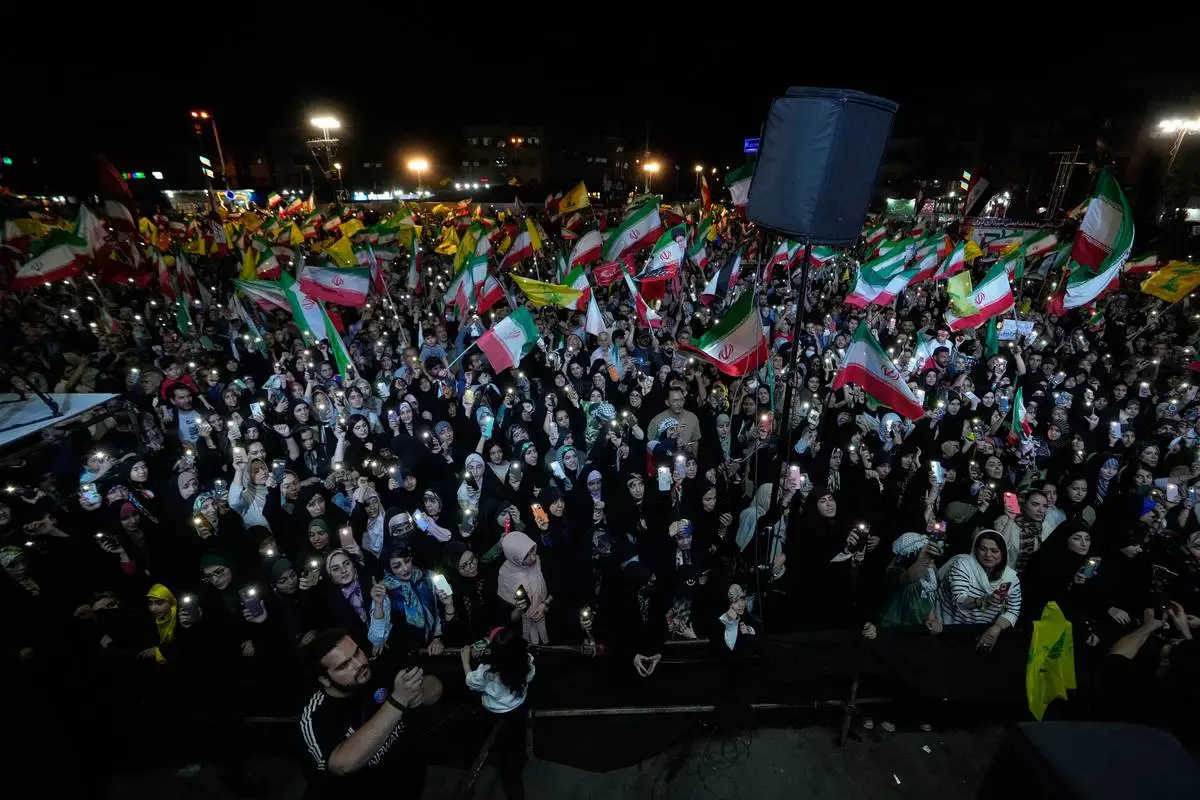
Demonstrators wave Iranian flags and flags of Lebanon's militant Hezbollah group during a pro-government gathering at Islamic Revolution Square in Tehran, Iran, Saturday, May 30, 2026. (AP Photo/Vahid Salemi)