MEXICO CITY (AP) — The United States military strikes on alleged drug-carrying boats transiting in Latin America have killed more than 200 people since September, when the Trump administration began an operation it has justified as necessary to stem the flow of drugs.
As the strikes continue, the administration has offered little evidence to support its claims of killing “narco-terrorists” against whom U.S. President Donald Trump has said the U.S. is in an “armed conflict.”
Critics have questioned the overall legality of the strikes as well as their effectiveness, in part because the fentanyl behind thousands of fatal overdoses is typically trafficked to the U.S. overland from Mexico. The fast boats in the Caribbean Sea and eastern Pacific are known to carry cocaine, not fentanyl.
Here’s what to know about the deadly strikes.
Trump has asserted that the longtime U.S. strategy of interdicting the boats at sea for decades has not worked. Yet, the U.S. Coast Guard set a record in 2024, the final year of former U.S. President Joe Biden's term, for cocaine seizures, hauling 225 metric tons of the drug.
The strikes began in September off Venezuela’s Caribbean coast and expanded to the Eastern Pacific in October. The deadliest month since the start of the operation was October, with 45 people killed. Most of this year’s strikes have been in the Pacific.
Trump and other senior officials have also contended that such boats are being operated by narco-terrorists and cartel members.
The Associated Press visited a region in Venezuela from which some of the suspected boats have departed and identified four men who were killed in the strikes. In several interviews, residents of the region and relatives said the dead men were mostly laborers or fishermen making $500 a trip.
Notably, the strikes started amid the largest buildup of U.S. military forces in Latin America in generations, in a pressure campaign that culminated with the January capture of Venezuela’s then-President Nicolás Maduro.
More than 60 boats have been struck in the monthslong operation.
Trump has claimed that the strikes have blown up boats carrying fentanyl and that each destroyed vessel has saved 25,000 American lives. According to experts and former U.S. counternarcotics officials, Trump’s statements are either exaggerations or false.
For the past decade, U.S. officials have sounded the alarm about rising overdose deaths, particularly from opioids and synthetic opioids. Overdose deaths from opioids surged during the 2021-2023 period to about 80,000 a year but dropped to an estimated 55,000 in 2024. Experts have attributed that decline partly to efforts during the last year of the Biden administration to boost the availability of lifesaving drugs that prevent overdose deaths. Federal data show the figure dropped further, reaching an estimated 44,000 last year.
Meanwhile, overdose deaths from cocaine, which is mostly produced in Colombia and Peru, are less frequent than those from fentanyl. About 22,000 people died in the U.S. from cocaine overdoses in 2024, down from more than 29,000 the year earlier, according to federal data. The number of cocaine overdose deaths went down to an estimated 19,000 in 2025.
The drug flowing to the U.S. from South America is cocaine. Fentanyl, on the other hand, typically makes it into the U.S. overland from Mexico, where it is produced with chemicals imported from China and India.
The operation has drawn intense criticism, particularly following the revelation that the military killed survivors of the very first boat attack with a follow-up strike. Administration officials and many Republican lawmakers said it was legal and necessary, while Democratic lawmakers and legal experts said the killings were murder, if not a war crime.
Amanda Klasing, national director for government relations at rights watchdog Amnesty International USA, in a statement last week said the “extrajudicial killings are becoming normalized” as the death toll continues to grow.
“Not only are these killings illegal, they are immoral,” she said. “People of good conscience cannot allow this to continue, yet Congress has so far failed to halt, or even slow down, this lethal and unlawful campaign.”
In January, the families of two Trinidadian nationals killed in a boat strike in October sued the federal government, calling the attack a war crime and part of an “unprecedented and manifestly unlawful U.S. military campaign.” The complaint echoes many of the frequently articulated concerns about the boat strikes, noting for instance that they have been carried out without congressional authorization and at a time when there is no military conflict between the U.S. and drug cartels that under the laws of war could justify the lethal attacks.
“These premeditated and intentional killings lack any plausible legal justification. Thus, they were simply murders, ordered by individuals at the highest levels of government and obeyed by military officers in the chain of command,” the lawsuit states.
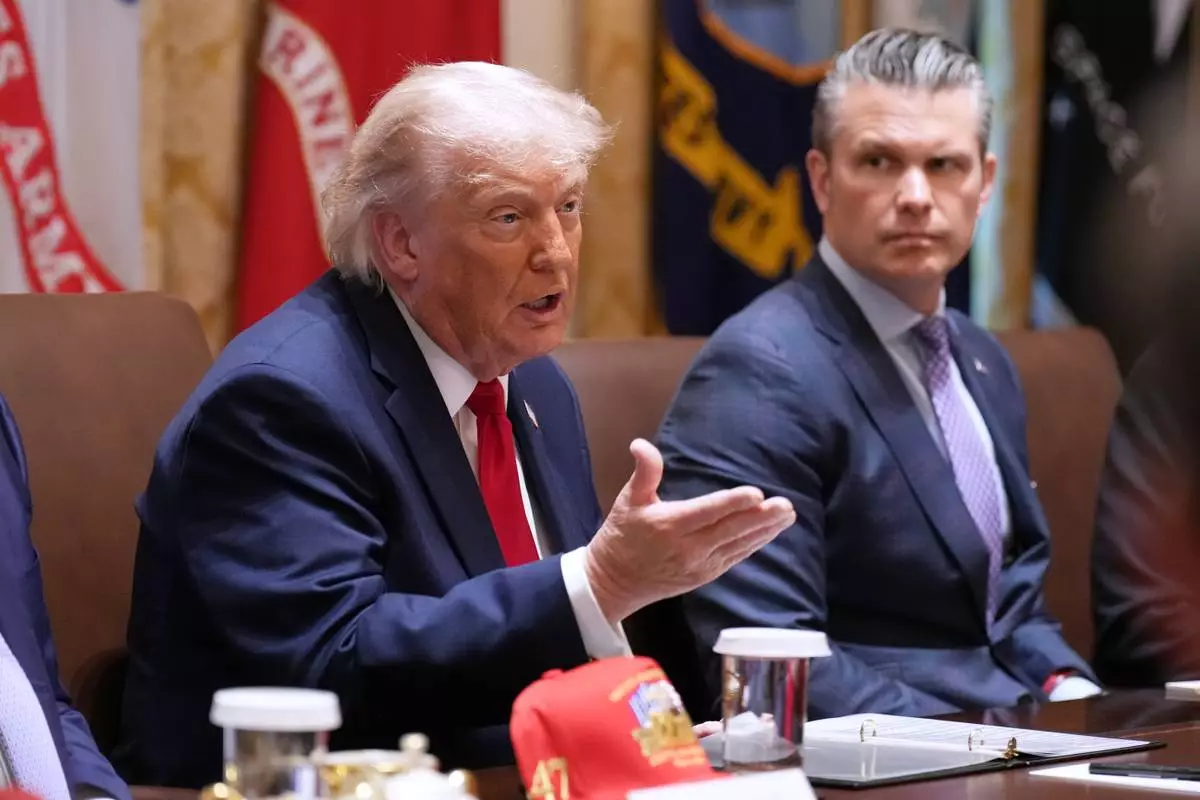
President Donald Trump speaks during a Cabinet meeting at the White House, Wednesday, May 27, 2026, in Washington, as Secretary of Defense Pete Hegseth, looks on. (AP Photo/Jacquelyn Martin)
A Trump administration policy illegally banned transgender troops from military service, a divided panel of federal appeal court judges ruled on Monday.
The majority opinion by a three-judge panel from the U.S. Court of Appeals for the District of Columbia circuit upholds a March 2025 ruling by U.S. District Judge Ana Reyes in Washington, D.C. Reyes concluded that President Donald Trump’s executive order to exclude transgender troops from military service likely violates their constitutional rights.
Meanwhile, the energy price spike triggered by the Iran war has seeped into the price of bonds that help fund the U.S. government, causing interest rates to climb in ways that are worsening affordability pressures, hampering economic growth and creating a new risk for Republicans in November’s midterm elections.
Also, the United States said Monday that it bombed radar and drone sites in Iran after Tehran shot down an American drone over the weekend. Iran then said it launched a strike of its own, and Kuwait reported incoming fire.
The nominal ceasefire between Iran and the U.S. has been repeatedly tested with such back-and-forth attacks, even as officials from both countries try to negotiate an end to the war.
Here's the latest:
The White House says the president will head to Chippewa County, located in the northwest part of the state.
The trip will highlight the administration’s efforts to benefit farmers, particularly on taxes and trade.
“Wisconsin families put their faith in President Trump in 2024, and he has spent every single day since taking office fighting and delivering for them,” White House spokeswoman Liz Huston said.
The visit is part of a series of trips that are intended for Trump to promote his economic agenda and achievements.
The Trump administration said Monday it will comply with a court ruling temporarily blocking a nearly $1.8 billion fund meant to compensate allies of the president, effectively agreeing to pause the plan for at least two weeks after setbacks in the courts and a fierce backlash from Republicans who objected to potential payouts to participants in the Jan. 6, 2021, riot at the U.S. Capitol.
The announcement from the Justice Department comes in response to a Friday court ruling by a federal judge in Virginia who ordered plans for the fund halted pending additional arguments later this month. The department said in a statement that it “disagrees strongly” with the ruling but would abide by it.
The Trump administration had defended the $1.776 billion “Anti-Weaponization Fund,” established to resolve Trump’s lawsuit against the Internal Revenue Service over the leak of his tax returns, as an appropriate corrective measure to make up for what officials insist was a weaponized law enforcement during the Biden administration.
Senate Majority Leader John Thune indicated Monday he was hopeful the White House would move to drop the $1.776 billion settlement fund designed to compensate Trump’s allies.
“I do think the best way to handle it is if the administration decides to shut it down themselves,” Thune told reporters.
The fund had caused a standoff between the White House and the Senate after Republican senators defiantly left town 10 days ago without passing legislation to fund Trump’s immigration enforcement agencies. The Senate returns today.
The State Department plans to drastically slash the number of U.S. embassies and consulates in Africa that can process visas for foreigners seeking to come to the United States.
The almost 50 U.S. embassies and consulates that are processing visa applications will be reduced to 20 in the coming weeks, according to three U.S. officials and an internal memo obtained by The Associated Press. There is not yet a set date for the change, but it is expected in June, according to the officials, who were not authorized to comment to the media and spoke on condition of anonymity.
The move is part of the Trump administration’s effort to crack down on issuing both immigrant and non-immigrant visas as part of its broader aim to limit immigration to the U.S. and clamp down on those who travel on temporary visas but then overstay them. The administration also has scaled back personnel at embassies and consulates around the world.
▶ Read more
President Donald Trump said Monday that Israel and Hezbollah have agreed to dial back fighting after he held talks with Israeli Prime Minister Benjamin Netanyahu and communicated with the Lebanon-militant group through mediators.
Trump announced the development in a social media post following his call with Netanyahu.
▶ Read more
A Trump administration policy illegally banned transgender troops from military service, a divided panel of federal appeal court judges ruled on Monday.
The majority opinion by a three-judge panel from the U.S. Court of Appeals for the District of Columbia circuit upholds a March 2025 ruling by U.S. District Judge Ana Reyes in Washington, D.C. Reyes concluded that President Donald Trump’s executive order to exclude transgender troops from military service likely violates their constitutional rights.
The administration appealed after Reyes issued a preliminary injunction requested by attorneys for six transgender people who are active-duty service members and two others seeking to join the military. The appeal court’s majority decided that the injunction should be narrowed to the plaintiffs currently serving in the military but not those seeking to join.
▶ Read more
Tina Peters, the former clerk convicted of participating in a scheme to chase election conspiracy theories promulgated by President Trump, was released from prison Monday after the president successfully pressured Colorado’s Democratic governor into commuting her sentence.
Peters’ release was confirmed by the Colorado Department of Corrections. The state agency said it would have no more information about the 70-year-old inmate. Her sentence was shortened by Colorado Gov. Jared Polis last month after Trump waged a lengthy pressure campaign against the governor and his state.
Former Colorado elections clerk and conspiracy theorist Tina Peters is scheduled to be released from prison Monday after serving less than a quarter of a nine-year sentence for her role in a scheme to copy her county’s election system.
Colorado Gov. Jared Polis, a Democrat, commuted Peters’ sentence last month following pressure from President Trump.
The Colorado Department of Corrections would not confirm the time of Peters’ release, and a representative for her attorney said Peters would not speak to the media when she’s freed.
Peters was the first local election official to be charged with breaching security after the 2020 election. She snuck in an outside computer expert affiliated with My Pillow Chief Executive Mike Lindell — who himself denied that Trump lost the White House in 2020 — and the person copied the county’s Dominion Voting Systems computer server as it was updated in 2021.
▶ Read more
Oil prices are rising following the latest fighting to threaten the U.S.-Iran ceasefire, but Wall Street isn’t very worried.
The S&P 500 slipped 0.1% early Monday, falling a bit below the record it set last week. The Dow Jones Industrial Average fell 166 points, and the Nasdaq composite was little changed.
Brent crude climbed 4.7%, and Treasury yields moved higher in the bond market. Tech stocks held up better than the rest of the market.
Science Applications International Corp. soared after becoming the latest U.S. company to report bigger profit for the latest quarter than analysts expected.
▶ Read more
A standoff between the White House and the Senate remains unresolved after Republican senators defiantly left town 10 days ago without passing legislation to fund President Trump’s immigration enforcement agencies.
Senate Republicans who are returning to Washington on Monday say they won’t have the votes to pass the Homeland Security spending bill until the White House works with them to place parameters on the new $1.776 billion settlement fund designed to compensate Trump’s allies. But Trump has shown little interest in doing so, even after a judge temporarily halted any payouts.
It’s unclear how they’ll settle the dispute.
▶ Read more
Former Federal Reserve Chair Jerome Powell used one of his first major public appearances since leaving office to defend independent institutions while accepting an award Sunday honoring his efforts to preserve the central bank’s independence.
Speaking at the John F. Kennedy Presidential Library overlooking Boston Harbor, Powell called universities, courts, Congress and the central bank “the foundation and the embodiment of our democracy” and argued that the Fed’s independence was a “priceless asset” that must be protected.
It was one of his most direct defenses of Fed independence, warning that a single administration’s decision to remove bank officials over policy differences would open the way for future elected officials to follow suit, ultimately undermining the credibility that the Fed has spent decades building.
Powell, who frequently clashed with Trump during his eight years as chair, stepped down as his term expired in May. He was succeeded by Kevin Warsh, whom Trump selected to lead the central bank.
▶ Read more
Trump on Saturday branded the federal judge who blocked his renovation of the Kennedy Center as “an anti Trump Hater” and predicted that the nation’s premier performing arts center, which he wanted to shutter for a two-year overhaul, will “soon be closed, probably never to open again.”
In a lengthy post on his Truth Social platform, Trump fumed about the Friday decision from U.S. District Judge Christopher Cooper, who also ordered Trump’s name removed from the center. Clearly angered by his latest legal setback, he said it was “impossible for me to be treated fairly,” tying Cooper’s ruling to earlier losses, including the Supreme Court’s rejection in February of his sweeping tariffs.
His post aimed to make the case for the project even as he says he’s giving up on it. Hours after Cooper’s decision, Trump said he was backing away from the renovations and making arrangements to relinquish control to Congress of what, until the Republican president’s second term, had been known as the John F. Kennedy Center for the Performing Arts.
▶ Read more
An upcoming celebration of America’s 250th anniversary, “The Great American State Fair,” recently had several musical guests back out partly over the event’s ties to President Trump. Now, Trump himself is slated to headline the festivities, the organizers said Saturday.
“I understand Artists are getting ‘the yips’ having to do with their performance,” Trump posted to his social media platform Truth Social Saturday, adding that he was thinking of bringing “the man who some say is the Greatest President in History (THE GOAT!), DONALD J. TRUMP, to take the place of these highly paid, Third Rate ‘Artists.’”
The group organizing the June fair on Washington’s National Mall, Freedom 250, confirmed the billing in a statement, writing, “We are excited to announce that President Trump will personally kick off this historic celebration on Wednesday, June 24.”
Freedom 250 is billed as nonpartisan, but was launched last year by Trump and is led by a former State Department appointee from Trump’s first term. Several artists, including Bret Michaels, the Commodores and Martina McBride dropped out last week.
▶ Read more
The United States said Monday that it bombed radar and drone sites in Iran after Tehran shot down an American drone over the weekend. Iran then said it launched a strike of its own, and Kuwait reported incoming fire.
The nominal ceasefire between Iran and the U.S. has been repeatedly tested with such back-and-forth attacks, even as officials from both countries try to negotiate an end to the war. It’s not clear how close they are to a deal — and there is always the risk that an attack could derail those talks.
In the meantime, Iran has maintained its chokehold on the Strait of Hormuz, disrupting global energy supplies and driving up the price of fuel around the world, with far-reaching consequences.
Fighting has also escalated between Israel and the Lebanese militant group Hezbollah, despite their nominal ceasefire. Israel has extended its occupation deep into Lebanon, and Hezbollah — which joined the war in support of its main backer, Iran — continues to launch drones into Israel.
▶ Read more
The world is getting more uptight about lending money to President Donald Trump’s government — causing interest rates to climb in ways that are worsening affordability pressures, hampering economic growth and creating a new risk for Republicans in November’s midterm elections.
The energy price spike triggered by the Iran war has seeped into the price of bonds that help fund the U.S. government. Interest rates on a 10-year U.S. Treasury note are topping 4.44%, up from 3.95% before the war started at the end of February. Average mortgage rates have climbed to their highest levels in nine months, while auto sales are slumping.
The challenge is global in scale, as interest rates have risen for multiple countries as the world has been adjusting to the prospect of higher inflation, mounting questions about the sustainability of government debt and a dramatic surge in investment in artificial intelligence.
▶ Read more
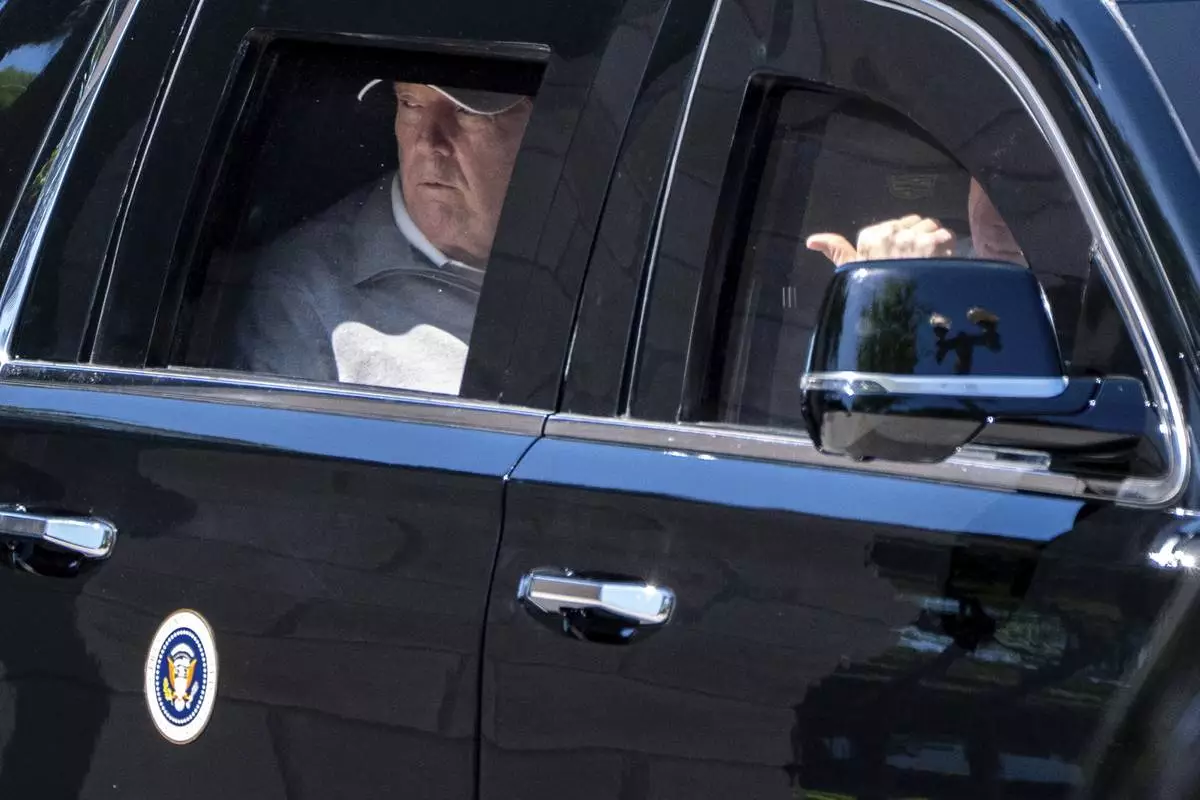
President Donald Trump looks out the window of his limousine at the construction in Lafayette Park as he departs the White House, Saturday, May 30, 2026, in Washington. (AP Photo/Alex Brandon)
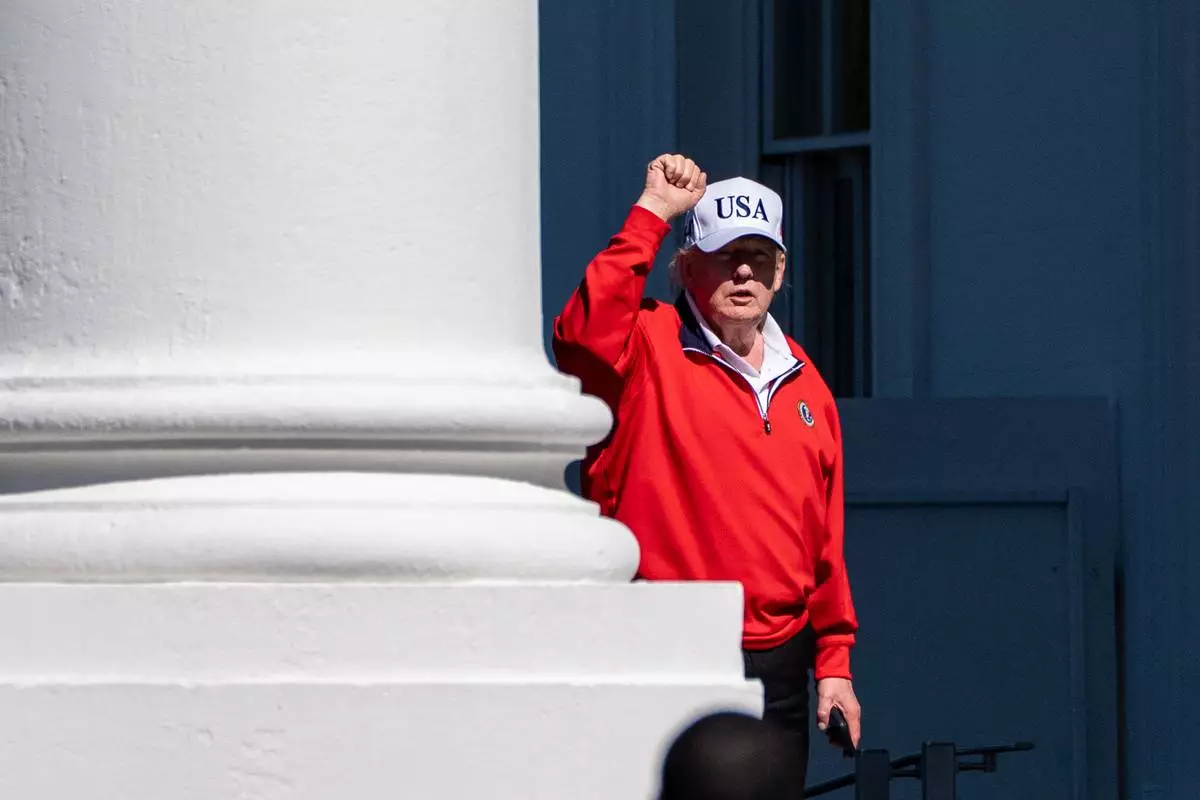
President Donald Trump pumps his fist as he arrives at the White House, Sunday, May 31, 2026, in Washington. (AP Photo/Alex Brandon)