China has overtaken the United States as Latin America’s preferred development model, a new survey of 12,000 people across ten countries shows, marking a sharp rise in China’s image across the region.
The shift is visible in Brazil, where the family of Fernando Zhu, who migrated from China in 1989, now runs three shopping malls in Sao Paulo. Zhu says attitudes toward China and toward Chinese people have changed markedly as the country’s global stature has grown.
"My father came to Brazil in 1989, along with my mother, looking for a better life. Now China is a superpower. So Brazilian friends who are interested in doing business with China - what are they looking for? They look for a Chinese person," said Zhu.
Zhu's experience reflects a recent report by AMLAT Radar, a collaboration between a major German research group and a Latin American political journal. Their survey of 12,000 people across ten Latin American countries found China's positive image on the rise, while that of the United States has dropped significantly.
For the first time, Latin Americans ranked China ahead of all other countries, including the U.S., as having the development model they would most like their country to follow.
A political science professor's new book examines the rivalry between China and the U.S., and he said the survey reflects what he is seeing on the ground.
"What has the United States offered Latin America since the Washington Consensus? They offer nothing concrete. They offer either lectures or the imposition of draconian austerity measures coming through the World Bank and the International Monetary Fund. What China comes here to do is to build and add - to bring more integration and more cooperation in the form of infrastructure, concrete infrastructure, for Latin America," said Pedro Costa, author of "USA vs. China - The Struggle for Global Power".
China's growing reputation in the region goes beyond trade and politics. It is also reflected in a heightened interest in Chinese culture and language.
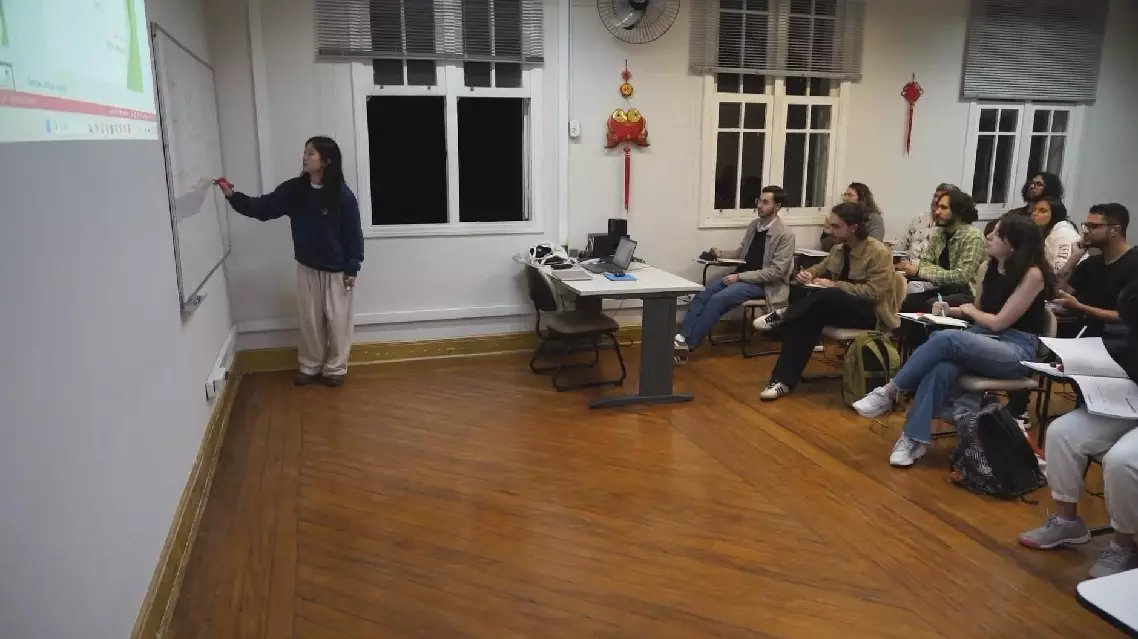
Across Latin America, the number of students signing up for Mandarin classes is on the rise, including here, at Sao Paulo's Confucius Institute.
"Most people think that China is the country of the future. Everybody knows that. So I think it's the way the planet is going, and everybody's following it," said Daniel Abdallah, Mandarin student.
"Chinese people are hard workers and there are a lot of opportunities to work or study there, and also pop culture. People are more open to watching Chinese TV shows," said Beatriz Rodrigues, Mandarin student.
China’s image rises in Latin America, overtakes US in development model preference: survey