DALLAS--(BUSINESS WIRE)--Jun 3, 2026--
Jacobs (NYSE: J) will continue serving as program manager for the Port of San Francisco’s Waterfront Resilience Program, a multiyear initiative to protect and future-proof the city’s historic waterfront. The multi-billion-dollar program addresses earthquake safety, near-term flood protection and long-term adaptation to sea level rise.
This press release features multimedia. View the full release here: https://www.businesswire.com/news/home/20260603561509/en/
Adapting 7.5 miles of the waterfront, including preserving and fortifying the city’s 100-year-old Embarcadero Seawall, the program will better protect critical regional transportation facilities, utilities and over $100 billion in assets and annual economic activity. Supporting the program for nearly a decade, Jacobs will continue as program manager guiding program development, strategic planning and engineering, working with PA Consulting to leverage innovation, ecosystem governance and scenario planning for the next phase of critical infrastructure modernization.
Jacobs Executive Vice President Eva Wood said: “The Waterfront Resilience Program is more than an infrastructure improvement program — it’s a lifeline for the city’s future. Having worked on the program since its inception in 2017, Jacobs brings deep experience in navigating the opportunities unique to San Francisco’s historic waterfront. Our continued work on this program will shape a resilient, vibrant waterfront for generations to come.”
The program’s life-safety upgrades will reinforce historic piers, wharfs and buildings that support emergency response, sea level rise recovery and the city’s municipal transit and utility systems.
Ranked as No. 2 in Program Management by Engineering News-Record, Jacobs delivers some of today’s most complex and challenging infrastructure and resilience programs. The company has helped manage the United Kingdom’s major flood risk management program in London and the Thames Estuary, advance Singapore’s national coastal adaptation and resilience efforts, rebuild the U.S. Virgin Islands after Hurricanes Irma and Maria, and is designing the world’s largest coastal storm surge barrier along the Texas Gulf Coast.
At Jacobs, we're challenging today to reinvent tomorrow – delivering outcomes and solutions for the world’s most complex challenges. With approximately $12 billion in annual revenue and a team of approximately 47,000, we provide end-to-end services in advanced manufacturing, cities & places, energy, environmental, life sciences, transportation and water. From advisory and consulting, feasibility, planning, design, program and lifecycle management, we’re creating a more connected and sustainable world. See how at jacobs.com and connect with us on LinkedIn,Instagram, X and Facebook.
About PA Consulting
On March 20, 2026, Jacobs completed its acquisition of the remaining equity interest in PA Consulting. The combined business serves clients across sectors, including government and private organizations, supporting work from strategy and design through execution across major capital programs, digital innovation and operational change.
Certain statements contained in this press release constitute forward-looking statements within the meaning of the Private Securities Litigation Reform Act of 1995. Forward-looking statements are statements that do not directly relate to any historical or current fact. When used herein, words such as "expects," "anticipates," "believes," "seeks," "estimates," "plans," "intends," "future," "will," "would," "could," "can," "may," and similar words are intended to identify forward-looking statements. We base these forward-looking statements on management's current estimates and expectations, as well as currently available competitive, financial and economic data. Forward-looking statements, however, are inherently uncertain. There are a variety of factors that could cause business results to differ materially from our forward-looking statements including, but not limited to, uncertainties as to, the timing of the award of projects and funding and potential changes to the amounts provided for under the Infrastructure Investment and Jobs Act and other legislation and executive orders related to governmental spending, including any directive to federal agencies to reduce federal spending or the size of the federal workforce, and changes in U.S. or foreign tax laws, including the tax legislation enacted in the U.S. in July 2025, statutes, rules, regulations or ordinances, including the impact of, and changes to tariffs and retaliatory tariffs or trade policies, that may adversely impact our future financial positions or results of operations, as well as general economic conditions, including inflation and the actions taken by monetary authorities in response to inflation, changes in interest rates and foreign currency exchange rates, changes in capital markets, the possibility of a recession or economic downturn, and increased uncertainty and risks, including policy risks and potential civil unrest, relating to the outcome of elections across our key markets and elevated geopolitical tension and conflicts, among others. For a description of these and additional factors that may occur that could cause actual results to differ from our forward-looking statements, see our filings with the U.S. Securities and Exchange Commission. The company is not under any duty to update any of the forward-looking statements after the date of this press release to conform to actual results, except as required by applicable law.

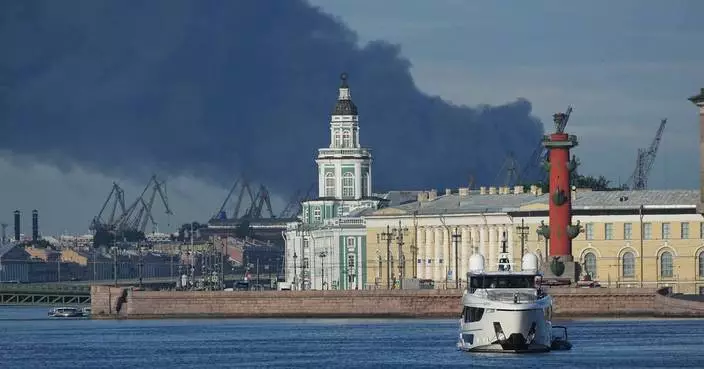
San Francisco's historic waterfront.
DUBAI, United Arab Emirates (AP) — Kuwait briefly shut the country's main airport Wednesday after Iranian drones heavily damaged a terminal building and killed one person — the latest salvo in a series of back-and-forth attacks by Tehran and Washington that have tested a fragile ceasefire.
The strikes came as semiofficial Iranian news agencies said the country had stopped communicating with mediators about extending a ceasefire in the war with the U.S. and Israel. A regional official said Tehran wanted the truce in Lebanon enforced before returning to talks. U.S. President Donald Trump said negotiations were continuing.
Those talks have dragged on for weeks, and repeated exchanges of strikes in the Gulf region and Israel’s broadening war in Lebanon are further straining the efforts.
All the while, Iran has maintained its stranglehold on the Strait of Hormuz — a crucial artery for the world’s oil and natural gas — and the U.S. has continued its blockade of Iranian ports, ensuring that global fuel prices remain high and the effects of the conflict are felt well beyond the region.
Kuwait’s Foreign Ministry said at least one person was killed and others wounded in the strike on the airport. It said Kuwait reserves the right to respond to Iran and that it will “neither accept nor tolerate” the attacks.
Earlier, Defense Ministry spokesperson Brig. Gen. Saud Abdulaziz Al-Otaibi had said that “a number of hostile drones” had targeted a passenger building at Kuwait International Airport.
Civil aviation authorities said the airport partially reopened later in the day, with Kuwait Airways flights resuming from a different terminal than the one that was hit. No other flights would be operating, they said. The airport only reopened Monday after closing early in the war.
The U.S. military said Iran fired two missiles at Kuwait that fell apart en route, and that it “downed multiple drones” targeting American forces in the country.
The military also said U.S. and Bahraini forces intercepted missiles aimed at the Gulf kingdom, which is home to the U.S. Navy’s 5th fleet. Bahrain’s Defense Ministry said its military intercepted and destroyed three missiles and a number of drones fired by Iran.
The U.S. military said it launched strikes on an Iranian military ground control station on Qeshm Island in the Strait of Hormuz.
Iran’s paramilitary Revolutionary Guard acknowledged that it targeted the headquarters of the 5th Fleet and U.S. military facilities in another country, but did not name Kuwait.
Both the U.S. and Iran said they were retaliating for earlier attacks or attaempted attacks.
Iran's Foreign Ministry condemned the U.S. strikes on Qeshm Island, where it said a telecommunications tower was struck, and other previous strikes. It called them “acts of aggression” that it said violated the ceasefire.
A senior Emirati diplomat called on Wednesday for “a firm, unified, and cohesive Gulf position” against Iran following the attacks.
“This aggression does not target a specific state, but rather all of us,” Anwar Gargash wrote on the X platform.
Iran’s Fars and Tasnim news agencies, both believed to be close to the Guard, reported that Iran’s negotiators have stopped communicating with ceasefire mediators as tensions flared in Israel’s separate but related fight against the Iranian-backed Hezbollah militant group in Lebanon.
A regional official involved in the mediation, speaking on condition of anonymity to discuss the talks, told The Associated Press that Iran had not communicated at all on Tuesday after saying that a ceasefire needed to be enforced in Lebanon for negotiations to continue.
Trump called reports of a cessation in talks “false and erroneous.”
“The conversations between us have been going on continuously, including four days ago, three days ago, two days ago, one day ago and today,” Trump said in a social media post. “Where they lead, one never knows, but as I told Iran, ’It’s time, one way or another, for you to make a Deal.”
Despite repeated outbreaks of violence, the declared ceasefire in Lebanon is officially in place. No side has formally withdrawn or declared the ceasefire over, but attacks continue. Israeli forces have moved deeper into Lebanon than at any time in over a quarter of a century while Hezbollah has launched rocket and drone attacks.
As the attacks continue, Lebanon has emerged as a key sticking point in Trump’s efforts to sign a ceasefire deal with Iran.
Tehran insists that any larger potential truce in the war there must also quell the fighting in Lebanon. Israeli Prime Minister Benjamin Netanyahu wants to keep the issues separate and is under heavy domestic pressure to strike Hezbollah as he prepares for new elections this fall.
The fighting has exposed a rift between close allies Israel and the U.S., with the U.S. pushing for restraint and Israel seeking to step up the military pressure on Hezbollah.
A person familiar with the situation said Netanyahu and Trump had a “tense” conversation earlier this week. The person spoke on condition of anonymity because they weren’t authorized to speak to the media. The person didn’t elaborate on the details of the call.
Magdy reported from Cairo. Associated Press writers Elena Becatoros in Athens, Greece, Sam Mednick in Jerusalem, and Aamer Madhani and Konstantin Toropin in Washington contributed to this report.
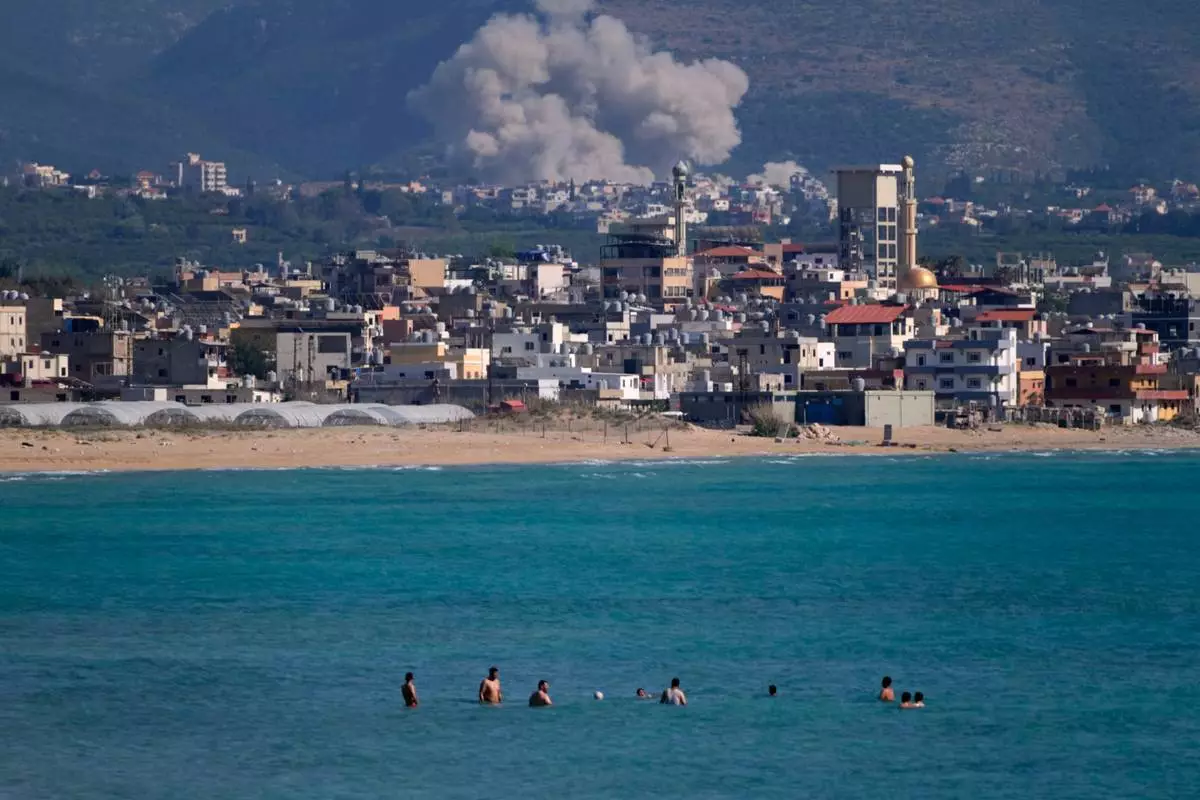
People swim on a public beach as smoke, background, rises from an Israeli airstrike that hit the Qlaileh village, seen from the southern port city of Tyre, Lebanon, Tuesday, June 2, 2026. (AP Photo/Mohammed Zaatari)
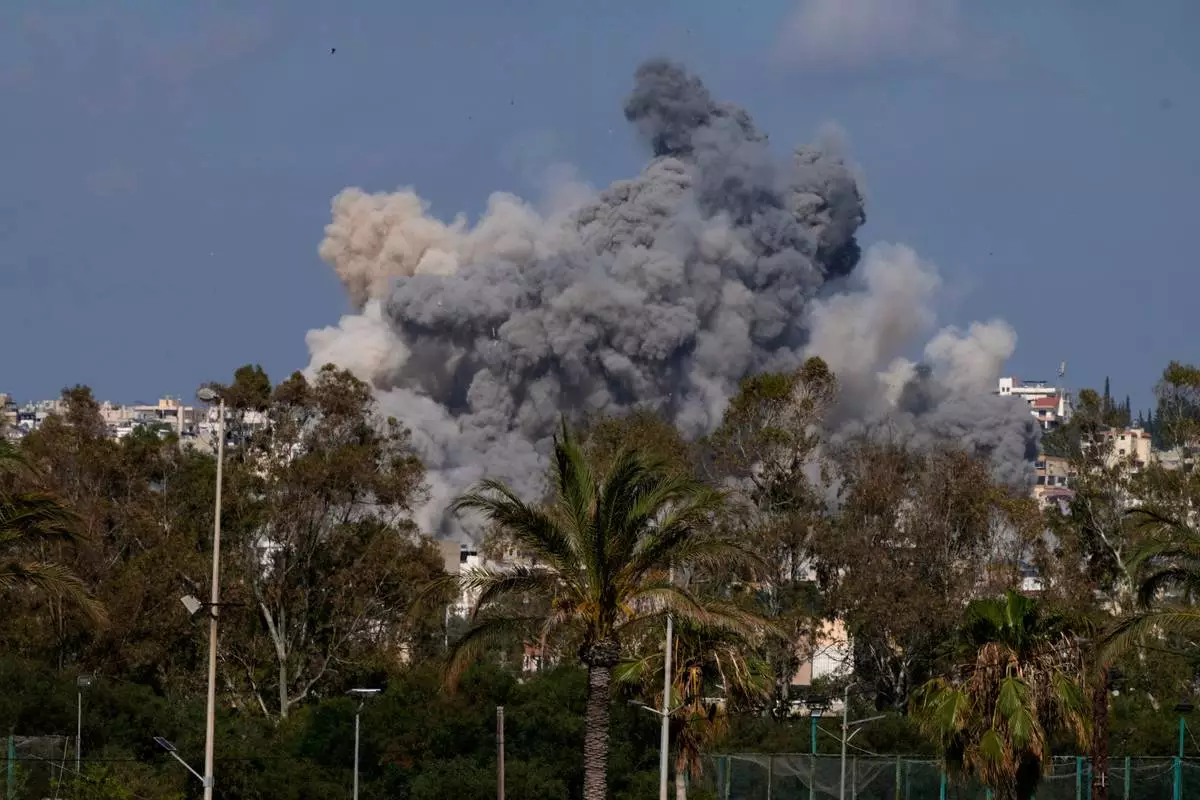
Smoke rises from an Israeli airstrike that hit Burj al-Shamali village near the southern port city of Tyre, Lebanon, Tuesday, June 2, 2026. (AP Photo/Mohammed Zaatari)
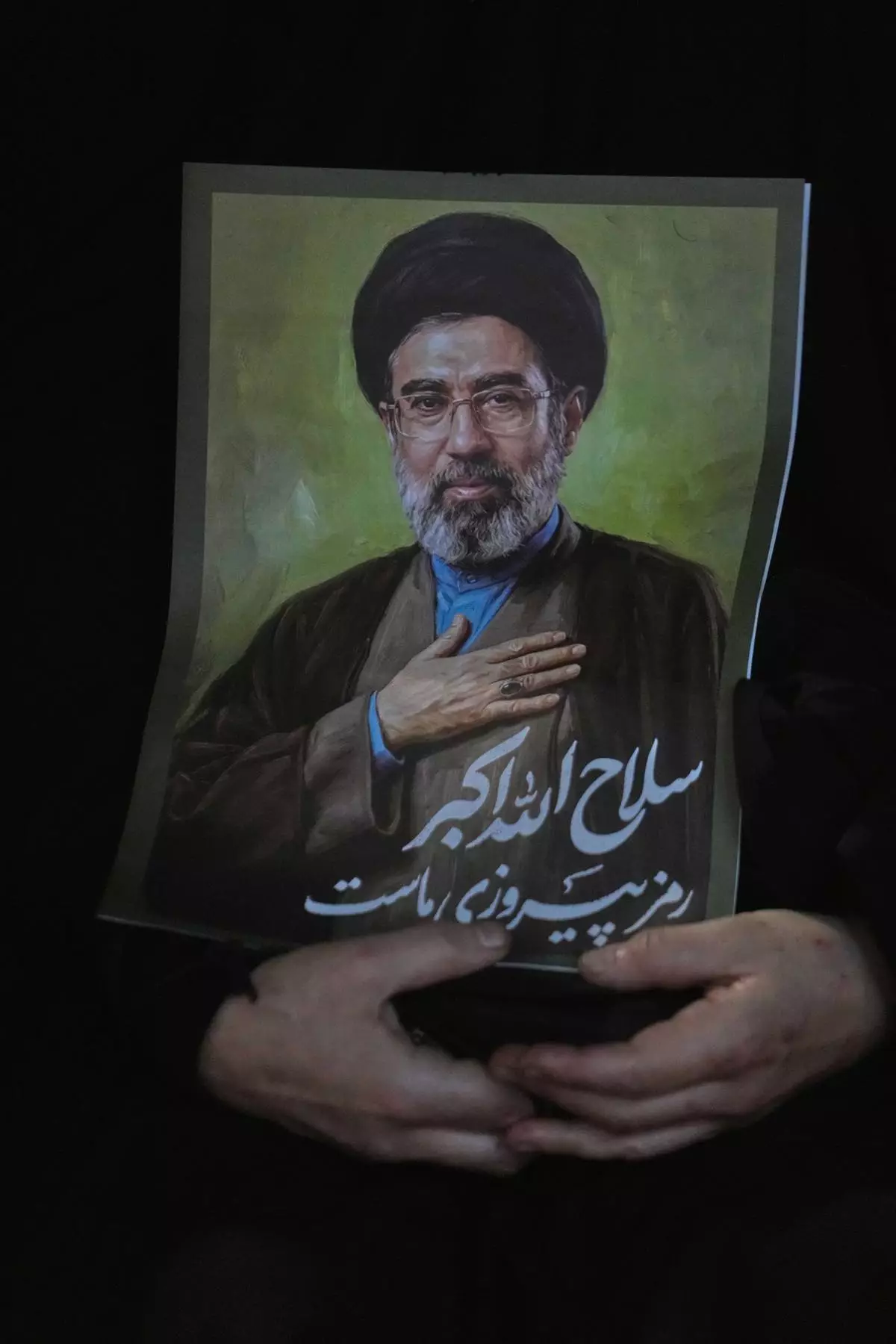
A woman holds a poster of the Iranian Supreme Leader Ayatollah Mojtaba Khamenei during a pro-government gathering at Islamic Revolution Square in Tehran, Iran, Saturday, May 30, 2026. (AP Photo/Vahid Salemi)

People gather on paddleboards in shallow water as cargo and service vessels are anchored in the Strait of Hormuz off Bandar Abbas, Iran, Monday, June 1, 2026. (Amirhosein Khorgooi/ISNA via AP)