SHENZHEN, China, June 3, 2026 /PRNewswire/ -- As vehicles become increasingly connected, electrified, and software-driven, automotive diagnostics are growing more complex than ever before. From traditional passenger vehicles to new energy vehicles (NEVs), technicians require reliable tools that can efficiently access vehicle data, perform diagnostics, and support maintenance operations in a variety of working environments.
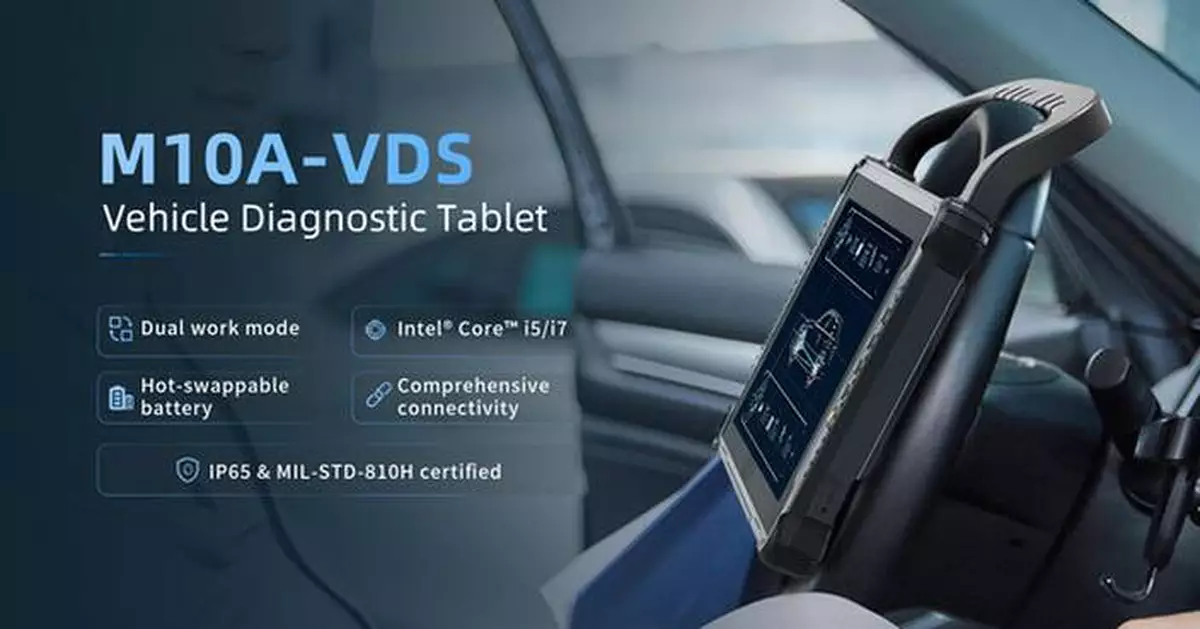
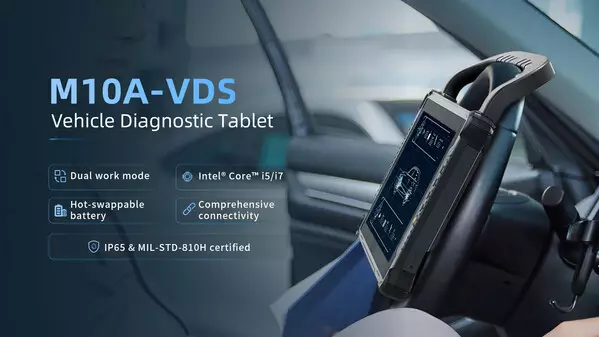
To meet these evolving demands, ONERugged offers its M10A-VDS Vehicle Diagnostic Tablet Solution. Purpose-built for automotive diagnostics, the solution combines rugged durability, enterprise-level performance, and comprehensive vehicle connectivity to help manufacturers, dealerships, and service centers improve diagnostic efficiency and streamline service workflows. Unlike consumer devices that fail in oily, high-vibration repair bays, the M10A-VDS integrates directly with OBD-II and VCI systems, ensuring zero downtime during complex NEV software programming and diagnostics.
Flexible Diagnostic Workflows for Workshop and Field Service
Automotive technicians often work across multiple environments, from repair bays and inspection stations to outdoor service locations. The ONERugged Vehicle Diagnostics Tablet Solution supports both fixed and mobile diagnostic workflows, enabling greater flexibility throughout the maintenance process.
In fixed mode, the tablet's integrated handle design allows it to be conveniently mounted on a vehicle's steering wheel. Connected to the vehicle's OBD-II interface through a VCI device, technicians can monitor diagnostic data and perform service procedures while keeping both hands free.
For mobile inspections, the tablet supports wireless connectivity with VCI diagnostic devices, allowing technicians to move freely around the vehicle while accessing real-time diagnostic information. This flexibility is particularly valuable during comprehensive vehicle inspections and troubleshooting procedures.
Enterprise-Class Performance for Fast Vehicle Diagnostics
Modern automotive diagnostic software requires significant processing power, especially when working with increasingly sophisticated vehicle electronics and control systems.
Powered by 12th-Gen Intel® Core™ i5/i7 processors, the M10A-VDS delivers the performance needed to run Windows 11 and mainstream automotive diagnostic applications smoothly. With up to 10 cores and 12 threads, technicians can perform diagnostics, access service documentation, and manage multiple tasks simultaneously without compromising responsiveness.
The vehicle diagnostic tablet is equipped with 16GB LPDDR4X memory and a 128GB PCIe SSD, providing fast data access and efficient multitasking capabilities while supporting future storage expansion requirements.
Hot-Swappable Battery for 12-Hour Automotive Repair Operations
Vehicle diagnostics often extend beyond standard work shifts, making battery reliability essential for uninterrupted operations.
The M10A-VDS features a dual-battery architecture consisting of a 9800mAh large battery and an 860mAh small battery. This design supports more than 12 hours of continuous operation and enables hot-swappable battery replacement, allowing technicians to change the large battery without shutting down the device.
Combined with a lightweight design of less than 1.5 kg, the tablet remains easy to carry throughout extended diagnostic sessions.
Comprehensive Connectivity for Automotive Diagnostic Applications
Unlike consumer-grade tablets, automotive diagnostic tablets must support a wide range of communication interfaces and vehicle protocols.
The M10A-VDS offers expandable interface modules including RJ45, USB, and RS232, enabling seamless integration with automotive diagnostic equipment. Support for mainstream protocols such as CAN and DoIP allows technicians to communicate directly with vehicle systems for fault code reading, diagnostics, programming, and maintenance operations.
To further improve workflow efficiency, the solution supports optional barcode scanning for rapid identification of vehicles and components, helping reduce manual data entry and improve accuracy.
Connected Diagnostics from Workshop to Cloud
Digital transformation is reshaping automotive service operations, making real-time data sharing increasingly important.
The M10A-VDS supports dual-band Wi-Fi 6 and 4G connectivity, enabling technicians to upload diagnostic reports, synchronize service records, and access cloud-based systems even in challenging network environments.
Bluetooth 5.1 connectivity supports wireless diagnostic peripherals, while integrated GPS and Glonass positioning capabilities allow location tracking for field service applications.
Additionally, a built-in fingerprint authentication module helps protect sensitive diagnostic data and supports secure access management.
IP65 Rugged Reliability for Oily and High-Temperature Automotive Environments
Automotive maintenance environments expose equipment to dust, oil, moisture, vibration, accidental drops, and extreme temperatures. To ensure reliable operation under these conditions, the M10A-VDS is engineered with industrial-grade durability.
The device features IP65-rated dust and water resistance, helping protect against workshop contaminants and water exposure. It also supports 1.22-meter drop resistance, reducing the risk of downtime caused by accidental falls.
Designed for year-round deployment, the tablet operates in temperatures ranging from -25°C to 60°C, making it suitable for both cold outdoor environments and high-temperature workshop conditions.
A 700-nit high-brightness display ensures clear visibility under strong sunlight, while reinforced materials help protect the device from scratches and daily wear.
Supporting the Future of Vehicle Maintenance
As automotive technology continues to advance, diagnostic equipment must evolve alongside it. The ONERugged Vehicle Diagnostics Tablet Solution combines mobility, connectivity, rugged reliability, and high-performance computing to help automotive professionals work more efficiently in today's increasingly digital service environment.
Whether supporting traditional vehicle maintenance, advanced diagnostics, or new energy vehicle servicing, the M10A-VDS provides a dependable platform designed to meet the demands of modern automotive operations.
About ONERugged
ONERugged, a brand of Emdoor Information (SHZ:001314), specializes in providing high-quality rugged mobile computing devices and customized solutions for industry clients worldwide. Its portfolio includes rugged handhelds, rugged tablets, rugged notebooks, vehicle PCs, and industrial panel PCs.
For more information, visit www.onerugged.com. Follow us on LinkedIn, YouTube, and Facebook.
** This press release is distributed by PR Newswire through automated distribution system, for which the client assumes full responsibility. **
ONERugged Vehicle Diagnostic Tablet Solution Empowers Smart Automotive Diagnostics
VIENNA, June 3, 2026 /PRNewswire/ -- From June 2 to June 4, 2026, ICRA, the flagship global conference in the field of robotics, was grandly held in Vienna, Austria. Xense Robotics appeared at Messe Wien Exhibition & Congress Center, Hall B-123. With "Touch Ignites Physical Intelligence" as its core proposition, Xense Robotics comprehensively displayed a full-stack tactile intelligence technology system covering tactile hardware perception, data acquisition, tactile world models, and VTLA models.
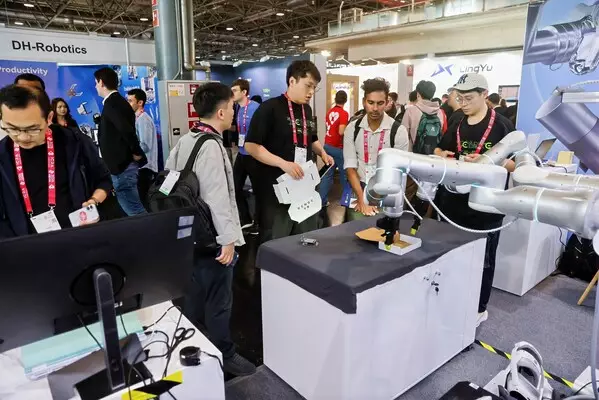
At the exhibition, Xense Robotics presented a major showcase of VTLA model-driven dual-arm long-horizon compliant manipulation, intuitively verifying the core value of tactile intelligence in real and complex robotic operations; the TacCap-Gripper tactile data acquisition device made its global debut, filling a key gap in the data closed loop for robotic physical interaction; meanwhile, a complete product matrix of multimodal tactile sensors was fully exhibited. It also offered an immersive tactile interactive experience at the booth, demonstrating the real-time response performance of high-precision tactile sensing in a lightweight and visualized manner, which highlighted to the global industry the solid ability of tactile intelligence in empowering robotic physical interaction and supporting the real-world implementation of embodied intelligence.
Tactile Intelligence Becomes the Key Gateway to Real-World Physical Intelligence
As visual perception, intelligent motion planning, and multimodal large-model technologies continue to advance rapidly, robots have made significant progress in environmental understanding and task planning. Yet in real, unstructured physical environments, the core challenge for robotic deployment often lies not in "seeing the environment clearly," but in "interacting with precision after contact."
Key physical information such as object slippage, material deformation, contact stability, and force magnitude cannot be accurately and precisely accessed by visual perception alone, yet it directly determines the success rate and performance stability of practical robotic tasks such as grasping, precision assembly, flexible folding, accurate alignment, and pressing. In other words, vision allows robots to see the world, while tactile intelligence enables robots to truly touch and autonomously interact with the physical world. It is a core breakthrough point for bringing embodied intelligence into industrial applications.
At ICRA 2026, Xense Robotics took "Tactile Intelligence Empowering the Implementation of Physical Intelligence" as its core exhibition theme and comprehensively presented its full-stack closed-loop physical intelligence ecosystem, including underlying tactile hardware R&D, high-precision tactile data acquisition, iteration of self-developed perception algorithms, tactile world model construction, and scenario-based application of VTLA models.
Real-World Validation of Core Value: Tactile-Driven Long-Horizon Compliant Autonomous Manipulation
The core showcase at the booth was a VTLA model-driven dual-arm long-horizon autonomous carton-forming operation demonstration, which presented a hard-core technical ability of implementation in a life-like scenario. The seemingly simple carton-forming task is in fact a typical complex robotic operation scenario involving flexibility, multiple steps, strong contact, and high disturbance. It requires the robot to continuously complete a series of long-sequence coherent operations, including cardboard grasping, spreading and unfolding, precise alignment, edge folding and shaping, and pressing and finalizing. It placed extremely high requirements on the device's adaptive capability and real-time regulation capability.
Different from traditional robot fixed-trajectory programming and purely vision-led passive operation modes, Xense Robotics' solution relies entirely on real-time "tactile + visual" feedback to drive autonomous decision-making and motion regulation. Faced with thin, lightweight, easily deformable flexible cardboard materials whose contact states change dynamically, the robot can sense contact position, force magnitude, material deformation, and contact stability in real time, autonomously access the operation state, and dynamically correct the coordinated movements of both arms. Without manually preset trajectories, it can adaptively complete the entire standardized forming operation process.
This real-world demonstration clearly proves that with tactile intelligence, robots can break free from the constraints of preset programs and advance from "passively executing commands" to "actively perceiving, autonomously adapting, and dynamically manipulating." It addresses a key industry pain point in flexible-material handling and long-horizon complex operations, providing a new solution for autonomous robotic work in unstructured scenarios.
Full Portfolio Showcase: Building a Full-Stack Technology Closed-Loop for Tactile Intelligence
In addition to the core real-world demonstration, Xense Robotics brought a major product debut and a full-series technology matrix display this time, elaborately presenting full-stack closed-loop physical intelligence capabilities of "hardware perception - data acquisition - algorithm optimization - scenario implementation."
At the site, TacCap-Gripper, a tailor-made device for robotic physical interaction data acquisition, made its global public debut. As a wearable two-finger tactile data acquisition device for physical intelligence, the product integrates high-precision visuo-tactile sensor, IMU inertial measurement unit, and high-resolution encoder, enabling synchronized acquisition and precise matching of multidimensional data from robot motion, vision, and touch.
In robotic operation, the most critical and difficult-to-capture information is the dynamic physical interaction process after contact. TacCap-Gripper can accurately record key micro-level information such as start and end states of contact, pressure distribution, material deformation, slippage trends, and force fluctuations. It turns ambiguous physical interaction behavior into high-quality embodied data that can be collected, synchronized, modeled, and used for training. This provides essential data support for fine robotic grasping, precision assembly, adaptive manipulation optimization, and iterative training of embodied intelligence models, while filling a critical gap in the industry's physical intelligence data loop.
At the same time, Xense Robotics fully exhibited its complete product matrix of multimodal tactile sensors, comprehensively covering all hardware forms including fingertips, grippers, flat surfaces, and curved surfaces, being adaptable to multiple scenario carriers such as dexterous hands, industrial robotic arms, humanoid robots, various embodied intelligent agents, and flexible interaction devices. Among them, the self-developed fingertip tactile sensor can accurately capture micro-deformation, texture changes, and multidimensional force states, precisely supporting high-precision operations such as alignment, poking, rolling, and fine grasping. Paired with a systematic whole-hand tactile solution, it can realize continuous and all-round hand tactile feedback, fully meeting the needs of complex human-robot interaction and fine operation.
From multimodal perception hardware to professional data acquisition devices, and then to the robotic operation demonstration of VTLA models, what Xense Robotics exhibited this time was not a single product, but a complete physical intelligence enablement system: capturing real physical information through tactile hardware, accumulating high-value interaction data through professional data acquisition devices, and ultimately realizing the continuous evolution of robotic operation capabilities based on self-developed VTLA model algorithms, so that every physical contact becomes a core data asset for robots' autonomous learning and scenario generalization.
Lightweight Immersive Experience: Making Advanced Tactile Technology Visible, Experiential, and Applicable
To intuitively convey the technical advantages of high-precision tactile sensing, Xense Robotics' booth specially set up a lightweight tactile interactive game experience area. Abandoning traditional mechanical handles, touch buttons, and other control methods, it relied entirely on Xense Robotics' self-developed planar tactile sensor. Through visitors' light touches, presses, and changes in force, it could respond in real time and control the progress of the game.
This relaxed and engaging interaction experience directly demonstrates the ultra-high sensitivity, millisecond-level real-time response, and fine-grained pressure recognition of Xense Robotics' tactile sensors. It allows all visitors to experience the delicate perception and dynamic interaction advantages of tactile intelligence firsthand, while also validating the broad application potential of tactile technology in human-robot interaction, multimodal intelligent input, and other scenarios.
Continuous Technical Commitment: Advancing Embodied Intelligence from "Seeing" to "Doing"
From tactile hardware perception and tactile data display to real-task validation and on-site interactive experiences, Xense Robotics, a hard-tech company among the first globally to propose the theory of tactile spatial intelligence, has long focused on the core field of robotic tactile intelligence. Xense Robotics has successfully built a full-stack closed-loop physical intelligence ecosystem covering tactile perception hardware, data acquisition hardware, tactile world models, and scenario-based VTLA applications.
The development of the industry has made it clear that next-generation advanced embodied intelligence systems cannot rely on vision alone for environmental understanding. They also need tactile intelligence to understand the logic of physical interaction and accurately identify core information such as force, deformation, and contact state, enabling adaptation to complex and changing real-world work scenarios. Only by combining visual cognition with tactile perception can robots truly understand the physical world and achieve the core upgrade from "simply executing actions" to "deeply understanding interaction, autonomously adapting to scenarios, and completing tasks reliably."
Looking ahead, Xense Robotics will continue to uphold its core proposition of "Touch Ignites Physical Intelligence". Xense Robotics will keep iterating high-precision tactile sensing hardware, improving the tactile data ecosystem, and optimizing perception and VTLA model algorithms. Xense Robotics will dedicate to making tactile intelligence a universal foundational capability for humanoid robots, industrial robots, and all types of embodied intelligent agents, accelerating the global expansion of China's hard-tech tactile innovation, and driving embodied intelligence worldwide from laboratory validation to large-scale real-world deployment.
Exhibition Information
Event Name: ICRA 2026 IEEE International Conference on Robotics and Automation
Dates: June 2-4, 2026
Venue: Messe Wien Exhibition & Congress Center | Hall B-123
About Xense Robotics
Xense Robotics Technology (Shanghai) Co., Ltd. ("Xense Robotics" or "Xense") was founded in May 2024 by Daolin Ma, Associate Professor at Shanghai Jiao Tong University and the sole global Best Paper Award winner at ICRA 2021. Oriented toward the era of physical intelligence, Xense Robotics is a high-tech company focused on the frontiers of intelligent robots' perception of and autonomous interaction with the real physical world, being committed to becoming a global leader in tactile intelligence technology.
Xense Robotics is deeply engaged in full-stack tactile intelligence technologies, and provides integrated tactile intelligence hardware and software solutions covering tactile sensors, embodied data acquisition rich in high-quality tactile data, tactile world models, and VTLA model algorithms incorporating tactile modalities. Guided by the core philosophy of "Touch Ignites Physical Intelligence," Xense Robotics gives intelligent robots the ability to accurately perceive, deeply understand, and autonomously interact with the real physical world, enabling intelligent machines to better contact, perceive, and interact with the world around them.
** This press release is distributed by PR Newswire through automated distribution system, for which the client assumes full responsibility. **
Touch Ignites Physical Intelligence: Xense Robotics Showcases the Real Ability of Tactile Intelligence at ICRA 2026