U.S. stocks ended lower on Wednesday, as lingering uncertainty over U.S.-Iran negotiations and escalating developments in Lebanon weighed on investor sentiment.
The Dow Jones Industrial Average fell 620.72 points, or 1.21 percent, to 50,687.07. The Standard and Poor's 500 sank 56.10 points, or 0.74 percent, to 7,553.68. The Nasdaq Composite Index shed 239.93 points, or 0.89 percent, to 26,853.98.
Six of the 11 primary Standard and Poor's 500 sectors closed in the red, with technology and financials leading the declines at 1.52 percent and 1.21 percent, respectively. Energy and consumer staples were the top performers, rising 1.38 percent and 0.77 percent, respectively.
Wall Street continued to closely monitor U.S. talks with Iran, which have shown no clear signs of resolution. Earlier this week, U.S. President Donald Trump stated on social media that negotiations were continuing "at a rapid pace." However, Israel's intensified military campaign against Hezbollah in Lebanon has emerged as a significant obstacle to reaching an agreement to end the conflict and reopen the Strait of Hormuz.
Oil prices rose materially on Wednesday. West Texas Intermediate crude for July delivery increased 2.26 U.S. dollars, or 2.41 percent, to settle at 96.02 dollars per barrel on the New York Mercantile Exchange. Brent crude for August delivery gained 1.81 dollars, or 1.89 percent, to settle at 97.81 dollars per barrel on the London ICE Futures Exchange.
Rising oil prices also pushed U.S. Treasury yields higher, with the 10-year yield approaching 4.5 percent and the 30-year yield nearing 5 percent.
Meanwhile, payroll provider ADP reported that companies added 122,000 workers in May, up from 105,000 in April and better than the Dow Jones consensus estimate of 110,000.
In corporate trading, IBM, Salesforce, Microsoft and Nvidia weighed on the market, falling between roughly 3 percent and 7 percent. Broadcom slipped 0.49 percent ahead of its earnings report, despite gaining nearly 5 percent on Tuesday to reach a record close.
Investors remain cautious amid the complex geopolitical situation in the Middle East, as well as Friday's nonfarm payrolls report.
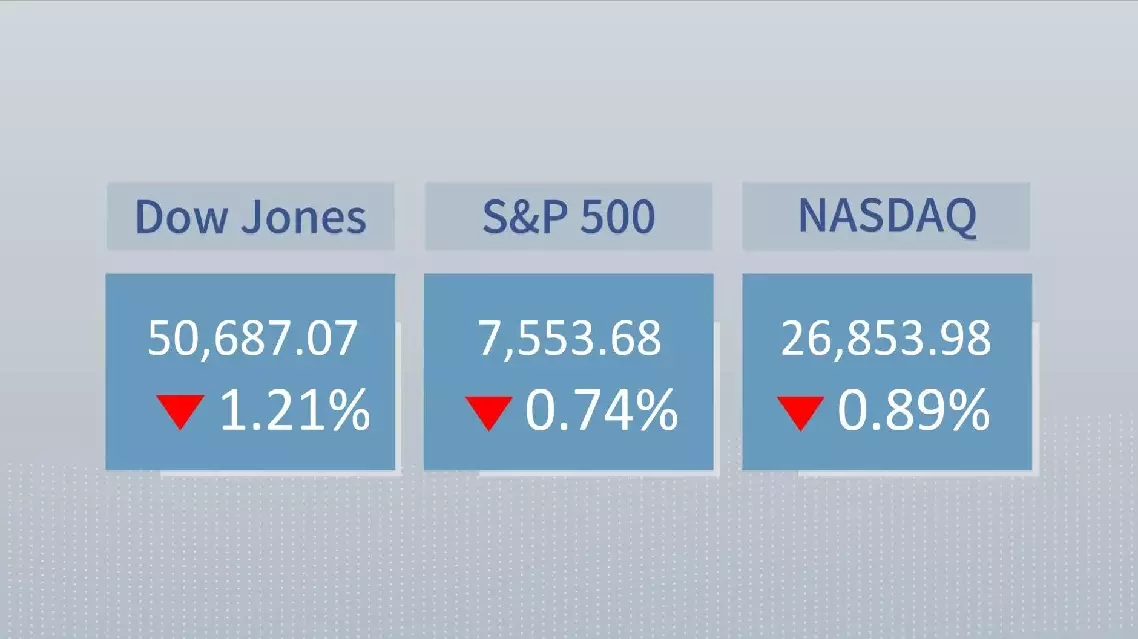
U.S. stocks retreat as Middle East tensions persist