SAN ANTONIO (AP) — The NBA banned two people for life from its arenas on Thursday, after one of them was arrested shortly after running onto the court during Game 1 of the NBA Finals and appearing to take a selfie next to San Antonio star Victor Wembanyama.
The incident occurred midway through the fourth quarter of Wednesday’s game between the Spurs and New York Knicks. The NBA did not disclose what role the second banned person, who did not run onto the court, played in the incident.
“The individual who entered the court area during Game 1 of The Finals was arrested and will be banned for life from all NBA arenas," an NBA spokesman said in a news release. "A second individual will also receive a lifetime ban for his role in the incident.”
The person who was arrested after running onto the court is a juvenile, according to a person with knowledge of the matter who spoke to The Associated Press on condition of anonymity because that detail — first reported by the San Antonio Express-News — was not revealed publicly.
That fan appeared to enter the court from the sideline opposite the team benches, starting from behind the play and running into San Antonio's offensive end. The person was quickly pulled from the court by two security guards and it did not appear the person made any physical contact with Wembanyama or any New York players.
Wembanyama did not appear bothered by the incident, either as it was happening or afterward.
“I’ve never been in that situation,” Wembanyama said. “I didn’t know how to act."
He compared the moment to a game in January 2024 when a bat got into the Spurs' arena and flew around the court, stopping a game against Minnesota for a couple of minutes.
Play on Wednesday was stopped for 1 minute and 29 seconds before the game resumed with a jump ball. The fan who entered the play was taken out of the court area through a baseline tunnel.
“I don’t think it was an event at all,” Spurs coach Mitch Johnson said. “I thought security got him out of there. I think everybody moved on to the next play.”
Another incident involving fan behavior occurred in the final minute, when New York guard Jalen Brunson — who had a game-high 30 points in the Knicks' come-from-behind win — appeared to be upset by something said to him by a patron in a courtside seat.
A second person, speaking to the AP on condition of anonymity because the NBA has not discussed the matter publicly, said the league is “looking into what happened” with the fan and what was said to Brunson.
Asked Thursday about that incident, Brunson declined to comment.
Fan behavior and conduct has been a point of emphasis for the NBA in recent years, and the league sent a memo to all 30 clubs at the start of this season saying it wants “consistent and vigilant enforcement of the NBA Fan Code of Conduct … to deter and address fan misconduct at NBA games and events.”
The NBA, in that October memo, told teams that arena staff “must be trained to identify behavior that violates NBA rules and to respond proactively.” The NBA, like many leagues, also has a video detailing a code of conduct for fans played in every arena before each game.
“It is critical that teams and arenas vigorously enforce the Code of Conduct and not tolerate any misconduct that impacts our players, fans, or otherwise disrupts the game,” the league said.
AP NBA: https://apnews.com/hub/nba
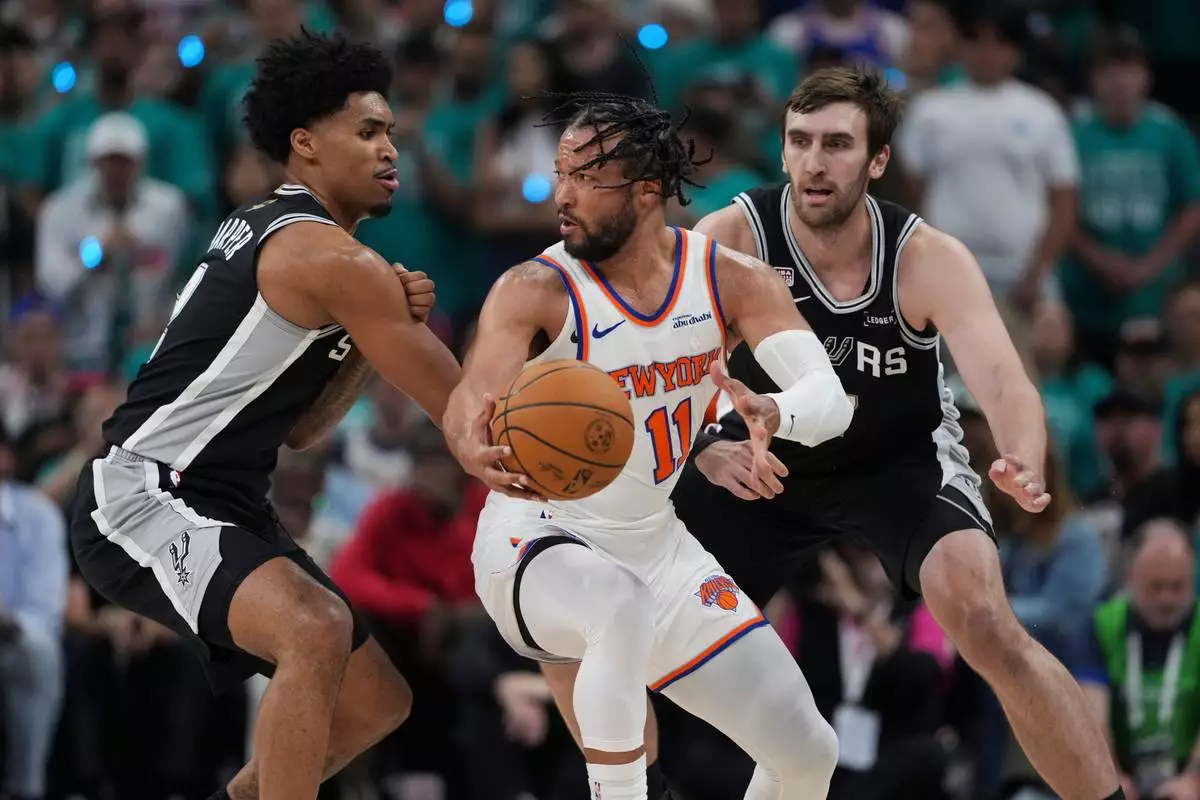
New York Knicks guard Jalen Brunson (11) spins as San Antonio Spurs guard Dylan Harper, left, defends during the first half of Game 1 of the NBA Finals basketball series, Wednesday, June 3, 2026, in San Antonio. (AP Photo/Eric Gay)

San Antonio Spurs forward Victor Wembanyama (1) drives against the New York Knicks during the first half of Game 1 of the NBA Finals basketball series, Wednesday, June 3, 2026, in San Antonio. (AP Photo/Eric Gay)
WASHINGTON (AP) — Senate Republicans cleared the first hurdle on Thursday as they are struggling to pass legislation to fund President Donald Trump’s immigration enforcement agencies, narrowly beating back a Democratic effort to permanently block Trump from creating a $1.776 billion settlement fund for payouts to allies who claim they were persecuted by the government.
Republicans still face a gauntlet of Democratic amendments before the bill can advance, setting up a daylong test of party unity. More votes on the settlement fund are planned, including proposals from Republicans, and it was unclear if GOP leaders would be able to fend them all off and pass the legislation.
“I can’t predict how it comes out," Senate Majority Leader John Thune told reporters between discussions with some of the holdouts off the Senate floor.
Senate Minority Leader Chuck Schumer said that Democrats plan to force votes on the tax immunity granted to Trump as part of the settlement and a host of other issues — including Trump’s East Wing ballroom project, his tariffs, his war with Iran and his immigration enforcement campaign.
“Amendment after amendment, vote after vote, Republicans are going to have to answer to the American people,” Schumer said.
Acting Attorney General Todd Blanche said this week that the fund would not move forward, and many GOP senators said Wednesday that they were satisfied with his remarks.
Yet Trump, who has been at odds with Senate Republicans in recent weeks, raised new doubts about the settlement’s future on Wednesday afternoon — just after the Senate had voted to start debate on the immigration bill — when he told reporters that the settlement is “very important” and said “I don’t know” whether it is dead or on hold.
“I’d have to ask the lawyers,” he said.
Republican Sens. Bill Cassidy of Louisiana, John Husted of Ohio and Dan Sullivan of Alaska held out for around three hours on the Democratic amendment banning the settlement amid discussions over whether to vote for it.
Cassidy, who eventually voted against the amendment, lost re-election in a GOP primary two weeks ago after Trump endorsed his opponent. Husted and Sullivan, who voted against it, are both up for re-election in November.
Senators then defeated a second amendment from Republican Sen. Thom Tillis of North Carolina that would also ban the settlement fund but would move the money to a separate anti-fraud fund at the Department of Justice. Most Democrats voted against the amendment, guaranteeing its defeat, but more than 10 Republicans supported it.
“If Blanche says this is largely inoperative, why not use this moment to codify that?” Tillis said ahead of the vote. “Otherwise, you’re exposing every one of our members who are in cycle to having to deal with this between today and Election Day, and that makes no sense for something that the DOJ says they’re not moving forward with."
It was unclear how Republicans would vote on additional amendments. Cassidy is also planning to offer an additional attempt to curb the fund, and he appeared to be in conversations with the Senate parliamentarian throughout the morning as he brought her proposals to review.
Passage of the roughly $70 billion bill to fund U.S. Immigration and Customs Enforcement and the Border Patrol would end the blockade by Democrats who demanded policy changes after the fatal shootings of two protesters by federal agents in January. The bill would fund the agencies for three years, through the end of Trump’s term.
Senate Republicans are using a complicated procedural maneuver to get around the filibuster and pass the budget legislation with no Democratic votes. But it has taken weeks to get the bill to the Senate floor as Republicans navigated various obstacles to passage created by Trump and the White House — including a $1 billion proposal for White House security that they eventually scrapped and the fierce bipartisan backlash to the settlement fund.
“The thing we’re trying to do here is to keep the focus on funding for ICE and CBP,” Thune said Wednesday evening, after the Senate voted to start debating the legislation.
“This was narrow and targeted from the very beginning and clean, and we’re trying to maintain it that way,” he said.
Democrats say any funding bill for the Homeland Security Department should place restraints on federal immigration authorities, including better identification for federal officers and more use of judicial warrants, among other asks.
After federal agents shot Renee Good and Alex Pretti in Minneapolis, Trump agreed to a Democratic request that the Homeland Security bill be separated from a larger spending measure that became law. But bipartisan negotiations went nowhere, and the DHS funding lapsed in mid-February with no agreement on changes to the Trump administration’s immigration enforcement tactics.
Congress eventually funded the rest of the Homeland Security Department at the end of April with Democratic support. But ICE and Border Patrol remained without regular funding, and Republicans launched a new effort to pass three years of funding for those agencies with no Democratic votes.
Work on the legislation was also delayed by Republican opposition to $1 billion in security funding for the White House, including for Trump’s new ballroom, that was added to the original bill.
Democrats and some Republicans questioned using taxpayer money for the massive project, and Republicans did not include it in the final bill when it was released on Wednesday.
Republican House leaders said Wednesday they would like to clear the legislation before the end of the week, if the Senate can finish it. House Majority Leader Steve Scalise, R-La., said that House leaders were having internal conversations about the schedule.
“We just need to make sure everybody’s there,” Scalise said.
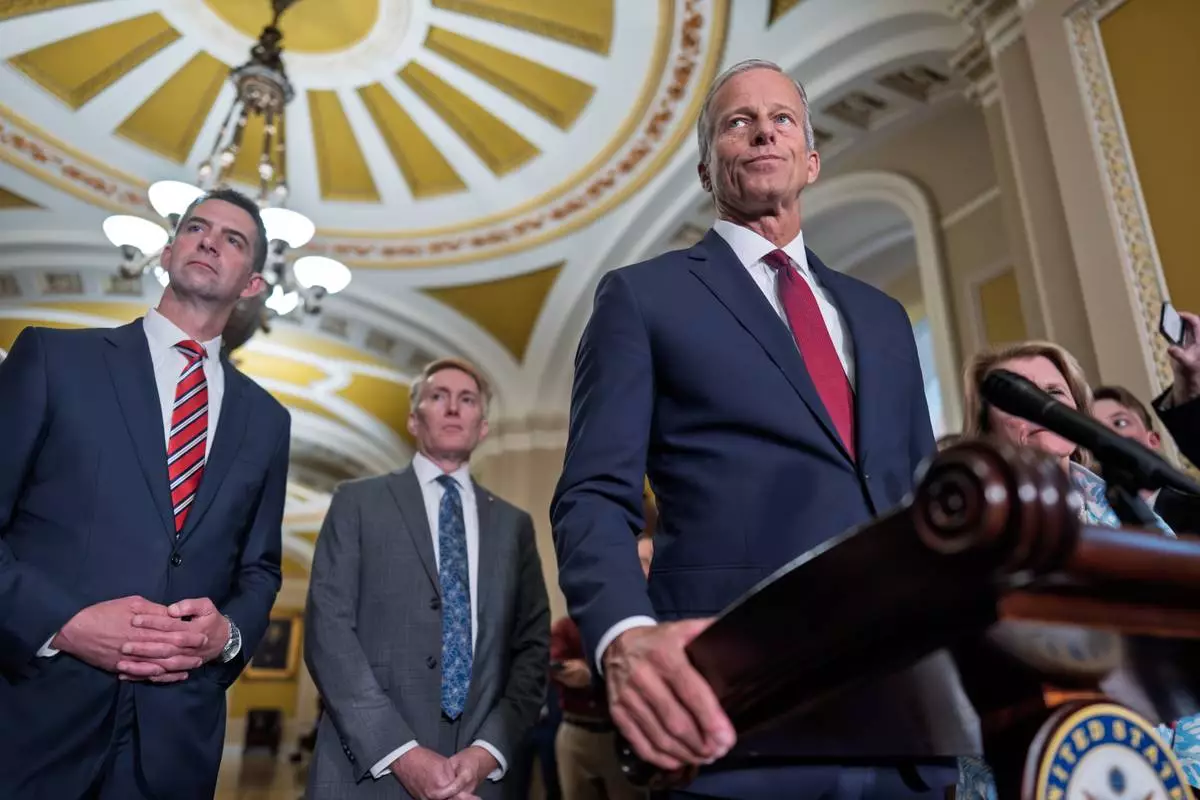
Senate Majority Leader John Thune, R-S.D., joined from left by Sen. Josh Hawley, R-Mo., and Sen. James Lankford, R-Okla., speaks to reporters after a closed-door meeting with fellow Republicans, at the Capitol in Washington, Tuesday, June 2, 2026. (AP Photo/J. Scott Applewhite)