A truck-driving preacher who helped thwart an alleged kidnapping attempt in South Carolina — all caught on his rig’s dashboard camera — said Thursday that he was not a hero, but a “divine” tool.
Anthony J. Moore, 53, was driving a route in Aiken County, about 20 miles from the Georgia border, last Friday when a woman ran directly into his path with her hands cuffed behind her back.
The video, which has no sound, shows the drama unfold: The woman passes in front of the truck, and a man in a Cadillac that had been on the side of the road swerves in front of the truck before taking off. The woman then runs down the road, and the man drives off.
“I just see it as a divine assignment from God, because had not I been there with the dashcam ... they probably wouldn’t have caught the footage that needed to be catched,” Moore told The Associated Press in a telephone interview. “It was another assignment from God, a special assignment from God. That a life needed to be saved.”
Authorities arrested Jonathan Willard, 39, of New Ellenton, on one count each of kidnapping and impersonation of a law enforcement officer. He was being held Thursday at the Aiken County Detention Center.
According to an incident report from the Aiken County Sheriff's Department, the woman was taking a walk when a man in a green Cadillac "came from behind her and told her he was with the police.” She said he took her phone and Social Security card, put her in handcuffs and placed her in the back seat of the car.
The woman told police that the man pulled over by a gated property and got out. She said she tried to open the rear doors, but they were locked.
As the man rummaged through the trunk, she said, she climbed over the seat and escaped through the open driver's side door.
Moore was driving south of Aiken when he saw the woman running toward him.
“I let my window down and she said, ‘Please help me. He’s trying to kidnap me,’" Moore said.
As the woman swerved, Moore said, the man chasing her pulled up beside him and showed “what looks to be a badge.”
“And he said, ‘I’m with law enforcement, and she jumped out of my car,’" Moore recounted. The man then left in the Cadillac.
Bystanders called 911, helped get the cuffs off the woman and gave her water. Moore said she told him that she had just graduated the day before, and that the man had also taken her diploma.
She asked Moore if he would accompany her back to the spot where she escaped, to see if the man had might have dumped her belongings. He said they found nothing.
The Aiken County Solicitor’s Office said Willard had not yet been assigned a defense attorney and no court dates had been scheduled. The AP called the jail to speak with Willard, but the request was denied.
Moore is pastor of Amazing Grace Ministries in Denmark, South Carolina. Moore is also a 27-year Army veteran, said his wife, Betty, an associate pastor at the church.
“When I learned that he was caught the next day I was relieved of a lot of things that he didn’t get away," he said, "to go try that again someplace else.”

This May 30, 2026, booking photo from the Aiken County (S.C.) Sheriff's Department shows Johnathan Willard, 39, who is charged with kidnapping and impersonating a law enforcement officer in connection with a dramatic incident caught on a trucker's dashboard camera. (Aiken County Sheriff via AP)
The New World screwworm fly is threatening the $113 billion U.S. cattle industry for the first time in more than a half century, with an infestation from its flesh-eating larvae confirmed in south Texas.
The infestation was discovered in a single 3-week-old calf in La Pryor, Texas, about 100 miles (161 kilometers) southwest of San Antonio and 50 miles (80 kilometers) from the U.S.-Mexico border. Federal and state officials had been working to keep the parasite from reaching Texas, home to $17 billion worth of the nation's cattle, making it the industry's No. 1 state.
The deadly flies were detected in Mexico late in 2024, after years of being contained at the southern end of Panama.
The fly was an annual warm-weather scourge of cattle ranchers from at least the 1930s through the 1960s, until the U.S. eradicated the pest by breeding sterile male flies and dropping swarms of them from planes to mate with wild females. The USDA said the most recent case was the first in Texas since 1966.
Here is what to know about the fly, the threat it poses and the response:
The New World screwworm fly in the Western Hemisphere and its Old World cousin in Africa and Asia are unusual among flies because their larvae, or maggots, eat live flesh and fluids instead of dead material. Females lay their eggs in open wounds and mucous membranes after mating only once in their monthslong lives.
Any warm-blooded animal, including wildlife, pets and occasionally even humans, can be infested.
Livestock are vulnerable because of how they're handled, Lee Haines, an associate research professor of biological sciences at the University of Notre Dame, said in an email Thursday. Standard practices with cattle can break the skin, including shearing and de-horning, or even moving them in and out of corrals can cause scrapes and cuts. Birth would also make a mother and calf vulnerable, she said.
Stephen Diebel, a Texas rancher and president of the Texas & Southwestern Cattle Raisers Association, added that even wounds “as small as a tick bite,” can put cattle at risk.
Death can result if an infestation is not treated, though a dozen treatments have been approved for use in a variety of species. In decades past, ranchers had tens of millions of dollars in losses — potentially billions in today's dollars.
But agriculture officials were quick to note that the fly does not infest food, and U.S. Agriculture Secretary Brooke Rollins said it’s unlikely to damage beef production -- welcome news given that consumers are already facing record prices.
Federal and state officials and cattle industry leaders have been sounding public alarms about the fly's movement through Mexico and toward the U.S. since a case was confirmed in southern Mexico in November 2024.
Officials had considered the pest eradicated from Central and North America nearly two decades before an outbreak in Panana prompted a state of emergency there early in 2023, according to the joint U.S.-Panama program established in 1994 to stop the parasite. Cases jumped to Costa Rica and Nicaragua later that year.
Edward Burgess, a University of Florida entomologist who studies the fly, said it reproduces quickly and is carried across wide areas by its hosts, namely wild animals such as deer. Outside of Panama, he said, programs that produced and released sterile flies have largely shut down.
"It’s hard to stay ahead of it because of how fast that fly is able to move and regenerate,” Burgess said.
As of June 2, the parasite had sickened more than 171,700 animals and 2,000 people across Central America and Mexico, according to the U.S. Centers for Disease Control and Prevention. There have been 10 human deaths, the CDC says.
Starting in May 2025, Rollins closed border entries to livestock and on Thursday she credited that move with delaying the fly's arrival in Texas by a year.
Rollins has argued that the Mexican government has not done enough to control animals moving within the country, a suggestion Mexican authorities have rejected.
But Haines said climate change is a key element in the spread of a tropical species that thrives in warm weather. Warmer temperatures are expanding the fly's habitat and cold snaps that killed them off each year in marginal habitats are becoming less frequent and less severe, she said.
Texas State Veterinarian Bud Dinges imposed a 12-mile (20-kilometer) quarantine zone covering much of Zavala County, home to La Pryor, and a small part of neighboring Uvalde County. Animals cannot leave that zone without being inspected.
Local ranchers are concerned that the fly will spread among wildlife, particularly deer, as a small, short-lived outbreak did in the Florida Keys in 2016. That was the last time a U.S. case was confirmed among animals, though the CDC confirmed a case last year in a Maryland man who had traveled to El Salvador and recovered.
Zavalas County Sheriff Eusevio Salinas said Thursday that state officials were setting up several road checkpoints in the county to enforce the quarantine.
“They said they were going to do that for three to four days, and hopefully after that it’s already under control,” Salinas said.
Diebel, whose family ranch is about 200 miles (322 kilometers) east of the quarantine zone, said ranchers are proactively giving injections that prevent screwworm infestation. They’re also taking extra care to treat wounds from ear tagging and other practices and keeping a close eye for signs of illness.
The USDA has been dropping sterile flies in south Texas since February, when it opened a center for dispersing them in south Texas. It is now dropping them twice a week, for a total of 4 million flies, and it’s also putting 4 million more a week in the ground as pupae, flies in the stage between larvae and adult, said Rear Admiral Michael Schmoyer, a member of the USDA’s response team.
Releasing sterile files is both time-tested and highly effective. While males are “promiscuous,” in the scientific sense, females are not, and if their one mating hookup is with a sterile male, no eggs from that female will hatch.
Once sterile males are prevalent enough, the fly’s population declines and then dies out.
But with sites outside Panama shut down for years, the USDA didn't think sterile flies were being bred fast enough. It invested $21 million in a new fly-breeding facility in southern Mexico that is expected to start operations next month.
The USDA also is spending $750 million to build a fly factory in southern Texas that can produce up to 300 million sterile flies a week. It is expected to begin operating next fall.
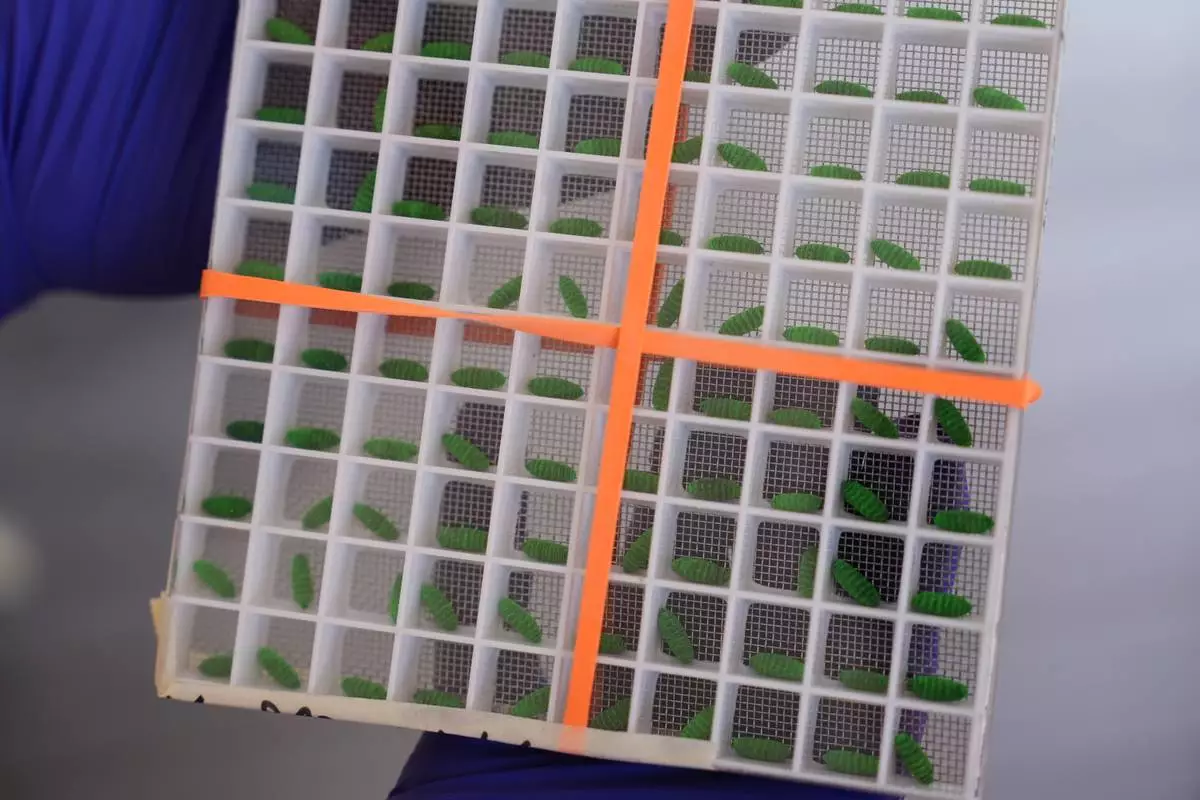
FILE - A test container of dyed fly pupae are displayed at a Domestic New World Screwworm Sterile Fly Production Facility to combat the northward spread of NWS and protect American livestock, in Edinburg, Texas, Feb. 9, 2026. (AP Photo/Eric Gay, File)
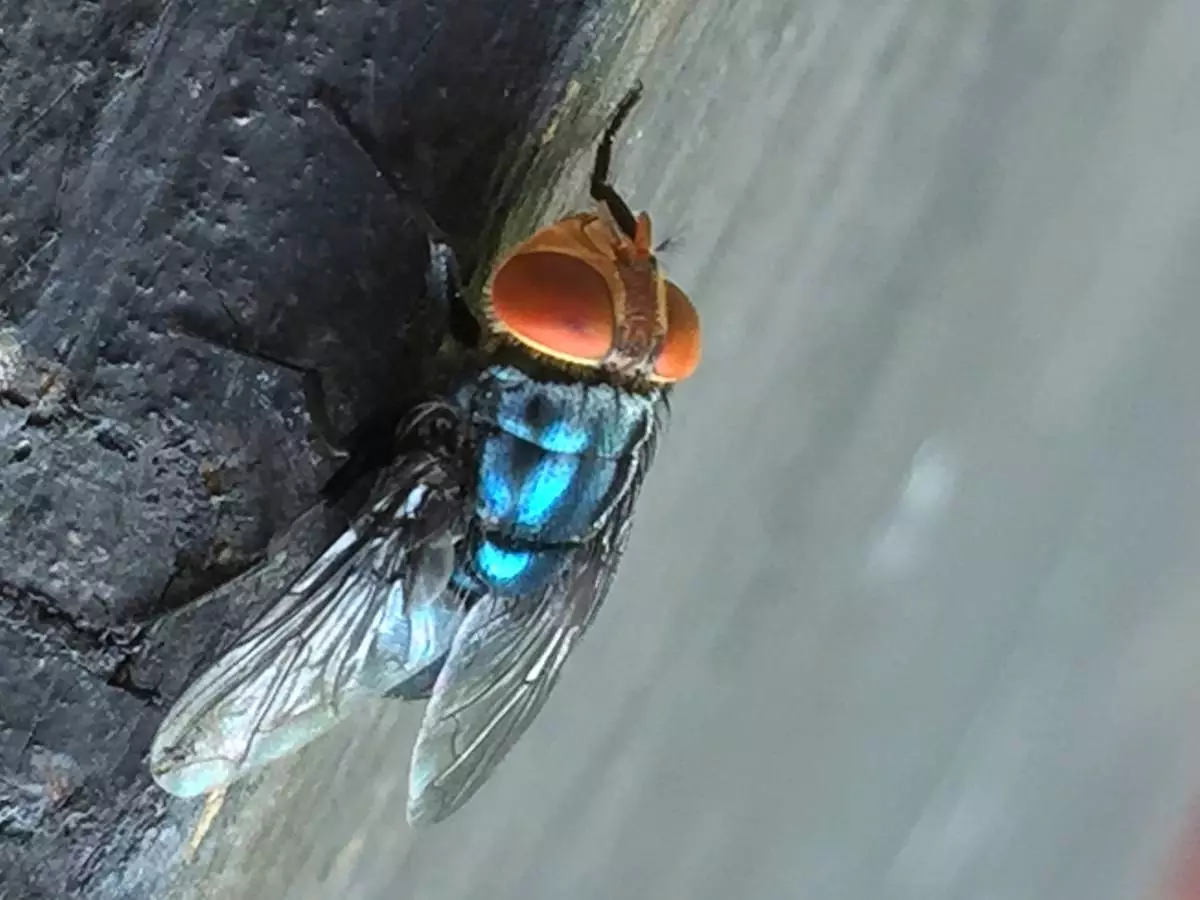
FILE - An adult New World screwworm fly sits in this undated photo. (Denise Bonilla/U.S. Department of Agriculture via AP)