Northwest China's Xinjiang Uygur Autonomous Region has leveraged the popularity of the region's grassroots-level Football Super League events to boost tourism, with local authorities rolling out incentives for visiting fans, including discounted or free entry to tourist sites.
The 2026 Tongxin Cup Xinjiang Football Super League kicked off on May 16 and is scheduled to last until August 9, with a total of 56 matches, attracting large numbers of football fans and tourists.
Taking advantage of the Super League's high popularity, business operators in various cities across Xinjiang have rolled out a variety of cultural and tourism discount packages favored by football fans and tourists.
In the Bortala Mongol Autonomous Prefecture, football fans holding Super League tickets can enjoy a 20-percent discount on tickets to the Sayram Lake Scenic Area. They can also enjoy free access to other tourism spots including the Alashankou Border Crossing Gate and the Muttar Desert Scenic Area. Local supermarkets, specialty restaurants, and chain hotels also offer corresponding discounts.
Starting on May 30, Altay Prefecture has launched a month-long cross-industry benefit campaign, connecting various scenarios such as gas station filling, accommodation and supermarket shopping. Football fans and tourists can scan a dedicated QR code to check all the discounts available.
"After scanning the QR code, we can see the introductions of many characteristic restaurants and horse farms in Altay. I can also enjoy a wide range of discounts with my accommodation vouchers," said Dong Rujiang, a tourist from east China's Jiangsu Province.
Turpan City has leveraged its home-field advantage to stimulate consumption across the city, setting up 30 large screens in urban areas and major scenic spots as secondary football watching options for the fans. The combination of food and sports has created a brand-new nighttime tourism consumption scenario.
"While enjoying pigeon meat soup and eating pilaf, we cheered for the team. The combination of delicious food and the football game made for a particularly fulfilling night," said Dai Qian, another tourist from Jiangsu.

Xinjiang leverages grassroots football league events to boost tourism
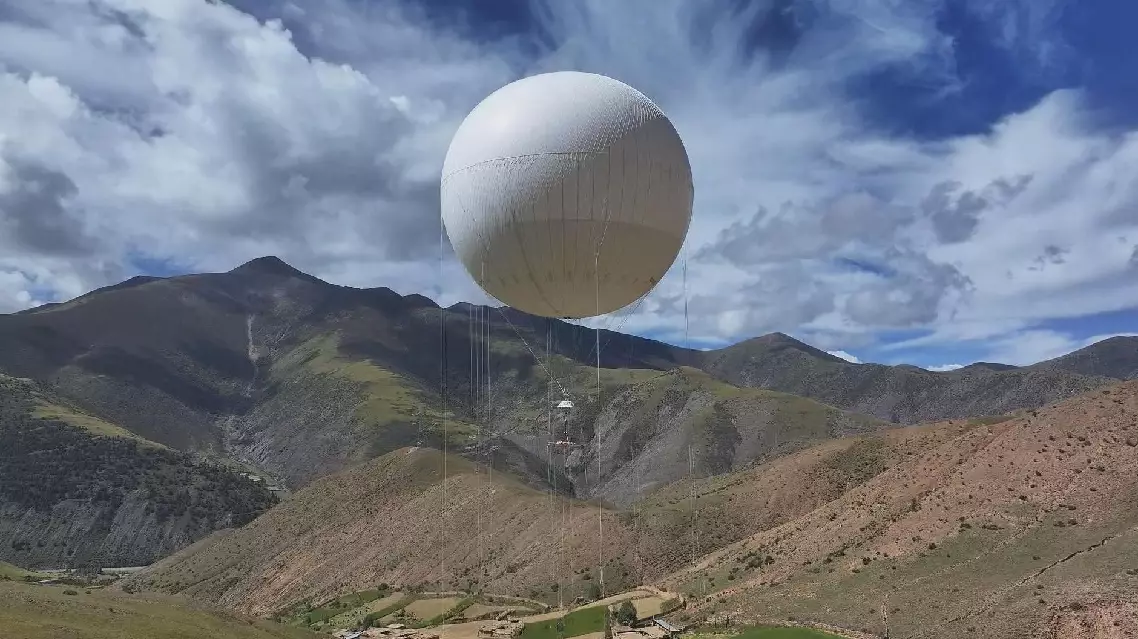
China's first two-tonne-class tethered balloon entered trial operation in a major power transmission project on Monday, providing a brand-new solution for transportation in power grid construction projects in high-altitude and ecologically sensitive areas, according to the State Grid.
The project is a massive ultra-high voltage (UHV) power transmission line that will carry clean energy from Xizang Autonomous Region in southwest China across thousands of kilometers to the Guangdong-Hong Kong-Macao Greater Bay Area in south China.
At the construction site, a large balloon with a diameter of 25 meters and a volume of 8,000 cubic meters slowly rose into the air.
As multiple mooring lines were simultaneously extended and retracted, the heavy construction materials suspended beneath the balloon were lifted off the ground and moved smoothly along a predetermined route toward the mountainous work site.
"This is our newly developed load-bearing tethered balloon. We have just completed a maximum load test of two tonnes at an altitude of 4,000 meters. Next, we will conduct a hoisting operation for power supply materials over a straight-line distance of 500 meters and a vertical drop of 120 meters," said Qin Jian, researcher at the Transmission and Transformation Engineering Technology Research Institute of the State Grid Electric Power Engineering Research Institute.
A heavy-lift tethered balloon involves launching a helium-filled balloon into the air and connecting it to the ground with one or several cables.
By adjusting the cable, the balloon's altitude and horizontal position are controlled to facilitate the transport of materials at high altitudes.
The balloon can travel up to 800 meters and carry a maximum load of two tonnes, with a positional accuracy of within 0.5 meters.
As the construction of new power grids is extending more rapidly into high-altitude, remote mountainous and ecologically sensitive areas, the transportation of materials for transmission projects has become a major challenge constraining construction progress.
Traditional road construction for transportation have long cycles and significant ecological disruption, while drones, though agile and flexible, face limitations in scenarios requiring heavy loads or prolonged continuous transport.
Tethered balloon transport technology effectively overcomes these difficulties.
"The construction section where this technology is applied is located in an uninhabited mountainous area at an altitude of over 4,000 meters. Many tower sites are situated on steep ridges inaccessible by road, making this the section with the highest altitude, most treacherous terrain and most challenging operations in the entire project. The two-tonne tethered balloon is better suited to high-altitude conditions characterized by thin air and strong winds, and its load capacity and stability can better meet transportation requirements," said Feng Tao, project manager of the State Grid Henan Power Transmission and Transformation Company.
China puts first 2-tonne tethered balloon into operation