Expansion arrangements of Southbound Travel for Guangdong Vehicles announced
The Hong Kong Special Administrative Region (HKSAR) Government today (June 8) announced the expansion arrangements of Southbound Travel for Guangdong Vehicles (Southbound Travel Scheme).
The Guangdong and Hong Kong governments implemented the Southbound Travel Scheme in end-2025, launching the part concerning the entry into the Hong Kong urban area by Guangdong vehicles (entry into urban area), and the "Park & Fly" service of the automated car park (port carpark) at the Hong Kong Port of the Hong Kong-Zhuhai-Macao Bridge (HZMB). Alongside Northbound Travel for Hong Kong Vehicles, the scheme enables mutual engagement through cross-boundary self-driving.

Southbound Travel for Guangdong Vehicles, Photo source: Xinhua News
Since its implementation half a year ago, the scheme has been operating in a smooth and orderly manner. The numbers of applications and travel bookings have been on the rise. As at end of May 2026, for entry into urban area, around 8 400 applications have been approved, with a total of around 6 700 travel bookings. During the past Labour Day Golden Week of the Mainland, the bookings were oversubscribed by two to three times. As for the "Park & Fly" service of the port carpark, over 8 600 user registration applications have been received, with a total of over 4 000 bookings. These numbers are expected to continue to rise.
Taking into account the port operations, overall road traffic conditions, user feedback and public adaptation, the Guangdong and Hong Kong governments agreed to gradually expand the Southbound Travel Scheme to all of Guangdong Province. As the first step, in the middle of this year, the scheme will be expanded to all the nine Mainland cities of the Guangdong-Hong Kong-Macao Greater Bay Area (GBA) (i.e. adding Shenzhen, Foshan, Dongguan, Huizhou and Zhaoqing) (new cities); the travel booking quota of entry into urban area will be increased from 100 to 200 vehicles per day (each vehicle shall remain to stay in Hong Kong for up to three days); and the "Park & Visit" service of the port carpark will be launched.
Guangdong and Hong Kong will first allow Guangdong vehicles of the new cities to use the "Park & Fly" service of the port carpark starting from June 15 this year. Guangdong vehicles of the new cities will be allowed to enter Hong Kong via the HZMB and the travel booking quota will be increased starting from July 25, and at the same time the "Park & Visit" service for Guangdong vehicles of all the nine Mainland cities will be launched. Guangdong and Hong Kong will continue to monitor the implementation arrangements, and subject to the implementation situation, target to expand the scheme to all 21 cities in Guangdong Province by the first quarter in 2027.
The Secretary for Transport and Logistics, Ms Mable Chan, expressed her heartfelt gratitude for the staunch support of the Central Government and the Guangdong Provincial Government in jointly taking forward the Southbound Travel Scheme in a prudent manner. "The northbound and southbound travel arrangements have opened up a new model for residents to travel between the two places by self-driving, fostering a new ground for the connectivity within the GBA through the HZMB. The Southbound Travel Scheme has been implemented in a prudent and orderly manner, and has achieved readiness for further gradual expansion. Under the strategies of ensuring safety, an effective diversion, well-equipped supporting facilities, and streamlined application processes, the HKSAR Government will continue to take forward the Southbound Travel Scheme, enabling the inflow of additional tourists from more Mainland cities, including individuals and families with higher purchasing power, to help drive Hong Kong's economic growth, and promote the integrated development of Guangdong and Hong Kong to a new level," Ms Chan said.
Implementation details
The key dates of opening of application, booking, and travel for users of the new cities are as follows:
Entry into urban area
Starting from 9am on June 9
To register for balloting with the Mainland authorities
Starting from 9am on June 29
Successful balloting applicants to submit applications to the Mainland authorities
Starting from 0.00am on July 25
To travel to Hong Kong via the HZMB according to the designated date of the successful booking
Port carparks
"Park & Fly"
Starting from 9am on June 9
To submit booking application
Starting from 0.00am on June 15
After parking at the carpark via the HZMB, travellers to transfer to flight at Hong Kong International Airport
"Park & Visit"*
Starting from 9am on July 16
To submit booking application
Starting from 0.00am on July 25
After parking at the carpark via the HZMB, travellers to go through immigration formalities at the HZMB Passenger Clearance Building and then transfer to local public transportation to travel to various districts in Hong Kong
* The "Park & Visit" service will be made available for all nine Mainland cities in the GBA at the same time.
For information regarding the specific application and travel booking guidelines under the Southbound Travel Scheme, please visit the following websites:
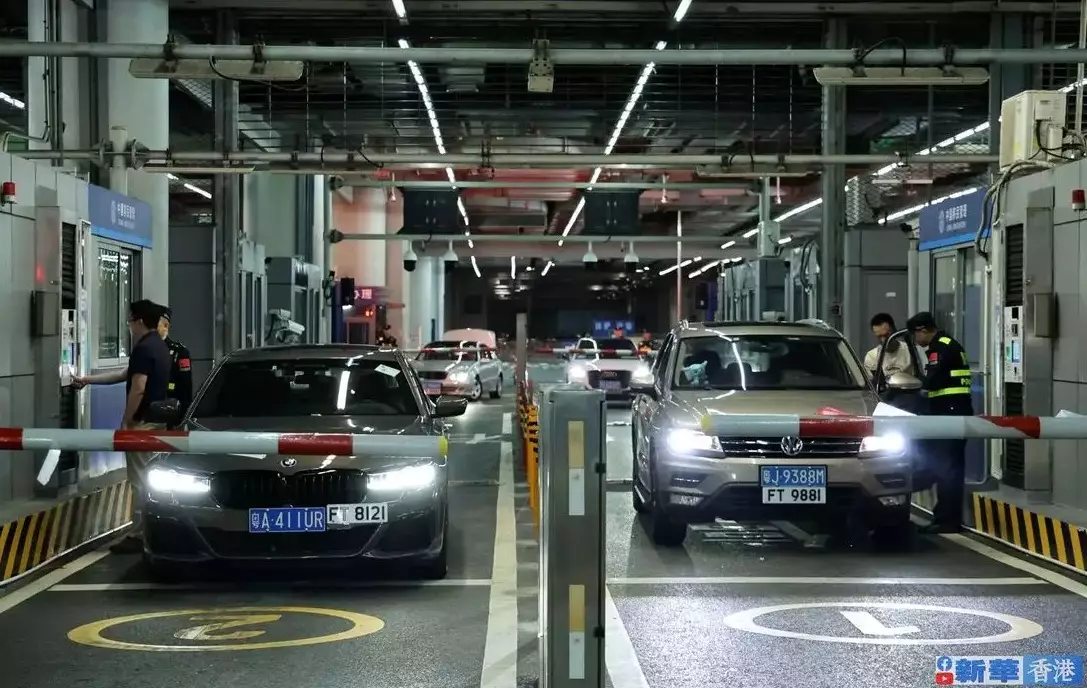
Southbound Travel for Guangdong Vehicles, Photo source: FB@Xinhua HK
Employers and employees should make work arrangements in times of rainstorm warnings
The Labour Department (LD) today (July 27) reminded employers to make prior work arrangements for employees during and after rainstorm warnings and extreme conditions as early as possible. These arrangements not only can ensure the safety of employees and smooth operation of organisations, but also are conducive to maintaining good labour relations.
Formulate work arrangements
Employers should make prior work arrangements and contingency measures which are reasonable and practical. In drawing up and implementing the relevant arrangements, employers should give prime consideration to employees' safety and the feasibility of employees travelling to and from their workplaces, etc. To avoid unnecessary disputes between employers and employees, employers should ensure that all employees are informed of and agree to the relevant work arrangements in advance. The work arrangements should cover the following areas:
* arrangements in respect of reporting for duty;
* arrangements in respect of early release from work;
* arrangements in respect of work resumption (e.g. the number of hours within which employees should resume duty after the relevant warning signal is cancelled or when extreme conditions come to an end, and when safety and traffic conditions allow);
* arrangements in respect of remote work (if applicable);
*arrangements regarding wages and allowances (e.g. calculation of wages and allowances in respect of reporting for duty); and
* arrangements for staff required to report for duty in times of adverse weather or extreme conditions.
"Employers should conduct an early and realistic assessment of whether there is any need for staff to report for duty at workplaces when rainstorm warning or extreme conditions are in force. In making the assessment, employers should take into account the safety of employees, the business nature, operational needs and urgency of service of their organisations, with due regard to the manpower requirements, staffing establishment and circumstances of individual employees, and keep the number of staff required to report for duty at workplaces to the minimum as far as possible," a spokesman for the LD said.
Work arrangements in times of adverse weather and extreme conditions
If a Red or Black Rainstorm Warning Signal is issued within working hours, employees working indoors should continue to work as usual unless it is dangerous to do so. Supervisors of employees working outdoors or in exposed areas should suspend outdoor duties as soon as practicable. They should arrange for their employees to take shelter temporarily and resume duty only when weather conditions permit. If the Black Rainstorm Warning Signal is still in force at the end of working hours, employees should stay in a safe place until the heavy rain has passed. Employers should also make available to employees a suitable area in the workplace as temporary shelter from wind and rain.
If the Government makes an extreme conditions announcement, except for those required to report for duty at workplaces according to prior agreements made with employers, employees should stay where they are or in safe places, instead of heading for work. Employees already on duty at workplaces could continue to work as usual in a safe manner. If the workplaces are in danger, employers should arrange to release staff from work early where practicable and safe to do so or arrange for them to take temporary shelter in a safe place. If working time ends while extreme conditions are still in force, employers can release employees from workplaces in a safe manner or provide a suitable area as temporary shelter for those still at workplaces.
If it is necessary for employees to report for duty at workplaces under adverse weather or extreme conditions, employers should discuss and agree with them in advance the duty arrangements and contingency measures. If public transport is suspended or only maintains a limited service when the Black Rainstorm Warning Signal or extreme conditions are in force, employers should provide safe transport services for employees travelling to and from workplaces, or grant them an additional travelling allowance.
The spokesman also reminded employers to observe the statutory liabilities and requirements under the Employment Ordinance, Occupational Safety and Health Ordinance, Factories and Industrial Undertakings Ordinance, Employees' Compensation Ordinance and Minimum Wage Ordinance.
Comply with requirements of legislation
"Tropical cyclones and rainstorms are natural calamities. If employees are not required to report for duty, or are released from workplaces early, or are unable to report for duty at workplaces or resume work on time, etc due to adverse weather, extreme conditions or other environmental factors beyond their control, employers should not deduct their wages, good attendance bonus, or allowances, nor require employees to compensate subsequently for the loss of working hours in response to the aforementioned situations, or reduce employees' entitlements to annual leave, statutory holidays or rest days under the Employment Ordinance to compensate for the loss of working hours resulting from the issuance of adverse weather warnings or the extreme conditions announcement," the spokesman said.
Employers have an obligation to provide and maintain a safe working environment for their employees under the Occupational Safety and Health Ordinance and the Factories and Industrial Undertakings Ordinance. If employees are required to work in times of tropical cyclone warnings, rainstorm warnings or extreme conditions, employers should ensure that the risks at work are reduced as far as reasonably practicable. Moreover, under the Employees' Compensation Ordinance, employers are liable to pay compensation for injuries or deaths incurred when employees are travelling by a direct route from their residence to their workplace, or from their workplace back to their residence after work, four hours before or after working hours on a day when Tropical Cyclone Warning Signal No. 8 or higher, a Red or Black Rainstorm Warning Signal or extreme conditions are in force.
The LD's latest revised "Code of Practice in Times of Adverse Weather and 'Extreme Conditions'" sets out the relevant guidelines in a reader-friendly and concise manner, reiterating the three major principles for formulating work arrangements under adverse weather and extreme conditions, including formulating work arrangements in advance, giving prime consideration to employees' safety, and complying with requirements of labour legislation, and incorporating corporate examples for reference. The booklet can be obtained from branch offices of the Labour Relations Division or downloaded from the department's webpage (www.labour.gov.hk/eng/public/wcp/Rainstorm.pdf).
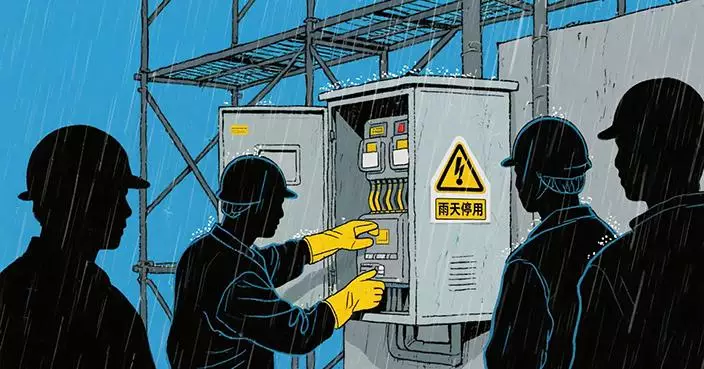
Source: AI-found images