The United Nations’ mission in Afghanistan has expressed concern over what it says are arrests and detentions of women in western Afghanistan for allegedly not adhering to regulations governing how they should dress.
The U.N. Assistance Mission in Afghanistan said on X late Sunday that the arrests and detentions in the city of Herat raise "serious human rights concerns.”
It did not provide details. Afghanistan’s Ministry for the Propagation of Virtue and the Prevention of Vice dismissed the reports of arrests as “rumors.”
“We remind the de facto authorities that all people have the right to freedom of movement and that all persons, both women and men, are entitled to equality before the law,” the U.N. mission said on X. It had expressed concern over similar arrests in the Afghan capital, Kabul, last year.
A human rights monitor, who spoke on condition of anonymity because they were not authorized to release details to the media, said Monday that monitors had verified at least 16 arrests and detentions, including of a pregnant woman, in Herat since Friday over alleged non-compliance with dress requirements.
On Friday, imams in mosques in Herat issued announcements during prayers on behalf of the vice and virtue ministry that women were not allowed to leave their homes without wearing the hijab. The human rights monitor said the arrests and detentions began shortly after that.
“The issues being spread about women being arrested in Herat are all rumors,” the vice and virtue ministry’s information office said in a statement. It added that “hijab is a divine command, a law that we are obliged to implement.” The headscarf and loose clothing cover the entire body.
Afghan authorities have imposed draconian restrictions on women and girls since the Taliban seized power in the country in 2021 in the wake of the chaotic withdrawal of U.S.-led forces. They have included bans on education beyond primary school and on working in all but very few professions, as well as strict regulations on what women are allowed to wear in public.
Government regulations stipulate that women can only go out in public when wearing full hijab as well as a face covering that leaves only the eyes visible. Many women in Afghanistan use face masks like those worn during the COVID pandemic to comply with regulations.

FILE - An Afghan woman walks out of a cell inside the women's section of the Pul-e-Charkhi prison in Kabul, Afghanistan, on Sept. 23, 2021. (AP Photo/Felipe Dana, File)
ChatGPT maker OpenAI filed preliminary paperwork that would open the door to it becoming a publicly traded company, the third in a powerhouse trio of artificial intelligence companies racing to Wall Street debuts.
The San Francisco-based company said Monday it has filed confidential paperwork with the U.S. Securities and Exchange Commission.
“We expect it to leak so we’re just announcing it,” the company said in a written statement. “We have not decided on timing yet; it may be a while because there are things we want to do that are likely easier as a private company. But it’s a complicated set of tradeoffs and this gives us the option to go public sooner if that ends up being best.”
OpenAI's move follows its rival Anthropic's June 1 disclosure that it is also moving toward an initial public offering of shares. Both are now following Elon Musk's space company SpaceX, which has started an IPO roadshow pitching itself as an AI-focused space company.
OpenAI CEO Sam Altman first publicly floated the possibility of an IPO last fall, describing it as the “most likely path” for the company given its size and the need for vast amounts of capital to advance its technology.
OpenAI began in 2015 as a nonprofit dedicated to developing AI for the common good and is now a company valued at $852 billion.
Paving the way for going public was OpenAI’s decision last year to reorganize its business structure and convert itself into a public benefit corporation even as it remains technically under the control of a nonprofit.
Also clearing the way for an IPO was OpenAI's victory against Musk in a federal jury trial last month. Musk, an OpenAI co-founder and early donor, had sued the company seeking to oust Altman from its leadership and unravel its conversion to a for-profit business. A judge dismissed the case after the jury found Musk filed his lawsuit too late.
OpenAI has not yet publicly disclosed how much money it is making or when it plans to turn a profit. Much like Anthropic and SpaceX, the company has been losing more money than it makes because of the huge costs of building AI. OpenAI faces its fiercest competition from fast-growing Anthropic, founded by ex-OpenAI leaders in 2021 and maker of the increasingly popular chatbot Claude.
In an April interview, OpenAI’s chief financial officer Sarah Friar declined to give a timeline for a potential IPO but said the company was already “acting with the good hygiene of a public company,” such as by measuring its revenue in the way a publicly traded firm would have to report earnings to the SEC.
“I want us to be ready,” she told The Associated Press. “I think it’s good to be able to tap the public markets. They’re much bigger than the private markets if you believe compute is a competitive advantage.”
She said OpenAI’s current valuation would make it one of the 15 biggest companies in the S&P 500.
She also said there is a “credentializing moment of being a public company.”
“At that point, people are checking your balance sheet, the SEC is governing you and so on,” she said.
In a separate statement Monday published around the same time as the announcement of the confidential filing, Altman outlined a broad vision for OpenAI that including three big goals: building an automated AI researcher, accelerating economic growth and giving “everyone on Earth a personal AGI,” which stands for artificial general intelligence or a form of AI that surpasses humans at many tasks.
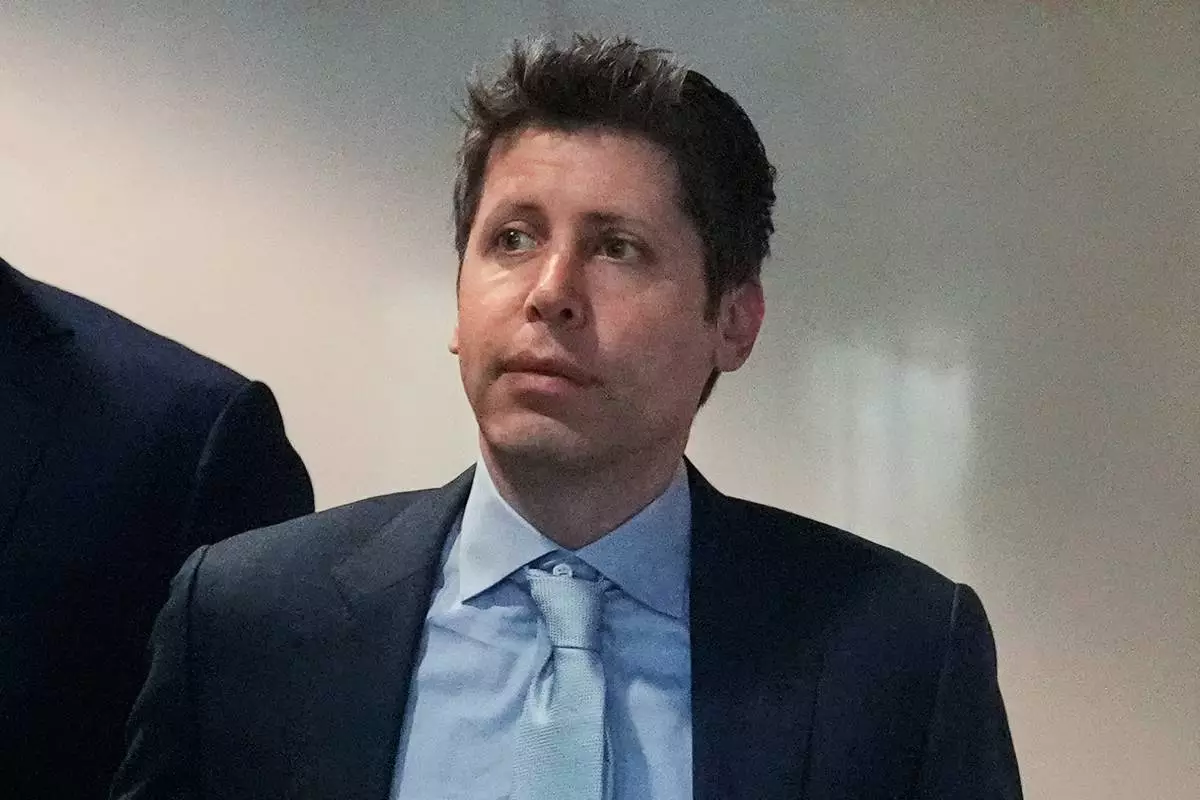
FILE - Sam Altman arrives at the U.S. District Court in Oakland, Calif., April 30, 2026. (AP Photo/Godofredo A. Vásquez, file)