BAMAKO, Mali (AP) — Rights groups on Wednesday denounced the arrest of two prominent journalists in Mali in the past two days, the latest crackdown on freedom of expression by the West African country's military leadership during a security crisis.
The “Maison de La Presse,” the main press association in Mali, had said Tuesday that Abdramane Keita was arrested on charges of “undermining national unity and the credibility of the State” and “dissemination of false and misleading information.”
Keita had said on his popular TV program “Grand Jury” that the Al-Qaeda-linked JNIM group controls the town of Kidal, a northern town that was seized by JNIM and separatists during major coordinated attacks in April.
In Mali, public statements suggesting that the military is losing ground to jihadist groups often lead to charges.
His arrest comes a day after the arrest of Chahana Takiou, a well-known television presenter and editor-in-chief of the newspaper “22 Septembre.” According to the same press association he was arrested Monday on charges of “undermining the credibility of the State through the judicial system.” Takiou had recently criticized the authorities' application of a cybercrime law, claiming it represents an attack on press freedom.
“The recent arrests starkly illustrate the problem Takiou identified: authorities increasingly use cybercrime legislation to punish peaceful criticism and sidestep the protections that press laws afford journalists,” Ilaria Allegrozzi, senior Sahel researcher for Human Rights Watch, said Wednesday.
She said Mali’s 2019 cybercrime law often uses broadly defined online offenses, including alleged threats and insults, to curb free expression, with penalties of up to 10 years in prison.
Sadibou Marong, director of Reporters Without Borders in West Africa, said the arrests of Keita and Takiou reveal "the degree of insecurity in which media professionals operate in Mali.” He said the military leadership has plunged the press into a “spiral of repression” through silencing tactics, exclusion of dissenting voices, and the use of justice as a weapon against independent media.
Both groups called for the two journalists' release.
Mali, alongside neighboring Niger and Burkina Faso, have been wracked by coups in recent years and are now ruled by military leaders who took power by force, pledging to provide more security to citizens.
Since seizing power, the juntas have cut ties with France and other Western powers, created their own security alliance and turned to Russia for military support to fight extremist insurgencies.
The security situation in Mali, Niger and Burkina Faso has worsened recently, analysts say, with a record number of attacks by Islamic extremists. Government forces have been accused of killing civilians they suspect of collaborating with militants.
Meanwhile, the military leaders have cracked down on political dissent and journalists. In January 2025, Malian authorities banned the sale of the Pan-African magazine Jeune Afrique. Several French media outlets, including France24, TV5 Monde, and Radio France International, are also banned from broadcasting in Mali. Several opposition leaders have been imprisoned for criticizing the military regime.
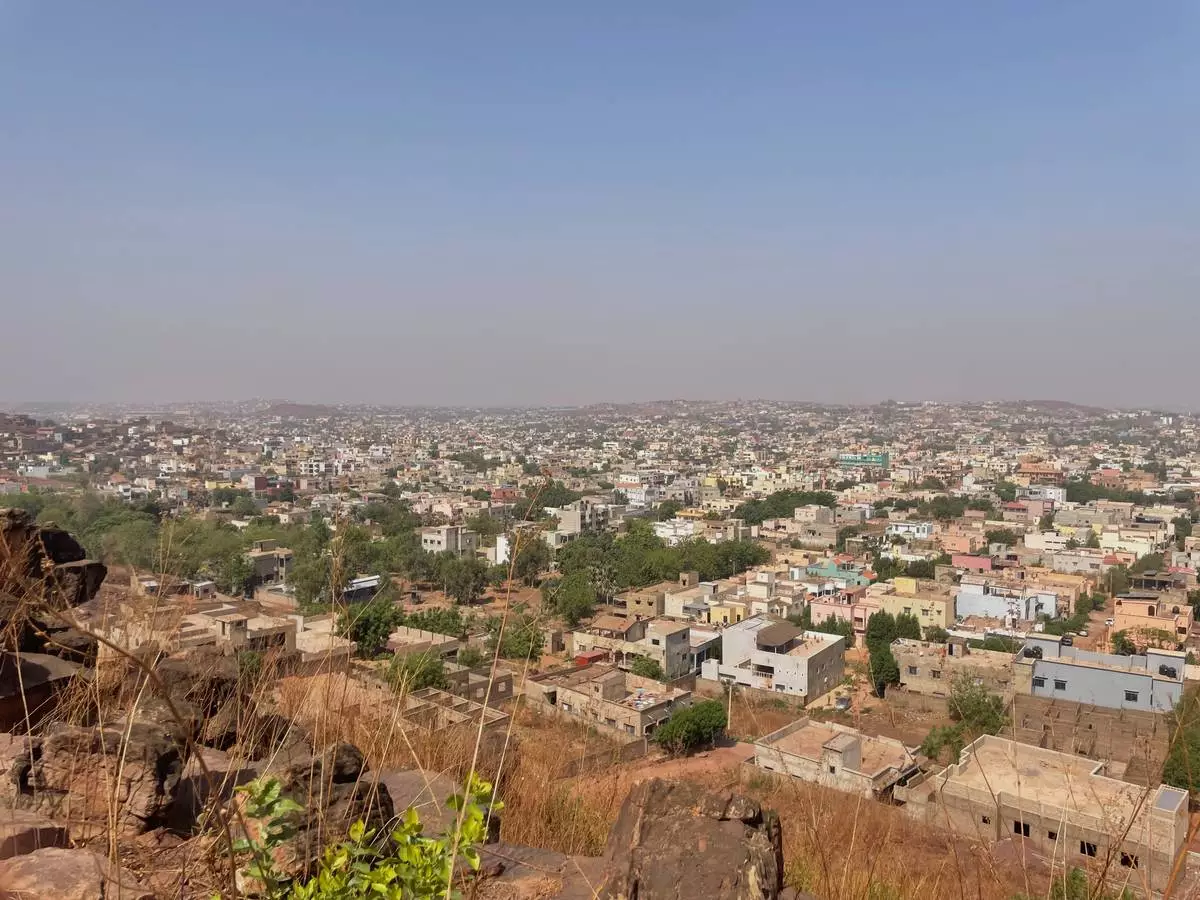
FILE - An aerial view of Bamako, Mali, April 25, 2026. (AP Photo, file)

FILE - Mali's junta leader Gen. Assimi Goita attends the funeral of former defense minister Sadio Camara at the Military Engineering Parade Ground in Bamako, Mali, Thursday, April 30, 2026. (AP Photo/Boubacary Bocoum, file)
LOS ANGELES (AP) — Large swaths of California are expected to see fire weather starting Thursday and thousands of people could lose power as utilities try not to spark wildfires during hot and windy conditions expected to last through Saturday.
Los Angeles Mayor Karen Bass, who has faced criticism for her city's response to deadly fires in 2025, said she's directed the fire department to deploy personnel and equipment ahead of the winds. The fire department has also requested assistance from the state’s office of emergency services, she said.
“It’s a pretty widespread event of elevated fire weather, so the whole SoCal region should really be on alert,” said Rose Schoenfeld, a meteorologist with the National Weather Service.
Dry, warm and gusty northeast winds known as Santa Anas, which blow from the interior of Southern California toward the coast and offshore, are expected, with the strongest winds forecast for Thursday afternoon through Friday afternoon.
The winds are expected to reach 20 to 40 mph (32 to 64 kph), with gusts from 50 to 70 mph (80 to 113 kph), in the San Gabriel mountains in Los Angeles County and the Santa Susana mountains, which are mostly in Ventura County, Schoenfeld said. Elevated, though brief, critical fire weather conditions are also forecast for portions of the Santa Lucia mountains in San Luis Obispo County.
Dangerous conditions began earlier in Northern California, with some communities in the Sierra Nevada and its foothills experiencing strong winds, high temperatures and low humidity starting Wednesday night, the National Weather Service said.
The service issued a Red Flag Warning for parts of central and Northern California starting Thursday and lasting through Friday morning, saying that any fires would spread rapidly. Such warnings are issued when weather conditions create an increased risk of wildfires.
Pacific Gas and Electric Company had notified 88,000 customers in 29 counties that it may need to proactively turn power off to reduce the risk of winds toppling over energized power lines that could start a fire. The planned shutoffs had started for some customers by Wednesday night.
The potential interruption in service to customers from the Central Coast to the upper corners of the Sierra Nevada could last through Saturday afternoon, the company said.
In Southern California, the Red Flag Warning for the mountainous areas in Ventura and Los Angeles counties will be in effect from Thursday morning through Friday night.
“We are augmenting our staffing, positioning our people and pre-deploying equipment ahead of this weather so we are ready before the first call comes in," Los Angeles Fire Chief Jaime Moore said. “We are asking residents to do their part, too. Clear the streets, have a plan and stay informed.”
In January 2025, the Palisades Fire — fanned by Santa Ana winds — ripped through a hillside Los Angeles neighborhood, killing 12 people and destroying mansions with spectacular ocean views. Another fire that burned at the same time in the city of Altadena, in Los Angeles County, killed 19 people and destroyed more than 9,400 homes and businesses.
Schoenfeld said the Santa Ana winds are not going to be as strong as during those fires, when they were gusting 60 to 100 mph (96 to 160 kph).
Authorities determined the Palisades Fire was a carryover fire from the Lachman Fire. The Eaton Fire was caused by sparks from an idle transmission tower owned by Southern California Edison, officials said.
Southern California Edison’s online dashboard on Wednesday showed it was considering public safety shutoffs that could affect 245,000 customers in Kern, Los Angeles, Santa Barbara, Tulare and Ventura counties. Most of those customers — 124,000 — are in Ventura County, just north of Los Angeles.
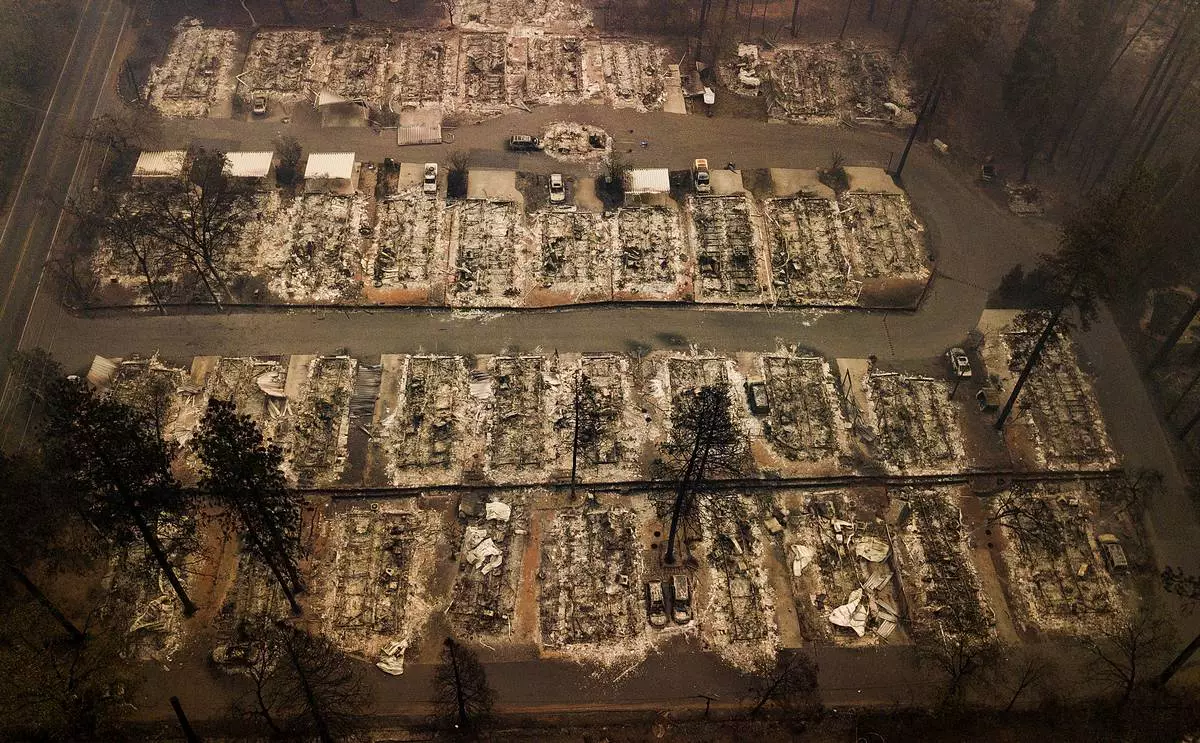
FILE - Residences leveled by a wildfire in Paradise, Calif., are seen on Nov. 15, 2018. (AP Photo/Noah Berger, File)
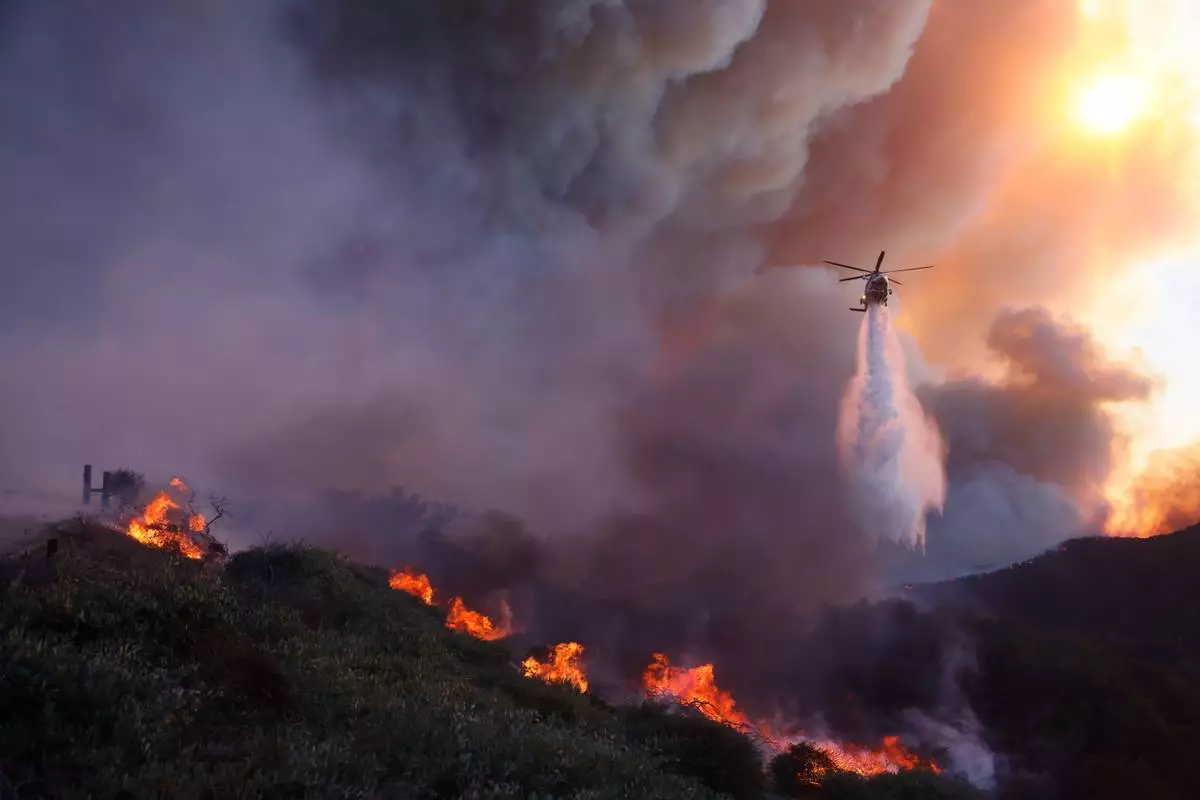
FILE - Water is dropped by helicopter on the advancing Palisades Fire in the Pacific Palisades neighborhood of Los Angeles, Jan. 7, 2025. (AP Photo/Etienne Laurent, File)
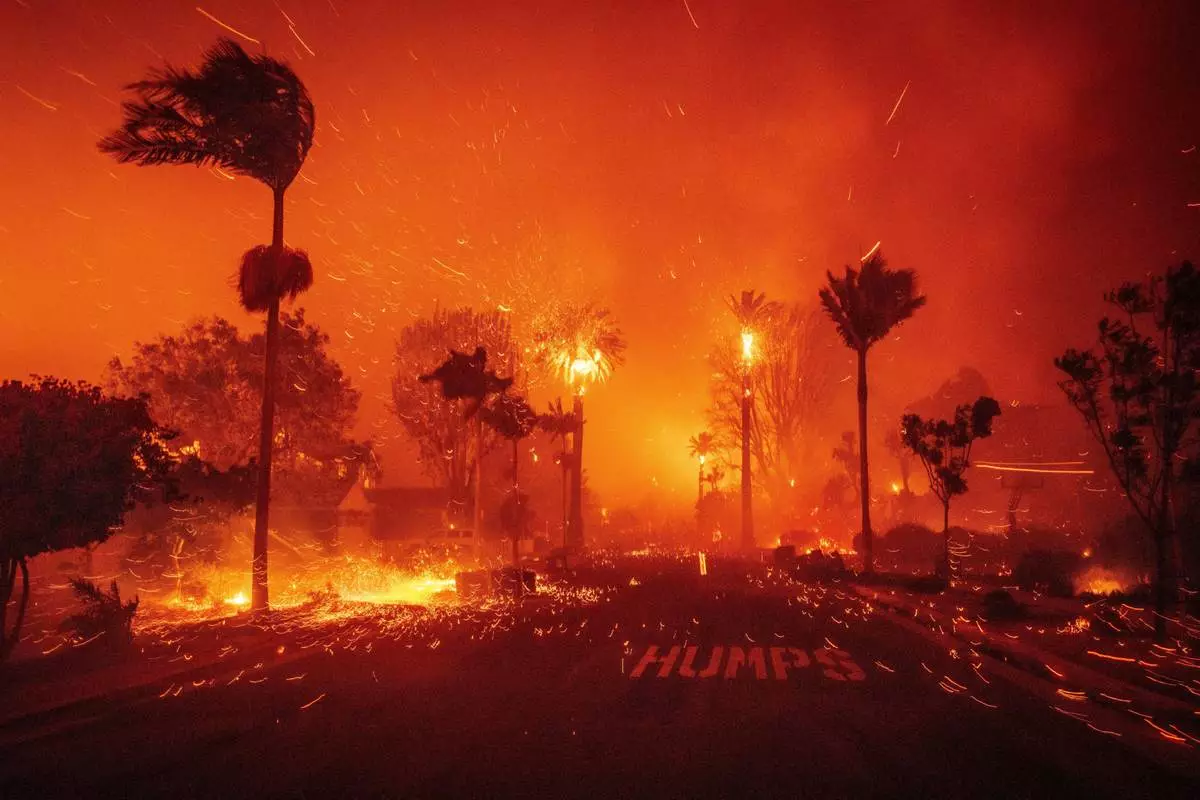
FILE - The Palisades Fire ravages a neighborhood amid high winds in the Pacific Palisades neighborhood of Los Angeles, Jan. 7, 2025. (AP Photo/Ethan Swope, File)
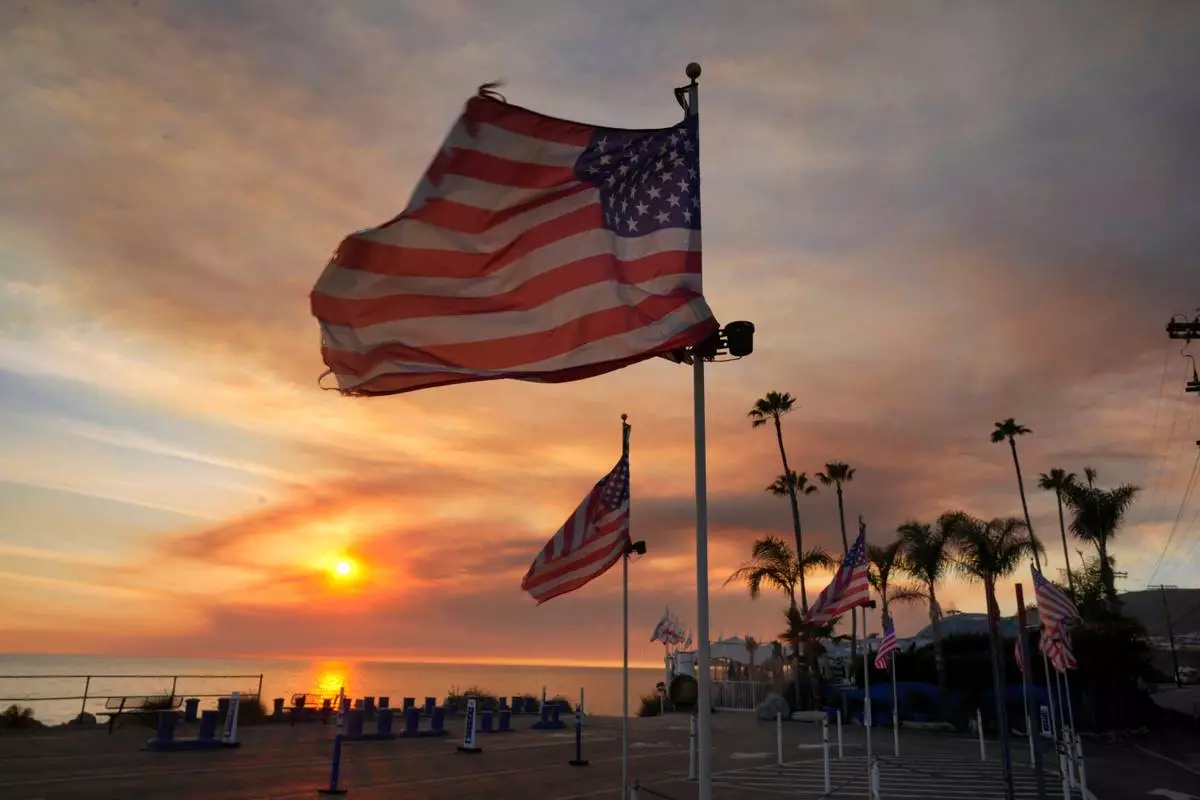
FILE - Flags fly under heavy winds before sunset as a plume of smoke from the Franklin Fire rises over the ocean Tuesday, Dec. 10, 2024, in Malibu, Calif. (AP Photo/Damian Dovarganes,File)