U.S. prosecutors said Wednesday they will not seek the death penalty as part of a plea agreement with the man charged in the political assassinations of the top Democrat in the Minnesota House along with her husband, as well as the attempted murders of a state senator and his wife.
The defendant, Vance Boelter, was scheduled for a change-of-plea hearing Thursday morning in federal court in Minneapolis.
“The Attorney General has authorized and directed the government not to seek the death penalty against Defendant Vance Luther Boelter in accordance with the terms delineated in a proposed plea agreement,” assistant U.S. attorneys Bradley M. Endicott and Matthew D. Forbes wrote in a letter to the court Wednesday.
The Justice Department had said earlier in the week that it decided not to pursue the death penalty. While the Trump administration has pushed for greater use of capital punishment, there were questions about whether Boelter’s case would qualify for it.
Boelter’s attorneys did not immediately respond to an email seeking comment. The court filing did not detail the terms of the plea agreement.
Former Minnesota House Speaker Melissa Hortman and her husband, Mark Hortman, and state Sen. John Hoffman and his wife, Yvette Hoffman, were shot by a man who came to their doors in the early hours of June 14, 2025, disguised as a police officer and driving a fake squad car. The Hortmans' golden retriever was so gravely injured that he had to be euthanized.
Boelter, 58, was captured near his home in rural Green Isle late the next day after what prosecutors have called the largest search for a suspect in Minnesota history. He faces federal and state murder, attempted murder and other charges. His state case has been on hold pending the resolution of his federal charges.
Minnesota abolished capital punishment in 1911 and has never had a federal death penalty case.
Daniel Borgertpoepping, a spokesperson for the Hennepin County Attorney’s Office, said the federal plea deal would not affect Boelter's state charges.
Under federal law, to obtain the death penalty against Boelter, prosecutors would have to show he committed the killings during another “crime of violence.” Boelter's underlying charge was that he stalked the victims.
A federal judge in New York earlier this year barred prosecutors from seeking the death penalty against Luigi Mangione in the killing of UnitedHealthcare CEO Brian Thompson, ruling that stalking doesn’t count as a violent crime.
Prosecutors have called the attacks on the Minnesota politicians political. When they announced the federal indictment in July, they released a rambling handwritten letter they say Boelter wrote to FBI Director Kash Patel in which he confessed to the shootings. However, the letter didn’t make clear why he targeted the Hortmans or the Hoffmans.
In some messages to media, Boelter referenced a vague and cryptic “investigation” he had been carrying out, sometimes suggesting it was about the COVID-19 vaccine.
Friends described Boelter as an evangelical Christian and occasional preacher and missionary, who held politically conservative views and had been struggling to find work.
When Minnesota's legislative session convened in February, Hoffman got a warm welcome as he walked up the stairs into the Senate chamber. He said in a lawsuit filed against Boelter in April that his left arm and hand likely would never fully recover, and that he also had permanent injuries to his digestive and urinary systems.
Yvette Hoffman was left with permanent physical weakness, the lawsuit said, while their adult daughter, Hope Hoffman, who was there and called 911 but was not shot, suffered severe psychological trauma.
Johnson reported from Seattle. Former AP reporter Steve Karnowski in Minneapolis contributed.
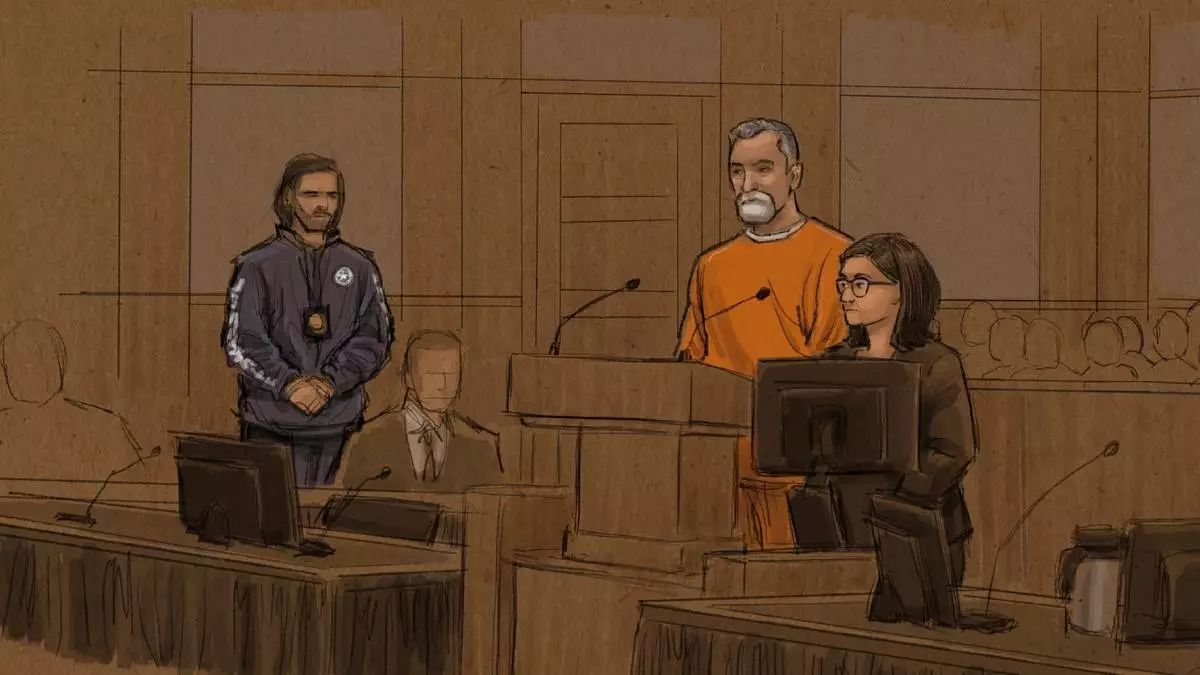
FILE - This courtroom sketch shows Vance Boelter, who is charged with killing the top Democrat in the Minnesota House and her husband and wounding a state senator and his wife, appears at federal court in Minneapolis on Aug. 7, 2025. (Cedric Hohnstadt via AP, File)
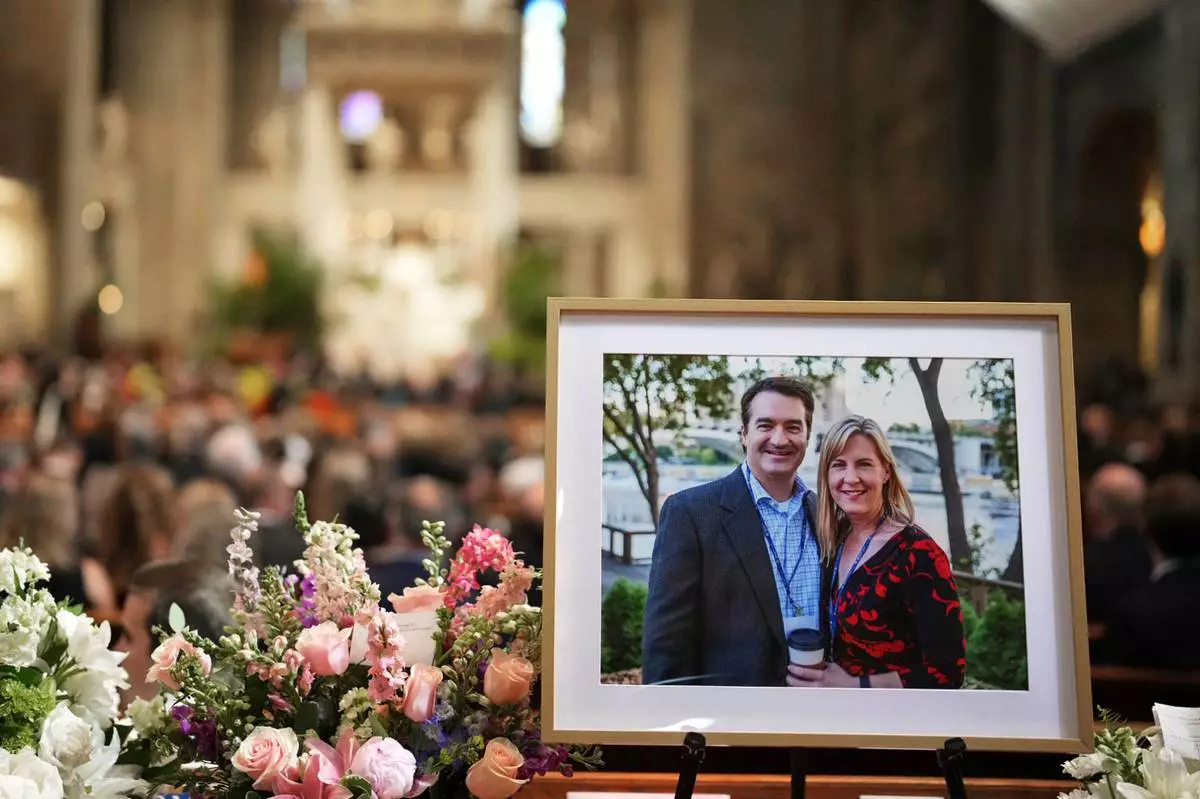
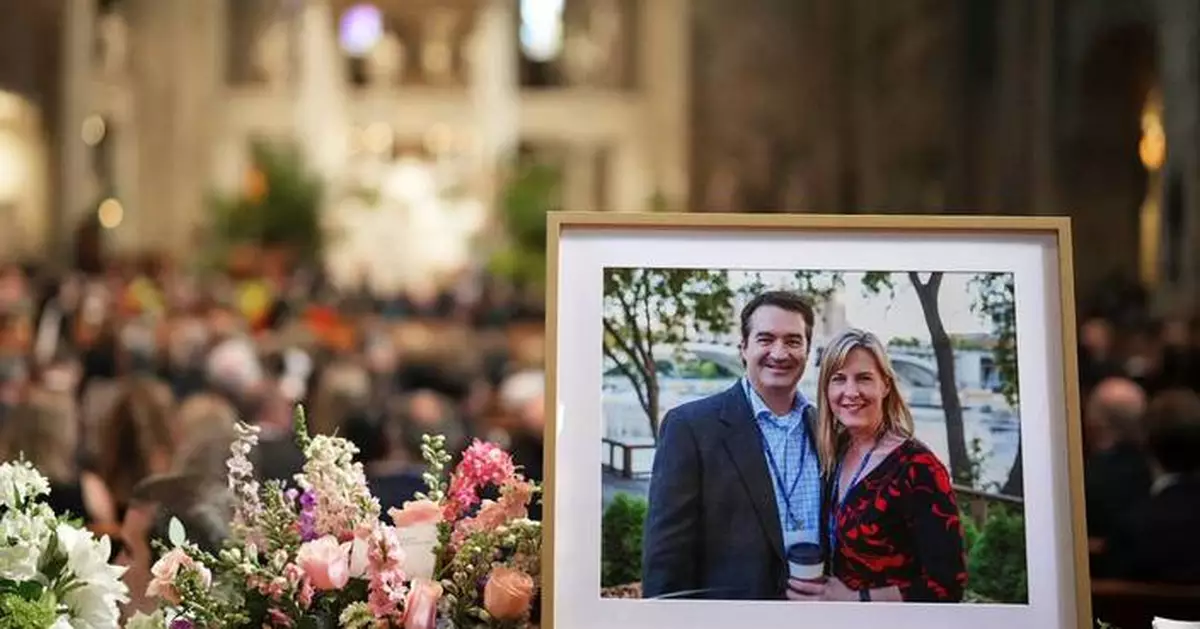
FILE - A photo of Mark and Melissa Hortman is displayed during their funeral service inside the sanctuary at the Basilica of St. Mary's in Minneapolis on June 28, 2025. (Alex Kormann/Star Tribune via AP, Pool, File)
BELFAST, Northern Ireland (AP) — Police blasted water cannons Wednesday at protesters in Northern Ireland who set small fires and hurled bricks, rocks and bottles at them during a second night of violence over a brutal stabbing on a Belfast street.
Demonstrators wearing masks tore bricks from the walls outside homes and smashed sidewalks with sledgehammers to toss at riot police. In one place, the unruly crowd used sections of a dismantled a picket fence to take cover on the street.
The clashes with police came several hours after a 30-year-old man from Sudan appeared in a Belfast court charged with attempted murder in a stabbing attack that left a man seriously injured and triggered anti-immigrant violence.
Hadi Alodid, 30, was ordered held in jail after appearing by video in Belfast Magistrates’ Court, where a detective said he blinded Stephen Ogilvie in the left eye during the knife attack. He was also charged with possessing a knife and threatening to kill a radiographer while being treated for a hand injury after the assault.
When police arrived at the crime scene, they found Alodid on the man, armed with a kitchen knife, the detective said. Alodid later told hospital staff: “I’ve killed someone, I don’t know if they are dead,” and said, “I will kill you."
He refused legal representation through an Arabic interpreter and did not enter a plea.
Police were prepared for more violence after masked men on Tuesday set fire to several homes they believed to house immigrants, burned trash bins, torched a Belfast bus and pelted police with objects.
Firefighters rescued several people from burning houses and more than two dozen people were left homeless.
Anselme Shima, a Belfast resident originally from Congo, said he saw smoke from burning vehicles near his home.
“I’ve lived on my street for almost 10 years, I have a good relationship with my neighbors, but last night was a horrific one,” he said. “We don’t know what to do. I’m scared. Seeing this, I’m wondering if I’m next.”
Families, one with a baby, were rescued and taken to police stations for safety, Police Service of Northern Ireland Chief Constable Jon Boutcher said.
“These weren’t just families from ethnic minority communities, these were families from across communities that were caught up in this vile behavior last night," Boutcher told the BBC. “There is absolutely no excuse for it.”
Boutcher said 200 more officers would be on the streets Wednesday and the PSNI was calling in support from other forces. Bus and train operators in Belfast said they would stop services early because of expected protests.
Ogilvie’s family appealed for an end to the violence and said migrants “make a deeply valuable contribution to our country.”
“We do not want this terrible tragedy to be used to divide people or fuel hostility,” the family said in a statement.
Politicians from both parts of Northern Ireland’s power-sharing government condemned the violence. First Minister Michelle O’Neill of Irish nationalist party Sinn Fein said it was “thuggery.”
“Groups of masked men burning families out of their homes is nothing less than disgusting cowardice,” she said.
Deputy First Minister Emma Little-Pengelly, of the pro-British Democratic Unionist Party, said that “taking frustration at the evil actions of a person out on those who had no part in it is utterly wrong.”
Monday’s attack, caught in video footage that quickly spread on social media, was seized on by anti-immigration activists. Ogilvie, a man in his 40s, was hospitalized with deep cuts to his head, face and back.
Police said Alodid entered Northern Ireland from the neighboring Republic of Ireland in 2023, applied for asylum and was given a 5-year permit to remain.
The Police Service of Northern Ireland said there is no information to suggest the attack was terrorism-related.
Protests were encouraged online by far-right activists, and the street violence erupted despite politicians' calls for calm.
Prime Minister Keir Starmer condemned the stabbing attack as “sickening,” but said violence against people based on their background would not be tolerated.
“The scenes in Belfast last night were shocking and completely unacceptable," Starmer said on X. “There is no justification for the violence and disorder that we saw threatening our communities, nor for those who encouraged it, online or elsewhere.”
Northern Ireland Justice Minister Naomi Long said social media agitators who “yesterday would have struggled to find Belfast on a map” were “weaponizing” the fears of local people.
“If you’re driving people from their homes based on nothing but the color of their skin, you can’t dress that up any other way, it’s racism, and those bad faith actors need to take a step back,” she told the BBC.
Some politicians said the stabbing should spark a review of the open border between Northern Ireland, which is part of the U.K., and the Republic of Ireland.
The border is a highly sensitive issue. Allowing the free flow of people is a major pillar of the peace process that largely ended decades of violence known as “The Troubles.” The conflict involving Irish Republican and British Loyalist militants and U.K. security forces left almost 3,600 people dead before a 1998 peace accord.
Much of Tuesday’s violence took place in working-class areas where former paramilitary groups still hold considerable sway over the streets.
Last week a separate case of a university student who was stabbed to death in Southampton, England, in December was seized on by activists and U.S. Vice President JD Vance, who blamed immigration for the violence, an idea rejected by Starmer and other British politicians.
Henry Nowak, who was white, was killed by Vickrum Digwa, a Sikh who falsely claimed to police that he was the victim of a racist assault by Nowak. When police officers arrived, they initially treated the wounded Nowak as a suspect before noticing his injury and trying to resuscitate him.
Digwa was convicted of murder and sentenced last week to life in prison with a minimum 21-year term. A protest over Nowak’s death turned violent, with some attacking police with chairs and rocks. Several people were charged with violent disorder.
Lawless reported from London. Brian Melley contributed to this story.

Jamie Corrie stands beside his burnt out house after rioting broke out late Tuesday, in east Belfast, Northern Ireland, Wednesday, June 10, 2026, following a stabbing incident. (AP Photo/Peter Morrison)
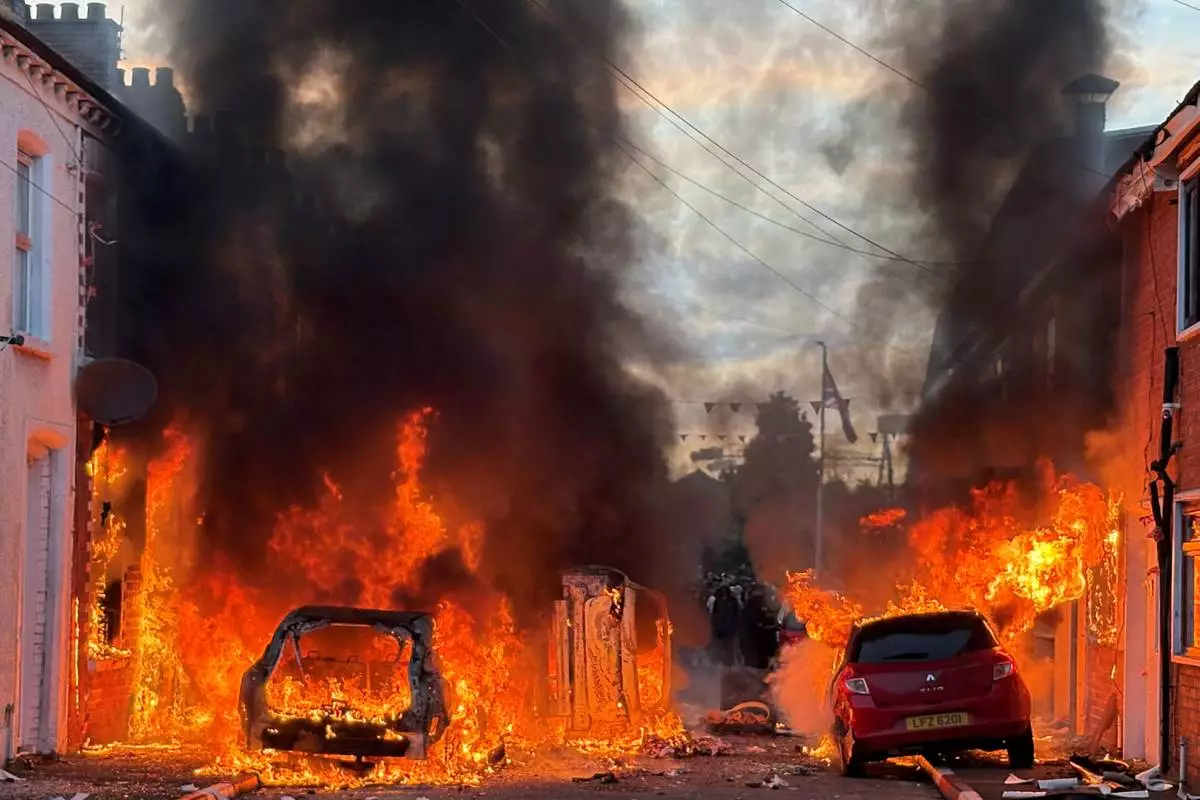
Vehicles set on fire by protesters burn on Lendrick Street in east Belfast, Northern Ireland, on Tuesday, June 9, 2026, after the arrest of a Sudanese man accused of stabbing a man in the northern part of the city. (PA via AP)
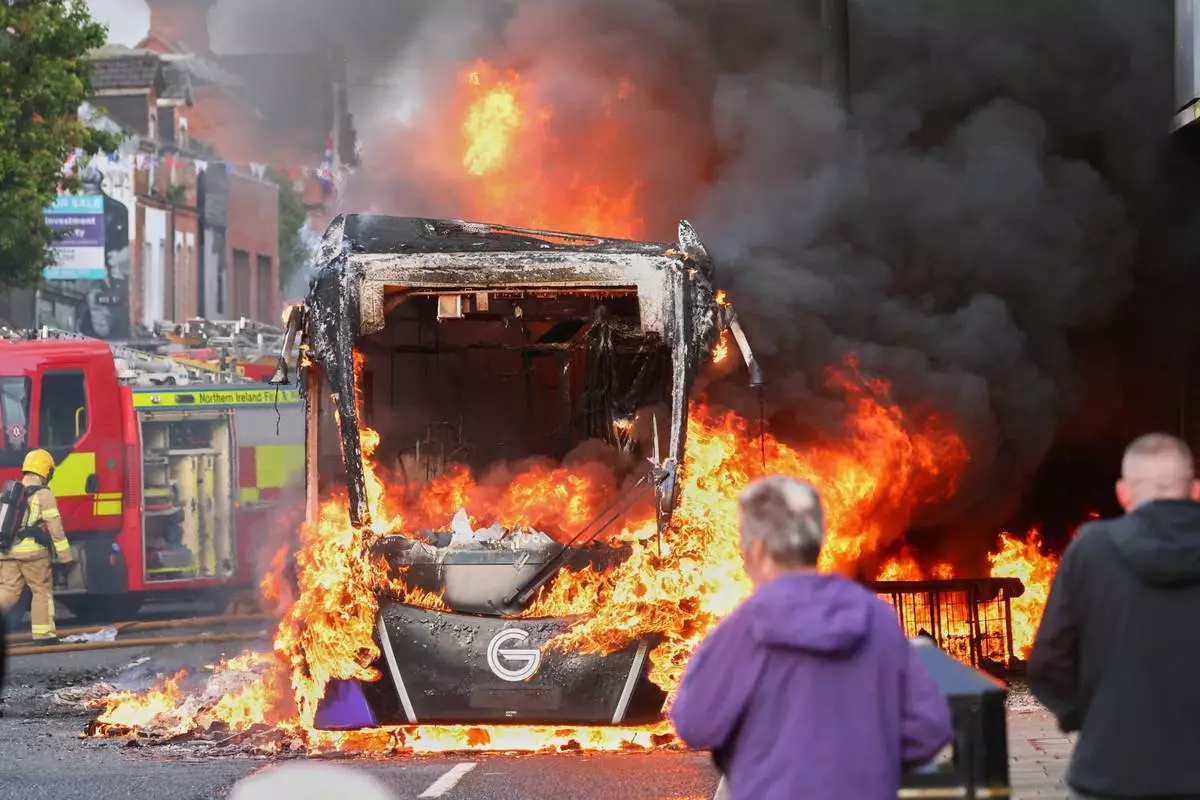
People watch as firemen arrive to put out vehicle that was set alight during a protest in East Belfast following a stabbing incident in Belfast, Tuesday, June 9, 2026. (AP Photo/Peter Morrison)
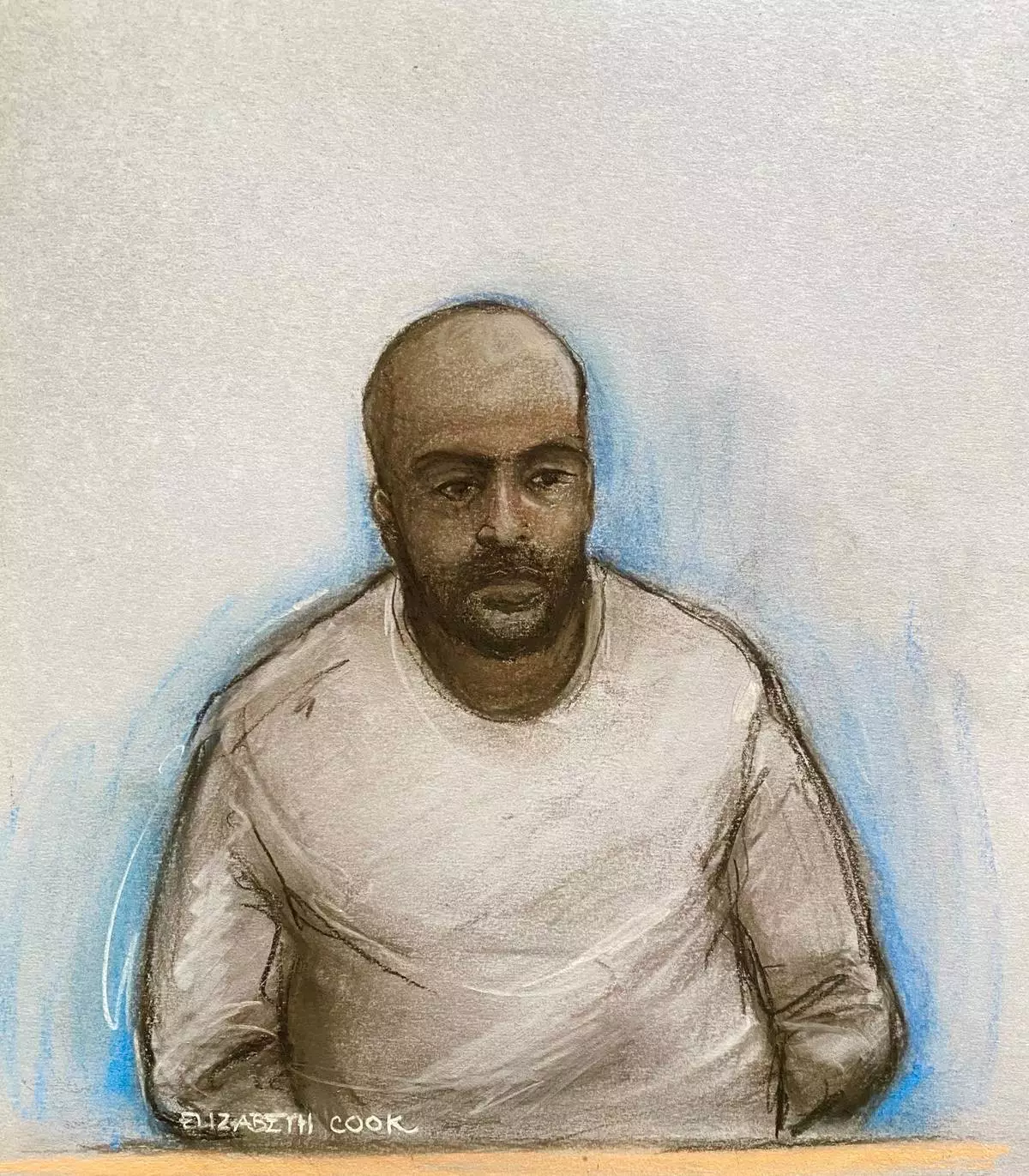
This is a court artist drawing by Elizabeth Cook of Sudanese national Hadi Alodid, 30 appearing via videolink at Belfast Magistrates Court, Belfast, Wednesday, June 10, 2026, after a stabbing attack. (Elizabeth Cook/PA via AP)
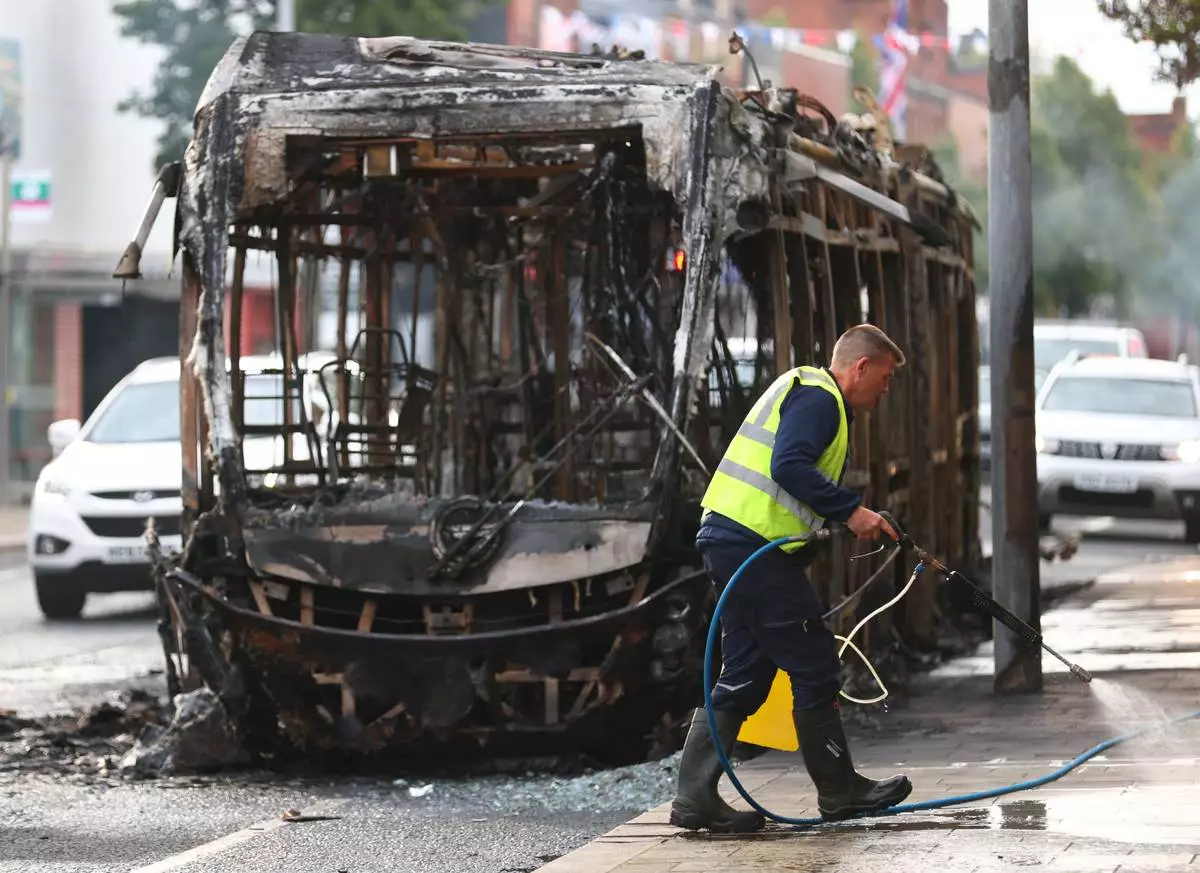
A worker clear up the debris in front of a burnt out bus, after rioting broke out late Tuesday, in east Belfast, Northern Ireland, Wednesday, June 10, 2026, following a stabbing incident. (AP Photo/Peter Morrison)
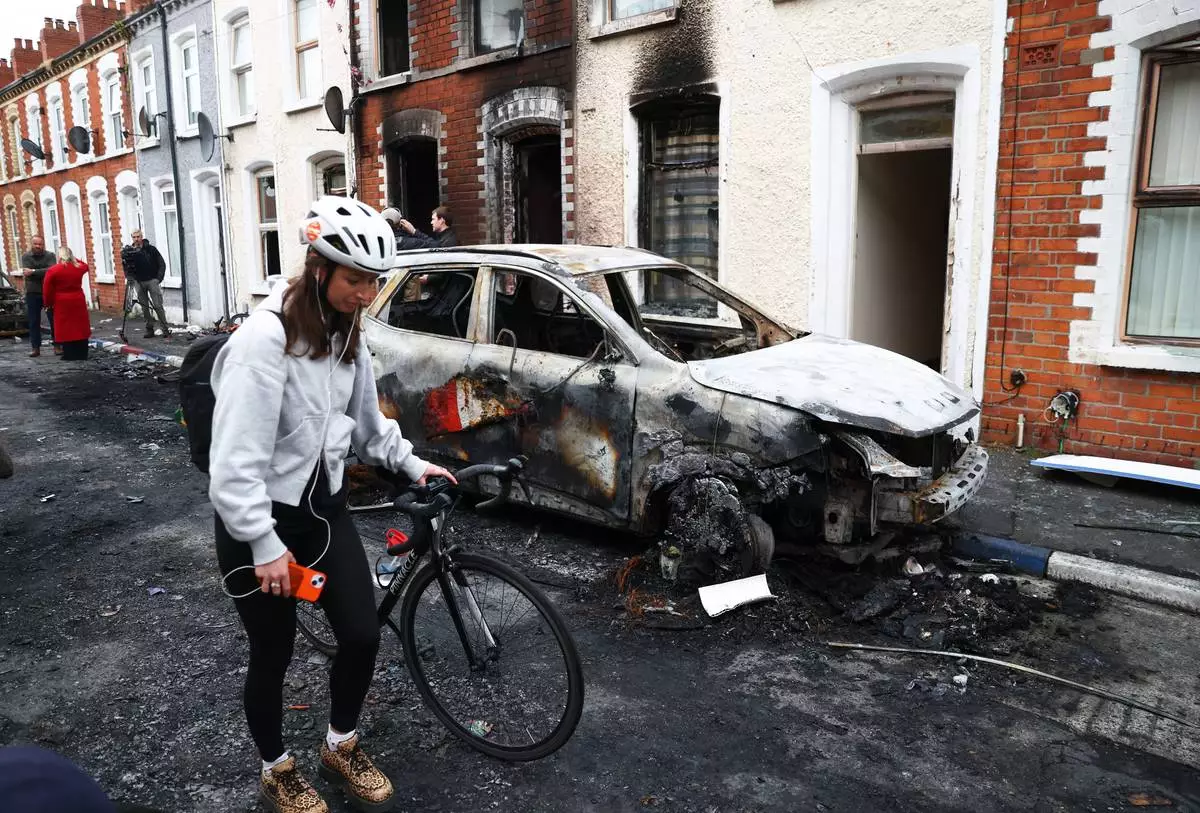
A woman walks past burnt out houses after rioting broke out late Tuesday, in east Belfast, Northern Ireland, Wednesday, June 10, 2026, following a stabbing incident. (AP Photo/Peter Morrison)
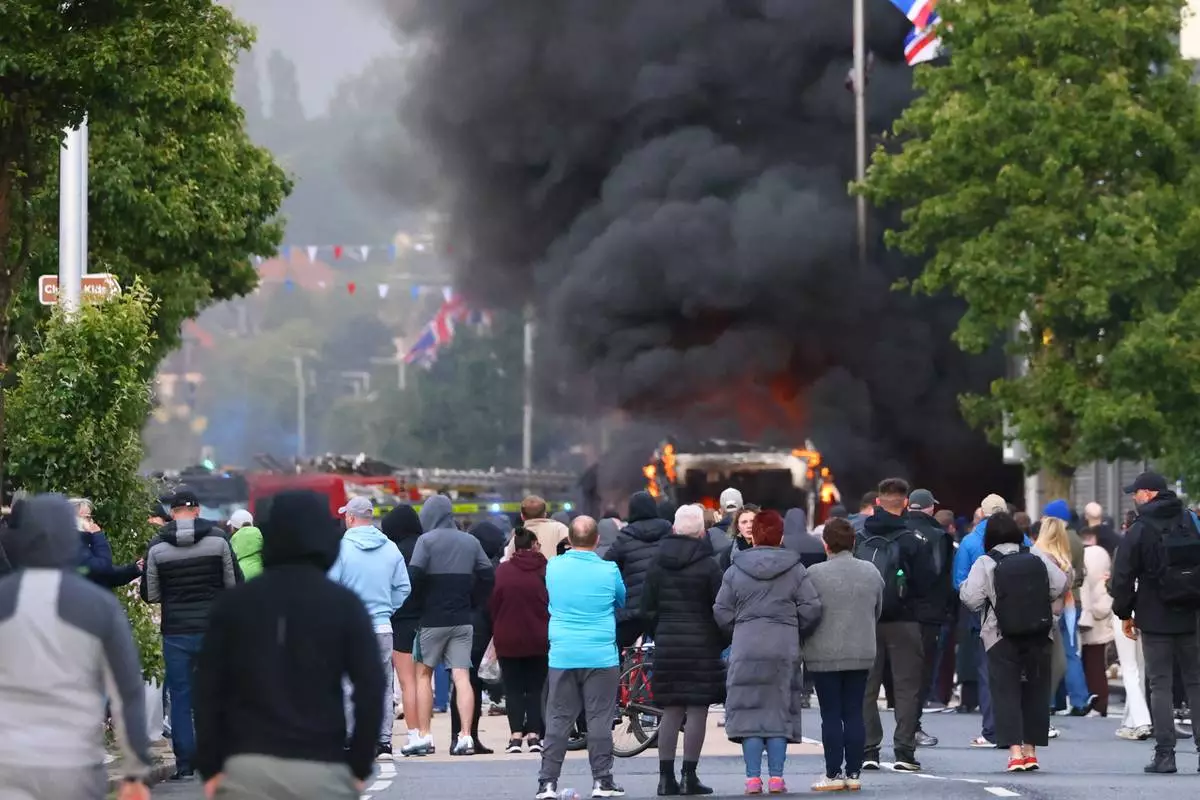
People watch as a vehicle burns during a protest following a stabbing incident in North Belfast, Tuesday, June 9, 2026. (AP Photo/Peter Morrison)
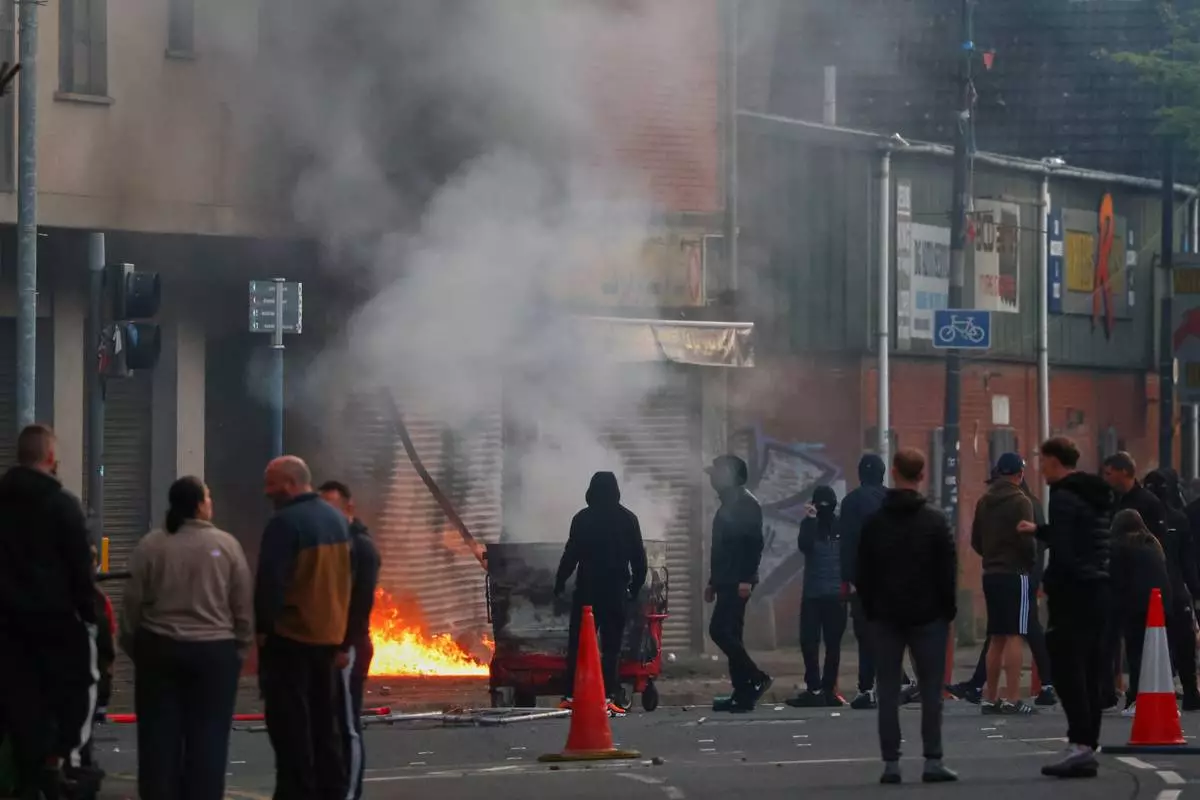
A building is set light to by protesters in central Belfast following a stabbing incident in Belfast, Tuesday, June 9, 2026. (AP Photo/Peter Morrison)
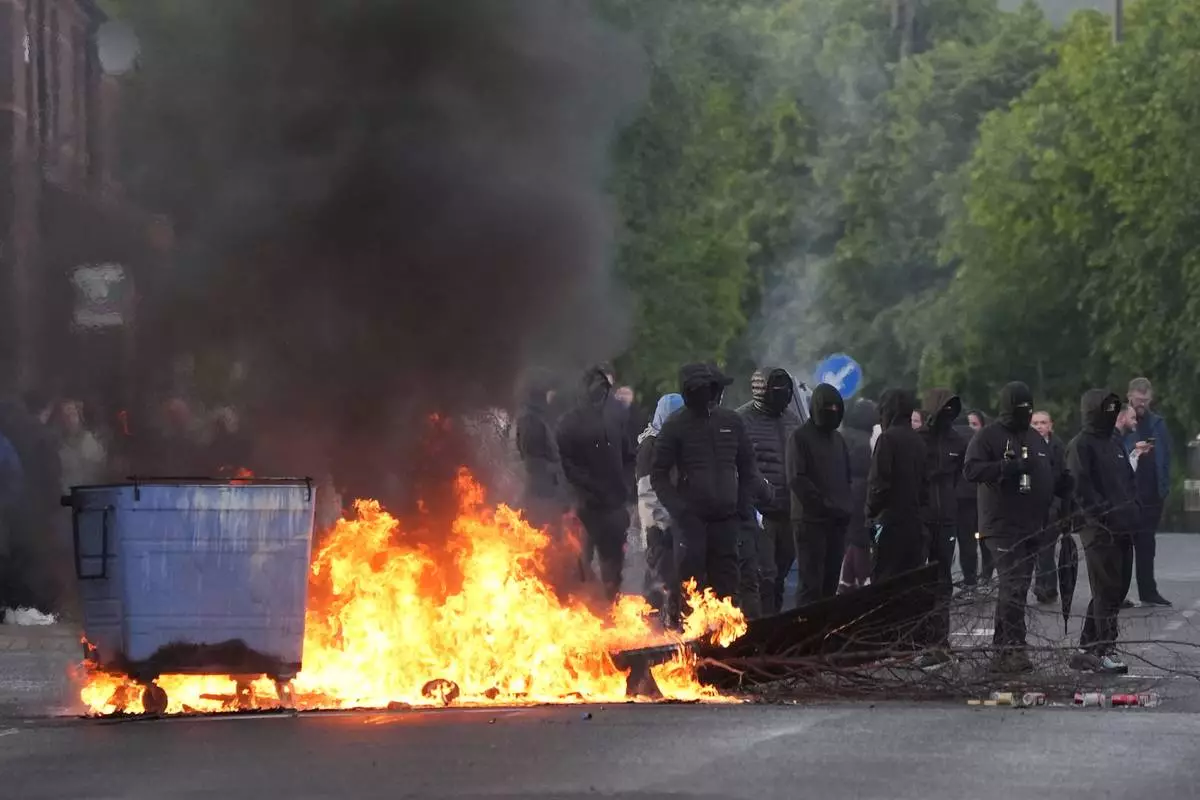
Masked protesters stand by burning trash containers on Ligoniel Road in Belfast, Northern Ireland, on Tuesday, June 9, 2026, after the arrest of a Sudanese man accused of stabbing a man in the northern part of the city. (PA via AP)
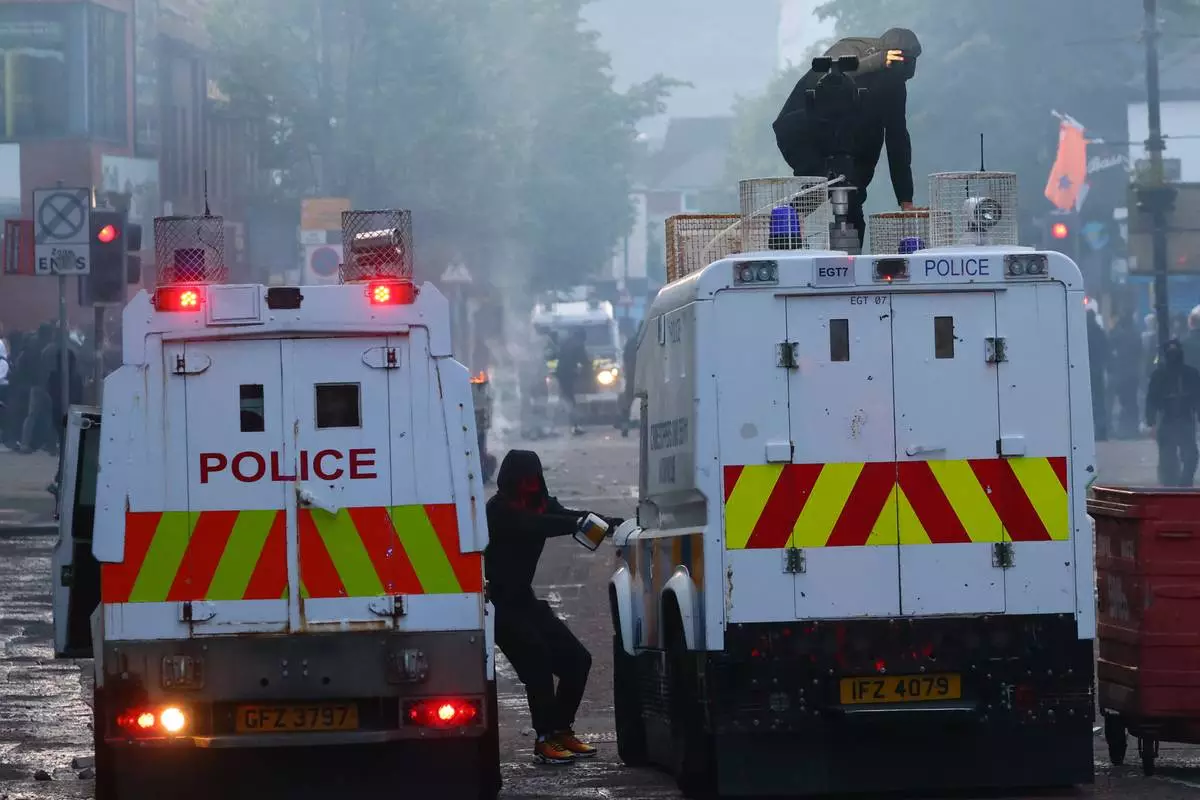
Police vehicles come under attack from protesters following a stabbing incident in Belfast, Tuesday, June 9, 2026. (AP Photo/Peter Morrison)
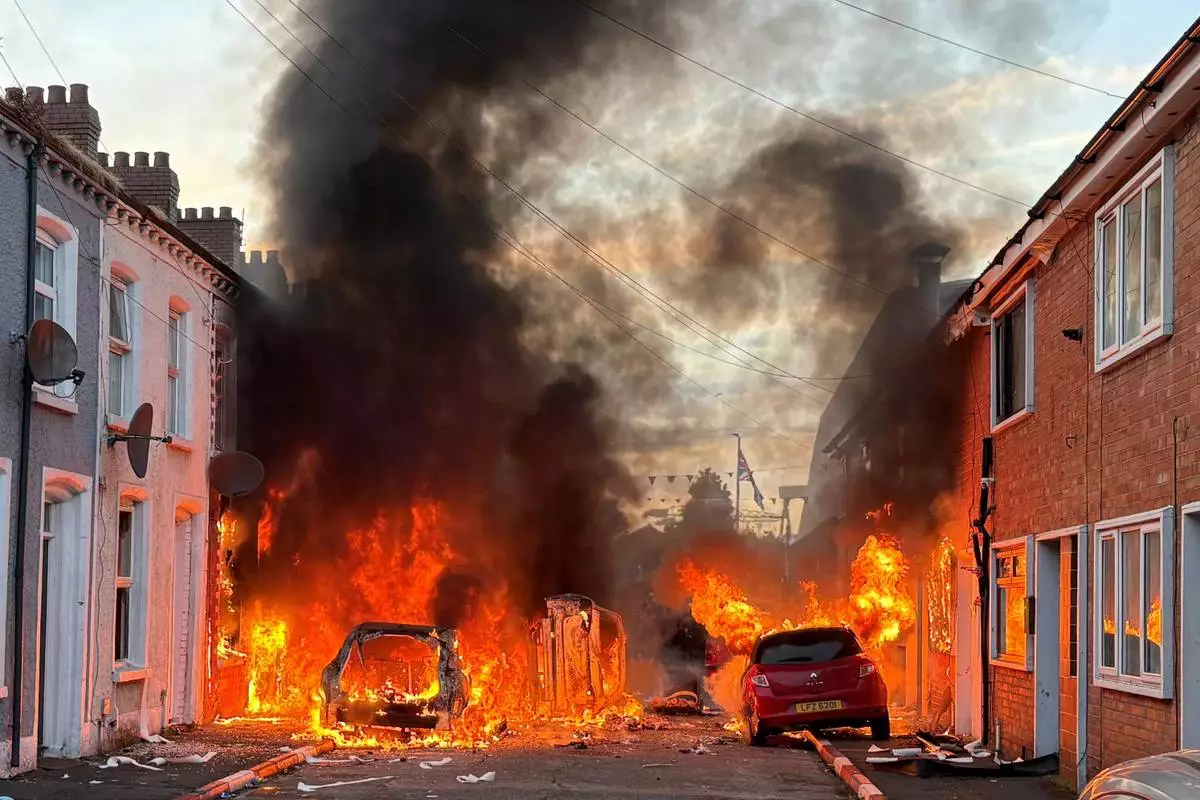
Vehicles set on fire by protesters burn on Lendrick Street in east Belfast, Northern Ireland, on Tuesday, June 9, 2026, after the arrest of a Sudanese man accused of stabbing a man in the northern part of the city. (PA via AP)