HOUSTON--(BUSINESS WIRE)--Jun 11, 2026--
Electrical Grid Monitoring (EGM) today announced its patented Accurate Fault Location and Detection™ (AFLD) solution as the first technology that can accurately locate both the time and location of power distribution‑grid faults to within a single pole‑span distance, capabilities which could reduce U.S. customer power outage times from 3-5 hours to approximately one hour, and related utility crew-time costs by 80% from $7 billion annually to around $1 billion annually, based on published industry outage statistics.*
This press release features multimedia. View the full release here: https://www.businesswire.com/news/home/20260611227808/en/
The EGM fault-location solution was independently tested in a blind study by the U.S. Department of Energy’s (DOE’s) National Laboratory of the Rockies (NLR) which then provided test data on fault location accuracy to EGM. According to EGM analysts, the study results, which consisted of 26 blind scenarios, showed promise that EGM’s patented Accurate Fault Location and Detection™ (AFLD) solution can locate multiple power distribution‑grid faults to within a single pole‑span distance. **
“We are pleased that the capabilities of EGM’s grid-fault location detection technology have been successfully validated through independent testing at NLR,” said Alex Levran, Ph.D., CEO of Electrical Grid Monitoring. “Our AFLD technology marks a significant advancement in grid‑reliability innovation by delivering an affordable solution that is unique in its ability to accurately identify both the time and location of a fault, which have traditionally been two of the most costly and time-consuming aspects of power-outage resolution.”
Levran explained that utility crews typically spend two-thirds of their time locating faults and one-third repairing them. By shortening detection and resolution times, EGM’s solution reduces costs for utilities and consumers and can potentially cut outage durations by half.
Addressing a costly challenge and reliability concerns
U.S. utilities spend approximately $7 billion annually to dispatch crews for locating and repairing 2.3 million*** power outages. Typical power outages last 2-3 hours, but challenging terrain can extend outages to 7 hours or more. While extreme weather events receive much attention, most interruptions are caused by everyday distribution faults such as branches on laterals, insulator failures, and momentary events.
According to industry estimates, more than 10 million utility “truck rolls” are dispatched yearly in the U.S., costing an average of $1,000 per trip—imposing substantial economic burdens on both utilities and consumers. However, annual utility maintenance costs are increasing due to an aging, overworked grid system, where vast areas contain “blind spots” because they lack detection systems to enable quick fault location and identification.
In its 2025 Report on Evaluating U.S. Grid Reliability and Security, the DOE warned that absent new firm capacity and continued retirement of reliable generation, customer outages could increase by up to 100 times by 2030, with outages rising to more than 800 hours annually in some regions.
The 2025 DOE Pathways to Commercial Liftoff Report says that U.S. electricity demand is expected to increase by 15%-20% in the next decade and double by 2050. In 2025, the DOE launched its “Accelerating Speed to Power” program. The program is designed to accelerate development timelines for large-scale transmission and generation projects to address the growing grid demands for AI, datacenters, and priority onshoring of U.S. manufacturing, while meeting rising demand for affordable, reliable and secure energy.
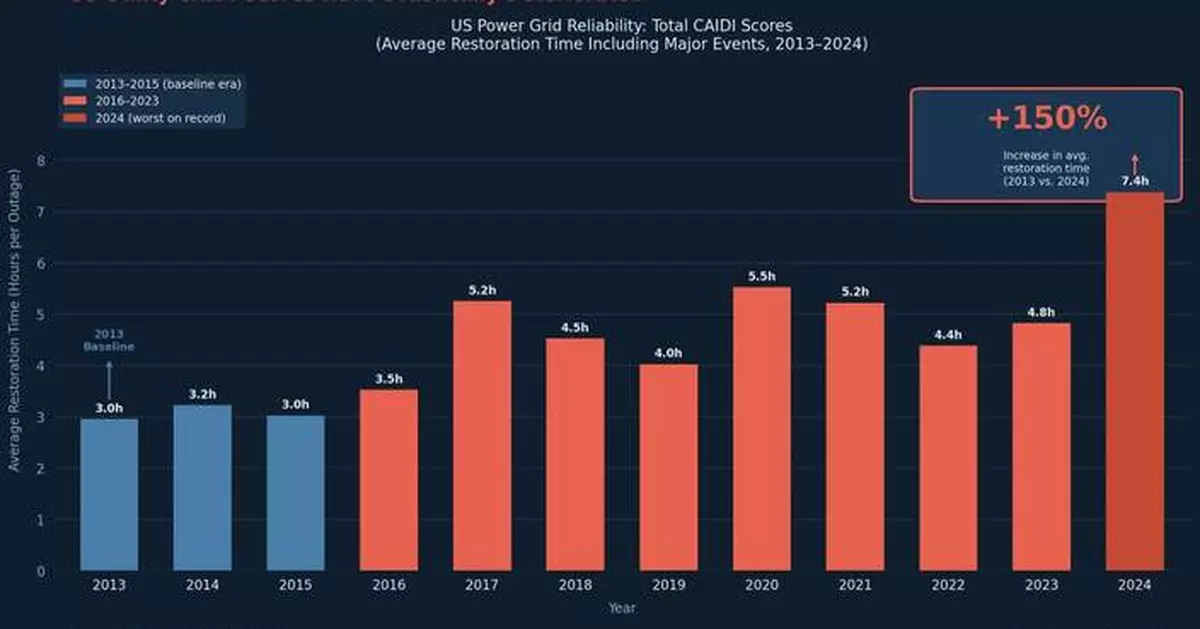
Reliability and affordability are critical because U.S. electricity prices have reached historic highs, especially in California, where consumers pay 34 cents per kilowatt—120% higher than 15 years ago. And U.S. power reliability metrics continue to worsen: System Average Interruption Duration Index (SAIDI) scores have risen nearly 300% since 2010, and Customer Average Interruption Duration Index (CAIDI) metrics have increased by 160%, according to the International Energy Agency (IEA).
The shift to U.S. manufacturing also requires lower energy rates for companies to profitably compete in international markets. The EGM Meta Alert system offers utilities a cost-effective solution by reducing grid-management expenses, and it will complement future grid configurations associated with mega-datacenters, Levran said. He also said that EGM is moving its own manufacturing facilities to the U.S. to improve efficiencies and reduce both costs and supply chain risks for its customers.
EGM’s system goes beyond fault detection, collecting critical electrical, mechanical, and environmental data—such as voltage, cable temperature, humidity, wind speed, and powerline movement. These parameters help utilities reduce the duration and risk of faults. For example, within minutes, the system can quickly identify incidents caused by heavy winds or fallen trees—such as wildfires, generating actionable data and real-time dashboards for operators.
The EGM Meta-Alert System offers a suite of applications to improve grid performance: power quality, wildfire protection, fault location, dynamic line ratings, and general telemetry. Utilities benefit from reduced service costs, prevention of major outages, and lower energy congestion.
With a return on investment (ROI) under one year, EGM’s offering helps sustain lower energy rates and unlike traditional pole-mounted devices requiring sensors on every pole, EGM deploys clusters of sensors at strategic feeder locations. Each sensor clamps directly onto power lines, capturing comprehensive fault signatures and measuring dozens of parameters previously unavailable. The data is transmitted in real-time to the EGM Meta-Alert™ software, which uses patented algorithms to triangulate fault locations.
The scale of the challenge drew Energy Growth Momentum, a London-based private-equity firm specializing in advancing digital solutions for decarbonized power, to invest in EGM. Energy Growth Momentum led the company’s Series B round, bringing current total funding for EGM to more than $40 million.
“At Energy Growth Momentum, we invest in highly scalable digital solutions that can have an outsized impact on the power grid and energy market,” said Chris Holcroft, an investor and board director at Energy Growth Momentum. “We are particularly focused on dislocations in the transmission and distribution grid, where demand for investment far outstrips supply,” Holcroft said.
Digital solutions can deliver reliability, efficiency, and affordability at scale, but at a fraction of the cost of building new infrastructure, Holcroft said. “EGM offers a complete, low-cost solution accessible to most utilities. We see tremendous potential in fault location for the U.S. market—with an annualized cost-savings potential between $7 billion and $20 billion.”
Alternatives to the EGM system each have limitations—they lack the ability to identify location or other key parameters, they require sensors to be mounted on every pole, which is impractical at utility scale—where networks span millions of poles. Other higher-end solutions are cost prohibitive for all but the largest utilities.
EGM is currently working with the Israel Electric Corporation and multiple U.S. investor‑owned utilities and cooperatives to deploy its technology on live distribution networks.
* & *** (Source: U.S. Public Service Commission data, Energy Information Agency (EIA) Form 861). The results of the EGM pilot study were presented at the Institute of Electrical and Electronics Engineers (IEEE) Conference in May 2026.
**NLR conducted the tests as part of its grid modernization and energy systems research activities. Reference to EGM technology does not constitute endorsement, recommendation, or certification by NLR, the U.S. Department of Energy, or the U.S. government.
About Electrical Grid Monitoring (EGM)
Electric Grid Monitoring (EGM) is a U.S.-based company that builds cost-effective, real-time monitoring systems for electric utility distribution and transmission systems. The company is based in Los Angeles, and is led by CEO Alex Levran, Ph.D. Levran formerly led Power-One, the world’s second-largest global solar-inverter supplier, which grew into a $1 billion solar business before it was sold to ABB in 2013.
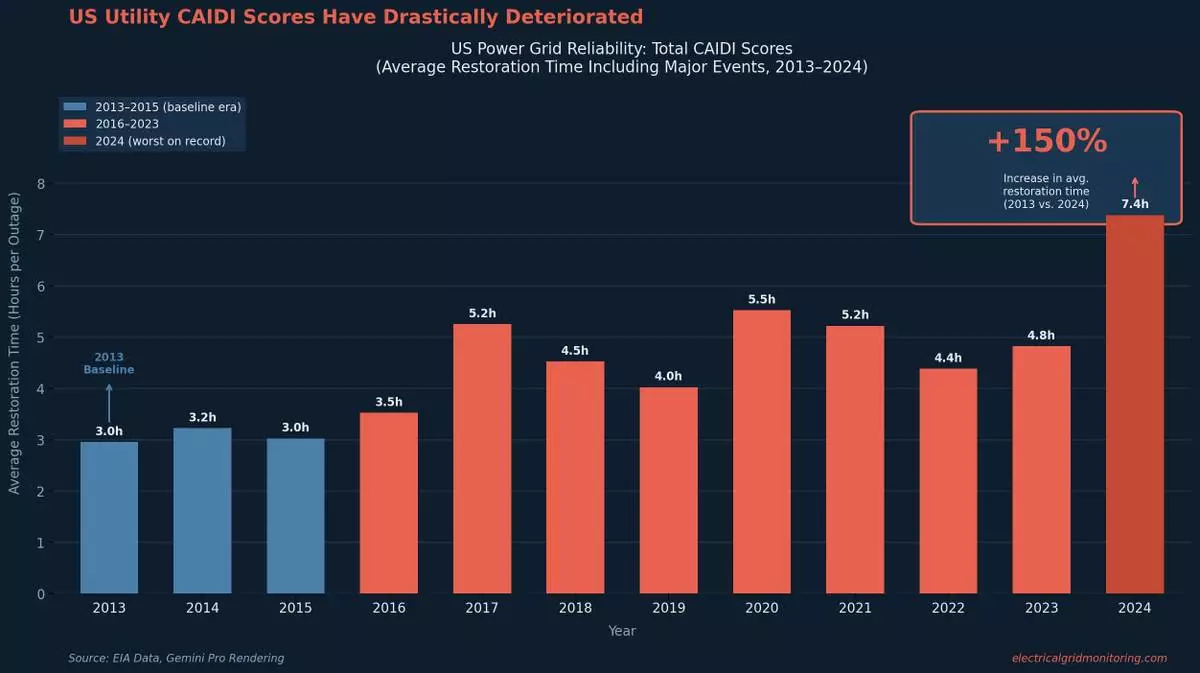
U.S. CAIDI scores are up 150%, with average outage restoration hitting a record 7.4 hours in 2024. EGM's Accurate Fault Location and Detection™ aims to reverse the trend—locating grid faults to within a single pole-span and potentially cutting outage times to ~1 hour while reducing utility crew costs up to 80%.
President Donald Trump on Thursday said the U.S. would hit Iran “VERY HARD TONIGHT,” threatening in a social media post to “assume total control” of Iran’s oil and gas industries, including the key Kharg Island, in the “not too distant future.”
The U.S and Iran traded strikes for a second day, pushing the Middle East closer to the resumption of a full-scale war.
It was the third time this week that back-and-forth strikes have rattled the Middle East. The first involved attacks between Iran and Israel, followed by the two rounds of fire between the U.S. and Iran, which hit countries in the region that host American bases.
Here's the latest:
Markwayne Mullin said he wouldn’t get into specifics on why the Somali referee was prevented from entering the U.S. to officiate at the World Cup. But Mullin said the government wasn’t going to admit people believed to have “criminal ties.”
“I’m not going to get into why we denied this individual, but there’s a reason why this person was denied,” Mullin said during a news conference.
Mullin said the department is also in close consultation with FIFA and explains their decisions in a case like this.
“We talk to FIFA and their directors constantly. Anybody that was denied, we made the case for and showed them why they were denied,” Mullin said.
“We did a phenomenal job on getting as many people cleared as we could, but some people just can’t clear,” he said.
American strikes on Iran that lasted into Thursday morning appeared more intense and widespread than the day before.
Tehran released little information on the extent of the damage and said it fired back at Kuwait, Bahrain and Jordan, as it had the previous day.
It was the third time this week that back-and-forth strikes have rattled the Middle East. The first involved attacks between Iran and Israel, followed by the two rounds of fire between the U.S. and Iran, which hit countries in the region that host American bases.
Iran’s Foreign Ministry said in a statement Thursday that the U.S. attacks had “effectively rendered the ceasefire ... meaningless,” without saying it was abandoning it.
Kharg Island — located on the other side of the Persian Gulf from U.S. bases in Kuwait and Saudi Arabia — is the beating heart of Iran’s oil industry, through which 90% of its exports pass. It’s important because Iran’s coastline is mostly too shallow for tanker ships to dock.
It was unclear how serious Trump was about his threat to seize it.
“My preference has always been to take Kharg Island,” Trump said in an interview Thursday on Fox News. “I don’t know that America has the stomach for it to be honest.”
American troops would be vulnerable on Kharg Island because of its close proximity — about 33 kilometers (21 miles) — to the Iranian mainland, from which missiles, drones and artillery could be fired.
Trump indicated in the interview that he remains averse to sending U.S. forces into Iran. “We could walk in there tomorrow. We could take soldiers — I don’t want to have boots on the ground. But if I wanted to we could put a small group of soldiers and take over the place.”
Cuba’s representative to the United Nations, Ernesto Soberón, reacted Thursday to U.S. Defense Secretary Pete Hegseth’s visit the previous day to the U.S. naval base at Guantánamo Bay in eastern Cuba.
“The future of #Cuba —a sovereign and independent country— belongs solely and exclusively to the Cuban people and government”, Soberón wrote in a social media post.
“Anyone who believes that Cuba’s future lies in other hands is completely and utterly mistaken,” added the diplomat, who accompanied his message with a photograph of Hegseth in front of his troops, officially released by the United States.
Hegseth’s visit to the eastern portion of the island, which is controlled by the United States, comes at a time of heightened tension between Washington and Havana.
The opening of the Canadian-U.S. bridge across the Detroit River that President Trump previously threatened to block has been delayed due to “outstanding issues.”
In a statement released Thursday ahead of a Friday ribbon-cutting ceremony at the bridge, the Windsor-Detroit Bridge Authority says “Canada and the United States have agreed to delay the opening of the bridge, taking the necessary time to resolve any outstanding issues.”
▶ Read more
The number of Americans filing for unemployment aid for the week ending June 6 rose by 4,000 to 229,000, the Labor Department reported Thursday. That’s the most since early February, before the U.S. and Israel launched attacks on Iran, but still considered a healthy level. It’s also more than the 216,000 new applications forecast by analysts surveyed by the data firm FactSet.
Weekly filings for unemployment benefits are considered a proxy for U.S. layoffs and are close to a real-time indicator of the health of the job market.
The four-week moving average of jobless claims, which softens some of the weekly volatility, rose by 4,250 to 219,000.
The total number of Americans filing for unemployment benefits for the previous week ending May 30 jumped by 24,000 to 1.8 million, slightly more than analysts predicted.
▶ Read more
The president on Thursday said the U.S. would hit Iran “VERY HARD TONIGHT,” threatening in a social media post to “assume total control” of Iran’s oil and gas industries, including the key Kharg Island, in the “not too distant future.”
The post came after the U.S and Iran traded strikes for a second day, pushing the Middle East closer to the resumption of a full-scale war. The American attack, which lasted into Thursday morning in Iran, appeared more intense and wider than the day before.
Iran released little information on the extent of the damage and said it fired back at Kuwait, Bahrain and Jordan, as it had a day before.
▶ Read more
A massive coastal development project linked to Jared Kushner, the son-in-law of President Trump, is facing growing resistance from protesters in Albania.
Thousands of protesters are taking to the streets in nightly protests, blowing whistles and holding up cardboard cut-outs of flamingos — one of the protected migratory bird species that could see their habitats threatened by the proposed luxury resort.
The government says the development on the Adriatic coast would be transformational for the former communist nation as it seeks to enter the high-end tourism market and pushes for European Union membership.
But the venture, spanning an abandoned island and a nearby stretch of seafront on Albania’s southern coast, has drawn opposition from environmental campaigners and critics of longtime Socialist Prime Minister Edi Rama.
▶ Read more
A federal judge on Wednesday rejected a government watchdog’s request for a court order temporarily blocking the Trump administration from forging ahead with a new $1.776 billion settlement fund for compensating people who claim to be victims of a weaponized government.
But the judge ended a hearing by issuing a “fair warning” to Trump’s administration: “Don’t play possum with this court,” U.S. District Judge Richard Leon told a government attorney.
Leon ruled from the bench in favor of the administration, which argued that the watchdog’s lawsuit is moot because acting Attorney General Todd Blanche told Congress earlier this month that the government is scrapping its plans for the fund. Leon, who was nominated to the bench by Republican President George W. Bush, said he accepts Blanche’s representation for now.
The judge’s refusal to issue a temporary restraining order isn’t the final word on the fate of the government’s “Anti-Weaponization Fund.” Leon said he will consider a separate request by the plaintiffs — Citizens for Responsibility and Ethics in Washington — for a preliminary injunction that would block payouts from the fund on a more permanent basis.
▶ Read more
A rare lapse in a law that allows the U.S. to gather intelligence abroad is growing more likely after Trump resisted calls from Republicans and Democrats on Capitol Hill to immediately name a permanent head of the nation’s intelligence agencies.
Trump has doubled down on his temporary pick for director of national intelligence, Federal Housing Finance Regulator Bill Pulte, even though he has little experience for the job. Democrats say they won’t support the renewal of Section 702 of the Foreign Intelligence Surveillance Act, known as FISA, unless the president withdraws Pulte’s appointment and nominates a permanent replacement.
The House will try early Thursday to approve a short-term FISA extension, but passage is unlikely. The Senate may follow suit, hoping to prevent what could be an unprecedented lapse in the surveillance tool.
The impasse could soon result in limitations on what intelligence the U.S. government can collect abroad just as World Cup games begin in cities around the country and ahead of celebrations for the nation’s 250th anniversary. The law expires on Friday at midnight.
▶ Read more
Trump’s planned UFC fight on the White House’s South Lawn has required a monumental effort from more than seven federal agencies, hundreds of staff working onsite daily and at least $60 million, according to a legal filing that offers a glimpse into the preparations.
The event is part of the 250th anniversary of America’s founding, and is scheduled for the weekend with the main attraction — seven mixed martial arts matches — on Sunday.
That is, if a judge doesn’t halt the proceedings, which is sought by two Virginia residents in a federal lawsuit against the National Park Service, which oversees the South Lawn.
The agency filed a rebuff of the request Tuesday in court, and, in it, laid out the operations for the event.
“Well over $60 million and tens of thousands of hours of labor have been expended,” the document read, adding that the money came from the UFC and groups affiliated with it.
▶ Read more
Trump Wednesday showed how he had learned to stop worrying about inflation and simply, in his own words, “love” it.
Asked about the new report that the consumer price index in May had jumped 4.2% over the last year, the president took a surprisingly optimistic tack with the challenging news. Trump didn’t dismiss the affordability issue as a “hoax” that was started by Democrats, as he has done previously. Nor did he claim that he was bringing down the cost of living.
Instead, after the government said that inflation spiked to the highest level since April 2023, Trump praised the numbers.
“You know what I really love?” Trump said. “I love the inflation.”
It was an unexpected take given that voters ahead of the November midterm elections have ranked the economy as a top concern — and have given Trump low marks on that issue. Within minutes of his on-camera comment, Democrats quickly rushed to promote it on social media.
▶ Read more
The U.S and Iran traded strikes for a second day, pushing the Middle East closer to the resumption of a full-scale war.
The American attack, which lasted into Thursday morning in Iran, appeared more intense and wider than the day before, but Tehran released little information on the extent of the damage. An Indian official said a U.S. attack on an oil tanker allegedly trying to violate Washington’s blockade on Iranian ports killed three Indian mariners, underscoring the danger to seafarers.
It was the third time this week that back-and-forth strikes have rattled the Middle East. The first involved attacks between Iran and Israel, followed by the two rounds of fire between the U.S. and Iran, which hit countries in the region that host American bases.
The new exchange of fire came as efforts to negotiate an end to the war appeared stuck, with Trump warning that Tehran would “pay the price” for stalled negotiations.
▶ Read more
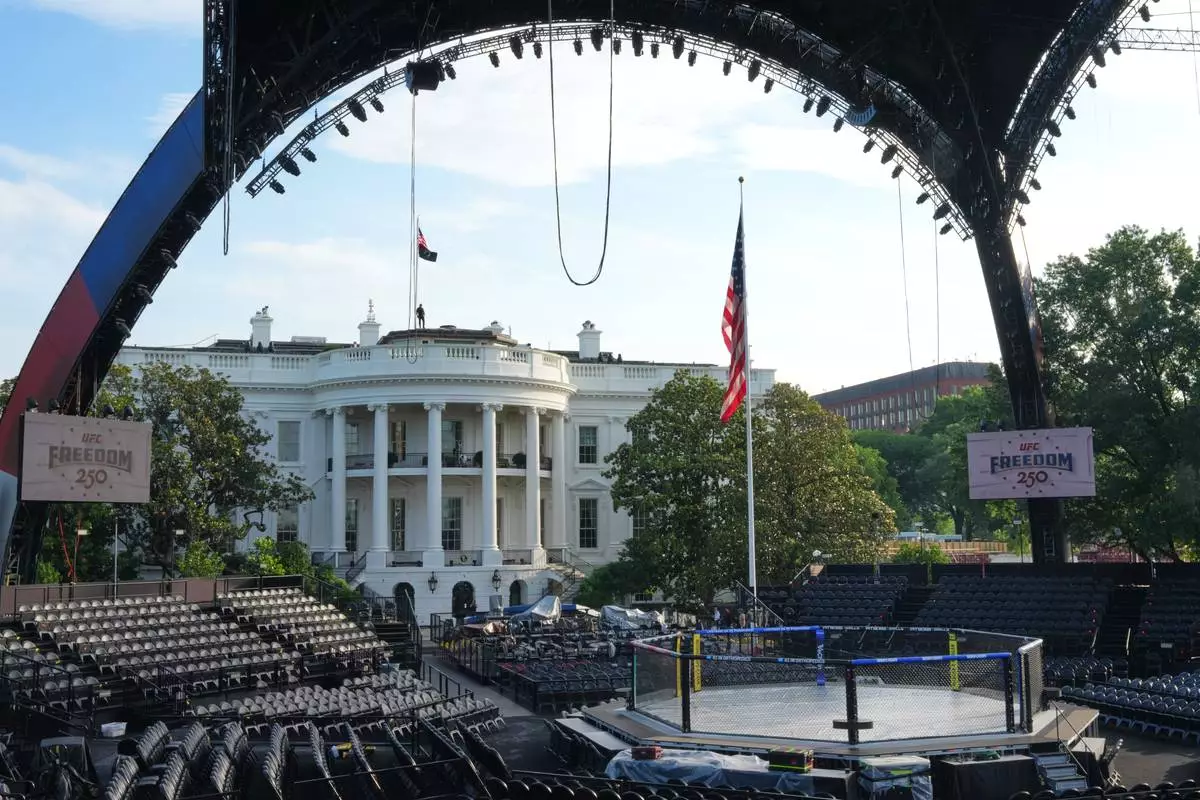
The arena for the UFC Freedom 250 fights on the South Lawn of the White House is photographed Thursday, June 11, 2026, in Washington. (AP Photo/Alex Brandon)
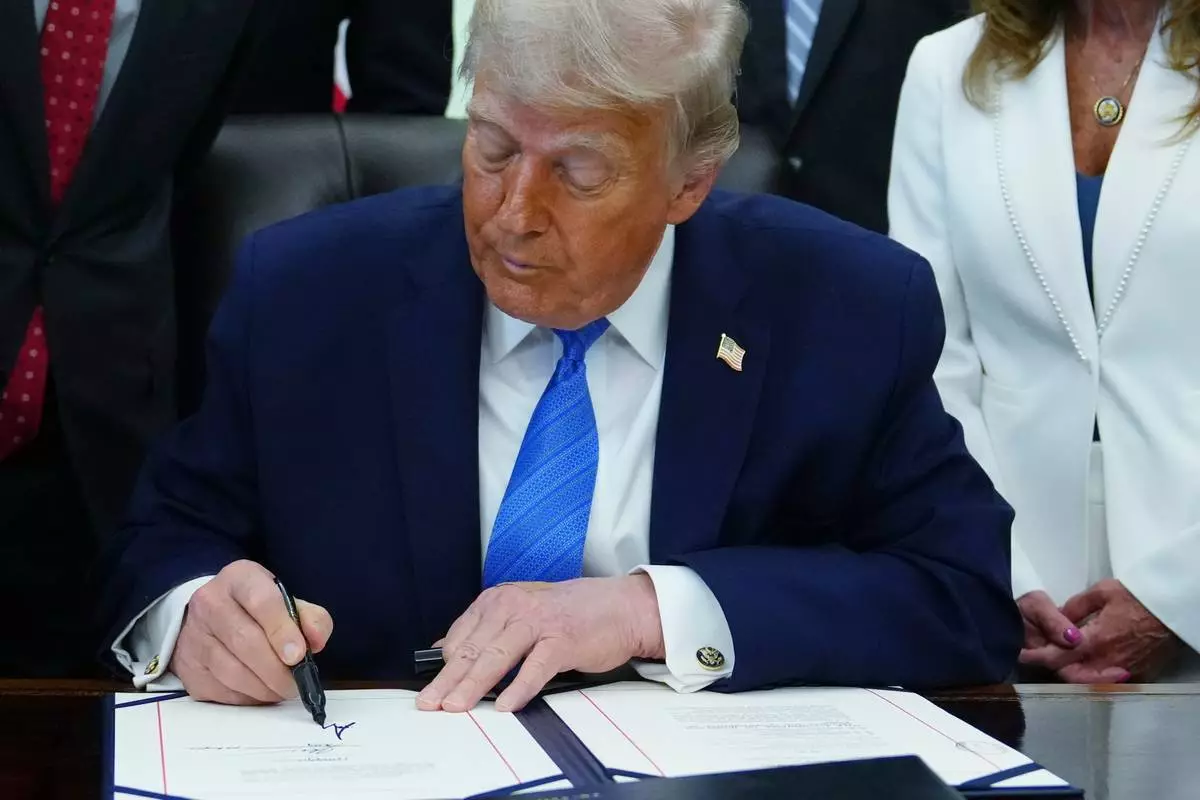
President Donald Trump signs a bill funding immigration enforcement in the Oval Office of the White House, Wednesday, June 10, 2026, in Washington. (AP Photo/Julia Demaree Nikhinson)