A fiery North Dakota derailment that happened two years ago demonstrated yet again why the National Transportation Safety Board has been urging the rail industry for decades to replace flawed tank cars that tend to rupture in a crash.
The NTSB said in its final report Thursday that the workhorse DOT-111 tank cars are long overdue for replacement because of the way the devastating impact of a derailment is magnified anytime hazardous chemicals leak, especially if they catch fire as they did in this derailment just outside the town of Bordulac, North Dakota.
In addition, the NTSB said railroads need to change the way they assemble their trains to ensure flammable liquids aren’t placed close to chemicals that could be toxic if they are inhaled. After this CPKC train derailed on July 5, 2024, methanol spilled out of five breached tank cars and caught fire. Then three tank cars filled with anhydrous ammonia breached in the fire.
The worst rail disasters in recent memory were all made worse by tank cars that leaked hazardous materials that caught fire including the 2023 East Palestine, Ohio, derailment, and the 2013 Lac Megantic derailment that devastated that Canadian town and killed 47. DOT-111 tank cars were also involved in a number of disastrous crude oil and ethanol derailments in the early 2000s when railroads routinely hauled entire trains of those flammable commodities.
And some of the upgraded tank cars developed after previous derailments dating back to the 1990s aren't good enough either because they still have a thin outer shell. Tougher newer rail tank cars are less likely to rupture in a derailment because they are made with stronger steel and better protections and safety features.
The NTSB has been recommending eliminating the use of those cars for hazardous materials at least since the 1990s because of their history of problems, and Congress did mandate that they be replaced for hauling flammable liquids by 2029. The DOT-111 tank cars and a related older model are no longer used for ethanol and rarely used for crude oil, according to the latest figures from the Association of American Railroads trade group.
The industry has been phasing them out since 2013, but several thousand older tank cars are still being used to carry other flammable liquids, including gasoline, solvents and some other chemicals.
The derailment itself was caused by a culvert that collapsed under the train, breaking a rail, but NTSB said the leak-prone tank cars made the resulting crash so much worse. The NTSB said the culvert had been inspected frequently enough, but those exams weren't thorough enough to identify the risk of a collapse ahead of time.
In the North Dakota crash, it was fortunate that few people lived nearby when 29 of the 151 cars on the train careened off the tracks. Only two homes were voluntarily evacuated for two days while crews put out the fires and dealt with the methanol and anhydrous ammonia that spilled. A dozen of the other cars that derailed were carrying plastic pellets.
No injuries were reported in the derailment itself though a handful of workers involved in the cleanup did seek treatment and report health problems after working around the anhydrous ammonia.
CPKC spokesman Patrick Waldron said the railroad received the report after it was released Thursday afternoon and is carefully reviewing it.
Officials at the Pipelines and Hazardous Materials Safety Administration didn't immediately respond to the NTSB report. The Federal Railroad Administration declined to comment immediately on the recommendations.
FILE - The seal of the National Transportation Safety Board (NTSB) is displayed in Washington, on Jan. 20, 2026. (AP Photo/Jacquelyn Martin, File)
LONDON (AP) — Artist David Hockney, whose paintings of pools shimmering in the Los Angeles sunshine became icons of 20th-century art, has died, his publicist said Friday. He was 88.
One of the most popular and critically lauded British artists of the last century, Hockney was born in the north of England but lived much of his life in Southern California, making its sun-drenched suburban views a major motif.
Later in life he returned to Europe, finding renewed inspiration in the wooded hills of his native county of Yorkshire and the fields and trees of France’s Normandy region. He became one of the U.K.’s most treasured artists, his works selling for record prices at auction.
Historian Simon Schama said it's no mystery why his work is so enduring.
“His work is admired — loved is not too strong a word — by the millions who, worldwide, flock to see it because it presupposes an expectation of pleasure,” Schama wrote in an essay accompanying a 2025 Hockney exhibition in Paris.
Hockney’s publicist, Erica Bolton, said he died at his home in London on Thursday, less than a month short of his 89th birthday. She did not give a cause of death.
He is survived by his longtime partner Jean-Pierre Gonçalves de Lima, his great-nephew and studio assistant Richard Hockney, his brothers Philip and John, and numerous nieces, nephews, great-nieces and great-nephews.
With his trademark round glasses and bleached-blond hair, Hockney was a well-known figure in the swinging British and American art scenes of the 1960s, even before he reached the age of 30. His paintings were just as distinctive, many of them creating a dreamlike world of patterned light bouncing off water and windows, and human forms rendered in flattened, simplified shapes in matte acrylic paint.
“I’m excited every day,” he told the Los Angeles Times in 1979. “London has lots of dreary parts but I never find anything dreary in Los Angeles.”
Hockney was born July 9, 1937, in Bradford, a large industrial city whose chief export was woolen textiles. He spent his first two decades there before going to London’s Royal College of Art. He made an impact even before his graduation, and art dealer John Kasmin took him into his stable of artists in 1961.
His artistic influences ranged widely, from Renaissance portraitists to 19th-century English landscape painter J.M.W. Turner, Pablo Picasso’s experiments in Cubism and 20th-century American pop art.
He shared with other pop artists an interest in the polished surface of modern life. And, like Andy Warhol with his Brillo boxes and Campbell’s soup cans, Hockney occasionally incorporated advertising labels, such as a British Typhoo Tea box used in his 1961 “Tea Painting in an Illusionistic Style.”
He told The New York Times in 1964 he enjoyed the burgeoning pop art scene in New York but wasn’t sure he was part of it.
“I’m just an ordinary artist,” he said. “I do admire American pop — in fact it seems that everything fresh-looking and vital in England these days has been coming from the U.S.” Nonetheless, he still considered himself “very much an artist in the English tradition,” he said in 1995.
Even his move to California in 1964 had a historic precedent, he noted, since earlier generations of English artists had sought out the brilliant light of Italy.
Hockney, who was out as a gay man long before it was common, explored erotic themes, giving youthful male bodies the same tender scrutiny that artists had been giving the female nude for centuries. Friends and lovers frequently posed as models, and some images were based on photos in men’s bodybuilding magazines.
Early works like “We Two Boys Together Clinging” and “Two Men in a Shower” celebrated gay relationships when homosexuality was still illegal in Britain.
Early in his career, two of his drawings were bought for the Museum of Modern Art in New York.
“The moment I first sold pictures to earn a living, I felt rich. I’ve been rich ever since,” he told The Associated Press in 1995. “I didn’t have much money but I did what I wanted. ... You are a rich man if you do the things you want to do.”
That freedom brought Hockney acclaim and wealth, with his works fetching record-breaking sums. In 2018, his 1972 painting “Portrait of an Artist (Pool with Two Figures)” sold at a Christie’s auction for $90.3 million, at the time a record for a living artist. In February 2020 another pool painting, “The Splash,” from 1966, sold at Sotheby’s for 23.1 million pounds ($30 million).
While paintings of pools were a Hockney trademark, he also literally painted a pool when he decorated the bottom of the swimming pool at the historic Hollywood Roosevelt Hotel in Los Angeles.
While many of his best-known paintings had American scenes, he also tackled British subjects. He immortalized his parents in several portraits. “Mr. and Mrs. Clark and Percy,” a 1971 dual portrait of two of his English friends and their cat, was ranked No. 5 in a 2005 BBC Radio-National Gallery (London) online poll of the greatest paintings in Britain. It was the only work by a living painter in the top 10.
Like many traditional artists, he considering drawing a fundamental skill and lamented that it wasn’t taught as rigorously as it used to be.
“Human beings are the most interesting things we see, so they’re the hardest to draw,” he said in a 1996 AP interview.
He didn’t limit himself to drawing and painting, though. He contributed costume and set designs for theater and the opera, including a celebrated production of “Tristan und Isolde” first staged in 1987 at the Los Angeles Opera.
Always an innovator, Hockney also embraced printmaking, photo collage and video in a seven-decade career.
When he took up photography, he fused genres, assembling individual photos into elaborate collages like “Pearblossom Highway, 11-18th April, 1986,” built up of individual views of a desert highway intersection.
“My photographer friends said it was a painting,” Hockney told the AP in 2001. “I said it’s a photograph; I used a camera.”
The insight he gained from his photo work led him to research and write a 2001 book, “Secret Knowledge: Rediscovering the Lost Techniques of the Old Masters.” He argued that through the centuries, artists used lenses and other optical devices to aid them in drawing much more often than most historians believe.
Later he began to draw on iPads, which became his favorite tool.
In the early 2000s he looked afresh at the fields and forests of Yorkshire in a series of landscape paintings that combined bold color with minute attention to the texture of snow on a hillside or a blossom on a hawthorn hedge. They featured in a 2017 exhibition at Tate Britain in London that was visited by half a million people and moved to the Pompidou Center in Paris and the Metropolitan Museum in New York.
Hockney used the English landscape for inspiration in his design for a stained-glass window at Westminster Abbey to celebrate the long reign of Queen Elizabeth II. Completed in 2018, the Queen’s Window depicts a landscape of blossoming hawthorn trees in hues of blue, green, yellow, orange, pink and red.
By this time, Hockney was widely considered Britain’s greatest living artist, and a national treasure. In 1997, the queen named him a Companion of Honour, an award limited to 65 people “of distinction.”
In 2019, he moved to Normandy, where during the 2020 coronavirus lockdown he produced joyous iPad drawings of springtime for his friends. His message — “Do remember they can’t cancel the spring” — was emblazoned in neon across the Fondation Louis Vuitton in Paris when it hosted a huge Hockney exhibition that opened in April 2025.
Art curator Norman Rosenthal, who helped put together the Paris exhibition, called Hockney “the Picasso of our times.”
“When I say that, people laugh at me, as Picasso was the archetypal artist of the 20th century,” Rosenthal told the Independent newspaper. “But David Hockney is also an incredibly popular artist whose work changes how we see things.”
An unrepentant cigarette smoker who railed against government anti-smoking rules, Hockney complained when a poster for the 2025 exhibition was banned from the Paris Metro because it showed him holding a cigarette.
The announcement of his death from his publicist noted that Hockney was “a committed life-long and defiant smoker, expressing the pleasure in life it brought him. ... He smoked up to the end.”
Hockney had a minor stroke in 2012 and was increasingly deaf in later years — something he said had improved his visual perception.
“If you lose one sense, you gain other senses, and I feel I could see space clearer,” he told the AP in 2017.
He never stopped working.
“It’s my work that keeps me young,” Hockney told the Sun newspaper in 2017. “I’ve been a professional painter for 60 years. Sixty years of getting up every day and doing exactly what I want to do.”
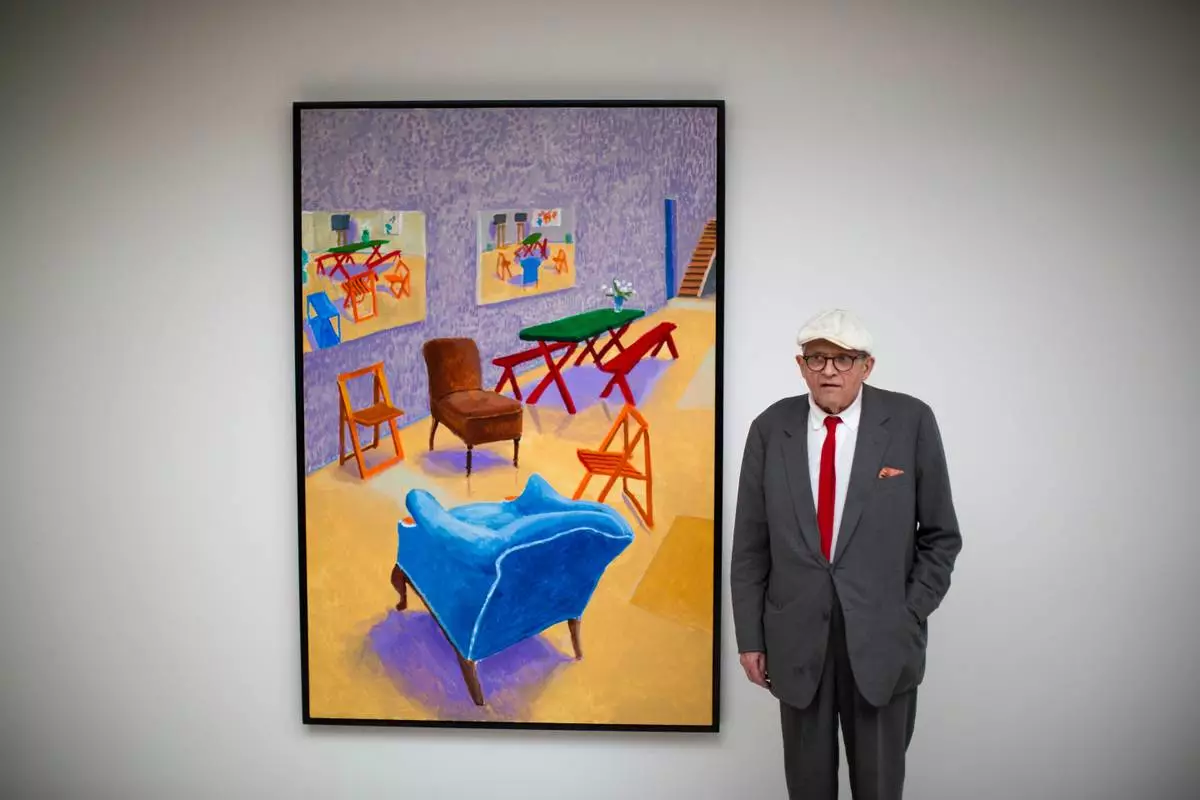
FILE - British artist David Hockney poses for photographers in front of his acrylic on canvas "Studio Interior #4" which features as part of the "David Hockney Painting and Photography" exhibition at the Annely Juda Fine Art gallery in London, Thursday, May 14, 2015. (AP Photo/Matt Dunham, File)
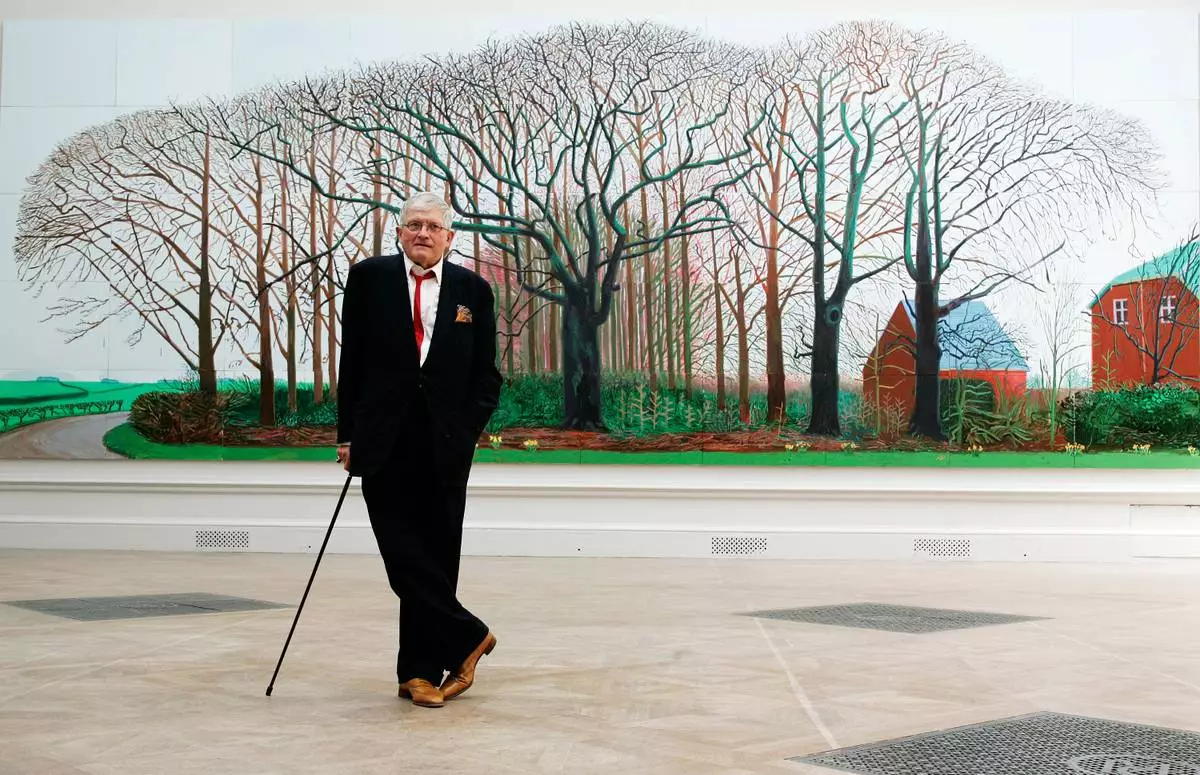
FILE - British artist David Hockney poses as he unveils his painting 'Bigger Trees Near Water', the largest painting ever shown at the Royal Academy's Summer Exhibition, London, Friday, May 25, 2007. (AP Photo/Sang Tan, File)
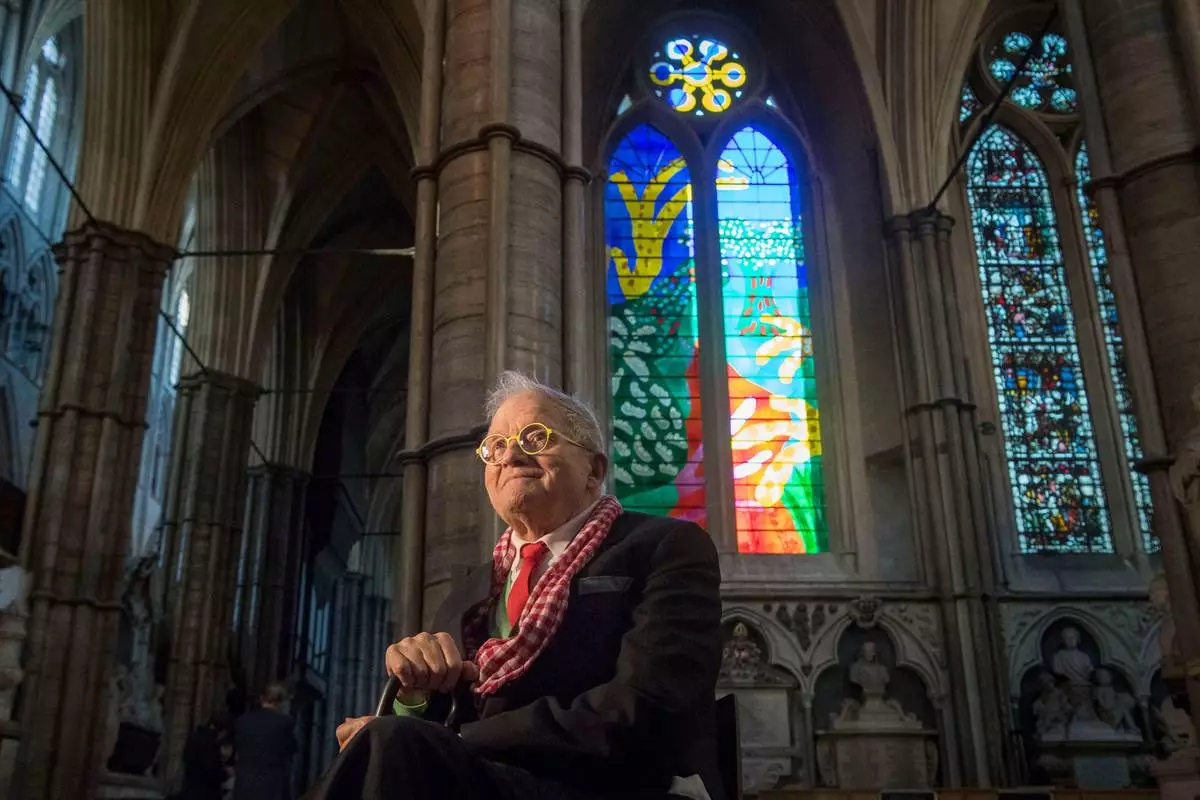
FILE - British artist David Hockney sits in front of The Queen's Window, a new stained glass window at Westminster Abbey, London, designed by David Hockney and revealed for the first time on Wednesday Sept. 26, 2018. (Victoria Jones/Pool via AP, File)
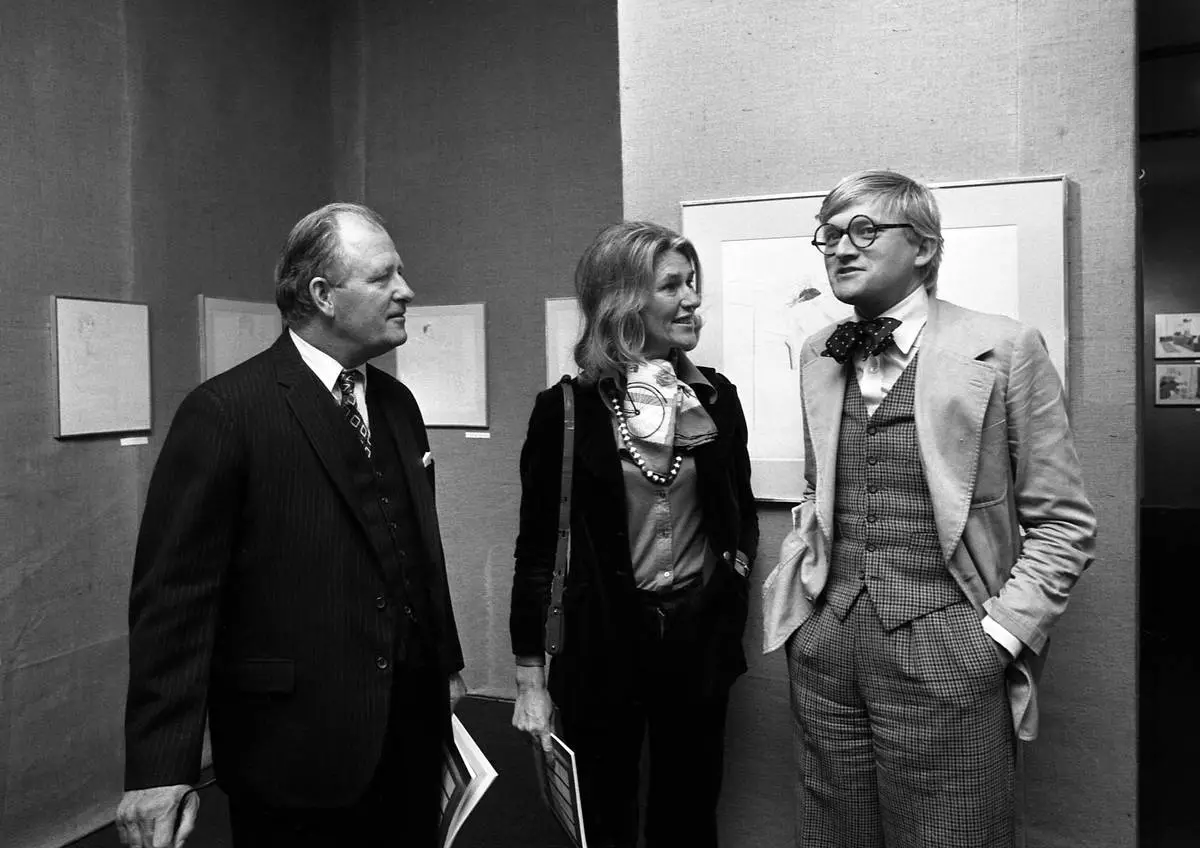
FILE - Painter David Hockney, right, with British Ambassador Edward Tomkins, left, at the opening of his exhibition at Musee des Arts Decoratifs on Oct. 10, 1974 in Paris. (AP Photo/Michel Lipchitz, File)
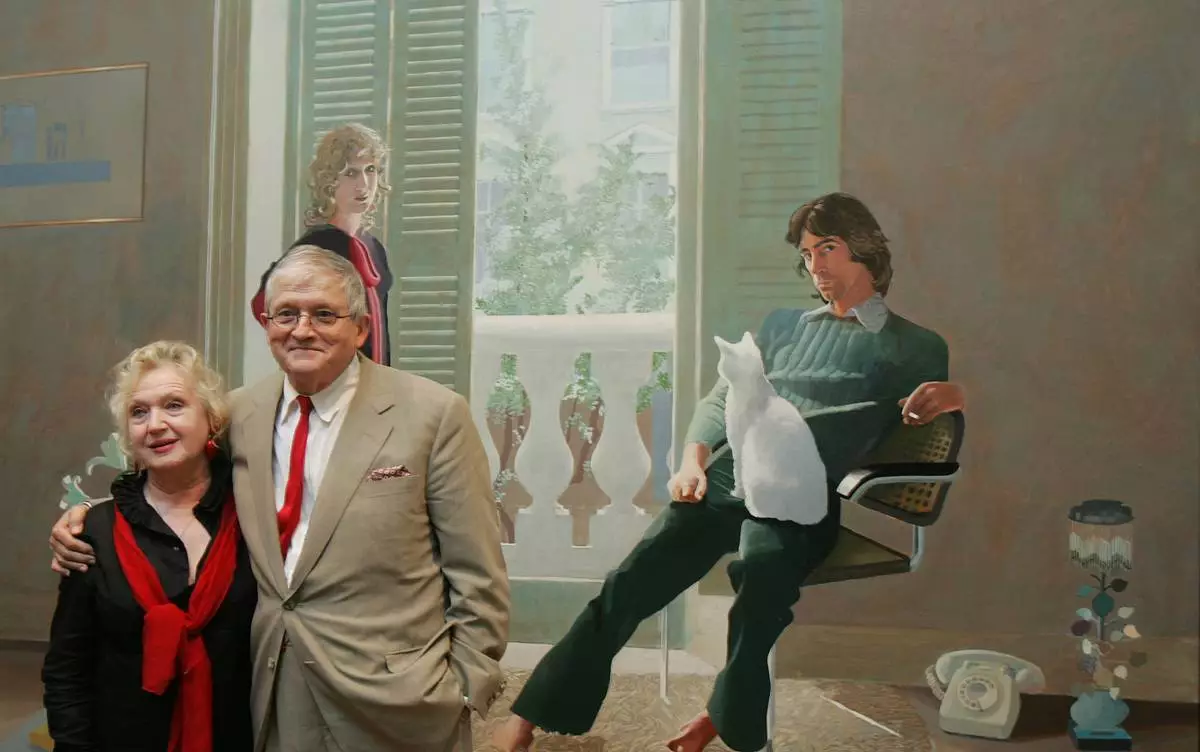
FILE - British artist David Hockney, stands next to his friend and model Celia Birtwell, in front of one of his most famous works ' Mr and Mrs Clark and Percy' at the National Portrait Gallery in London, Wednesday Oct. 11, 2006. (AP Photo/Alastair Grant, File)
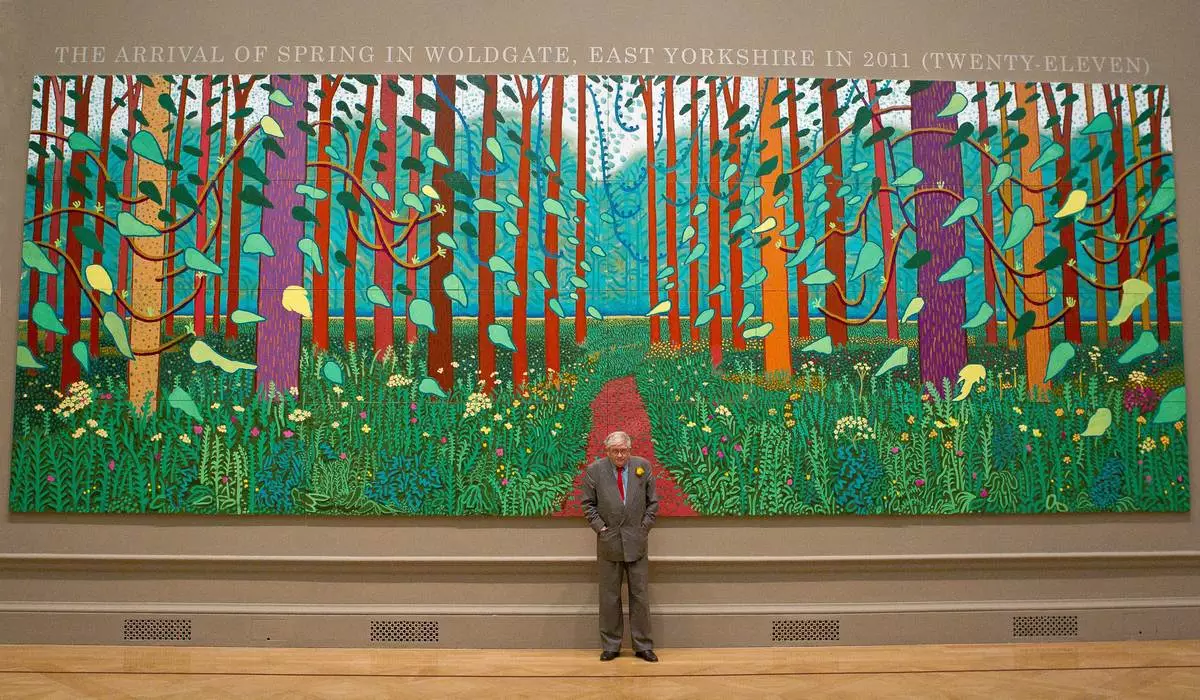
FILE - British artist David Hockney stands before one of his paintings of the East Yorkshire landscape at The Royal Academy of Arts in Piccadilly, London, Monday, Jan. 16, 2012, ahead of his exhibition called 'A Bigger Picture'. (AP Photo/Joel Ryan)
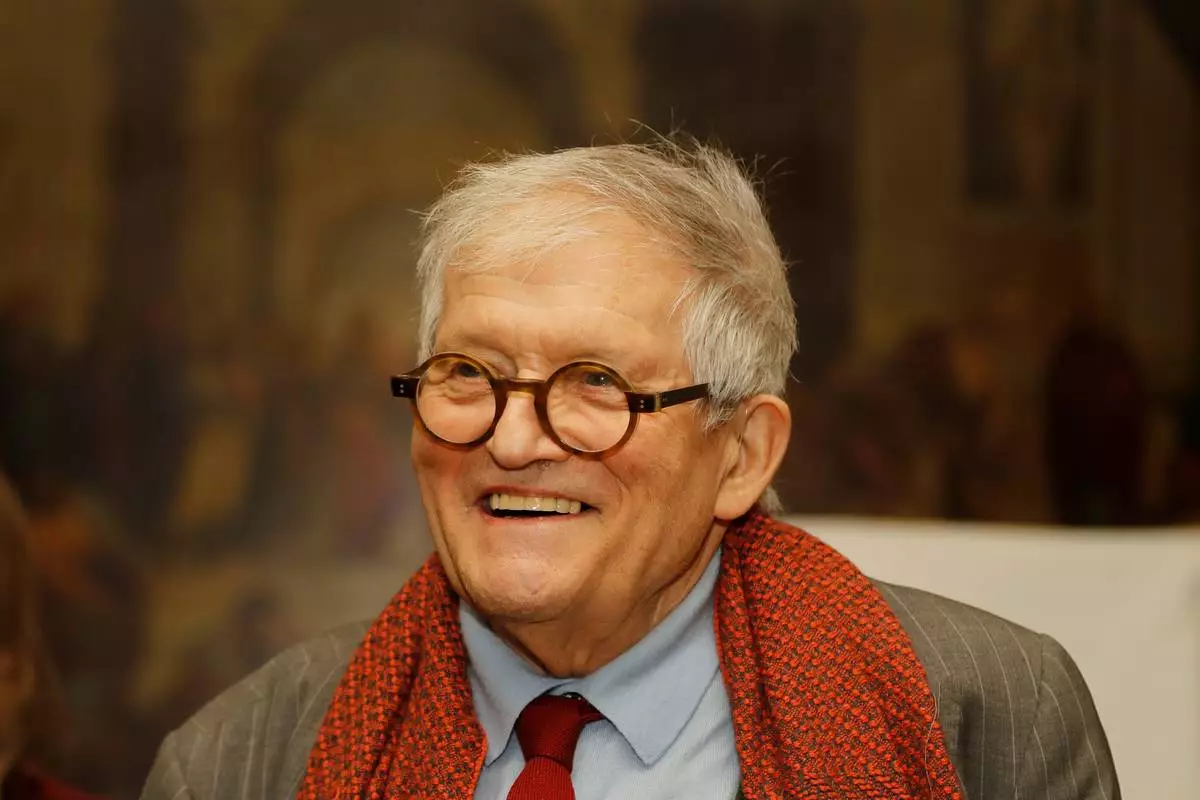
FILE - Artist David Hockney after unveiling the bottle design for the 2014 vintage wine of Château Mouton Rothschild in London, Friday, Feb. 3, 2017. (AP Photo/Frank Augstein, File)