GREEN BAY, Wis. (AP) — Lukas Van Ness acknowledges his career hasn’t gone the way he expected when the Green Bay Packers selected him with the 13th overall pick in the 2023 draft.
Van Ness wants to change that trajectory. He certainly has the opportunity.
The Packers need someone to chase opposing quarterbacks while All-Pro edge rusher Micah Parsons misses the start of the season to recover from a torn anterior cruciate ligament. Van Ness’ status as a recent first-round pick makes him an obvious contender, but he has totaled only 8 ½ sacks over his first three seasons.
“It’s probably not been my ideal career if you would have talked to me in 2023 when I was a fresh rookie coming in here, but everyone’s got their own process and their own path,” Van Ness said this week during the Packers’ mandatory minicamp. “I’ve trusted the path. I feel really good about where I’m at.”
Van Ness had four sacks in a promising rookie season but had just three in 2024 and 1 ½ in an injury-shortened 2025. He played just nine games last season after getting carted off the field with a foot injury in an Oct. 12 victory over Cincinnati, though he had a sack in Green Bay’s playoff loss at Chicago.
Now he’s healthy again and hoping to fill a void for Green Bay, which went winless after Parsons’ Dec. 14 injury last season. The Packers traded Rashan Gary to Dallas and lost Kingsley Enagbare to the New York Jets in free agency, leaving them without many proven edge rushers as they await Parsons’ return.
They need Van Ness to live up to his draft position.
“I think pressure is a privilege to have,” Van Ness said. “We’re obviously in a blessed position where there’s people watching our spot and people are obviously going to have their own opinions, but at the end of the day I think you’ve just got to believe in yourself and believe in what you’re hearing in the building from your coaches and from your circle and other players in the defensive room.”
Those people have offered praise.
Packers coach Matt LaFleur says Van Ness has “shown a ton of growth” and points out that it’s typical for pass rushers to need some time to get going. Quarterback Jordan Love believes Van Ness is “in a great spot.”
“He puts the work in and he’s a guy that he’s always making practice hard on us,” Love said. “I think for him his get-off is what I’m noticing right now, his speed around the edge, so I’m excited about it.”
Parsons is perhaps Van Ness’ biggest booster. Parsons was discussing Green Bay’s pass rushers with reporters last week when he noted that “I definitely think I’m going to have my hands full with Luke on who’s going to be best,” assuming Van Ness stays healthy.
“I think Luke is someone that people sleep on the most, and I don’t know why,” Parsons said.
Van Ness said he appreciates having Parsons in his corner and notes that it speaks to the All-Pro’s character. Van Ness also cited support he received from Gary over the past few years.
“I think also being a first-round pick, coming in, (Gary) kind of had a similar career path that I did, had his ACL, dealt with injuries,” Van Ness said. “He was really just a guy who was able to get to a second contract, stayed on me with the motivation and my mental and to just keep everything positive.”
The Packers have exercised their fifth-year option on Van Ness, whose contract now runs through 2027. His chances of getting his own long-term deal depend on whether he can take a step forward.
He’s ready for the challenge.
“At the end of the day, I feel like talk is cheap,” Van Ness said. “You’ve just got to put it out there when it matters.”
NOTES: Former LSU and Notre Dame coach Brian Kelly attended Thursday’s practice. LaFleur worked for Kelly as a graduate assistant with Central Michigan in 2004-05 and as a Notre Dame quarterbacks coach in 2014. … Green Bay has its final round of organized team activities next week, but LaFleur said that would only be for rookies.
AP NFL: https://apnews.com/hub/nfl
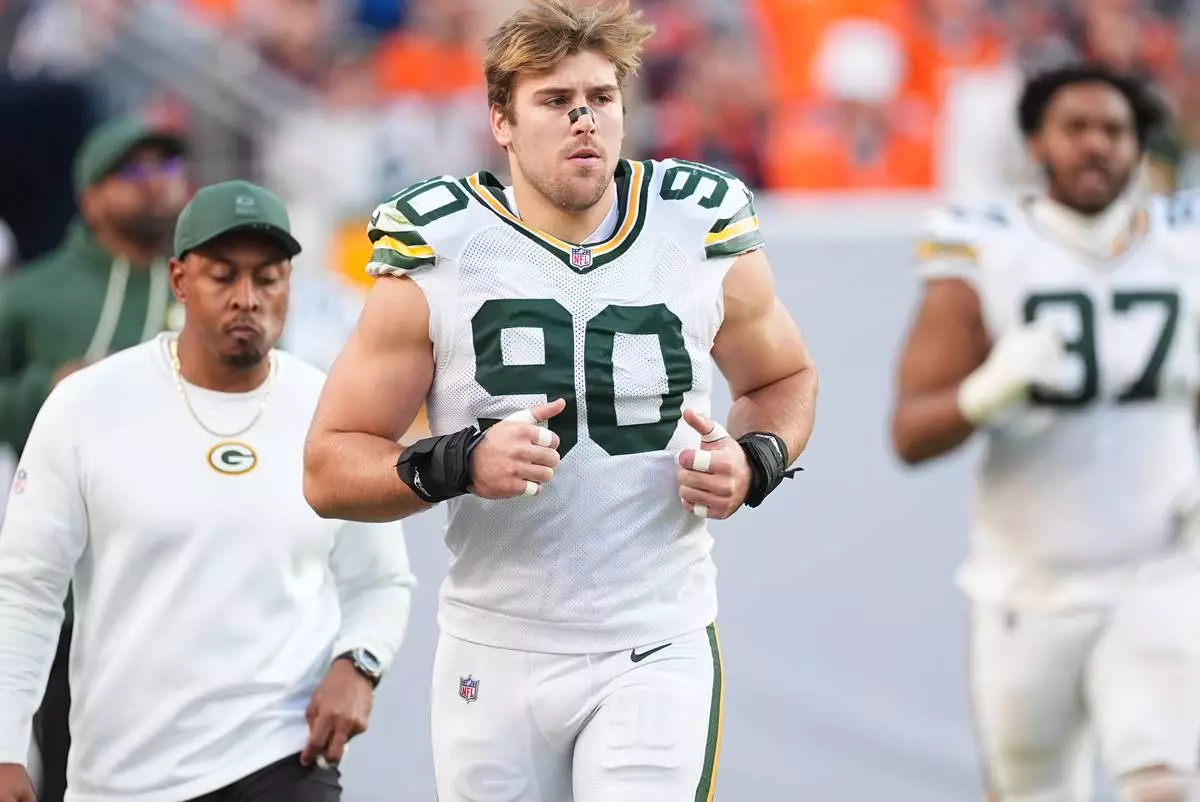
FILE - Green Bay Packers defensive end Lukas van Ness (90) in the second half of an NFL football game, Dec. 14, 2025, in Denver. (AP Photo/David Zalubowski, File)
VINNYTSIA, Ukraine (AP) — The two burly men stare straight ahead, hands intertwined on a pottery wheel, fingers buried in the clay. They sense each other’s presence through touch alone.
One is a veteran who lost his sight in combat and now teaches other blind veterans. Slowly, a piece resembling a cup takes form.
The instructor, Ivan Shostak, 37, said he has made more than 1,000 such pieces but has never seen a single one. The craft came into his life only after he lost his sight during one of Ukraine’s bloodiest and longest battles.
Making plates, cups, mugs, candle holders and other objects helped him find new meaning in a life upended by trauma. What began as a rehabilitation exercise has grown into a business and a mentoring practice for veterans and others.
“I have two kids I have to help through life and show by my own example that you have to fight for your life,” Shostak said.
Shostak rejoined the army in the early years of Russia’s full-scale invasion, not joining right away since he wanted to be there for his second son’s birth. He previously fought in eastern Ukraine after the conflict broke out in 2014.
His second tour lasted a few months. While fighting in the battle of Bakhmut in March 2023, a rocket-propelled grenade exploded just above his head. The blast destroyed his eyes.
Besides blindness, he also had a concussion, a traumatic brain injury and displaced vertebrae in the neck.
He said the real ordeal began at home. His wife at the time could not endure it. She left him alone with his new challenges.
“There was a family, and after the injury there was no family,” Shostak said. But his parents stayed close, supporting him.
He spent half a year bedridden, dulling the pain with medication. The despair was harder to manage. No pills could ease that.
A fellow soldier home on leave came to his aid, taking him to a local rehabilitation center for people who had lost their sight. Within a month, staff taught him to use a phone and a cane and to handle daily life.
“It turned out you could live even in total darkness,” Shostak said.
One day, he and others from the center were invited to visit a pottery workshop, where he made his first plate. “And after that came the thrill that I could still do something,” he recalled.
He began attending classes regularly and later sold his work. He became an instructor after the first “Pottery in the Dark” project, supported by Sweden and the U.N. Development Program, in Vinnytsia in central Ukraine. The program helps veterans who lost their sight, including in the war.
Then he launched his business.
Shostak has three others on his team who help him sell his pottery, mostly through his Instagram page. He keeps no strict schedule, working according to his mood in a workshop that his older brother, also a soldier, set up for him in his apartment.
“Clay is that kind of material, and pottery is that kind of work, where if you feel bad, there’s nothing to do here. It won’t come out at all. Everything breaks, comes out crooked,” he said. “Only when you feel good, you sit down, you work, and it all turns out great.”
The later stages happen in another workshop, where he gets help with firing and glazing. But he chooses every color himself, guided by his imagination.
Each piece bears the emblem of the air assault forces he served in — a dome, wings and a sword — with the motto “Nobody but us” and his name on the side.
Roman Shtohryn, director of the Podillia rehabilitation center in Vinnytsia, said six of the 11 project participants who completed the pottery training already earn an income from it. All but one are veterans.
“We planned all this so it would turn into a business,” Shtohryn said.
Pottery serves multiple functions, he said. The first is psychological: A person concentrates on something, stops thinking about problems and stays in a kind of flow, in the moment. Second, working with clay yields an immediate result.
At the rehabilitation center, Shostak works with fellow veteran Viacheslav Sadovskyi, 47.
“All good? Hands working?” Shostak asked, laughing, before reaching for Sadovskyi's hands. He guided them toward the wheel.
“There, I can feel it,” said Sadovskyi, who had served in the military since the start of Russia's invasion. In 2024, a drone exploded near him, damaging the left side of his face and forcing him to undergo five surgeries.
Shostak directed him, telling him how to press the clay and from which side, his hands never leaving Sadovskyi's.
“It matters that a veteran teaches a veteran,” the director Shtohryn said. “We’re equals. We understand and support each other.”
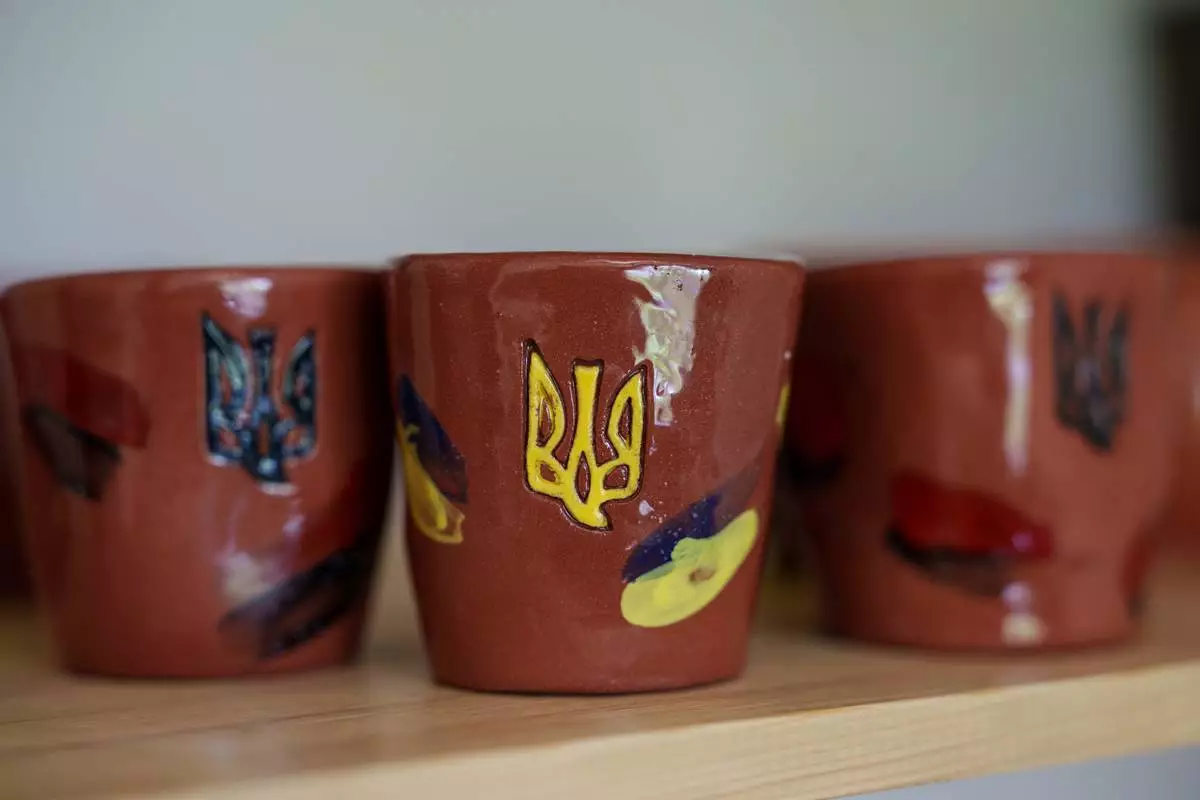
Clay cups decorated with Ukrainian triangle are seen inside apartments of blind Ukrainian war veteran Ivan Shostak in Vinnytsia, Ukraine, on May 21, 2026. (AP Photo/Evgeniy Maloletka)
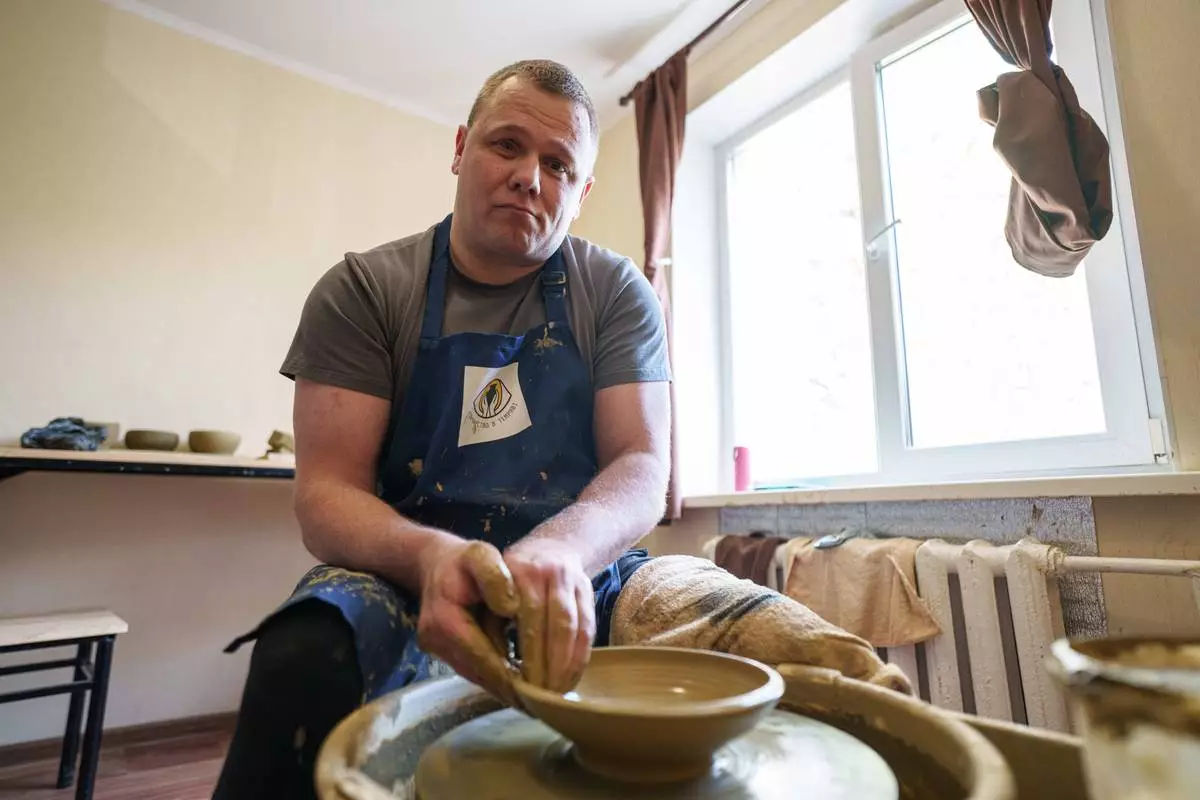
Ivan Shostak, a blind Ukrainian war veteran makes a clay plate on a pottery wheel at his apartment in Vinnytsia, Ukraine, on, May 21, 2026. (AP Photo/Evgeniy Maloletka)
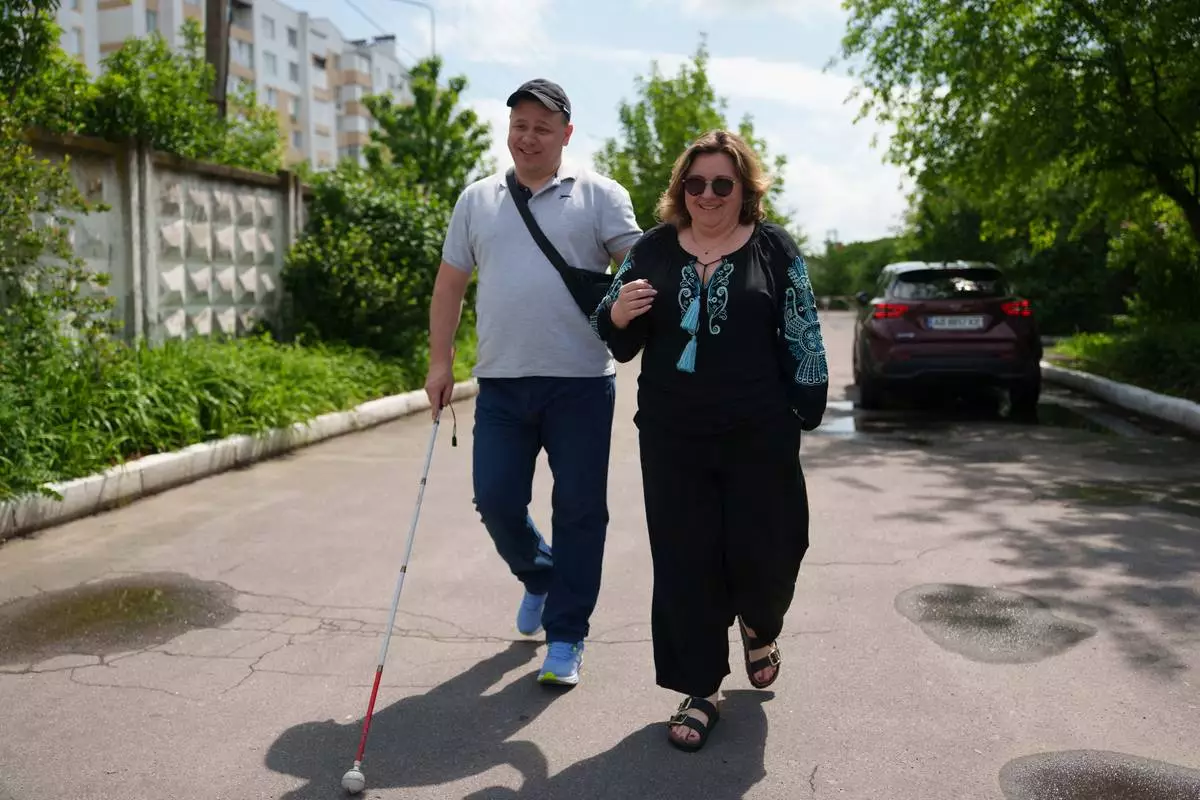
Ivan Shostak, left, a blind Ukrainian war veteran and Anastasia Lanina, community development officer of UNDP walk on a street in Vinnytsia, Ukraine, on May 21, 2026. (AP Photo/Evgeniy Maloletka)
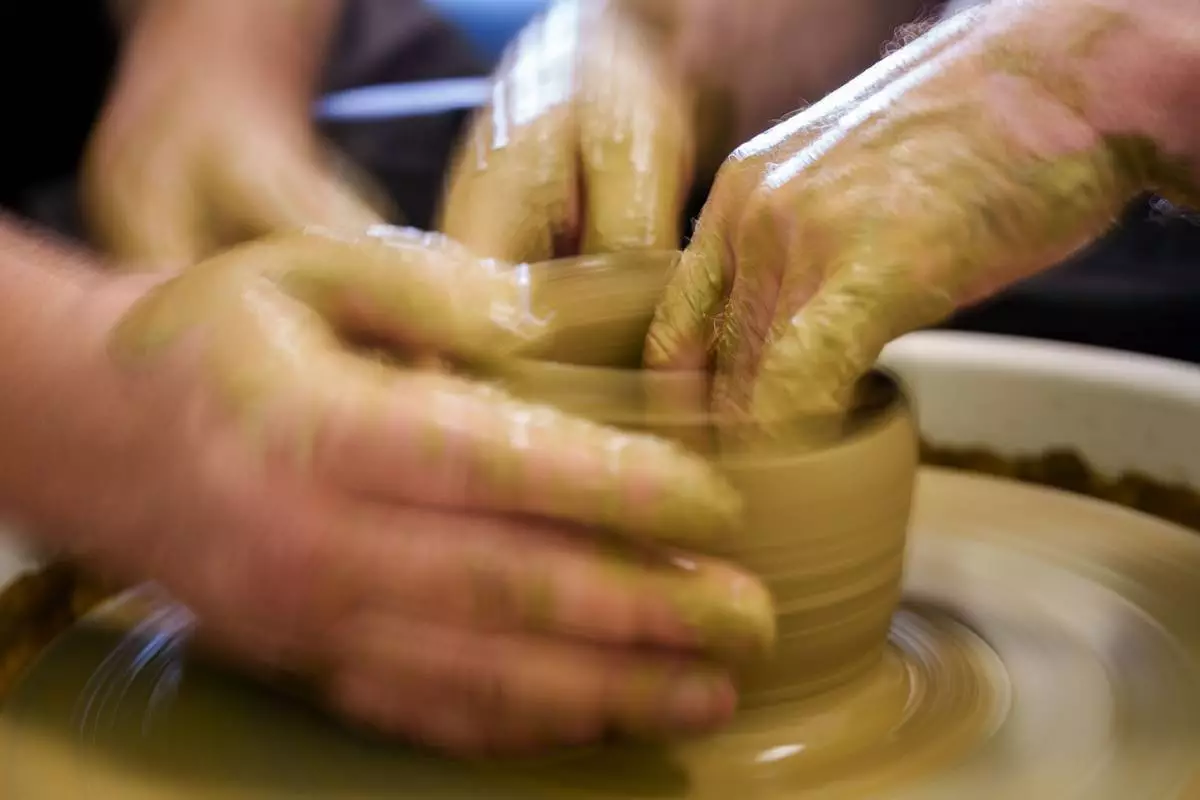
Ivan Shostak, a blind Ukrainian war veteran trains his blind comrade Viacheslav Sadovskyi to make a clay plate on a pottery wheel in a workshop at a rehabilitation center in Vinnytsia, Ukraine, on May 21, 2026. (AP Photo/Evgeniy Maloletka)
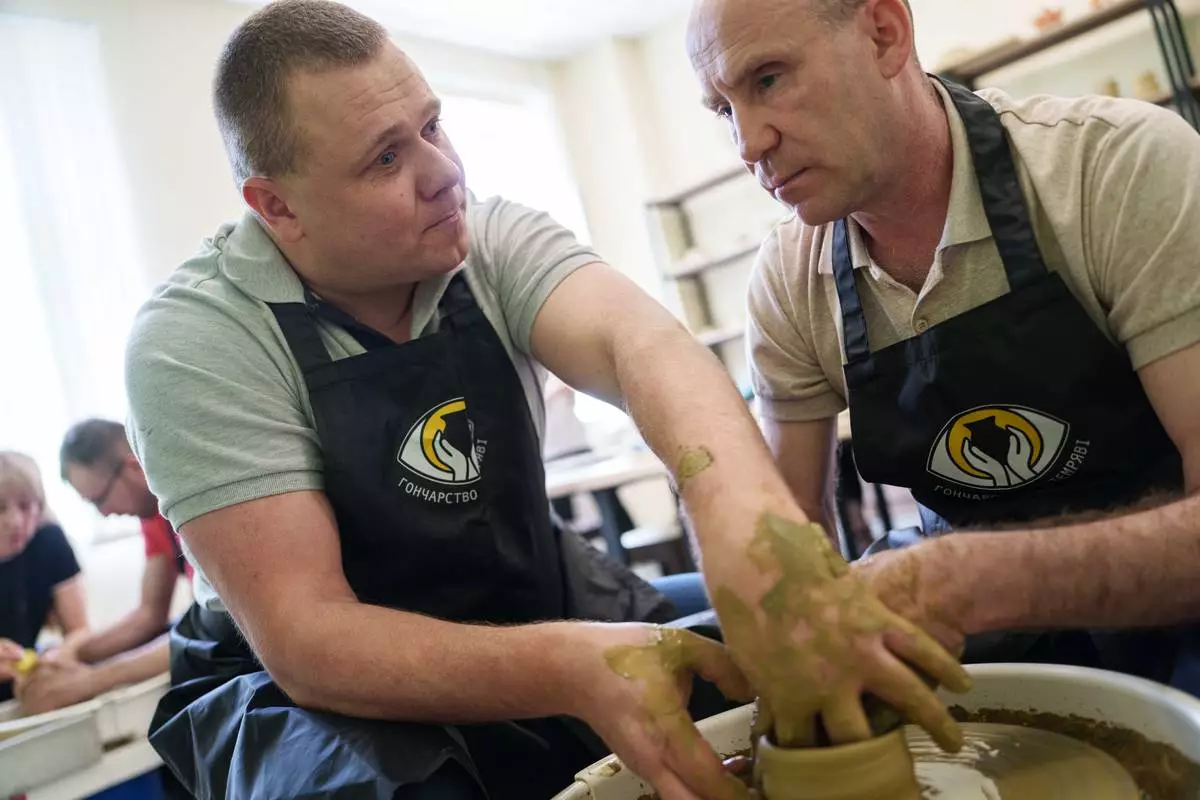
Ivan Shostak, left, a blind Ukrainian war veteran trains his blind comrade Viacheslav Sadovskyi, right, to make a clay plate on a pottery wheel in a workshop at a rehabilitation center in Vinnytsia, Ukraine, on May 21, 2026. (AP Photo/Evgeniy Maloletka)