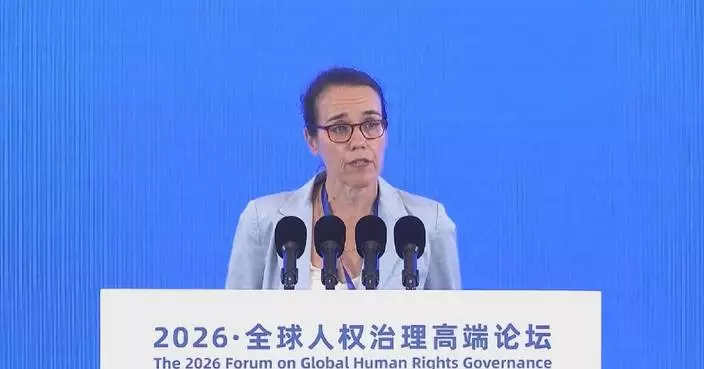
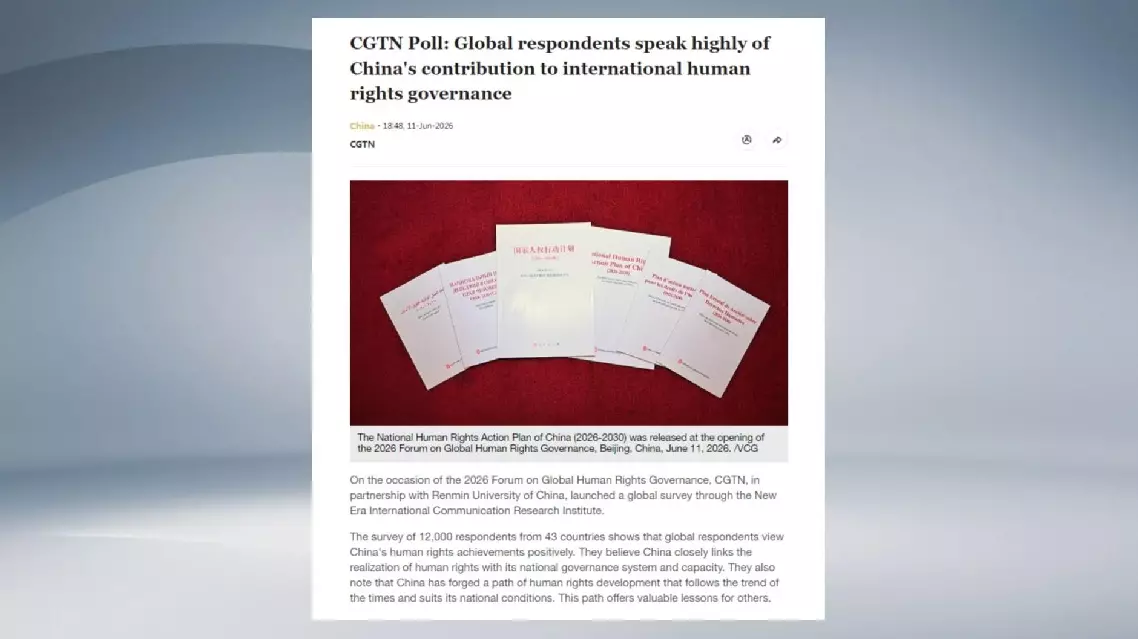
On the occasion of the 2026 Forum on Global Human Rights Governance, CGTN, in partnership with Renmin University of China, launched a global survey through the New Era International Communication Research Institute.
The survey of 12,000 respondents from 43 countries shows that global respondents view China's human rights achievements positively. They believe China closely links the realization of human rights with its national governance system and capacity. They also note that China has forged a path of human rights development that follows the trend of the times and suits its national conditions. This path offers valuable lessons for others.
Human rights are not just abstract slogans, but rather tangible, accessible and attainable rights that ordinary people experience in their daily lives. China adheres to a people-centered governance philosophy, and the effectiveness of government governance is an important window for observing the level of China's human rights development.
In the survey, global respondents give high praise in this regard. Satisfaction exceeded 60 percent across eight governance fields: infrastructure, education, employment, per capita income, living environment, public health, social security and ecological governance. Among these, the top four – infrastructure, education, employment and income – all received satisfaction ratings above 70 percent. By age group, respondents under 45 expressed over 80 percent satisfaction with the Chinese government's performance in infrastructure and education, with the highest satisfaction recorded among those aged 18 to 24 (83.6 percent for infrastructure and 85.9 percent for education).
China's practices in human rights governance have not only transformed its own destiny but also provided a replicable model for the world. China's vision of building a community with a shared future for humanity, four major global initiatives – the Global Development Initiative, Global Security Initiative, and Global Civilization Initiative, and the Global Governance Initiative, as well as the Belt and Road Initiative have all received positive responses from the international community.
The survey shows that more than 60 percent of respondents praise China's global governance contributions and look forward to its participation, and their satisfaction with the Belt and Road Initiative stands at over 70 percent. Moreover, 78.2 percent of respondents appreciate China's vision of building a community with a shared future for humanity.
Respondents from Global South countries show the highest percentage agreeing that this vision "benefits the development of their own countries", while respondents from developed countries generally believe that the vision "complements their own countries' development philosophies". Furthermore, 71.7 percent of respondents believe that the Belt and Road Initiative helps build a more just and equitable global governance system. Also, 72.9 percent of respondents say the Belt and Road Initiative is of great significance in promoting inclusive and sustainable global development. Among respondents from Global South countries, approval ratings for both of these statements exceeded 80 percent.
The survey was conducted online using a sample database, with samples matched to national census distributions by age and gender. It covered major developed countries and representative Global South countries. The findings have been compiled into the Global Public Opinion Survey Blue Book on "China's Role in Global Human Rights Governance".
Global respondents speak highly of China's contribution to int'l human rights governance