Hong Kong and Cyprus enter into tax pact
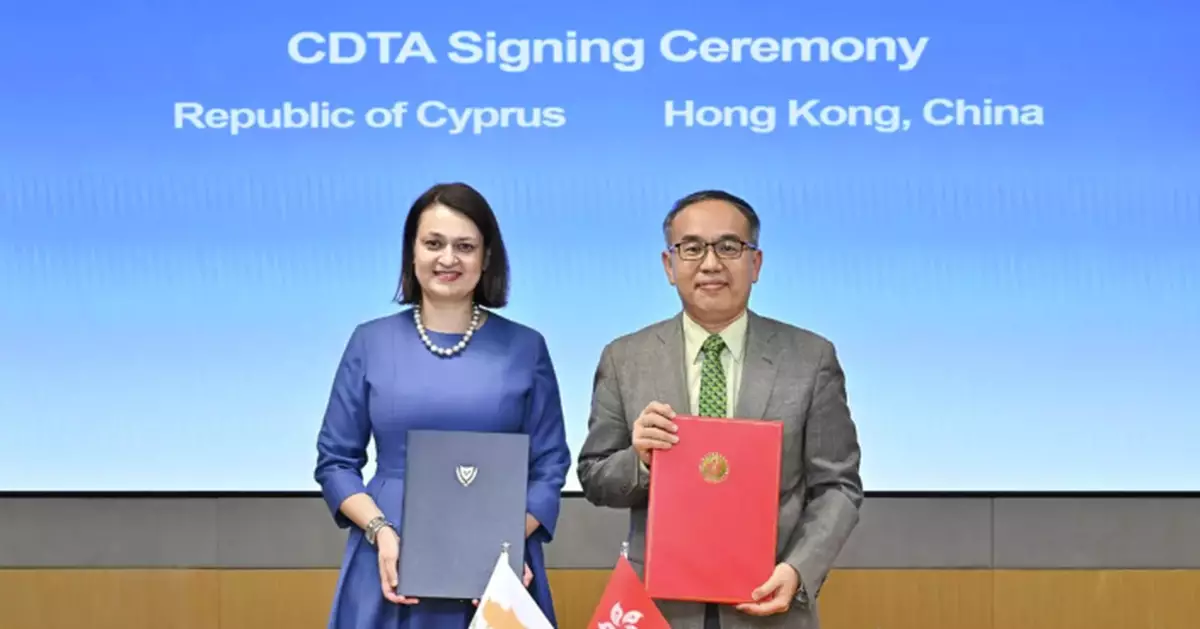
The Secretary for Financial Services and the Treasury, Mr Christopher Hui, had a bilateral meeting with the Ambassador of the Republic of Cyprus to China,Ms Koula Sophianou, in Hong Kong today (June 12) and signed on behalf of the Hong Kong Special Administrative Region (HKSAR) Government a comprehensive avoidance of double taxation agreement (CDTA) with the Government of Cyprus.
Click to Gallery
The Secretary for Financial Services and the Treasury, Mr Christopher Hui, and the Ambassador of the Republic of Cyprus to China, Ms Koula Sophianou, signed on behalf of the Hong Kong Special Administrative Region Government and the Government of Cyprus respectively a comprehensive avoidance of double taxation agreement today (June 12). Photo shows (from left) the Honorary Consul of the Republic of Cyprus in Hong Kong, Dr Harindarpal S Banga; Ms Sophianou; Mr Hui; the Commissioner of Inland Revenue, Mr Benjamin Chan; and Deputy Secretary for Financial Services and the Treasury (Treasury) Mr Anson Lai, at the signing ceremony. Source: HKSAR Government Press Releases
The Secretary for Financial Services and the Treasury, Mr Christopher Hui (right), and the Ambassador of the Republic of Cyprus to China, Ms Koula Sophianou (left), signed on behalf of the Hong Kong Special Administrative Region Government and the Government of Cyprus respectively a comprehensive avoidance of double taxation agreement today (June 12). Photo shows Mr Hui and Ms Sophianou at the signing ceremony. Source: HKSAR Government Press Releases
The Secretary for Financial Services and the Treasury, Mr Christopher Hui (right), and the Ambassador of the Republic of Cyprus to China, Ms Koula Sophianou (left), sign on behalf of the Hong Kong Special Administrative Region Government and the Government of Cyprus respectively a comprehensive avoidance of double taxation agreement today (June 12). Source: HKSAR Government Press Releases
The Secretary for Financial Services and the Treasury, Mr Christopher Hui (second left), and the Ambassador of the Republic of Cyprus to China, Ms Koula Sophianou (first right), have a bilateral meeting today (June 12). Mr Hui highlights to Ms Sophianou the advantages of Hong Kong as an international financial centre and its latest developments, including its rise to become the world's largest cross-boundary wealth management centre and the efforts made to build an international gold trading market in Hong Kong. Source: HKSAR Government Press Releases
Mr Hui said, "This is the 58th CDTA that Hong Kong has concluded and also the third one this year, signifying the HKSAR Government's ongoing achievements in expanding the CDTA network. To date, the current-term Government has signed 13 CDTAs. We will continue to actively seek to sign CDTAs with more tax jurisdictions to enhance the attractiveness of Hong Kong as a business and investment hub.
"This week, we announced the Action Plan to Promote the Development of Corporate Treasury Centres in Hong Kong, which sets out targeted strategies to elevate Hong Kong as a major base for corporate treasury centres. Continued expansion of our CDTA network is one of the key strategies. Going forward, we will focus on engaging economies along the Belt and Road. This will provide Hong Kong-based enterprises with greater tax certainty and avoidance of double taxation when expanding their businesses overseas."
At the meeting, Mr Hui highlighted to Ms Sophianou the advantages of Hong Kong as an international financial centre and its latest developments, including its rise to become the world's largest cross-boundary wealth management centre and the efforts made to build an international gold trading market in Hong Kong.
Mr Hui added, "Cyprus is a participant in the Belt and Road Initiative and an important trading partner of Hong Kong in Europe. This CDTA sets out the allocation of taxing rights between Hong Kong and Cyprus, which will enable investors to better assess their potential tax liabilities from cross-boundary economic activities and avoid double taxation. This will help promote bilateral trade and investment."
In accordance with this CDTA, any tax paid by Hong Kong residents in Cyprus will be allowed as a credit against the tax payable in Hong Kong in respect of the same income, subject to the provisions of the Inland Revenue Ordinance (Cap. 112) (IRO). Moreover, Cyprus' withholding tax rates for Hong Kong residents on royalties, currently at up to 10 per cent, will be reduced to 3 per cent.
The CDTA will come into force after completion of ratification procedures by both sides. In Hong Kong, the Chief Executive in Council will make an order under the IRO, which will be tabled at the Legislative Council for negative vetting. Details of the CDTA are available on the Inland Revenue Department's website.
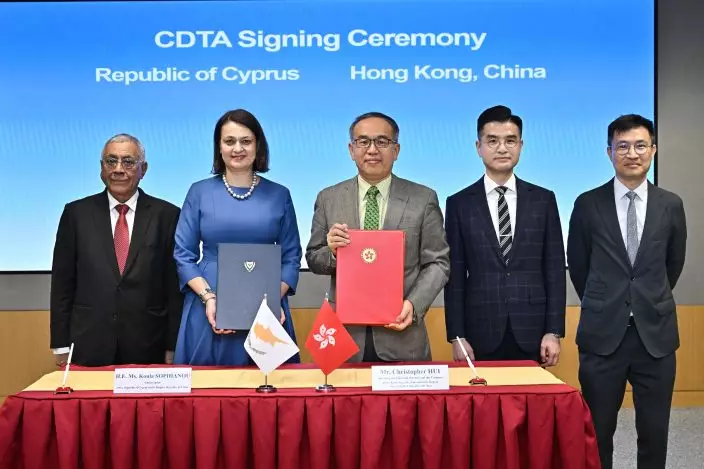
The Secretary for Financial Services and the Treasury, Mr Christopher Hui, and the Ambassador of the Republic of Cyprus to China, Ms Koula Sophianou, signed on behalf of the Hong Kong Special Administrative Region Government and the Government of Cyprus respectively a comprehensive avoidance of double taxation agreement today (June 12). Photo shows (from left) the Honorary Consul of the Republic of Cyprus in Hong Kong, Dr Harindarpal S Banga; Ms Sophianou; Mr Hui; the Commissioner of Inland Revenue, Mr Benjamin Chan; and Deputy Secretary for Financial Services and the Treasury (Treasury) Mr Anson Lai, at the signing ceremony. Source: HKSAR Government Press Releases
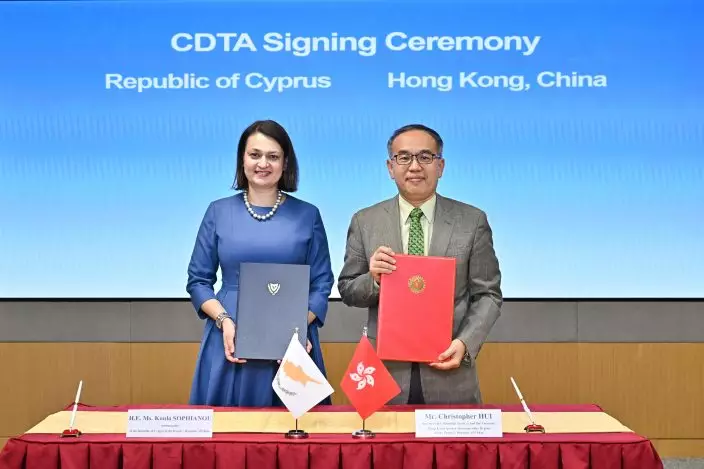
The Secretary for Financial Services and the Treasury, Mr Christopher Hui (right), and the Ambassador of the Republic of Cyprus to China, Ms Koula Sophianou (left), signed on behalf of the Hong Kong Special Administrative Region Government and the Government of Cyprus respectively a comprehensive avoidance of double taxation agreement today (June 12). Photo shows Mr Hui and Ms Sophianou at the signing ceremony. Source: HKSAR Government Press Releases
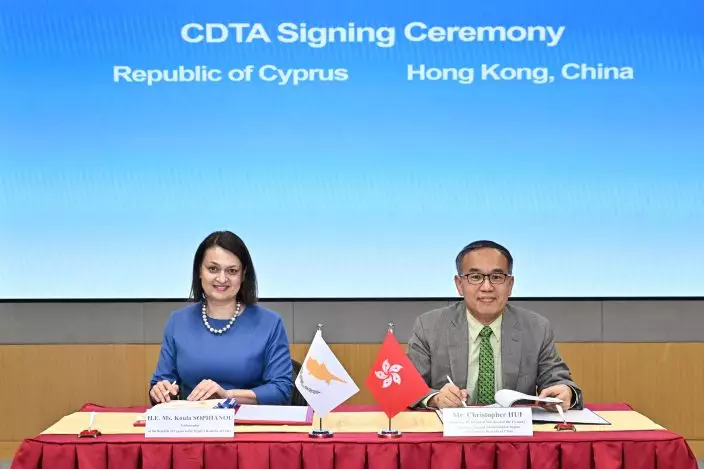
The Secretary for Financial Services and the Treasury, Mr Christopher Hui (right), and the Ambassador of the Republic of Cyprus to China, Ms Koula Sophianou (left), sign on behalf of the Hong Kong Special Administrative Region Government and the Government of Cyprus respectively a comprehensive avoidance of double taxation agreement today (June 12). Source: HKSAR Government Press Releases
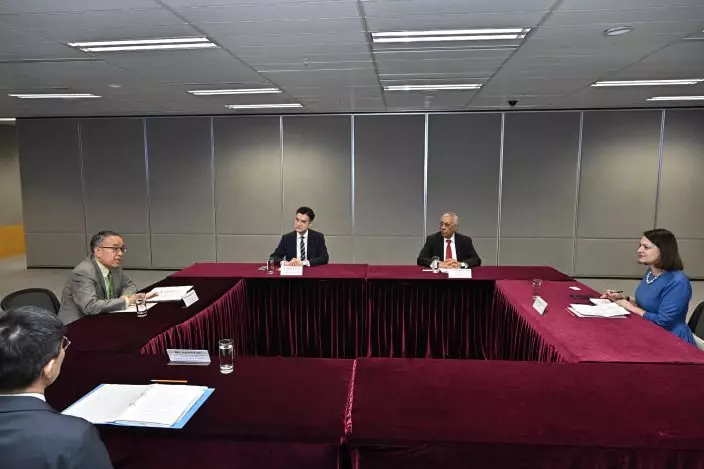
The Secretary for Financial Services and the Treasury, Mr Christopher Hui (second left), and the Ambassador of the Republic of Cyprus to China, Ms Koula Sophianou (first right), have a bilateral meeting today (June 12). Mr Hui highlights to Ms Sophianou the advantages of Hong Kong as an international financial centre and its latest developments, including its rise to become the world's largest cross-boundary wealth management centre and the efforts made to build an international gold trading market in Hong Kong. Source: HKSAR Government Press Releases
HKSAR Government strongly condemns Washington Post editorial on Subsidiary Legislation safeguarding national security
The Government of the Hong Kong Special Administrative Region (HKSAR) strongly condemns the wanton slander and groundless allegations made by The Washington Post in its article entitled "Hong Kong's nightmare gets darker", criticising the Safeguarding National Security (Procedural Matters) Regulation (Procedural Matters Regulation). The article clearly exposes The Washington Post's irrational anti-China stance and double standards, falling well short of what is expected of professional journalism.
A spokesperson for the HKSAR Government stated, "In accordance with international law based on the Charter of the United Nations, it is each and every sovereign state's inherent right, as well as an international practice, to enact laws safeguarding national security. With at least 21 pieces of legislation in the United States (US) safeguarding national security, anti-China media, in particular The Washington Post, shamelessly display its hypocrisy and double standards by pointing fingers at the HKSAR as we continuously improve our legal system to fulfill a constitutional duty to safeguard national security."
In response to the article's baseless allegations, the spokesperson points out that, "The Procedural Matters Regulation only aims to state clearly the classification mechanism under the Law of the People's Republic of China on Safeguarding National Security in the Hong Kong Special Administrative Region (HKNSL) and the Safeguarding National Security Ordinance (SNSO) for 'other offences endangering national security under the law of the HKSAR', thereby bringing even greater certainty to the implementation of the relevant provisions under the HKNSL, the SNSO and other laws.
"Any reasonable and objective person who has studied the three provisions of the Procedural Matters Regulation with care, and observed the relevant discussions at the Legislative Council (LegCo) meetings would have no difficulty in finding that the Procedural Matters Regulation has no retrospective effect at all. It does not create any new offence or alter the penalties of any offence. It certainly does not turn any lawful conduct into an offence. It is not applicable to legal proceedings that are concluded. Yet, The Washington Post falsely and maliciously claimed that 'people can now be charged retroactively for crimes that didn't exist when they allegedly committed them'. Its ignorance of facts and betrayal of the basic tenets of responsible journalism are shocking, irresponsible, and totally unacceptable behaviour for any media organisation.
"More important, the Procedural Matters Regulation will in no way infringe any legitimate right of a defendant. Hong Kong is a place underpinned by the rule of law. The guilt or innocence of a defendant remains a matter to be adjudicated by the court independently and in accordance with law. The court will, as always, ensure a defendant's right to a fair trial. Article 4 of the HKNSL stipulates that human rights shall be respected and protected in safeguarding national security. The rights and freedoms, which the residents of the HKSAR enjoy under the Basic Law and the provisions of the International Covenant on Civil and Political Rights and the International Covenant on Economic, Social and Cultural Rights as applied to Hong Kong, shall be protected in accordance with the law. Article 5 stipulates that the principle of the rule of law shall be adhered to in preventing, suppressing, and imposing punishment for offences endangering national security, which includes protection for the right to defend oneself and other rights in judicial proceedings that a criminal suspect and defendant are entitled to under the law. Section 2 of the SNSO also clearly stipulates that the Ordinance is based on the above principle of respect and protection for human rights and the principle of the rule of law."
The spokesperson pointed out, "Another allegation by The Washington Post about the issuance of a certificate by the Chief Executive under Article 47 of the HKNSL or section 115 of the SNSO is plainly wrong. The issuance of the certificate by the Chief Executive is a rigorous and solemn action. As the top official with primary responsibility for safeguarding national security in the HKSAR, the Chief Executive has access to all relevant information, including extremely sensitive intelligence and information on acts and activities endangering national security, which are not suitable for public disclosure. Such confidential information may even pertain to threats by state actors. It follows that the Chief Executive must shoulder the important responsibility, and indeed is in the best position, to make the necessary assessments and exercise the power to issue certificates on whether a criminal act involves national security. It must be firmly stated that this is a very rigorous and cautious process, leaving absolutely no room for uncertainty.
"As a matter of fact, it is a well-established principle at common law, upheld by the highest courts of common law jurisdictions including Hong Kong, the US and the United Kingdom, that the courts accord deference to the assessments and judgments of the executive authorities on national security. Constitutionally, the executive authorities have the responsibility for assessing and addressing risks to national security, whereas the court is tasked to administer justice and adjudicate disputes independently. For institutional reasons, the executive has the requisite experience, expertise, resources and access to information and intelligence, which make it best suited to making evaluative judgments on those matters. Notably, a judgment of the Supreme Court of the US in 2010 (which has been applied in many subsequent Supreme Court judgments) explained why the judiciary must defer to the executive authorities' assessment of national security issues, stating that 'national security and foreign policy concerns arise in connection with efforts to confront evolving threats in an area where information can be difficult to obtain and the impact of certain conduct difficult to assess', and 'the lack of competence on the part of the courts is marked'. Turning a blind eye to the above simply demonstrates The Washington Post's double standards and ignorance."
The spokesperson also stressed that the legislative process on the Procedural Matters Regulation is entirely in compliance with all legal and procedural requirements. "The Procedural Matters Regulation is a piece of subsidiary legislation made under section 110 of the SNSO. It is subject to scrutiny by the LegCo under the negative vetting procedure, as in the case of many other pieces of legislation that are currently in force in Hong Kong. In accordance with section 34 of the Interpretation and General Clauses Ordinance (Cap. 1), the LegCo may pass resolution to amend the subsidiary legislation in any manner consistent with the power to make such subsidiary legislation. As a matter of fact, the LegCo convened a subcommittee on June 11 to study the Procedural Matters Regulation. Members of the subcommittee asked Government officials numerous questions concerning the policy, legal and drafting aspects of the Procedural Matters Regulation, and were satisfied that it is in order in all respects."
Regarding The Washington Post's baseless claim that Hong Kong is now "a lesssecure place to visit or do business", the spokesperson said, "It is most appalling that The Washington Post has to resort to dirty tricks and tell bold-faced lies to smear the HKSAR. In fact, a simple online "fact-check" will reveal this is completely at odds with how investors and businesses around the world perceive the HKSAR: Hong Kong has been heralded the world's freest economy for decades; in the World Competitiveness Yearbook 2025, Hong Kong's ranking improved by two places to third globally; Hong Kong continues to rank among the top three international financial centres, and is number one in the world in terms of initial public offering (IPO) fundraising in the first quarter of 2026, as well as the largest cross-boundary wealth management centre.
"Foreign businesses have no reason to worry about the laws safeguarding national security in the HKSAR. In fact, many entrepreneurs welcome such laws, which ensure a safer and more stable environment for investments and economic development. The findings of a survey by the American Chamber of Commerce in Hong Kong earlier this year, showed increased confidence in Hong Kong's business environment for 2026; 94 per cent of the respondents expressed confidence in Hong Kong's rule of law, a marked increase from 83 per cent in 2025. It is time for The Washington Post to face facts and respect the truth, including honest opinions expressed by their fellow countrymen who invest their money and do business in and with Hong Kong.
"The HKSAR Government will, as always, resolutely, fully and faithfully implement the HKNSL, the SNSO and other relevant laws safeguarding national security in the HKSAR, to effectively prevent, suppress and impose punishment for acts and activities endangering national security in accordance with the law, while upholding the rights and freedoms of Hong Kong people in accordance with the law, so as to ensure the steadfast and successful implementation of the principle of 'one country, two systems'."

Source: AI-found images