Skip to Content Facebook Feature Image

Baidu's Apollo Go Expands European Footprint as AmiGo, in Partnership with PostBus, Receives Level 4 Regulatory Approval in Switzerland

Business

Baidu's Apollo Go Expands European Footprint as AmiGo, in Partnership with PostBus, Receives Level 4 Regulatory Approval in Switzerland
Business

Business

Baidu's Apollo Go Expands European Footprint as AmiGo, in Partnership with PostBus, Receives Level 4 Regulatory Approval in Switzerland

2026-06-12 19:47 Last Updated At:20:05

  • AmiGo, an on-demand autonomous mobility service between Baidu's Apollo Go and Swiss Post's PostBus, has received a special permit from Switzerland's Federal Roads Office (FEDRO) for Level 4 autonomous operations in Eastern Switzerland, confirming the service meets Switzerland's rigorous safety and quality requirements.
  • Open-road autonomous driving trials began on June 1, 2026, across an approximately 80 km² service area in the cantons of St. Gallen, Appenzell Ausserrhoden, and Appenzell Innerrhoden.
  • Provided all safety and regulatory requirements are met, regular fully driverless operations are expected to launch in early 2027, with Apollo Go powering what is set to be the largest planned automated public transport operation of its kind in Europe.
  • BEIJING, June 12, 2026 /PRNewswire/ -- Baidu, Inc. (NASDAQ: BIDU and HKEX: 9888) today announced that AmiGo, the on-demand autonomous mobility service developed through a partnership between Apollo Go and PostBus, has received a special operating permit from the Federal Roads Office (FEDRO) for Level 4 autonomous operations in Eastern Switzerland. AmiGo vehicles have been conducting open-road testing since June 1, 2026, marking a major development in Apollo Go's European expansion and validating the global readiness of its autonomous driving technology.

    The FEDRO special permit confirms that AmiGo's vehicles and autonomous driving system meet Switzerland's clearly defined safety and quality requirements, underscoring the maturity and reliability of Apollo Go's globally proven technology. Autonomous driving trials with a safety operator on board now cover an approximately 80 km² service area across the cantons of St. Gallen, Appenzell Ausserrhoden, and Appenzell Innerrhoden.

    "Automated driving evolves through real-world operating experience. That is exactly what AmiGo represents. With the largest trial of this kind, Switzerland is reaching a new dimension: multiple vehicles, a real service area, and a concrete public transport offering. The FEDRO permit provides the framework — with clear requirements, defined responsibilities, and the objective of learning from operations for the next steps," said Jürg Röthlisberger, Director of FEDRO.

    "Receiving FEDRO 's special permit is an important milestone for AmiGo and a strong validation of our technology. Under Switzerland's rigorous safety framework, AmiGo represents an important step toward integrating autonomous mobility into the country's public transport system. We look forward to working closely with PostBus to deliver a safe, reliable, and sustainable service for communities in Eastern Switzerland," said Nan Yang, Vice President of Baidu and General Manager of Overseas Business Unit, Intelligent Driving Group.

    "With AmiGo, we are making automated mobility in public transport tangible," said Stefan Regli, CEO of PostBus and member of the Executive Board of Swiss Post. "The special permit from FEDRO shows that we can implement operations step by step and under clearly defined safety requirements. Our focus is on building a safe and reliable service that meaningfully complements existing public transport."

    AmiGo brings together Apollo Go's RT6 vehicles and autonomous driving expertise with PostBus's deep knowledge of Swiss public transport operations. The service complements the existing public transport network, particularly in areas where conventional services reach their limits, and is fully electric and bookable via the AmiGo app.

    The next phase will involve a closed-group user trial, followed by initial rides without safety operators once all safety evidence is fully provided. The longer-term goal is to launch regular operations from 2027, with rides bookable via the AmiGo app. The service, which is expected to be the largest planned automated public transport operation of its kind in Europe, will be deployed using Apollo Go RT6 vehicles. Each RT6 vehicle is fully electric, carries up to three passengers, and is equipped with over 30 sensors enabling comprehensive environmental perception and real-time onboard data processing. The steering wheel is designed to be removed once the service transitions to fully autonomous operations.

    Apollo Go is the world's leading autonomous ride-hailing platform, with a proven track record of large-scale operations. In the first quarter of 2026, Apollo Go delivered 3.2 million fully driverless rides, with weekly rides peaking at over 350,000 in March, representing 120% year-over-year growth. As of April 2026, cumulative rides provided to the public exceeded 22 million. Apollo Go's global footprint now spans 27 cities, and its fleets have accumulated over 330 million autonomous kilometers as of May, including over 220 million fully driverless kilometers.

    About Baidu:

    Founded in 2000, Baidu's mission is to make the complicated world simpler through technology. Baidu is a leading AI company with strong internet foundation, trading on the NASDAQ under "BIDU" and HKEX under "9888." One Baidu ADS represents eight Class A ordinary shares.

BEIJING, June 12, 2026 /PRNewswire/ -- Baidu, Inc. (NASDAQ: BIDU and HKEX: 9888) today announced that AmiGo, the on-demand autonomous mobility service developed through a partnership between Apollo Go and PostBus, has received a special operating permit from the Federal Roads Office (FEDRO) for Level 4 autonomous operations in Eastern Switzerland. AmiGo vehicles have been conducting open-road testing since June 1, 2026, marking a major development in Apollo Go's European expansion and validating the global readiness of its autonomous driving technology.

The FEDRO special permit confirms that AmiGo's vehicles and autonomous driving system meet Switzerland's clearly defined safety and quality requirements, underscoring the maturity and reliability of Apollo Go's globally proven technology. Autonomous driving trials with a safety operator on board now cover an approximately 80 km² service area across the cantons of St. Gallen, Appenzell Ausserrhoden, and Appenzell Innerrhoden.

"Automated driving evolves through real-world operating experience. That is exactly what AmiGo represents. With the largest trial of this kind, Switzerland is reaching a new dimension: multiple vehicles, a real service area, and a concrete public transport offering. The FEDRO permit provides the framework — with clear requirements, defined responsibilities, and the objective of learning from operations for the next steps," said Jürg Röthlisberger, Director of FEDRO.

"Receiving FEDRO 's special permit is an important milestone for AmiGo and a strong validation of our technology. Under Switzerland's rigorous safety framework, AmiGo represents an important step toward integrating autonomous mobility into the country's public transport system. We look forward to working closely with PostBus to deliver a safe, reliable, and sustainable service for communities in Eastern Switzerland," said Nan Yang, Vice President of Baidu and General Manager of Overseas Business Unit, Intelligent Driving Group.

"With AmiGo, we are making automated mobility in public transport tangible," said Stefan Regli, CEO of PostBus and member of the Executive Board of Swiss Post. "The special permit from FEDRO shows that we can implement operations step by step and under clearly defined safety requirements. Our focus is on building a safe and reliable service that meaningfully complements existing public transport."

AmiGo brings together Apollo Go's RT6 vehicles and autonomous driving expertise with PostBus's deep knowledge of Swiss public transport operations. The service complements the existing public transport network, particularly in areas where conventional services reach their limits, and is fully electric and bookable via the AmiGo app.

The next phase will involve a closed-group user trial, followed by initial rides without safety operators once all safety evidence is fully provided. The longer-term goal is to launch regular operations from 2027, with rides bookable via the AmiGo app. The service, which is expected to be the largest planned automated public transport operation of its kind in Europe, will be deployed using Apollo Go RT6 vehicles. Each RT6 vehicle is fully electric, carries up to three passengers, and is equipped with over 30 sensors enabling comprehensive environmental perception and real-time onboard data processing. The steering wheel is designed to be removed once the service transitions to fully autonomous operations.

Apollo Go is the world's leading autonomous ride-hailing platform, with a proven track record of large-scale operations. In the first quarter of 2026, Apollo Go delivered 3.2 million fully driverless rides, with weekly rides peaking at over 350,000 in March, representing 120% year-over-year growth. As of April 2026, cumulative rides provided to the public exceeded 22 million. Apollo Go's global footprint now spans 27 cities, and its fleets have accumulated over 330 million autonomous kilometers as of May, including over 220 million fully driverless kilometers.

About Baidu:

Founded in 2000, Baidu's mission is to make the complicated world simpler through technology. Baidu is a leading AI company with strong internet foundation, trading on the NASDAQ under "BIDU" and HKEX under "9888." One Baidu ADS represents eight Class A ordinary shares.

** This press release is distributed by PR Newswire through automated distribution system, for which the client assumes full responsibility. **

Baidu's Apollo Go Expands European Footprint as AmiGo, in Partnership with PostBus, Receives Level 4 Regulatory Approval in Switzerland

Baidu's Apollo Go Expands European Footprint as AmiGo, in Partnership with PostBus, Receives Level 4 Regulatory Approval in Switzerland
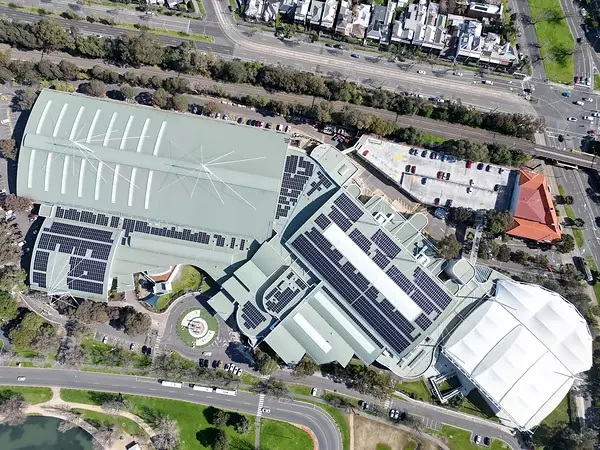
Shade-tolerant ABC modules and a flush-mount design unlock around 53% more capacity than tendered on one of Melbourne's most complex roofs.

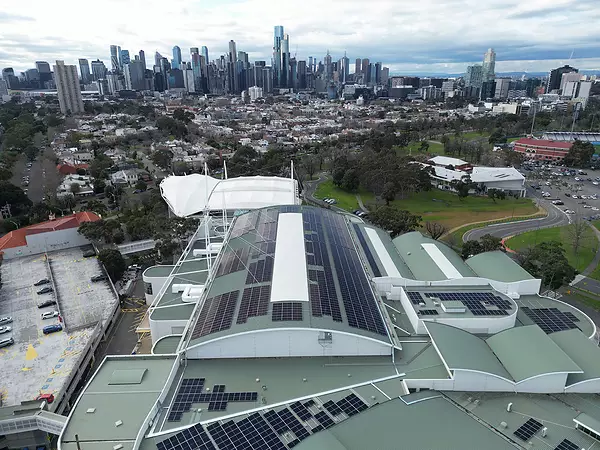
MELBOURNE, Australia, Oct. 2, 2026 /PRNewswire/ -- Next Green Group (NGG) has delivered a 1.3 MW rooftop solar system at the Melbourne Sports and Aquatic Centre (MSAC) using AIKO's Comet series All Back Contact (ABC) modules.

The completed system increased capacity by more than 50% compared with the original 850 kW tender, converting the venue's distinctive curved roof into a major renewable energy asset.

MSAC is managed by the State Sport Centres Trust and welcomes more than two million visitors each year. The venue has hosted more than 40 international events, including the aquatic events of the 2006 Commonwealth Games, and operates a mix of pools, sports courts, stadiums, fitness spaces and associated building services.

The solar system, owned and operated by the State Electricity Commission (SEC) under an agreement with the Trust, began operating in September. It is expected to generate more than 1 GWh of renewable electricity each year, supplying around one-quarter of MSAC's electricity needs.

Innovative ABC Technology Overcomes Structural and Shading Challenges

MSAC's roof presented a difficult design challenge. Tower structures and cables cast shadows across much of its surface, while the roof geometry and structural constraints limited the use of a conventional tilted array.

A conventional design that avoided shaded roof areas was modelled at approximately 800 kW. After carefully assessing the roof geometry, shading profile and structural loads, NGG selected AIKO Comet ABC modules for their power density, low module weight and certified partial-shading performance.

AIKO's ABC cell architecture is designed to reduce the impact of partial shading, enabling designers to capture more value from roof sections that might otherwise be excluded. TÜV Rheinland has certified the modules Class A for partial shading resistance. This allowed NGG to work with the unavoidable shade, lifting system capacity to 1.3 MW, approximately 60% above the conventional design.

To preserve MSAC's iconic curved roofline, NGG installed a flush-mount system rather than a standard tilted array. The design reduced the clearance gaps required between tilted rows, allowing more modules to be installed across the available roof area while maintaining the building's visual integrity.

Before installation, NGG trialled mounting on the sharpest curves and conducted comprehensive wind and dead-load tests to ensure structural safety. The final installation comprises 2,016 AIKO mono-glass modules secured across approximately four kilometres of rail.

At 28 kg per module, the AIKO Comet panels offered a high power-to-weight ratio for the project's structural constraints. The array adds approximately 56 tonnes of module weight to the roof, significantly less than a conventional system of equivalent capacity.

"At MSAC, every square metre had to earn its place," said Thomas Bywater, Head of AIKO Australia & New Zealand.

"This project shows how ABC technology can help EPCs and asset owners increase solar capacity on rooftops where conventional approaches may be constrained by shading, roof geometry or structural limits."

More Energy and Cost Savings for the Community

MSAC has a substantial and consistent electricity demand. Its 10 multi-sport stadiums, 10 aquatic areas and more than 30 individual courts require energy for pumps, water treatment, heating and cooling, ventilation, lighting, scoreboards and other operational systems.

The solar system will help meet this demand by supplying electricity to the centre's pools, spa and sauna, along with the scoreboards serving its 10 indoor basketball courts. Its daytime operating profile also supports the use of on-site solar generation to reduce reliance on grid-supplied electricity.

The Victorian Government estimates the system will generate more than 1 GWh of renewable electricity annually and save the venue around $70,000 each year. Announcing the project, Minister for Energy and Resources Jaclyn Symes said the SEC was helping cut energy bills at the places Victorians use every day, from schools to sporting centres.

"MSAC required a design that responded to its roof geometry, shading and structural constraints rather than treating them as reasons to reduce system capacity," said Nathaniel Galindo, Executive General Manager – Integrated Energy Solutions, Next Green Group.

"By combining detailed engineering with AIKO's ABC module technology, we were able to make more of the available roof area while maintaining the building's safety and visual integrity."

Partnership Drives Engineering Excellence

Next Green Group served as the primary contractor, designing, building and now maintaining the system under a five-year maintenance agreement. With over 14 years of industry experience and more than 15,000 energy projects delivered nationwide, NGG brought a methodical, engineering-driven approach to every stage of the project.

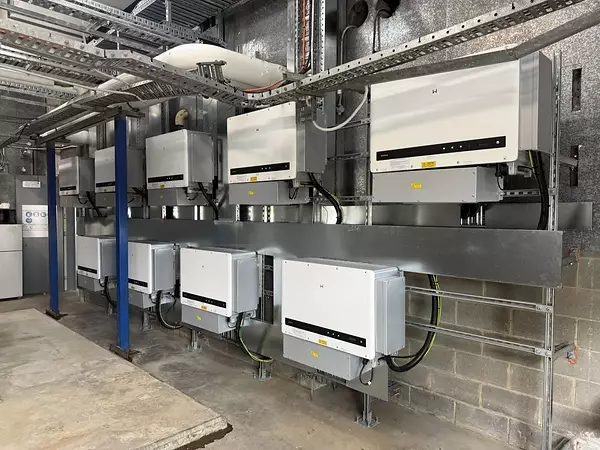
A room near the main switchboard that previously housed MSAC's 20-year-old gas cogeneration unit was repurposed to accommodate nine 110 kW GoodWe HT Series inverters and the PV distribution board. The former cogeneration unit is being redeployed on an agricultural farm, while the room it occupied now houses MSAC's new renewable energy system.

The project was delivered in close coordination with MSAC and the State Sport Centres Trust to manage the structural requirements, preserve the building's appearance and minimise disruption to an active public venue. It reflects NGG's specialisation in large commercial and industrial sites, including active public venues with high energy demands like aquatic centres.

Accelerating Australia's C&I Solar Transition

The MSAC project reflects a wider opportunity across Australia's commercial, industrial and public-sector building stock. The Institute for Energy Economics and Financial Analysis estimates that commercial and industrial rooftops have close to 40 GW of technical solar potential, compared with 5.6 GW currently installed.

While many large facilities have significant roof areas and daytime energy demand, the practical potential for rooftop solar is often reduced by factors such as roof geometry, structural loading, shading, heritage or aesthetic considerations. Unlocking more of that potential will take a more tailored approach, one that tackles roof challenges to deliver greater generation and energy-cost savings.

The MSAC case demonstrates how AIKO's All Back Contact technology can improve project feasibility and economics where conventional layouts fall short. It also highlights the value of EPCs' design and engineering expertise and their local understanding of Australian structural standards, grid-connection requirements and the practical demands of a high-traffic public venue.

AIKO and Next Green Group are working to turn more of Australia's commercial roof space into productive energy assets, making the benefits of renewable energy available to more businesses, public facilities and community organisations and accelerating the nation's energy transition.

For more information on the MSAC solar project, see the official Victorian Government media release: SEC Makes Savings Splash at MSAC

References

  1. IEEFA, Unlocking the clean energy potential of Australian business rooftops, June 2026. ieefa.org
  2. TÜV Rheinland Certificate of Conformity, Partial Shading Resistance Class A, tested according to 2 PfG 2926/01.23. Registration No. AK 50633875 0001, Report No. CN243P92 001, issued 6 June 2024. Available on request.

About AIKO Energy Australia & New Zealand

AIKO is a global solar technology company specialising in All Back Contact (ABC) cells and modules. Rated Tier 1 by BloombergNEF, AIKO has delivered more than 170 GW cumulative of solar products worldwide. Its ABC technology achieves module efficiencies of up to 25.2%, among the highest in mass production, delivering more energy, reliability and safety from every square metre of roof. With a strong local presence in Australia and New Zealand, AIKO works closely with leading EPCs, installers and distributors to deliver durable, high-performance solar for residential, commercial and industrial rooftops.

About Next Green Group

Next Green Group is a vertically integrated energy partner for Australian businesses, organisations and communities. Next Green Group designs, builds, and maintains solar and battery systems up to the megawatt scale, specialising in large commercial and industrial sites. This expertise extends to complex local government facilities and public venues, such as aquatic centres. Through its retail energy arm, NGG also provides access to the wholesale electricity market. With 14 years of industry experience, over 15,000 projects delivered, 25,000 customers supported nationwide, and more than $100 million saved in total energy costs, Next Green Group is a trusted partner in Australia's clean energy transition.

** This press release is distributed by PR Newswire through automated distribution system, for which the client assumes full responsibility. **

AIKO and Next Green Group Power Melbourne Sports and Aquatic Centre with 1.3 MW Rooftop Solar System

AIKO and Next Green Group Power Melbourne Sports and Aquatic Centre with 1.3 MW Rooftop Solar System

AIKO and Next Green Group Power Melbourne Sports and Aquatic Centre with 1.3 MW Rooftop Solar System

AIKO and Next Green Group Power Melbourne Sports and Aquatic Centre with 1.3 MW Rooftop Solar System

AIKO and Next Green Group Power Melbourne Sports and Aquatic Centre with 1.3 MW Rooftop Solar System

AIKO and Next Green Group Power Melbourne Sports and Aquatic Centre with 1.3 MW Rooftop Solar System

Recommended Articles