PORTLAND, Maine (AP) — Maine began counting ranked choice ballots on Friday to determine nominees for its open governor's office and a pivotal race for the U.S. House of Representatives.
Results are expected sometime next week, the secretary of state’s office said.
Maine and Alaska use ranked choice voting for some statewide elections. Voters in ranked choice elections are allowed to rank the candidates on their ballot in order of preference.
Under that scenario, if no candidate breaks 50% of the popular vote, the bottom finisher is eliminated, and voters’ second choices come into play. The tabulations continue until a candidate achieves a majority of the total votes.
No candidates exceeded 50% in Tuesday’s Republican and Democratic primaries for governor or the Democratic primary for the 2nd Congressional District. The Maine Secretary of State Department said Friday that the counting the ballots would begin that afternoon and would be open to the public and available on the secretary of state’s YouTube page.
Democratic Gov. Janet Mills, who has served since 2018, is termed out of office, and that created a wide-open field for both parties. Democrats had five candidates actively campaigning in the June 9 primary and the Republicans had seven. The Democratic race was especially close, with the top four candidates within a few percentage points of each other.
Democrats chose between Maine Secretary of State Shenna Bellows; former Maine Senate President Troy Jackson; former state House Speaker Hannah Pingree; energy executive Angus King III; and former director of the Maine Center for Disease Control and Prevention Nirav Shah.
Bellows, whose office is running the ranked counting, “has stepped aside from this part of the process and has delegated to her staff,” said Jana Spaulding, the deputy secretary of the office.
Republicans chose between former U.S. Assistant Secretary of State Bobby Charles; healthcare executive Jonathan Bush; former Senate Majority Leader Garrett Mason; former Paris, Maine, selectman Robert Wessels; and businessmen Owen McCarthy, David Jones and Ben Midgley.
Mills ran in the primary for U.S. Senate in Maine this year, but suspended her campaign in April. That primary was won by oyster farmer Graham Platne r, who will run against longtime Republican Sen. Susan Collins.
In the 2nd Congressional District, former Secretary of State Matt Dunlap, state Sen. Joe Baldacci, former U.S. Senate candidate Jordan Wood and social worker Paige Loud were on the ballot for the Democrats.
The winner faces Republican former Gov. Paul LePage, an ally of President Donald Trump who was unopposed in the Republican primary. LePage served as governor from 2010 to 2018, during which time he fashioned himself as a vocal critic of liberalism and a staunch defender of Trump.
The 2nd District seat has no incumbent in the November election because Democratic Rep. Jared Golden, who has held the seat since 2018, is stepping down.
The district has consistently voted for Trump but also elected Golden four times.
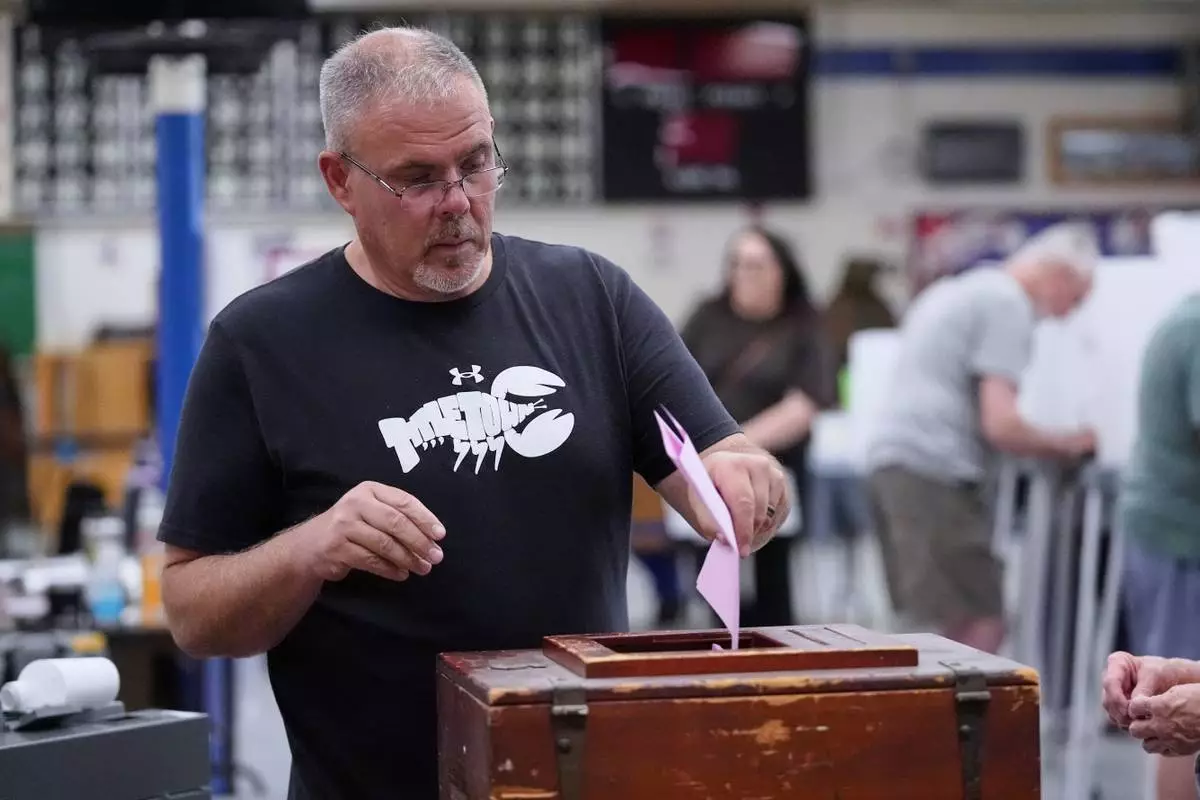
Art Fairbrother casts one of his ballots while voting in the Maine Primary, Tuesday, June 9, 2026, in Belfast, Maine. (AP Photo/Robert F. Bukaty)

Mary Saunders gets help from election officials after picking up her ballots to vote in the Maine Primary, Tuesday, June 9, 2026, in Augusta, Maine. (AP Photo/Robert F. Bukaty)
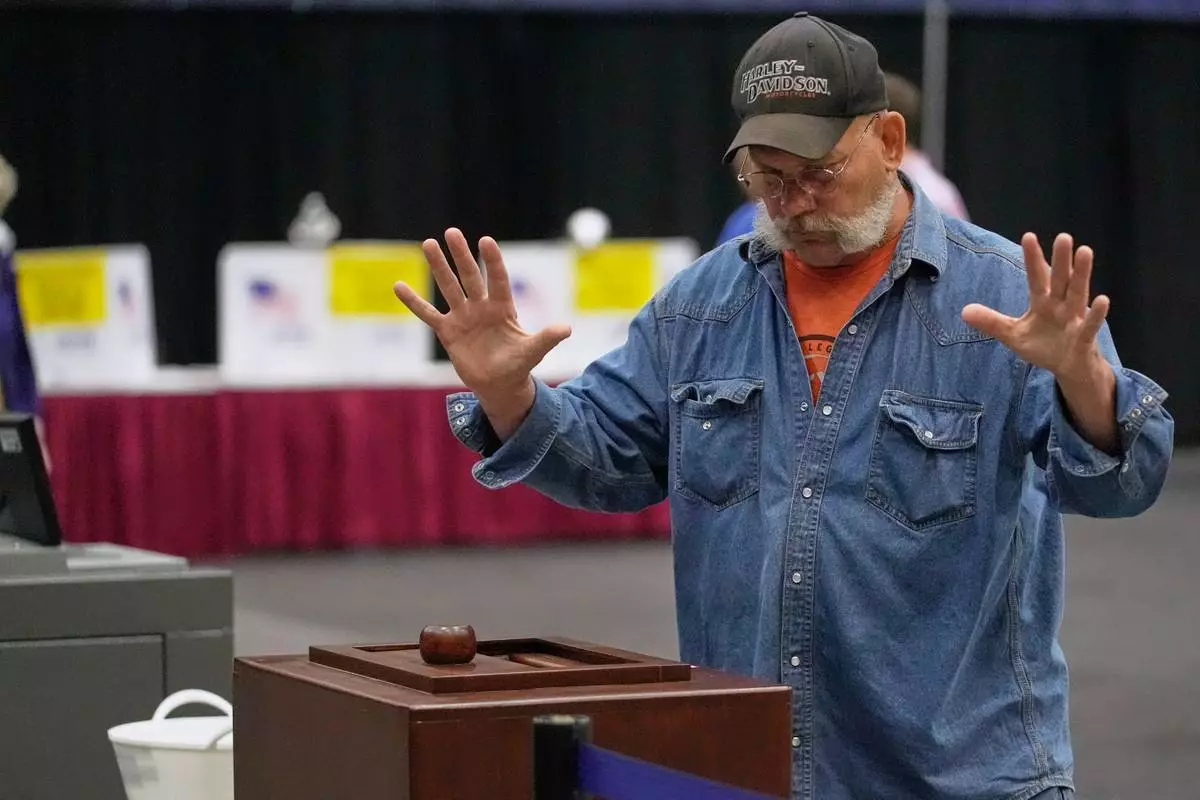
A Mainer reacts after his papers successfully dropped into to a ballot box while voting in the Maine Primary, Tuesday, June 9, 2026, in Augusta, Maine. (AP Photo/Robert F. Bukaty)
WASHINGTON (AP) — Minnesota Sen. Tina Smith came to the Senate at a very different moment for Democrats.
Appointed in late 2017 to replace Sen. Al Franken after fellow Democrats demanded his resignation amid allegations of unwanted touching and kissing, Smith entered Washington during the height of the #MeToo movement. Democrats were pushing members from office and contrasting their approach with Republicans’ willingness to stand by Donald Trump through scandal and controversy.
Nearly a decade later, Smith says Democrats are focused on something simpler.
“Democrats want to win,” she said.
As the party aims to flip both chambers of Congress in the midterms, Smith and other Democrats have backed Maine U.S. Senate candidate Graham Platner despite a growing list of controversies, including a tattoo recognized as a Nazi symbol, sexting with other women shortly after he married and allegations, which Platner denies, that he locked an ex-girlfriend in a room and forcefully twisted her arm. Platner cruised to victory in this week’s primary after Gov. Janet Mills suspended her campaign.
The support for Platner is about more than one candidate. It reflects a Democratic Party increasingly willing to overlook behavior it might once have deemed disqualifying, and instead judge candidates by whether they can energize voters and help the party regain power.
“Voters are looking for candidates that are speaking their language and talk about the things that matter to them,” said Smith. “That's the standard that we have to hit in order to win.”
The support for Platner comes at a fraught moment for Democrats, who are in the minority in both chambers of Congress while Trump once again occupies the White House.
In the wake of their sweeping losses in 2024, many Democrats argued the party needed a bigger tent with fewer purity tests and more room for candidates and voters who don’t fit neatly within the party’s traditional coalition.
But expanding that tent has raised difficult questions about where Democrats should draw the line. In Virginia, Democrat Jay Jones won election as attorney general after reports surfaced during the campaign that he had texted a fellow delegate suggesting the then-House speaker should get “two bullets to the head.”
Some in the party also condemned Michigan Senate candidate Abdul El-Sayed for appearing with progressive streamer Hasan Piker for a campaign event. Piker, a 34-year-old streamer with 3.1 million followers on Twitch and 1.8 million on YouTube, has made many controversial remarks, including that “America deserved 9/11.”
Platner’s candidacy has become one of the clearest examples. While some Democrats view his controversies as disqualifying, others argue that voters made their choice.
“He won the nomination. That was the decision of Maine voters. And I respect that decision,” said Sen. Adam Schiff, D-Calif.
Arizona Sen. Ruben Gallego, who has endorsed Platner, agreed the decision lies with voters.
“It’s not up to the politicians to decide,” he said.
For some Democrats, the shift reflects lessons learned during the Trump era. Republicans stood by Trump through scandals, impeachments and criminal convictions, often without paying a lasting political price at the ballot box. Many Democrats now argue voters care more about whether a candidate speaks to their concerns than whether they meet traditional expectations for personal conduct.
“I think what the people of this country and the people of Maine are interested in is how we're going to have a government that represents all of us and addresses the many crises we face. Not the marriage problems of a campaign,” said Sen. Bernie Sanders, an early Platner supporter.
Progressives who have long argued that Democrats spend too much time policing candidates and not enough time channeling voter frustration see Platner’s victory as evidence that the party’s base is hungry for something different.
Maine voter Elizabeth Massey, a Platner supporter from Penobscot, said she took the allegations seriously and remains troubled by parts of Platner’s past. But she said his willingness to apologize and the issues facing the country ultimately mattered more to her vote.
“So do I care more about texts that he sent or the war in Iran and what that’s doing to gas prices?” Massey said. “Pretty clearly the latter.”
Massey said Platner’s appeal is that he speaks directly to voters’ concerns, not that he is without flaws.
“He owns them. He has apologized for them,” she said of the allegations.
Other supporters argue that Republicans are holding Platner to standards they have not applied to Trump.
“The Republicans don’t have much moral high ground to stand on when they’re criticizing him for what he’s done when Trump is a convicted felon,” said Annette Babcock, who is from Platner’s hometown of Sullivan.
The willingness to embrace candidates with baggage comes as many Democrats remain deeply dissatisfied with their party.
Only about two-thirds of Democrats had a “somewhat” or “very” favorable view of their party in an April AP-NORC poll, a decline from 85% in September 2024. In a separate AP-NORC poll in August 2025, many Democrats described their political party as “weak” or “ineffective.”
But while Platner may fire up the base, questions linger about whether that will translate to general election wins. Platner now faces Republican Sen. Susan Collins, one of the GOP’s most durable incumbents and a politician with a long history of attracting independents and crossover Democratic voters.
“The test is never going to be who wins the primary,” said Michigan Sen. Gary Peters, who led the Senate Democrats’ campaign arm in 2022 and 2024. “It's going to be who wins the general election.”
Many Democrats have not given full throated support of Platner’s candidacy.
Among them is New York Sen. Kirsten Gillibrand, the chair of the Senate Democrats’ campaign arm, who has primarily focused on defeating Collins rather than embracing Platner. Gillibrand helped lead the push for Franken’s resignation, saying “enough is enough” and that she believed the women who accused him.
Other Democrats have been more openly skeptical. Pennsylvania Sen. John Fetterman and New Jersey Rep. Josh Gottheimer have spoken out against Platner, while some lawmakers have offered only qualified endorsements after his primary victory.
“Well, Maine supports him. So yes,” Sen. Peter Welch, D-Vt., responded when asked if he supports Platner.
Emily Cherniack, the executive director of New Politics, an organization that recruits military veterans and national service leaders to run for office, said she has been “stunned” by some Democrats’ willingness to downplay allegations of aggression and volatility against Platner.
“Democrats are saying, we think it’s actually more important to win the majority and protect democracy, regardless of what he did. That to me is what the message is,” Cherniack said.
“Just be honest and explicit about that choice.”
Associated Press reporter Patrick Whittle in Maine contributed to this report.

Democratic U.S. Senate candidate Graham Platner stands on stage during a primary election night watch party after winning the Democratic nomination Tuesday, June 9, 2026, in Blue Hill, Maine. (AP Photo/Robert F. Bukaty)