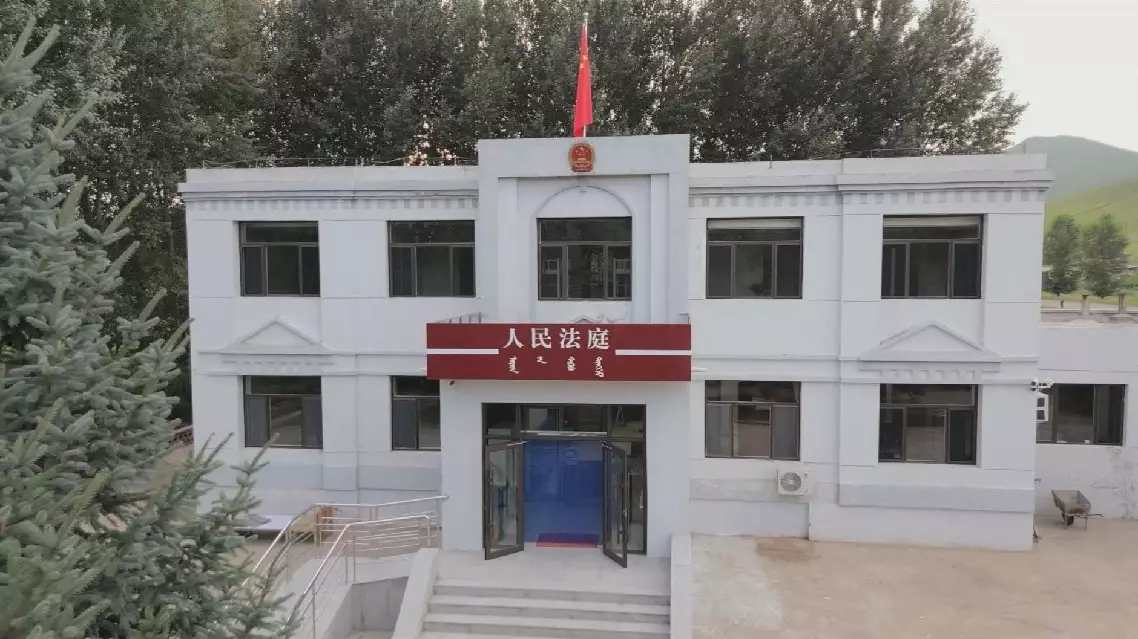
In the vast grasslands of north China’s Inner Mongolia Autonomous Region, herder families often live kilometers apart, and trips to town can be few and far between. But for Judge Bai Yongsheng, justice cannot be delayed by distance.
Bai has been working at the Zhalute Banner People's Court in the autonomous region's Tongliao City. Ever since he studied in law school, he has dreamed of this job.
"My image of judges was of wearing a judicial robe, holding a gavel, appearing solemn in the courtroom," said Bai.
But reality is somewhat different. His mornings begin in a cramped office sorting through thick case folders before embarking on marathon road journeys across a jurisdiction spanning over 8,000 square kilometers, larger than some countries.
A recent two-day journey the judge took revealed the extraordinary lengths required to deliver justice in the grasslands. After driving two and a half hours to reach the general vicinity of a case, Bai and his team faced the final challenge, the last several kilometers on foot across open steppe which deny any vehicle access.
Finally, in the open steppe with no courthouse in sight, court convened. The case that required such extraordinary effort -- a dispute over 10,000 yuan (about 1,478 U.S. dollars), with a litigation fee of just 25 yuan (about 3.7 U.S. dollars).
While the monetary values may seem modest, the human stakes are significant. Leaving these remote locations can prove as challenging as arriving, though local herders always help find a way out.
In the later stages of the two-day trip, even more minor cases were followed. Simple cases, but never easy. Each required patience and a unique approach, calmly explaining the law, educating herders about their responsibilities, and guiding disputants toward mutual understanding.
"Rome wasn't built in a day. Often, if small issues are ignored, they can turn into big problems. We always emphasize: minor issues are resolved within the village, while even major affairs are addressed directly in the town," said Bai.
Slowly, arguments give way to understanding, while disputes give way to handshakes. And at the end of the day, he shares his secret to handling cases seemingly so smoothly.
"The key is not to see yourself as a judge. Once you understand that, everything in this relationship becomes much easier to handle," said Bai.
What he has not mentioned is the physical cost: every handshake represents hours of travel, crossing rivers and mountains, sometimes even on horseback. In his 8,000-square-kilometer patch of steppe, Bai handles hundreds of cases every year. Each one leaves footprints pressed deep into the grass.
Bai said, after years on these endless roads, he has truly understood what he did not learn in law school.
"The courtroom can be anywhere. What matters is letting people feel fairness, justice and the human warmth of the law," Bai said.
Grassroots judge travels across grassland to deliver justice