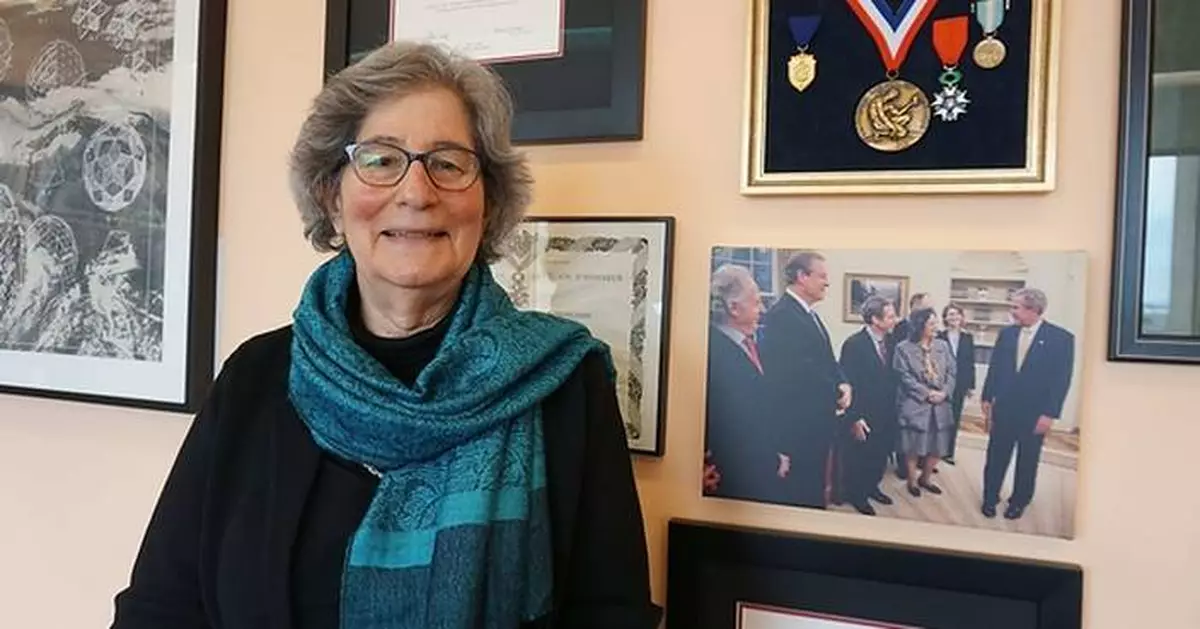
TAIPEI, June 15, 2026 /PRNewswire/ -- The Tang Prize, one of the world's leading academic awards established to address the critical needs of the 21st century, recognizes achievements in four major fields: Sustainable Development, Biopharmaceutical Science, Sinology, and Rule of Law. Beginning today, the Tang Prize Foundation will announce the 2026 laureates over four consecutive days, with each prize carrying a cash award of NT$50 million. The first award to be announced today, June 15, is the Tang Prize in Sustainable Development, which has been awarded to American atmospheric chemist Professor Susan Solomon. Professor Solomon is recognized "for groundbreaking advances and leadership in atmospheric and climate sciences that shaped global policy for Sustainable Development."
Climate change is one of the most urgent issues facing global sustainable development today. Professor Solomon is world-acclaimed for her seminal work on ozone layer depletion and climate change. By combining Antarctic field research, modeling innovations, and deep engagement with policy and the public, she has played a pivotal role in both the success of the Montreal Protocol and global climate negotiations. Her major contributions include proving that chlorofluorocarbons (CFCs) were indeed the cause of the widening ozone hole in Antarctica; proposing the heterogeneous chemical reactions that explain ozone hole formation; demonstrating that the impacts of CO₂ emissions are largely irreversible for more than 1000 years; and co-leading the production of the United Nations Intergovernmental Panel on Climate Change (IPCC)'s Fourth Assessment Report on the Physical Science Basis of Climate Change, which comprehensively synthesized key knowledge in climate science.
Professor Solomon is currently the Lee and Geraldine Martin Professor of Environmental Studies in the Department of Earth, Atmospheric and Planetary Sciences at the Massachusetts Institute of Technology (MIT). She began her scientific career at the National Oceanic and Atmospheric Administration (NOAA) from 1981 to 2011, and joined MIT in 2012 after 30 years of service at NOAA. Over the course of her career, she has received nearly 70 international awards and honors, including the U.S. National Medal of Science, the U.S. National Academy of Sciences Award for Chemistry in Service to Society, and the Blue Planet Prize. Her receipt of the Tang Prize comes exactly forty years after she first led expeditions to Antarctica in 1986.
From 1986 to 1987, Professor Solomon served as the Head Project Scientist of the U.S. National Ozone Expedition at McMurdo Station, leading teams to Antarctica and collecting the first direct measurements of reactive atmospheric chlorine compounds. These measurements confirmed that CFCs were indeed the main cause of the expanding Antarctic ozone hole. Her findings provided one of the scientific cornerstones for the Montreal Protocol on Substances that Deplete the Ozone Layer, the landmark international agreement to phase out ozone-depleting substances, widely regarded as one of the most successful environmental treaties in history. Few scientists have had such a direct and lasting impact on a global treaty that safeguards the biosphere. In 2016, her research group at MIT identified the first encouraging signs of ozone recovery over Antarctica as a direct result of international cooperation to phase out the ozone-depleting chemicals— a landmark moment in sustainability science.
In 2009, Professor Solomon published a groundbreaking study indicating that the climate impacts of CO₂ emissions on surface temperature, rainfall, and sea level are largely irreversible for more than 1000 years, even after CO₂ emissions cease. This paradigm-shifting finding demonstrated the long-term environmental harm caused by global warming, crystallized the urgent need for early and sustained action on climate mitigation, and had a lasting influence on both scientific understanding and international policy, reinforcing the link between science and sustainability.
Professor Solomon also showed how the thickness of the ozone layer in the Southern Hemisphere affects atmospheric flows and temperatures all the way down to ground level. For more than 40 years, her pioneering research on the impacts of human-influenced trace gases on the Earth's climate system has contributed enormously to our fundamental understanding of Earth's chemistry-climate interactions.
Her proposed mechanism of heterogeneous chemical reactions showed that, under the extremely cold conditions of the Antarctic stratosphere during winter and spring, polar stratospheric clouds (PSCs) form, and the surfaces of their ice crystals provide highly effective reaction sites. These surfaces allow chlorine gas (Cl₂) to form much more rapidly than it would in the gas phase. This mechanism has become an indispensable theoretical foundation for stratospheric chemistry models and is regarded as a classic in environmental science.
From 2002 to 2008, Professor Solomon co-led the production of the IPCC's Fourth Assessment Report on the Physical Science Basis of Climate Change. The IPCC was awarded the 2007 Nobel Peace Prize for its work. The report brought together the world's leading climate science research, provided a comprehensive synthesis of scientific knowledge, and became a cornerstone for global climate negotiations. She also communicated key scientific findings to international policy-makers, which helped inform the language of the 2015 Paris Agreement. Its message of "Warming of the climate system is unequivocal" and "Most of the observed increase in global average temperatures since the mid-20th century is very likely due to the observed increase in anthropogenic greenhouse gas concentrations" has set the fundamental tone of the world's deliberations on adaptation, mitigation, vulnerability, and resilience.
In 1994, Antarctica's Solomon Glacier (78°23'S, 162°30'E) and Solomon Saddle (78°23'S, 162°39'E) were officially named in her honor, recognizing her outstanding leadership and contributions to Antarctic research. For a scientist who has devoted her career to the study of polar regions and planetary systems, this recognition carries special significance.
Beyond her scientific achievements, Professor Solomon has also been an extraordinary ambassador for connecting science to sustainability. She has delivered hundreds of lectures around the world, briefed national governments and international bodies, and testified before the U.S. Congress on climate and atmospheric issues, actively advancing the integration of scientific knowledge into public policy.
About the Tang Prize
Since the advent of globalization, humanity has enjoyed unprecedented benefits from advances in civilization and science. Yet a multitude of challenges, such as climate change, the emergence of new infectious diseases, the widening wealth gap, and moral degradation, have surfaced along the way. Against this backdrop, Dr. Samuel Yin established the Tang Prize in December 2012. It consists of four award categories: Sustainable Development, Biopharmaceutical Science, Sinology, and Rule of Law. Every two years, four independent and professional selection committees, comprising many internationally renowned experts, scholars, and Nobel laureates, choose Tang Prize laureates who have made substantive contributions and generated a far-reaching impact on the world, regardless of race, nationality, gender, or religion. A cash prize of NT$50 million (approximately US$1.6 million) is allocated to each category, with NT$10 million (approximately US$320,000) of it being a grant intended for research or educational outreach programs to encourage professionals in every field to examine mankind's most urgent needs in the 21st century, and become leading forces in the sustainable development of human society through their outstanding research outcomes and active civic engagement.
** This press release is distributed by PR Newswire through automated distribution system, for which the client assumes full responsibility. **
Atmospheric Chemist Susan Solomon Awarded the 2026 Tang Prize in Sustainable Development, Unraveling the Mystery of the Ozone Hole and Advancing Global Environmental Governance