PROVIDENCIALES, Turks and Caicos Islands, June 17, 2026 /PRNewswire/ -- KuCoin, a leading global crypto platform built on trust, today announced the launch of the KuCoin Wealth Quant Fund, introducing its first product, the Neutral Enhanced Fund. Designed for high-net-worth users, the fund brings professionally managed, market-neutral digital asset strategies into the KuCoin Wealth experience, offering a more structured approach to long-term capital allocation, risk management and portfolio diversification.
As the digital asset market matures, investor needs are moving beyond simple market access, spot trading and basic yield products. High-net-worth users and professional investors are increasingly focused on how to manage digital assets more effectively across market cycles, activate existing holdings, reduce reliance on one-sided market exposure and gain greater clarity around strategy, fees, liquidity and risk.
This shift is revealing a layer of demand between conventional crypto yield products and institutional-style private fund solutions. While basic Earn products are accessible, they may not fully meet the needs of users seeking more advanced allocation strategies. Private funds and institutional solutions, meanwhile, can involve higher thresholds, longer processes and less standardized access. In response to this market demand, KuCoin Wealth Quant Fund was designed to provide access to a professional market-neutral strategy through an exchange-native product experience with clear subscription, redemption, NAV and fee mechanisms.
The Neutral Enhanced Fund employs quantitative market-neutral strategies, including arbitrage and long-short trading, with the goal of minimizing dependence on overall market movements. Designed to offer both accessibility and flexibility, the fund is denominated in USDT, has a relatively low minimum subscription requirement of 50,000 USDT, and features a 30-day lock-up period, providing investors with greater liquidity than many longer-term alternatives. Transparency is also a key feature of the fund. There are no subscription or management fees, and performance fees are charged only when an investor's NAV surpasses their individual high-water mark and generates new gains. No performance fee is incurred during drawdown periods or when the NAV remains below the high-water mark, ensuring that fees are closely aligned with actual investment results.
Supported by an independent custody framework, sub-account management, real-time monitoring and comprehensive risk controls, KuCoin Wealth Quant Fund reflects KuCoin's broader commitment to building trusted, transparent and responsible digital asset wealth management solutions for users moving from trading toward long-term allocation.
About KuCoin
Founded in 2017, KuCoin is a leading global crypto platform trusted by over 40 million users across 200+ countries and regions. Known for its user-first approach, the platform combines advanced technology, deep liquidity, and strong security safeguards to deliver a seamless trading experience. KuCoin provides access to 1,500+ digital assets through a broad product suite and remains committed to building transparent, compliant, and user-centric digital asset infrastructure for the future of finance, backed by SOC 2 Type II, ISO/IEC 27001:2022, and ISO/IEC 27701:2019 Certifications. In recent years, we have built a strong global compliance foundation, marked by key milestones including AUSTRAC registration in Australia, a MiCA license in Europe, and regulatory progress in other markets.
Learn more at www.kucoin.com.
** This press release is distributed by PR Newswire through automated distribution system, for which the client assumes full responsibility. **

KuCoin Wealth Introduces Its First Quant Fund as Demand Grows for Professional Digital Asset Allocation
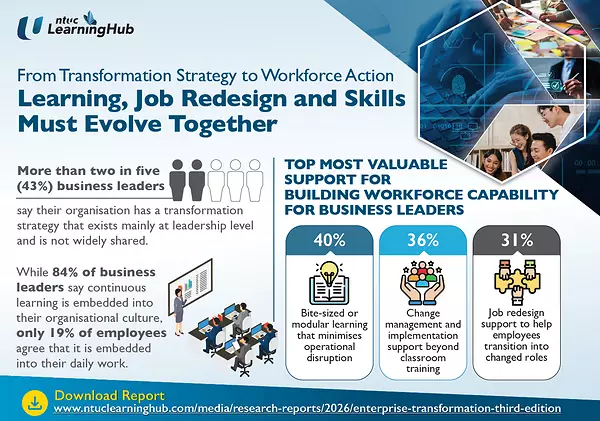
- More than two in five business leaders (43%) say their organisation has a transformation strategy that exists mainly at leadership level and is not widely shared, while only 13% say it is documented and actively communicated across the organisation.
- While 84% of business leaders (13% strongly agree, 71% agree) say continuous learning is embedded into their organisational culture, only 19% of employees agree that it is embedded into their daily work. Instead, 45% of business leaders say learning depends mainly on individual initiative, while 44% of employees describe it as ad hoc training or self-study outside work.
- Job redesign is often reactive, with more than two in five business leaders (44%) saying roles change when specific issues or gaps arise. About one in five (21%) say their organisation has not started job redesign, while only 7% report that it is embedded and continuously reviewed.
- To build workforce capability, business leaders place the greatest value on bite-sized learning (40%), followed by change management support (36%), leadership development (33%), job redesign support (31%), and skills gap diagnostics and workforce capability assessments (31%).
SINGAPORE, Oct. 12, 2026 /PRNewswire/ -- Enterprise transformation depends not only on having a strategy in place, but on whether organisations can translate it into how employees learn, how job roles evolve and how workforce capabilities are built.
Among business leaders surveyed, more than two in five (43%) say their organisation has a transformation strategy that exists mainly at leadership level and is not widely shared. A further 24% say transformation is taking place without a formal strategy, while one in five (20%) report that a strategy is still being developed. Only 13% say their organisation's transformation strategy is documented and actively communicated across the organisation.
Most business leaders (13% strongly agree, 71% agree) say continuous learning is embedded into their organisational culture, while more than three in four employees (18% strongly agree, 59% somewhat agree) agree that continuous learning is generally encouraged. However, only 19% of employees say it is embedded into their daily work.
These findings are drawn from the second and third editions of NTUC LearningHub's Enterprise Transformation Report, a three-part series on how enterprise transformation is reshaping organisations and the workforce. The report surveyed 450 working professionals, comprising 150 business leaders and 300 employees in July 2026.
While the first edition explored organisational approaches to transformation, including Artificial Intelligence (AI) adoption and business outcomes, the second examined how transformation is experienced on the ground, covering leadership, communication, and employee involvement. The third and final edition focuses on workforce readiness and the capabilities needed to support sustained transformation.
Nearly half of business leaders (45%) say learning depends mainly on individual initiative, while a similar proportion of employees (44%) describe continuous learning as ad hoc training or self-study outside work. The findings also reveal relatively low participation in formal transformation-related training. Just 24% of business leaders have attended training on leading enterprise transformation in the past two years, with 22% of employees having received training to help them adapt to workplace changes.
Many do intend to pursue training within the next six months to two years (59% of business leaders, 48% of employees), reflecting the recognition to build capabilities for transformation. AI literacy emerges as the top skills gap, cited by 39% of business leaders and 32% of employees, while adaptability (36% and 31% respectively) and critical thinking (35% and 26%) also rank highly, underscoring the importance of both technical and human capabilities.
Yet 18% of business leaders and 30% of employees currently have no plans to attend such training, suggesting that a sizeable segment of the workforce may be underprepared to support ongoing transformation efforts. Operational demands may also limit organisations' capacity to expand upskilling efforts. More than two in five business leaders (43%) say employees cannot take time away from daily operations, making this the leading barrier to scaling training. Employees experience similar challenges, with about one in three (34%) citing not having enough time away from daily work, followed by 32% saying too many changes make priorities unclear and 28% saying training is too generic.
The challenge also extends beyond learning to how jobs themselves are evolving. Business leaders most often describe job redesign as reactive, with more than two in five (44%) saying roles change only when specific issues or gaps arise. About one in five (21%) say their organisation has not started job redesign, with only 7% reporting that it is embedded and continuously reviewed.
These constraints are also shaping the kinds of support organisations say they need. Business leaders rank bite-sized or modular learning that minimises operational disruption (40%) as the most valuable form of support for building workforce capability, followed by change management and implementation support beyond classroom training (36%) and leadership development for managers (33%), job redesign support (31%), and skills gap diagnostics and workforce capability assessments (31%).
Commenting on the findings, Mr Tay Ee Learn, Assistant Chief Executive Officer and Chief Sector Skills Officer, NTUC LearningHub, says, "Enterprise transformation is ultimately about people. This means making workforce capability-building a core part of how transformation is planned and delivered. Technology, job redesign and upskilling or reskilling are often treated as separate workstreams, but transformation is most effective when they are brought together from the outset with a clear link between business priorities, how job roles will evolve and the technical and human capabilities employees need. Communicating the strategy is only the starting point; employees also need to understand what it means for their work and how they will be supported through change. The real opportunity for organisations is to build a workforce that can adapt as quickly as business needs change, turning transformation from a series of initiatives into an enduring organisational capability."
To download all three editions of the Enterprise Transformation Report, please visit https://www.ntuclearninghub.com/media/research-reports. To find out more about enterprise learning solutions, training, and grants, please contact NTUC LearningHub at www.ntuclearninghub.com.
About NTUC LearningHub
NTUC LearningHub is the leading Continuing Education and Training provider in Singapore which aims to transform the lifelong employability of working people. Since our corporatisation in 2004, we have been working with employers and individual learners to provide learning solutions in areas such as Infocomm Technology, Generative AI & Cloud, Healthcare, Retail & Food Services, Employability & Literacy, Business Excellence, Workplace Safety & Health, Security, Human Resources & Coaching and Foreign Workers Training.
To date, NTUC LearningHub has helped over 34,000 organisations and achieved more than 3.2 million training places across more than 1,000 courses with a pool of about 1,000 certified trainers. As a Total Learning Solutions provider to organisations, we also forge partnerships to offer a wide range of relevant end-to-end training. Besides in-person training, we also offer instructor-led virtual live classes (VLCs) and asynchronous online learning. The NTUC LearningHub Learning eXperience Platform (LXP)—a one-stop online learning platform—offers timely, bite-sized and quality content for learners to upskill anytime and anywhere. Beyond learning, LXP also serves as a platform for jobs and skills development for both workers and companies.
For more information, visit www.ntuclearninghub.com.
** This press release is distributed by PR Newswire through automated distribution system, for which the client assumes full responsibility. **
From Transformation Strategy to Workforce Action: Learning, Job Redesign and Skills Must Evolve Together