Skip to Content Facebook Feature Image

Syngenta Signs MoU to Be Strategic Partner in India’s First Open-Data Agricultural Ecosystem Annam.AI

Business

Syngenta Signs MoU to Be Strategic Partner in India’s First Open-Data Agricultural Ecosystem Annam.AI
Business

Business

Syngenta Signs MoU to Be Strategic Partner in India’s First Open-Data Agricultural Ecosystem Annam.AI

2026-06-15 15:37 Last Updated At:15:40

BASEL, Switzerland--(BUSINESS WIRE)--Jun 15, 2026--

India’s agriculture sector is a global powerhouse, uniquely characterized by its massive scale, vast arable land, diverse agro-climatic zones and rich biodiversity. These strengths have propelled the country to become one of the world’s leading producers of crops such as rice and wheat. However, farmers in the country face significant challenges – from erratic monsoons, severe droughts and unseasonal rains compounded by El Nino, to pests and diseases that destroy an estimated 30 percent of crops annually. More than 80 percent of India’s estimated 150 million farming households are composed of smallholder farmers who operate on less than two hectares of land. This limits economies of scale, sets obstacles to the wider adoption of advanced technologies and could widen a systemic gap between large commercial agricultural operations and the bulk of its farming population.

This press release features multimedia. View the full release here: https://www.businesswire.com/news/home/20260615154481/en/

Providing India’s farmers with free, real-time and personalized agricultural intelligence – at scale – could transform the country’s agriculture.

This vision is at the heart of an ambitious program called Annam.AI, which aims to build a nationwide agricultural intelligence backbone based on open data, that enables precision agriculture and fosters climate resilience. This would provide India’s farmers hyperlocal, AI-powered advisories that integrate crop intelligence, real-time microclimate data and multilingual engagement tools. Annam.AI (Alliance for Next-gen Nourishment through Agriculture Modernization, and denoting “food” in Sanskrit language) is backed by the Government of India through the Ministry of Education, the Ministry of Agriculture and Farmers Welfare, global technology partners such as Google, and is driven by IIT Ropar, a premier engineering and technology university in Punjab that is part of the prestigious Indian Institutes of Technology (IIT) system.

Syngenta, a global leader in agricultural innovation with a long-standing presence in India, today announced it has signed a Memorandum of Understanding to be a strategic partner in the Annam.AI program, at an event in Nice, France attended by India’s Prime Minister Narendra Modi and France’s President Emmanuel Macron. Syngenta is to leverage its R&D and agronomic expertise in building accurate crop health, pest forecasting and heat stress models.

Jeff Rowe, Syngenta Group’s Chief Executive Officer, said: “At Syngenta we're creating breakthroughs for farmers in every field, to deliver higher yields with lower impact. Annam.AI presents a unique opportunity to contribute to a transformative, digital foundation for Indian agriculture that will benefit more than 600 million people in this country. We are deeply honored to work with many talented and committed people in India’s government and universities, as well as with other innovation leaders in fulfilling this vision.”

About Syngenta Group

Syngenta Group is one of the world’s biggest agricultural innovation companies, employing over 50,000 people in more than 90 countries. Syngenta Group is focused on developing technologies and farming practices that empower farmers, so they can make the transformation required to feed the world’s population while preserving our planet. Syngenta Group’s bold scientific discoveries deliver better benefits for farmers and society on a bigger scale than ever before. Guided by its Sustainability Goal, Syngenta Group supports farmers to grow healthier plants in healthier soil with a higher yield.

Syngenta Group, which is registered in Shanghai, China, and has its management headquarters in Switzerland, draws strength from its four business units: Syngenta Crop Protection, headquartered in Switzerland; Syngenta Seeds, headquartered in the United States; ADAMA ®, headquartered in Israel; and Syngenta Group China.

For Syngenta Group photos and videos, please visit the Syngenta Group Media Library.

To find out more about how our innovation is empowering farmers around the world, read our stories and follow-us on social media.

Website | LinkedIn | Instagram | YouTube | X

Data protection is important to us. You are receiving this publication on the legal basis of Article 6 para 1 lit. f GDPR (“legitimate interest”). However, if you do not wish to receive further information about Syngenta Group, just send us a brief informal message and we will no longer process your details for this purpose. You can also find further details in our privacy statement.

Cautionary Statement Regarding Forward-Looking Statements

This document may contain forward-looking statements, which can be identified by terminology such as “expect,” “would,” “will,” “potential,” “plans,” “prospects,” “estimated,” “aiming,” “on track” and similar expressions. Such statements may be subject to risks and uncertainties that could cause the actual results to differ materially from these statements. For Syngenta Group, such risks and uncertainties include, amongst others, risks relating to legal proceedings, regulatory approvals, new product development, increasing competition, customer credit risk, general economic and market conditions, refinancing risk, interest rate fluctuations and access to capital markets, compliance and remediation, evolving environmental and sustainability regulations, changes in agricultural policies or subsidy regimes, intellectual property rights, implementation of organizational changes, impairment of intangible assets, consumer perceptions of genetically modified crops and organisms or crop protection chemicals, climatic variations, fluctuations in exchange rates and/or grain prices, supply chain disruptions, (geo)political risks, trade restrictions, sanctions, and export controls, natural disasters, and breaches of data security or other disruptions of information technology. Syngenta Group assumes no obligation to update forward-looking statements to reflect actual results, changed assumptions or other factors.

© 2026 Syngenta. All rights reserved.
®/™ are Trademarks of companies belonging to the Syngenta Group.
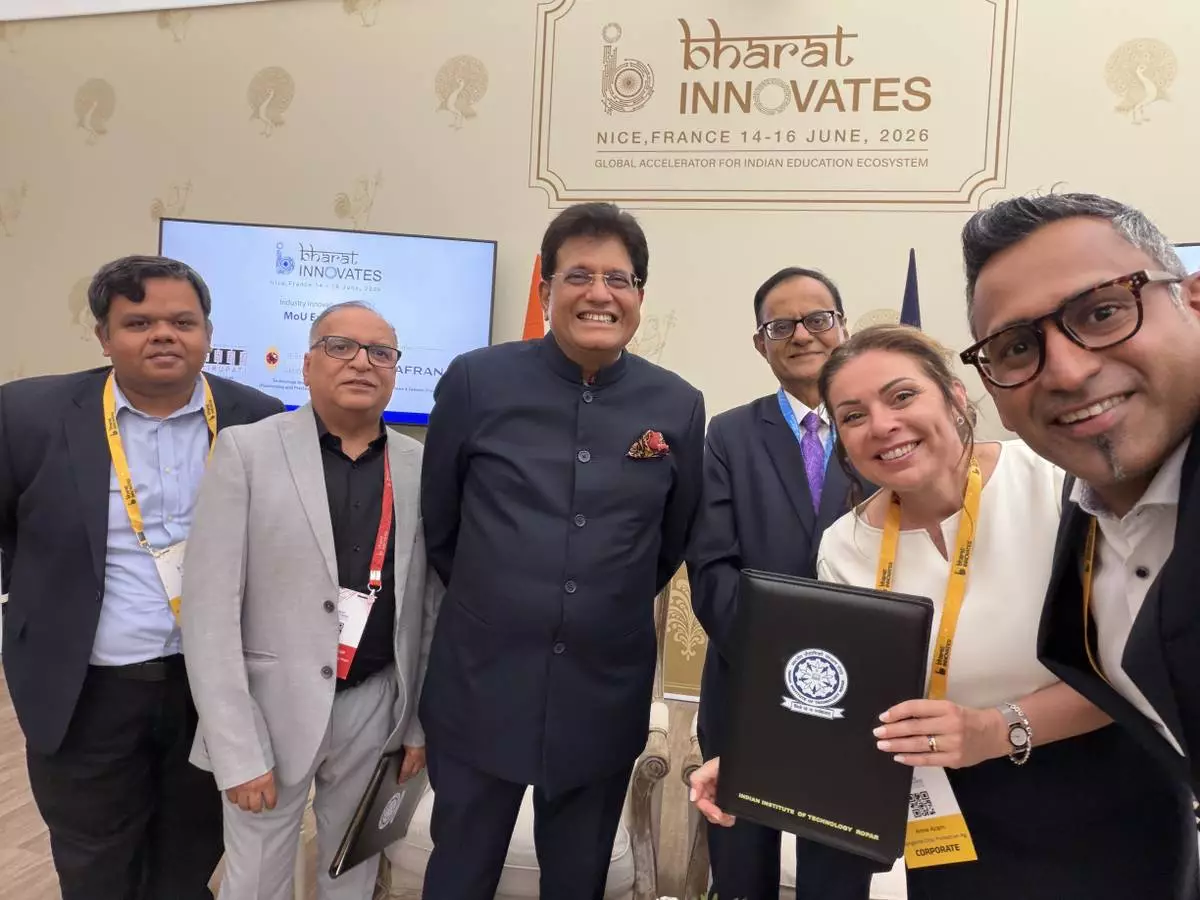
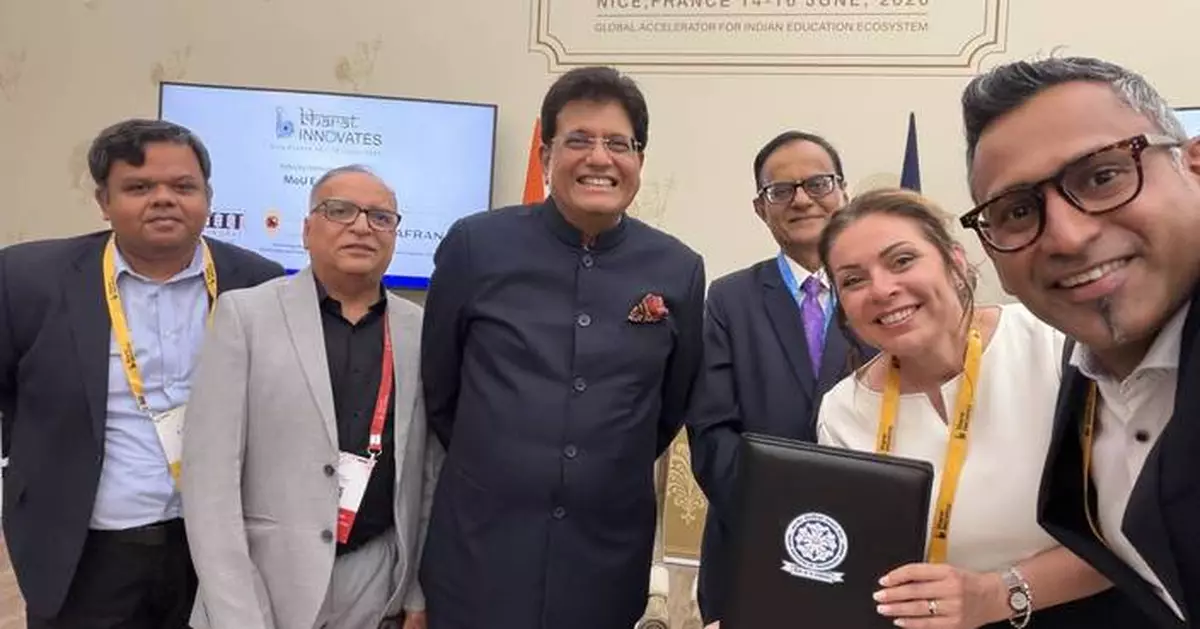
Syngenta Country Head for France Anne Azam (2nd from right) with India’s Minister of Commerce and Industry Piyush Goyal (3rd from left) and Annam Principal Scientific Advisor to the Government of India Dr. Ajay Sood (3rd from right) at the signing ceremony.

Syngenta Country Head for France Anne Azam (2nd from right) with India’s Minister of Commerce and Industry Piyush Goyal (3rd from left) and Annam Principal Scientific Advisor to the Government of India Dr. Ajay Sood (3rd from right) at the signing ceremony.
Leaders at the Group of Seven summit wrap up three days of talks in the French Alps on Wednesday with discussions on the contentious future of artificial intelligence and U.S. dominance of the industry.

U.S. President Donald Trump and other national leaders are closing the formal talks of the leading industrial nations in the lakeside resort of Evian-les-Bains with a session on the future of artificial intelligence and another on fostering economic growth.

The heads of several leading AI companies will attend the discussions, including OpenAI CEO Sam Altman, Google DeepMind CEO Demis Hassabis and Anthropic CEO Dario Amodei.

Trump plans to stop outside Paris for a glitzy dinner at the Palace of Versailles before he jets back to Washington on Wednesday.

The G7 leaders spent the bulk of the meetings Tuesday discussing the war between Russia and Ukraine and a tentative deal to end the Iran war. Trump did not reveal details of the agreement expected to be signed by the United States and Iran on Friday at a resort on Switzerland’s Lake Lucerne.

The G7 includes France, Canada, Germany, Italy, Japan, the U.S. and the United Kingdom. Guest nations at this summit include Brazil, Egypt, India, Kenya, South Korea, Qatar, Ukraine and the United Arab Emirates.

Here is the latest:

Merz is reiterating Berlin’s intention to help support a peace deal in the Middle East. That could include a military mission in the Strait of Hormuz if there is a ceasefire.

But Merz said there is “a series of preconditions that are not yet fulfilled, so there is no immediate hurry.”

Germany’s government would need to secure a parliamentary mandate for any military mission.

Merz noted that there are still two weeks of parliamentary sessions before the legislature’s summer break starts in July and said that “there is no time pressure at the moment.”

“It’s a memorandum of understanding and if I don’t like it, we’ll go back to shooting at them, dropping bombs,” Trump said.

Trump also repeated his claim that his negotiating prowess and willingness to use military action pushed the Iranians to make a deal.

“Nobody could have made this deal,” he said.

During a news conference with Trump on the sidelines of the summit, Egyptian President Abdel-Fattah el-Sissi said that his government “values the U.S. support to Egypt,” as well as efforts to solve the Ethiopian dam issue.

El-Sissi has forged close ties with Trump since the American leader’s first term in the White House.

Egypt fears that Ethiopia’s controversial dam could slash its share of Nile water, and it has called for a legally binding agreement on the dam’s operation.

German Chancellor Friedrich Merz said the outcome of the summit shows that the group’s support for Ukraine is “as strong as seldom before.”

He said it also sends a clear signal to Moscow that all G7 members will step up pressure on Russia, including through sanctions.

“That sets a new tone, including in trans-Atlantic unity and determination,” Merz said, adding that it could be a “decisive step” toward peace negotiations.

The G7’s AI lunch will be one of the first times that OpenAI CEO Sam Altman and Anthropic CEO Dario Amodei will be appearing together since they made an awkward appearance at an AI summit in India earlier this year.

At that meeting, the two rivals were part of a group of 13 tech leaders on stage when the summit host beckoned them to lift up their hands in a chain, like at the end of a theater show.

But Altman and Amodei avoided hand contact, and both eventually put up their fists instead, in a moment that went viral on social media.

The two have longstanding differences over approaches to AI safety. Amodei worked at OpenAI before he and a group quit to form Anthropic in 2021.

“Nobody knows what it is but it’s very strong,” Trump said of the deal that is expected to be formally signed by U.S. and Iranian officials on Friday.

Trump added that a surging stock market is validating the deal.

“There’s nothing so smart as the market, and the market loves it, Trump said.

Among those not expected at the G7 lunch was Nvidia CEO Jensen Huang, who opened a new factory in Dallas on Tuesday and gave an exclusive interview to The Associated Press. Huang, whose company’s advanced chips are seen as essential for the AI boom, said he thought new social norms are needed when it comes to AI.

Another tech figure who was in France but not at the G7 was Amazon founder Jeff Bezos, who appeared at a tech conference in Paris. Bezos told the crowd his new AI startup, Prometheus, would be different from current AI large language models because it would be the basis for a series of engineering tools.

He also said disagreed with the view that AI will eliminate jobs, saying the technology “is going to create a labor shortage because it’s going to make it possible for people to identify more problems” to solve with AI.

Trump offered a round of applause for Macron at the beginning of the G7 session on global economic imbalances, saying the French president is “doing great” and paying tribute to the Evian summit’s organisation, a diplomat informed of the talks said.

An AP reporter close to the meeting’s room was able to hear the applause.

A senior French diplomatic official later described the Evian gathering as “the best G7” in years, citing the quality of informal exchanges among leaders. The official said those discussions helped secure endorsement from all G7 members, including Trump, of a joint statement on key geopolitical issues, including the Middle East and Ukraine.

Officials would not speak publicly about the leader’s talks that were behind closed doors.

High-profile AI industry figures will take part in a rare huddle with political leaders on the meeting’s final day.

The leaders of three of the world’s most powerful AI companies — OpenAI CEO Sam Altman, Google DeepMind CEO Demis Hassabis and Anthropic CEO Dario Amodei — were due to attend a working lunch on the theme of “Ensuring a safe, rapid and effective deployment of artificial intelligence.”

European AI labs were represented by Arthur Mensch, CEO of France’s Mistral AI; Robin Rombach, CEO of Germany’s Black Forest Labs, Victor Riperbelli of U.K.-based Synthesia and Uljan Sharma, CEO of Italy’s Domyn.

Other AI founders joining the lunch include Aidan Gomez, CEO of Canada’s Cohere, Ren Ito, the founder of Japan’s Sakana AI, Vivek Raghavan of India’s Sarvam AI. Salesforce CEO Marc Benioff was also taking part.

That was his opening phrase as he walked in — late — to the first session of the day at the G7 summit.

The room laughed, and Trump grinned. After exchanging niceties with the U.S. president, Macron then got the meeting underway.

G7 leaders were to discuss concerns that China is flooding export markets with subsidized products, unfairly out-competing their own industries and destroying jobs. They gathered for a session focusing on “promoting balanced, shared and sustainable economic growth” alongside partners including leaders of India, South Korea, Kenya and Brazil.

Talks come as China is redirecting its products away from the U.S. tariff wall and toward more open markets in Europe and elsewhere in Asia.

The shift in Chinese trade risks creating a European sequel to the China Shock that wiped out hundreds of thousands of factory jobs in the American heartland in the 2000s. Despite U.S. sanctions, China notched a record global trade surplus last year.

Leaders of France, the UK, Italy, Germany and Canada have gathered for informal talks ahead of a G7 session on global economic imbalances, French President Emmanuel Macron’s office said.

They then joined the meeting involving partners including India, South Korea, Kenya and India.

Keir Starmer says he isn’t sure whether Trump has made a decision about whether to reimpose sanctions on Russian oil.

The British leader says he talked to Trump about the temporary U.S. sanctions waiver.

Starmer told British broadcaster ITV he and Trump had “a very constructive discussion about Ukraine,” but “I don’t know that a decision has been made yet.”

He said G7 leaders shared “a real determination to stand with Ukraine,” including through more sanctions on Russia.

Trump said on Wednesday that he’s delaying Jay Clayton’s nomination to lead the U.S. intelligence community in a bid to force Congress to act on a voter ID bill that currently lacks enough support for passage.

Trump said in a lengthy post on his social media site that he will keep Bill Pulte, a top U.S. housing official, as acting director of national intelligence. Lawmakers in both parties had opposed Trump’s nomination of Pulte, citing his apparent lack of experience in the intelligence field, which essentially forced Trump to turn to Clayton.

Clayton had been set to appear on Wednesday for a Senate confirmation hearing that was fast-tracked because of the lapse of a crucial surveillance program due to bipartisan anger over Trump’s pick of Pulte.

Carney did not get a bilateral meeting with Trump at the summit, despite the free trade agreement between the countries being up for renewal on July 1.

Carney says he had seven or eight discussions with Trump and he expects to have more Wednesday.

He says they discussed a wide range of subjects, from the economy, relations, his birthday, artificial intelligence, Ukraine and Iran.

Canadian prime ministers usually get a bilateral meeting with an American president at G7 summits. And it is a crucial time for talks to potentially renew the free-trade agreement between the two countries and Mexico. Trump said last week that he may not renew the deal.

Macron is the only G7 leader to get a bilateral meeting thus far. Trump met with the leaders of non-G7 countries of Qatar, UAE, Egypt and India.

The expansive palace is where he’ll have dinner with Macron before the flight back to Washington.

At the final day of the G7 summit in Evian-les-Bains, Trump is set to participate in working sessions with his counterparts from France, Britain, Canada, Germany, Italy and Japan, alongside leaders from some developing nations and tech CEOs.

In between sessions, he’ll hold one-on-one talks with Egypt’s president and India’s prime minister.

Trump is also holding a news conference before the trip to Versailles.

G7 leaders said in a joint statement overnight they would increase military support for Ukraine after recent “progress on the battlefield.”

They also plan to levy harsher sanctions on Russia’s energy sector in the wake of the recent deal to reopen the Strait of Hormuz.

They plan to give more air defense technology including interceptors and grant military production licenses to Ukraine.

Kyiv has sought the permits to construct their own Patriot missiles.

Carney says a tentative deal to end the Iran war could be a game changer in the world.

The Canadian prime minister, speaking on the final day of the summit, said the agreement could have positive effects including the ability to provide additional defensive support in Ukraine.

Carney said here has been a change in tone concerning Ukraine, which was discussed in detail at the summit on Tuesday.

Many countries are vested in making the Iran deal work, he said.

Leaders gathered at the G7 summit issued a joint statement overnight Tuesday on the agreement reached between the U.S. and Iran focused on securing safe passage without tolls in the Persian Gulf.

“We reaffirm that the right of transit passage without restrictions or tolls is the bedrock of international trade,” said the statement of leaders from Canada, France, Germany, Italy, Japan, the United Kingdom and the United States.

Iran floated a similar idea in April to fund reconstruction of areas in the country damaged by war.

The closure of the strait has driven up fuel and fertilizer costs and rattled economies worldwide.

The statement also offered support to a French and British-led naval mission to the Persian Gulf to safeguard ships and remove mines from one of the crucial choke-points in the world’s energy supply chain.

Canadian Prime Minister Mark Carney gave U.S. President Donald Trump a present for his 80th birthday, but said it’s “not gold.”

Trump was “very pleased,” Carney said, adding that he “likes it a lot.”

Carney didn’t specify what the gift was and a spokesperson for the prime minister didn’t immediately know.

Trump is known for his love of gold. An Oval Office makeover at the start of his term included large amounts of fresh gold trim.

Trump and Carney have a positive relationship despite Trump’s previous comments about making Canada the 51st state of the United States.

Britain's Prime Minister Keir Starmer, left, Brazil's President Luiz Inacio Lula da Silva, second from left, and Canada's Prime Minister Mark Carney, second from right, arrive for a group photo at the G7 summit, Tuesday, June 16, 2026, in Evian-les-Bains, France. (AP Photo/Julia Demaree Nikhinson)

Britain's Prime Minister Keir Starmer, left, Brazil's President Luiz Inacio Lula da Silva, second from left, and Canada's Prime Minister Mark Carney, second from right, arrive for a group photo at the G7 summit, Tuesday, June 16, 2026, in Evian-les-Bains, France. (AP Photo/Julia Demaree Nikhinson)

European Council President Antonio Costa, Ukrainian President Volodymyr Zelenskyy, Japan's Prime Minister Sanae Takaichi and others gather for a group photo at the G7 summit, Tuesday, June 16, 2026, in Evian-les-Bains, France. (AP Photo/Julia Demaree Nikhinson)

European Council President Antonio Costa, Ukrainian President Volodymyr Zelenskyy, Japan's Prime Minister Sanae Takaichi and others gather for a group photo at the G7 summit, Tuesday, June 16, 2026, in Evian-les-Bains, France. (AP Photo/Julia Demaree Nikhinson)

President Donald Trump helps France's first lady Brigitte Macron up a step as she arrives for a group photo with leaders and their spouses at the G7 summit, Tuesday, June 16, 2026, in Evian-les-Bains, France. (AP Photo/Julia Demaree Nikhinson)

President Donald Trump helps France's first lady Brigitte Macron up a step as she arrives for a group photo with leaders and their spouses at the G7 summit, Tuesday, June 16, 2026, in Evian-les-Bains, France. (AP Photo/Julia Demaree Nikhinson)

U.S. President Donald Trump arrives to attend a musical interlude before a gala dinner as part of the G7 summit, in Evian-les-Bains, France, Tuesday June 16, 2026. (Ludovic MARIN/Pool Photo via AP)

U.S. President Donald Trump arrives to attend a musical interlude before a gala dinner as part of the G7 summit, in Evian-les-Bains, France, Tuesday June 16, 2026. (Ludovic MARIN/Pool Photo via AP)

U.S. President Donald Trump walks after posing for a family photo photograph during a gala dinner as part of the G7 summit, in Evian-les-Bains, France, Tuesday June 16, 2026. (Ludovic Marin/Pool Photo via AP)

U.S. President Donald Trump walks after posing for a family photo photograph during a gala dinner as part of the G7 summit, in Evian-les-Bains, France, Tuesday June 16, 2026. (Ludovic Marin/Pool Photo via AP)

Recommended Articles