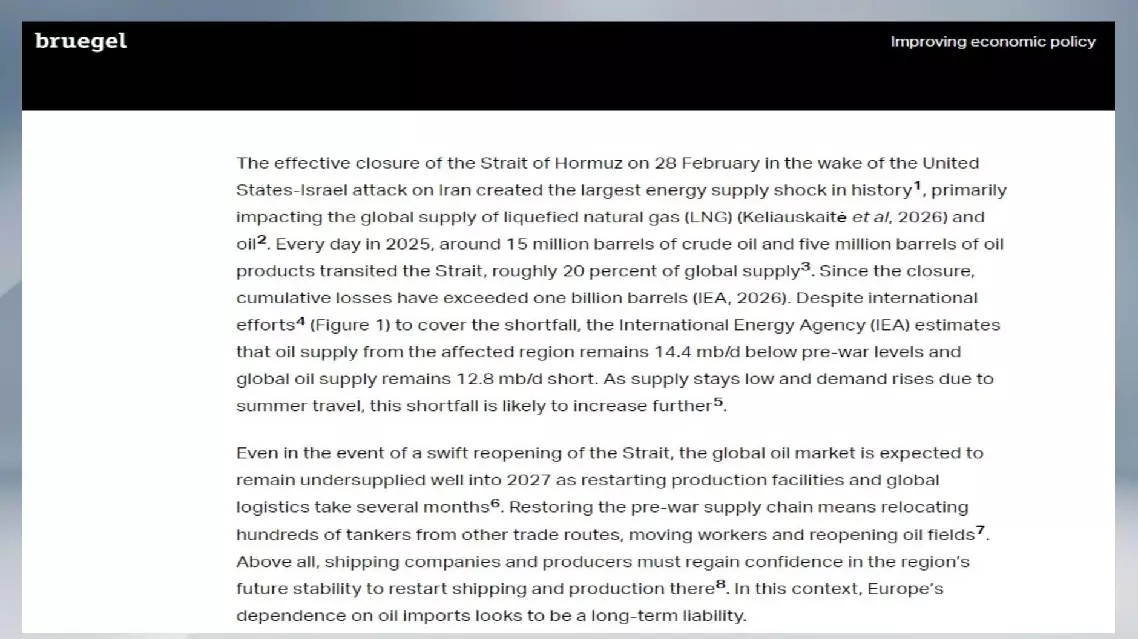
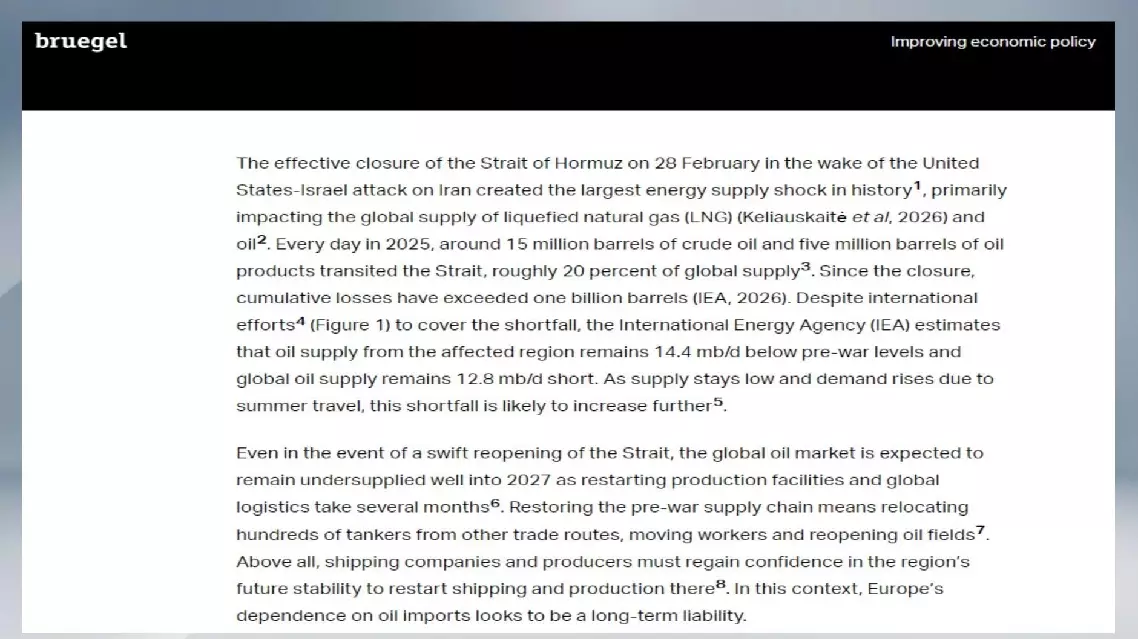
The global oil market will remain imbalanced through 2027 despite any reopening of the Strait of Hormuz, a vital artery for global energy shipping, the European think tank Bruegel said Monday.
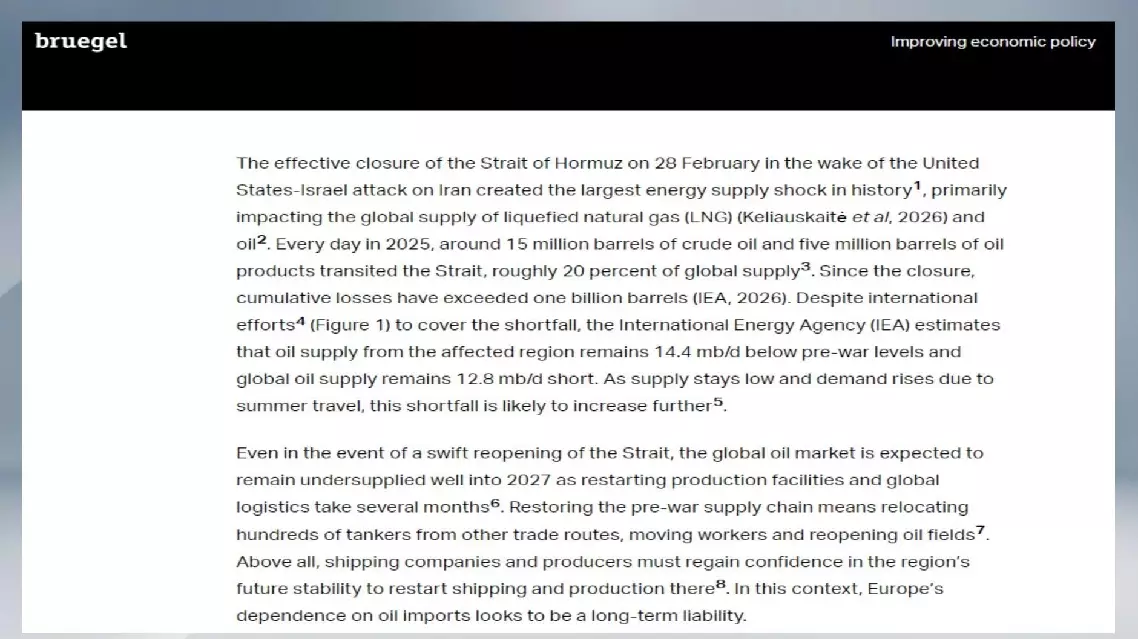
The report noted that the U.S.-Israeli war against Iran has severely disrupted the Strait of Hormuz, causing the largest energy supply shock in history.
In 2025, about 15 million barrels of crude oil and 5 million barrels of petroleum products passed through the Strait of Hormuz each day, accounting for roughly 20 percent of global supply.
Since shipping through the strait was disrupted, the International Energy Agency estimates the world has faced a daily shortfall of 12.8 million barrels, the largest supply gap on record. The report said that even if the strait reopens soon, restarting oil fields and redeploying tankers will take months, and the global oil market imbalance is expected to continue into 2027.
In this context, the report noted that Europe's dependence on imported oil could become a long-term development vulnerability.
The European Union relies on imports for 97 percent of its crude oil. European jet fuel inventories have already shrunk significantly.
Goldman Sachs and S and P Global, among others, hold pessimistic outlooks on Europe's summer jet fuel supply prospects.
European think tank forecasts oil market imbalance to persist through 2027
European think tank forecasts oil market imbalance to persist through 2027
European think tank forecasts oil market imbalance to persist through 2027
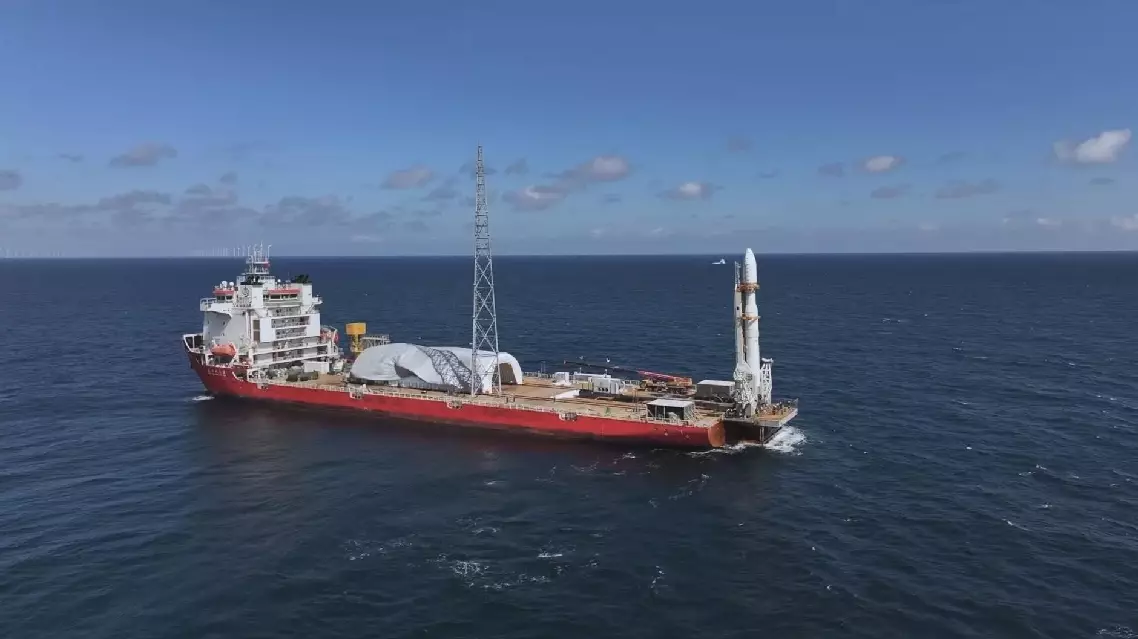
The Lijian-1 carrier rocket completed the rehearsal on Tuesday for its first sea-based launch mission, which is now in countdown, according to the CAS Space, developer of the rocket series.
The Lijian-1, a medium-sized solid-fuel commercial carrier rocket designed for the rapid deployment and networking of micro and small satellites in low-to-medium orbits, will send three satellites into space in the upcoming mission in waters near south China's Guangdong Province.
The comprehensive rehearsal featured a dozen tests.
"Launching a rocket offshore is like performing surgery on a bumpy carriage, as both safety and accuracy of the launch might be compromised, while salt spray corrosion could damage the rocket's delicate electronic components. So, it's essential to develop a customized solution with strong environmental adaptability for the offshore launch," said Dou Xu'an, deputy chief designer of the Lijian-1 rocket.
Meanwhile, the Lijian-2 Y2, another member of the Lijian series, has finished final assembly.
The new rocket, designed with a greater payload capacity than the Lijian-1 for the construction of low-orbit constellations, is scheduled to send 18 satellites into space in a single mission this October.
"The Lijian-2 Y2 carrier rocket has passed all factory reviews, with all performance indicators fully meeting flight requirements. The assembly and testing cycle for this rocket was shorter than that of Lijian-2 Y1, marking a steady step towards standardized mass production and launch of Lijian-2 rockets," said Li Qinfeng, deputy chief designer of the Lijian-2 rocket.
Lijian-1 completes rehearsal for first offshore launch