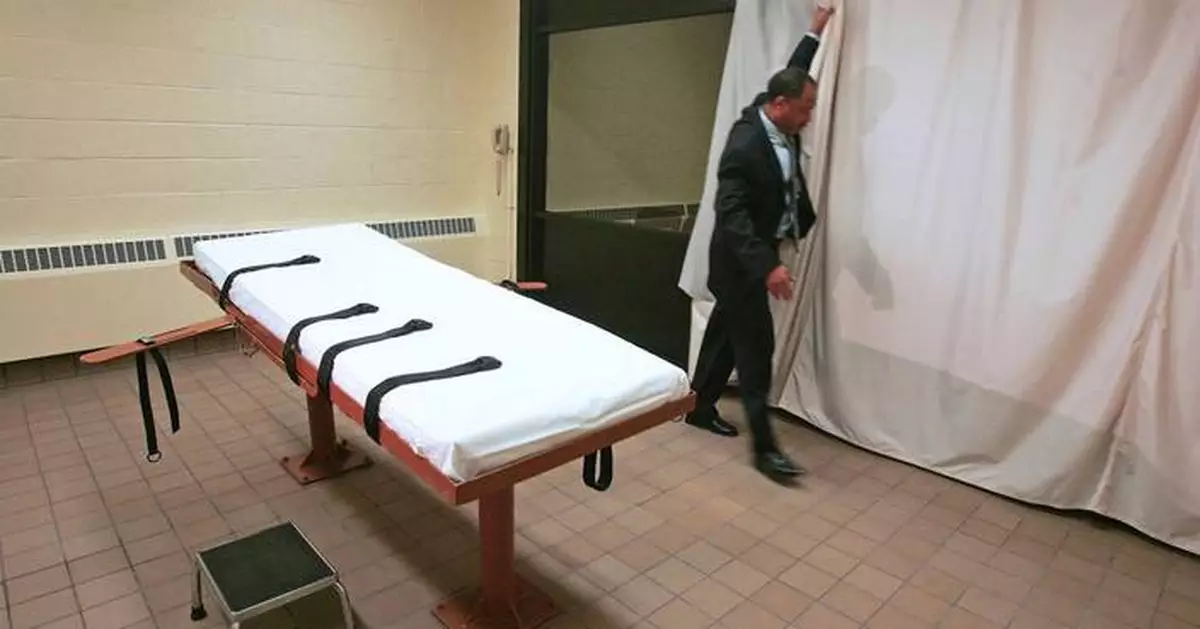
COLUMBUS, Ohio (AP) — Republican Gov. Mike DeWine, who has repeatedly postponed executions over the past seven years, said Tuesday that Ohio should abolish the death penalty, confirming his change of heart on the policy he helped write as a state legislator 45 years ago.
DeWine, 79, said during a news conference that data indicates the death penalty is not serving as a deterrent to violent crime, which he had always believed was its moral imperative.
“I do not believe that argument today can be successfully made, nor do I believe that there’s any chance in the future the facts that I’ve cited to support that belief will change,” he said. “Therefore, I believe Ohio should abolish the death penalty.”
To bolster his case, DeWine brandished charts and graphs detailing the diminishing number of death sentences meted out by courts and showing the exceedingly long wait times that elapse as legal appeals play out for those on death row. He said condemned murderers are increasingly unlikely to ever be executed, sometimes dying by natural causes or by suicide before their execution date arrives.
“In summary, each decade that the death penalty has been in effect, the chances of a murderer getting executed get more and more and more remote,” DeWine said.
He also cited years of pain brought to victims’ loved ones by the delays and the toll taken on the mental health of state employees who serve on execution teams.
DeWine, who faces a term limit in December, said he felt compelled to share his observations now, having had 50 years of experience with the issue from the time he was a young county prosecutor, through being a congressman and U.S. senator, and then serving as Ohio's attorney general. But he said his outright opposition to the procedure has only crystallized over the past year.
Headed into the announcement, any chance of a legislative repeal of the death penalty appeared unlikely.
Republican House Speaker Matt Huffman said in February he would “vigorously oppose” such an effort, and then-Ohio Attorney General Dave Yost agreed with him on social media. It remains unclear how Interim Attorney General Andy Wilson, appointed last month to serve the remainder of Yost's term, will respond, and whether the position held by Huffman, who is Catholic, might be affected by immediate praise for DeWine's announcement by the Catholic Conference of Ohio.
“In a state and country in which alternatives to execution exist, we should support punishments that are in greater conformity with the dignity of the human person, made in the image and likeness of God,” executive director Brian Hickey said in a statement.
In repeatedly extending Ohio’s unofficial death penalty moratorium by postponing scheduled executions, DeWine has cited pharmaceutical suppliers’ unwillingness to provide the drugs used in lethal injections. In January 2025, President Donald Trump ordered then-U.S. Attorney General Pam Bondi to help states try to resolve that issue, and Yost — a capital punishment supporter — had told Bondi that “without the assistance of the federal government, Ohio’s situation is unlikely to change.”
Republican State Auditor Keith Faber, running this fall to succeed Yost, said DeWine was wrong.
“The current law has not been utilized. It should be,” he said in a statement. “I’ll work with the General Assembly to identify constitutional methods of execution that can be implemented immediately.
DeWine has already said he expects no further executions during his term, but he said the compelling nature of the death penalty data remains the same whether you include the past seven years, when executions have been on hold, or not.
Other states also have been rethinking the procedure in recent years. New Hampshire state lawmakers overrode a governor’s veto in 2019 to abolish the death penalty in that state. Colorado followed suit in 2020 and Virginia in 2021. Pennsylvania Gov. Josh Shapiro has urged legislators to follow suit, announcing he wouldn’t sign any new execution warrants. Gov. Kate Brown commuted sentences of the 17 people on Oregon’s death row in 2022 and ordered the execution chamber dismantled.
Pushing back the dates for condemned killers to be put to death has left Ohio with 30 executions scheduled over the next four years, according to the Ohio Department of Rehabilitation and Correction.
Ohio hasn’t put an inmate to death since July 18, 2018, when Robert Van Hook was executed for stabbing a man he met at a Cincinnati bar in 1985. DeWine assumed the governor’s office in 2019.
The state declared execution unconstitutional in 1972, but reinstated capital punishment in 1981 under a law co-written by DeWine. Ohio resumed death penalties in 1999 and 56 people have since died by lethal injection in the state.
DeWine’s support for the death penalty has slowly shifted since his political career began in 1976. As attorney general, DeWine ordered the Ohio prison system to consider alternative lethal injection drugs. A year later, in 2020, he said lawmakers would have to choose a different method before any more inmates could be executed.
Since then, neither a bipartisan push to ban the practice nor a competing effort to bring nitrogen gas executions to Ohio has gone anywhere. A nitrogen gas execution in Alabama was halted last week, after the U.S. Supreme Court refused to set aside a lower-court ruling that found the method unconstitutionally cruel.
Kevin Werner, executive director of Ohioans to Stop Executions, said the governor's decision is in line with “an evolution on the death penalty” across the political spectrum in Ohio.
“Nobody supports a system that harms victim families, convicts innocent people and wastes millions of dollars without a shred of improved public safety,” Werner said.
Abraham Bonowitz, executive director of Death Penalty Action, said his group had been anticipating DeWine’s announcement, which he called “well-reasoned.”
Kent Scheidegger, legal director of the Criminal Justice Legal Foundation, which supports the death penalty and crime victims’ rights, said DeWine may be right that Ohio's death penalty isn't currently serving as a deterrent.
“The problem could be fixed, though, and we have known for a long time how to do it,” he said. “What is needed is the political will and effective leadership.” He said “not a single state has effectively opted in” to an option for fast-tracking capital cases that Congress has provided.
But former Republican Ohio Gov. Bob Taft, who oversaw 24 executions from 1999 to 2007, said in a statement that he agrees with DeWine.
Associated Press reporter John Raby in Cross Lanes, West Virginia, contributed.

FILE - Kyle Rubin, of Columbus, Ohio, protests against the death penalty in Terre Haute, Ind., July 17, 2020. (AP Photo/Michael Conroy, File)
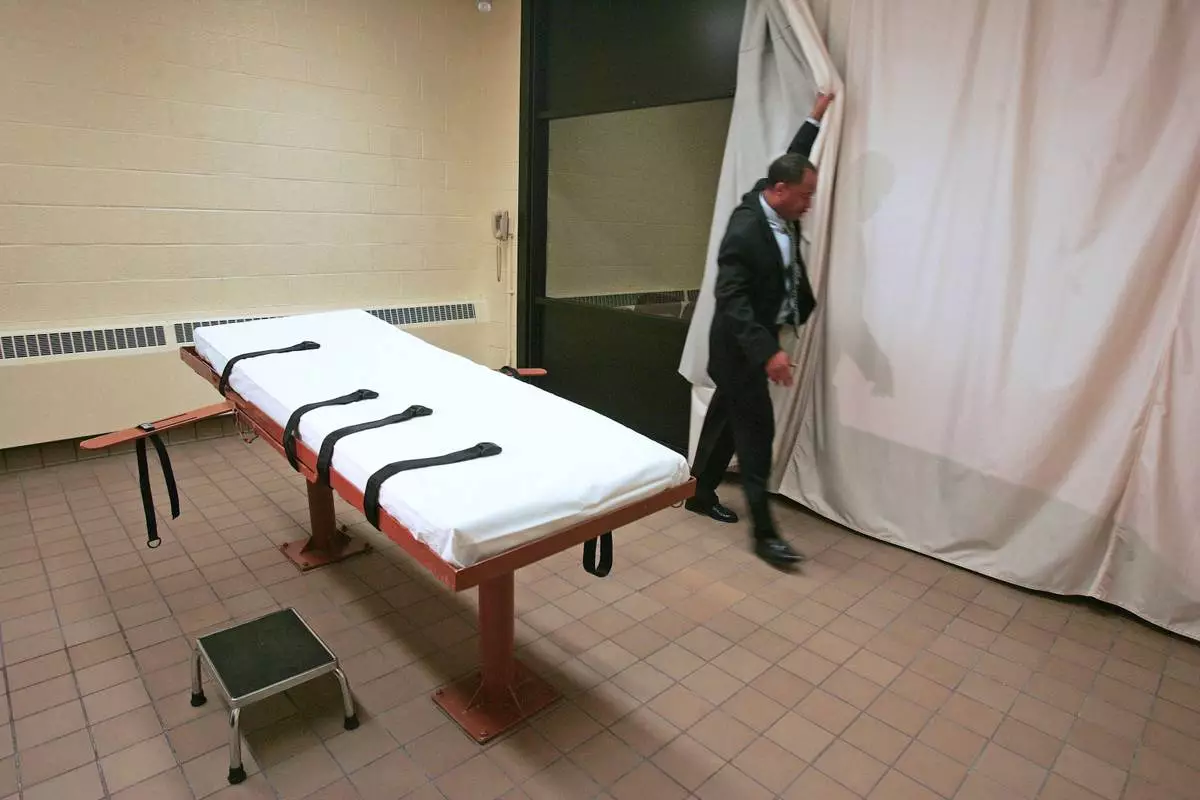
FILE – Larry Greene, public information director of the Southern Ohio Correctional Facility, demonstrates how a curtain is pulled between the death chamber and witness room at the prison in Lucasville, Ohio, in November 2005. (AP Photo/Kiichiro Sato, File)