PLEASANTON, Calif.--(BUSINESS WIRE)--Jun 16, 2026--
CharmHealth, a leader in healthcare technology solutions for providers, today unveiled an enhanced version of its integrated revenue cycle management (RCM) service. The new offering pairs the company’s CharmBillerPro platform with a dedicated team to handle the entire billing life cycle on behalf of growing and enterprise medical practices.
This press release features multimedia. View the full release here: https://www.businesswire.com/news/home/20260616005181/en/
CharmHealth’s RCM service is designed to give practices a faster, more transparent, and more efficient alternative to traditional third-party billing companies. It assists them by decreasing costs while reducing the administrative burdens that pull personnel away from patient care.
The service was created based on a significant pain point. Most third-party RCM firms are still manually entering patient demographics, insurance information, procedure codes, and diagnosis codes for every claim. This workflow limits even the most productive billers to a throughput of approximately 30 to 35 claims per day. For enterprise practices processing high claim volumes, that ceiling creates a fundamental scalability problem.
CharmHealth’s RCM service evolves beyond the outdated model. Because it runs natively on CharmHealth and is deeply integrated with the EHR, all patient, insurance and encounter data entered during the clinical workflow moves seamlessly into the billing platform. Coverage, copays and deductibles are verified automatically before the appointment. Claims are generated automatically from signed chart notes and routed through clearinghouses, enabling CharmHealth’s RCM team to process claims at a rate several times higher than the industry norm. Moreover, experienced coders and billing specialists with deep specialty expertise, combined with automation throughout the billing process, help reduce errors, minimize denials, and improve overall revenue cycle performance.
“When billing companies are manually pulling data that already exists in an EHR, they’re wasting time and introducing risk at every stage,” said Pramila Srinivasan, Ph.D., CEO of CharmHealth. “We built our RCM service from the ground up to eliminate that redundancy entirely. Practices benefit, but more importantly, patients benefit from streamlined processes that keep care rooted in satisfying their needs.”
Intelligent Operations, From Chart Notes Through Billing
Unlike traditional software deployments, CharmHealth’s RCM service establishes an ongoing operational partnership. It is structured around the simple principle that providers should focus on patient care rather than navigating billing workflows behind the scenes. Once a provider signs a chart note, they can select completed encounters and submit them to RCM with a single click. From that point forward, CharmHealth takes ownership of the entire process, moving from claim generation through scrubbing, submission, follow-up and then ultimately collections.
For practices that rely on paper superbills or manual data exports to communicate with their billing vendors, the operational difference is significant. Staff previously tasked with billing coordination and management/oversight can shift into higher-value roles, like practice management, using CharmHealth’s RCM service.
Real-Time Transparency Built Into the Platform
One of the most distinctive features of CharmHealth’s RCM service is its commitment to real-time transparency. While most billing companies operate as black boxes that release curated reports on their own schedules, CharmHealth gives practices direct, continuous access to the same reporting data its own billing team works from. Teams can optimize the workflow in ways that few third-party billers using someone else’s software could.
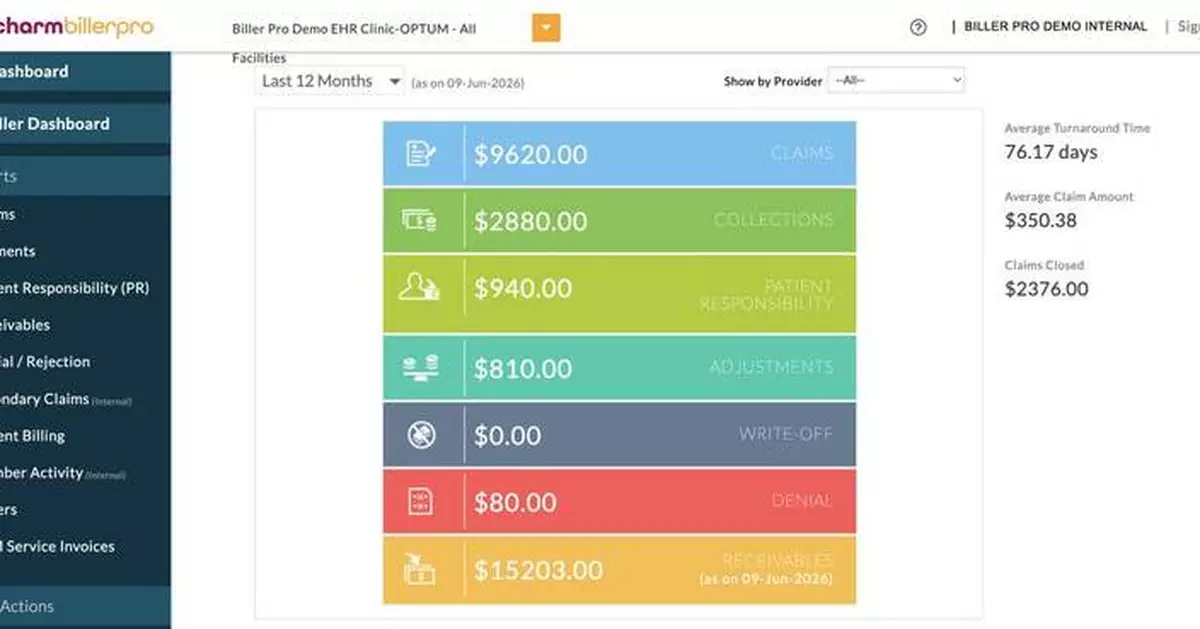
Through the centralized dashboard, accessible via both web and iOS, practice owners and administrators can view claims statuses, collections, contractual adjustments, write-offs, denial rates, and CPT-level denial reports at any time, without waiting for a vendor to run and send a report. Additionally, all write-off decisions are manual and logged, giving practices full visibility into every financial action taken on their behalf.
Built to Scale for the Enterprise
CharmHealth’s RCM service is specifically architected to serve enterprise-scale medical groups that have outgrown the capacity of conventional billing vendors. Because claim generation is fully automated, CharmHealth can process claims at heavy volume without the proportional staffing overhead that legacy billing models demand. The result is a materially lower cost to serve, making high-quality billing support more accessible to growing practices.
The RCM service will continue to drive efficiencies through CharmHealth’s ongoing development of AI-based features and intelligent validation tools. This investment in AI on billing services aligns well with the company’s broader efforts to apply AI across both clinical and administrative workflows for the betterment of providers and patients.
To learn more about how CharmHealth is transforming healthcare through strategic applications of technology, please visit www.charmhealth.com.
About CharmHealth
CharmHealth is a leading provider of innovative healthcare technology solutions that empower healthcare organizations to deliver efficient, high-quality care. With a focus on interoperability, patient engagement, and streamlined workflows, CharmHealth offers a comprehensive suite of solutions designed to meet the evolving needs of modern healthcare. For more information on CharmHealth, visit www.charmhealth.com. To get breaking news, follow the company on LinkedIn, Facebook and @charmhealth.
All brand names and solution names are trademarks or registered trademarks of their respective companies.
Tags: CharmHealth, revenue cycle management, CharmBillerPro, Pramila Srinivasan, electronic health record, EHR, healthcare, digital health, claims, billing, chart notes, healthcare innovation, healthcare technology, AI, artificial intelligence, healthcare delivery, medical practices, patients
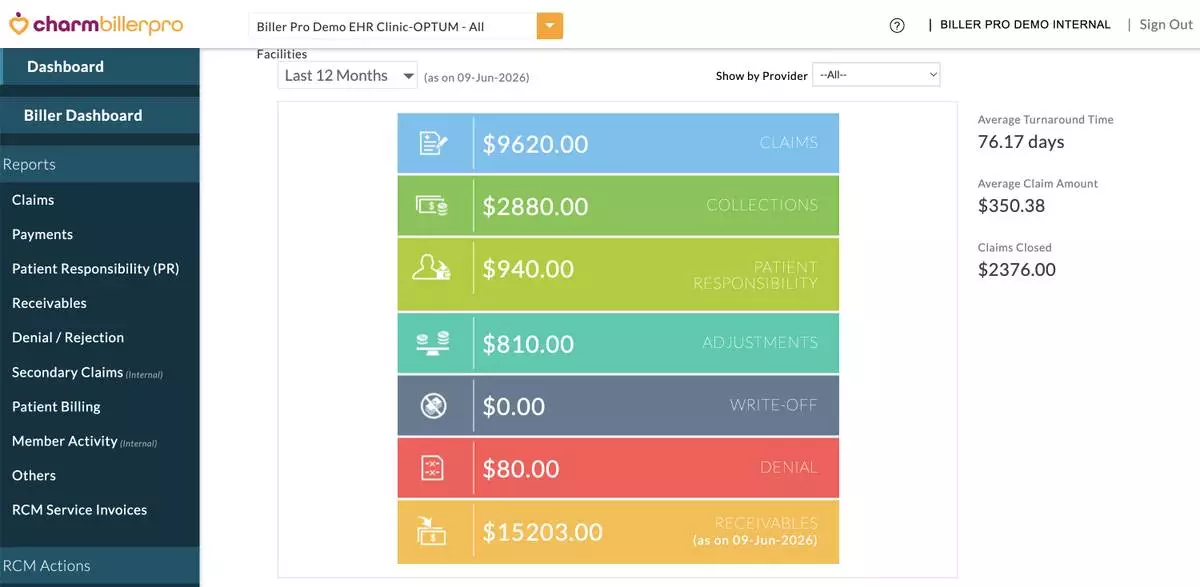
The RCM dashboard is accessible to practice owners and administrators via both web and iOS.