Skip to Content Facebook Feature Image

About Mike DeWine, the Republican Ohio governor who has called for an end to the death penalty

News

About Mike DeWine, the Republican Ohio governor who has called for an end to the death penalty
News

News

About Mike DeWine, the Republican Ohio governor who has called for an end to the death penalty

2026-06-17 05:39 Last Updated At:05:40

COLUMBUS, Ohio (AP) — Gov. Mike DeWine on Tuesday used his bully pulpit to call for an end to the death penalty in Ohio.

The 79-year-old Republican cited his expertise on the issue as a former county prosecutor, member of both chambers of Congress and Ohio attorney general, as well as his seven years as governor.

But DeWine’s support for a policy change is far from assured to make waves, even in a state controlled by his own party. That is because DeWine is more moderate than many younger Republicans in the state, whose political aspirations rely on endorsements from President Donald Trump, a staunch death penalty supporter.

Here's a closer look at DeWine and his place in Ohio's political landscape:

DeWine was first elected to public office in 1976, when he became prosecuting attorney in Greene County, where he grew up. He still lives in the historic home there where he and his wife, who had eight children, hosted a summer ice cream social each year to encourage and celebrate GOP candidates and officeholders. The event ended its 50-year run just last weekend.

When DeWine was elected to the state Senate in 1980, Ohio had no death penalty law. The old one had been declared unconstitutional, and DeWine was instrumental in writing the new one, which cleared both legislative chambers with overwhelming bipartisan majorities. It has been in effect now since 1981.

He said Tuesday that he always believed the moral justification for the death penalty was its potential to deter violent crime.

During his four terms in the U.S. House, DeWine supported federal legislation signed by President Ronald Reagan that expanded the number of crimes eligible for the death penalty. As a U.S. senator, he backed a bill signed by President Bill Clinton that attempted to speed up the review of capital cases in federal courts.

In between those positions, DeWine was lieutenant governor of Ohio under storied Republican Gov. James Rhodes.

He took a brief break from politics after losing a Senate reelection bid to Democrat Sherrod Brown in 2006, before being elected Ohio attorney general in 2010. In that role, he said Tuesday, he “vigorously” carried out the state's death penalty law.

Since he became governor in 2019, problems obtaining lethal injection drugs have led to an unofficial moratorium on executions in the state, which last conducted one in 2018.

DeWine may be the titular head of the Ohio Republican Party, but that doesn't mean his party always listens to him. Particularly in the Trump era, he has presided over a party rife with internal divisions.

Clashes became particularly fierce during the COVID-19 pandemic, when DeWine and then-state Health Director Amy Acton — now the Democratic nominee for governor — presided over one of the most rigorous virus responses in the country in early 2020. Within months, a faction of Republicans had mutinied against DeWine's mandates, particularly over business closures, threatening to pass a bill limiting his powers or even to impeach him.

In 2023, after DeWine struck down a ban on gender-affirming care and transgender athletes participating in girls' sports, the Republican-dominated state Legislature easily overrode his veto.

The divisions have also been seen in this year's critical elections.

DeWine had tried to position popular former Ohio State Buckeyes football coach Jim Tressel as a potential successor, appointing the moderate Republican as lieutenant governor last year. But the state GOP rushed to back Trump-endorsed biotech billionaire Vivek Ramaswamy in the race in May 2025, before Tressel had even made up his mind whether to run. DeWine endorsed Ramaswamy in January.

DeWine said Tuesday that he had not shared his decision to call for an end to the death penalty with Ramaswamy, now the GOP gubernatorial nominee. The recent effort by the Trump administration to take on Medicaid fraud has found DeWine defending his administration's work on the issue, even as Ramaswamy, Ohio-born Vice President JD Vance and GOP lawmakers take aim at Ohio's existing fraud-fighting efforts.

Among proponents of DeWine's push to end the death penalty in Ohio were a host of fellow Republicans, including some staunch conservatives.

“For many years, I was a proponent of the death penalty," former congresswoman and current state Rep. Jean Schmidt said in a statement. "My views changed because of the risks of executing an innocent person, the exorbitant costs, and my belief in the sanctity of life. The death penalty is no longer a policy worth preserving.”

Former Ohio Auditor and Attorney General Jim Petro cited wrongful convictions among the flaws that make the death penalty no longer tenable.

Former Ohio Gov. Bob Taft, the great-grandson of President William Howard Taft and grandson of “Mr. Republican” Sen. Robert A. Taft Sr., also sided with DeWine.

DeWine “has been thoughtful and given this issue the careful consideration it needs,” Taft said.

FILE - Sen. Mike DeWine, R-Ohio, right, looks on as former National Archives employee Robert Wolfe speaks at a Washington news conference, May 13, 2004. (AP Photo/Susan Walsh, File)

FILE - Sen. Mike DeWine, R-Ohio, right, looks on as former National Archives employee Robert Wolfe speaks at a Washington news conference, May 13, 2004. (AP Photo/Susan Walsh, File)

FILE - Sen. Mike DeWine, R-Ohio, left, debates his challenger Rep. Sherrod Brown, D-Ohio, on NBC's 'Meet the Press' Oct. 1, 2006, in Washington. (AP Photo/Kevin Wolf, File)
FILE - Sen. Mike DeWine, R-Ohio, left, debates his challenger Rep. Sherrod Brown, D-Ohio, on NBC's 'Meet the Press' Oct. 1, 2006, in Washington. (AP Photo/Kevin Wolf, File)

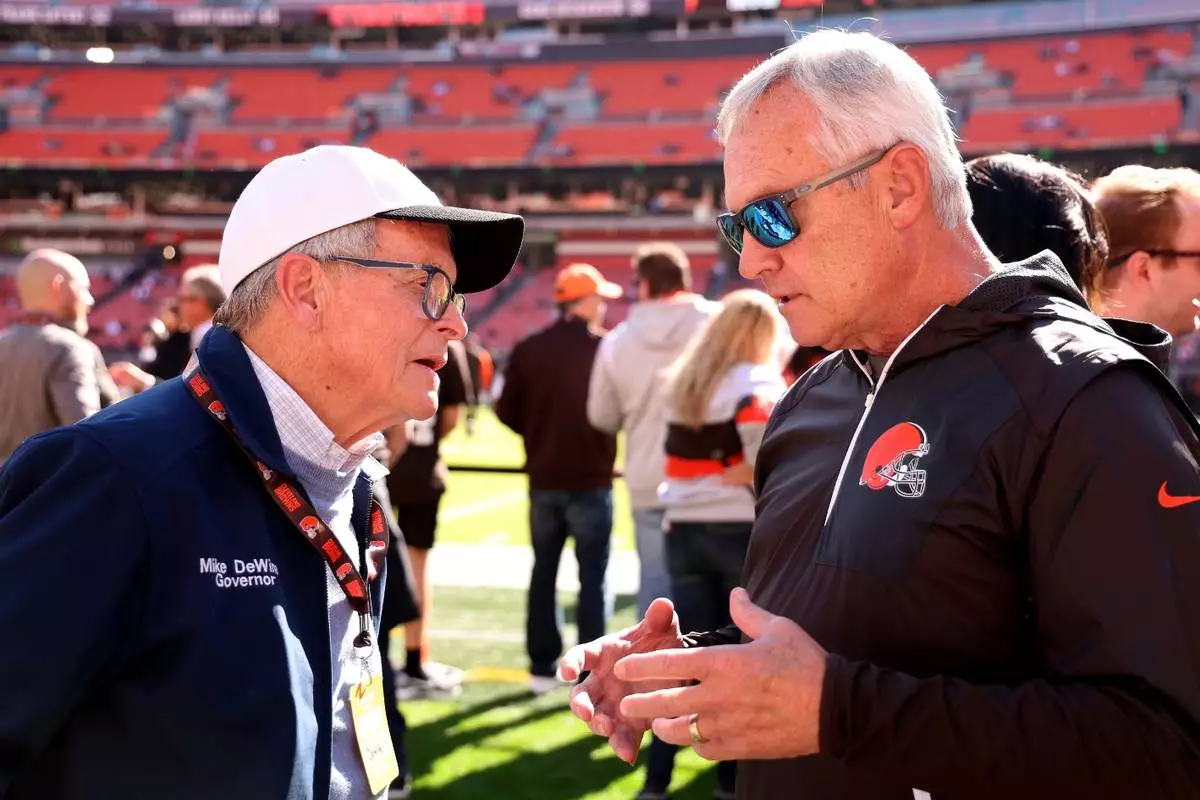
FILE - Ohio Gov. Mike DeWine talks with former Ohio State coach Jim Tressel while standing on the sideline prior to the start of an NFL football game between the Cincinnati Bengals and the Cleveland Browns, Oct. 20, 2024, in Cleveland. (AP Photo/Kirk Irwin, File)

FILE - Ohio Gov. Mike DeWine talks with former Ohio State coach Jim Tressel while standing on the sideline prior to the start of an NFL football game between the Cincinnati Bengals and the Cleveland Browns, Oct. 20, 2024, in Cleveland. (AP Photo/Kirk Irwin, File)

MILWAUKEE (AP) — Cooper Pratt has reached the major leagues 2 ½ months after the Milwaukee Brewers signed the shortstop prospect to an eight-year, $50.75 million contract.

The Brewers called the 21-year-old Pratt up from Triple-A Nashville before their Tuesday night game with the Cleveland Guardians while designating third baseman Luis Rengifo for assignment.

Pratt was the Brewers' starting shortstop on Tuesday. He should start getting accustomed to that assignment.

“This is a kid we’ve signed for the long term,” Brewers manager Pat Murphy said. “We feel confident he will be our shortstop of the future. He’s going to play.”

Pratt found out he was going to the big leagues when Nashville manager Rick Sweet notified him during the Sounds' game on Sunday.

“It was magical, man,” Pratt said. “It didn’t quite feel real.”

The news came at an ideal time for Pratt because the Brewers were off Monday, enabling his family to make it to Milwaukee for his Tuesday debut. Pratt's father, Russell Pratt, doesn't travel by airplane.

That meant a 700-mile drive from the Pratt's family home in Oxford, Mississippi. Those long-distance drives were common during Pratt's road to the big leagues.

“We drove in travel ball for like 20 hours sometimes, from like Mississippi to Arizona,” Pratt said. “Arizona to Texas. We drove all over.”

Pratt signed an eight-year deal on April 3 that includes club options for 2034 and 2035. The $50.75 million contract includes escalators that could raise the value by $10 million if he repeatedly finishes high in MVP voting and the team exercises those two options.

In the weeks after agreeing to that deal, Pratt felt pressure to live up to that contract. His batting average in Nashville didn't climb above .200 for good until April 26.

He has performed better lately. He was hitting .241 with a .349 on-base percentage, six homers, 32 RBIs and 17 steals in 58 games with Nashville at the time of his promotion.

Pratt's defense is ahead of his offense at this point in his development. He won a Gold Glove as the top shortstop in the minor leagues in 2024.

“Now we’re well aware of a guy making his first trip to the big leagues, it could go many different ways,” Murphy said. “When are they ready? When is it a perfect time? Right now, in my opinion, it doesn’t really matter. It matters he gets comfortable in the big leagues, understands it, starts to make his adjustments he needs to make, and then we roll from there.”

Murphy has a connection to Pratt's family. Pratt is the nephew of BYU coach Trent Pratt, who played for Murphy at Arizona State from 1999-2000.

The Brewers can afford to be patient with Pratt’s bat as long as he fields the way he did in the minor leagues.

Milwaukee has received little offensive production from the left side of its infield all season, yet the Brewers still entered Tuesday leading the NL Central by 4 ½ games over St. Louis as they chase their fourth straight division title. The versatile David Hamilton had been splitting time with Joey Ortiz at shortstop and with Rengifo at third base.

Hamilton is batting .231 with a .316 on-base percentage, .320 slugging percentage, three homers, 11 RBIs and 14 steals in 58 games. Ortiz is hitting .207 with a .299 on-base percentage, .262 slugging percentage, one homer, 14 RBIs and five steals in 60 games.

Rengifo was hitting .205 with a .280 on-base percentage, .254 slugging percentage, no homers, 19 RBIs and three steals in 57 games.

Murphy mentioned that he now might have Hamilton and Ortiz splitting time at third base, with Hamilton primarily starting against right-handers and Ortiz getting the call against lefties. Ortiz was Milwaukee's starting third baseman in 2024.

“I've had many meetings with Joey, and he totally understands what's happening," Murphy said. “Six weeks ago, I sat with Joey and said, ‘Joey, this has happened. They signed this guy. Do you understand that? ... But it doesn’t mean you can't have an incredible career in the big leagues, including playing shortstop for us at times.' ”

Pratt was one of two Brewers prospects to sign a lucrative long-term deal this year while still in the minors. Luis Lara, a 21-year-old outfielder playing for Nashville, signed a seven-year deal worth $31 million last week.

AP MLB: https://apnews.com/hub/MLB

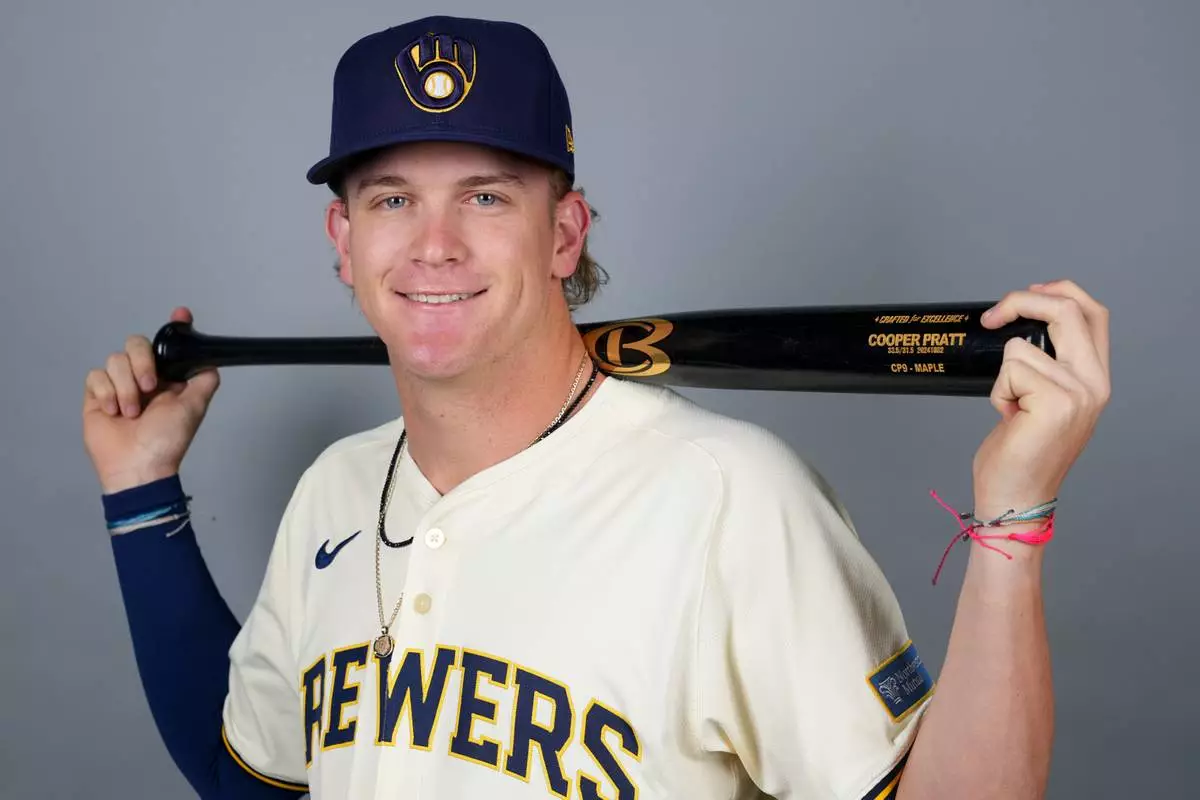
FILE - Milwaukee Brewers infielder Cooper Pratt poses for an official photo, Feb. 21, 2025. (AP Photo/Lindsey Wasson, File)

FILE - Milwaukee Brewers infielder Cooper Pratt poses for an official photo, Feb. 21, 2025. (AP Photo/Lindsey Wasson, File)

Recommended Articles