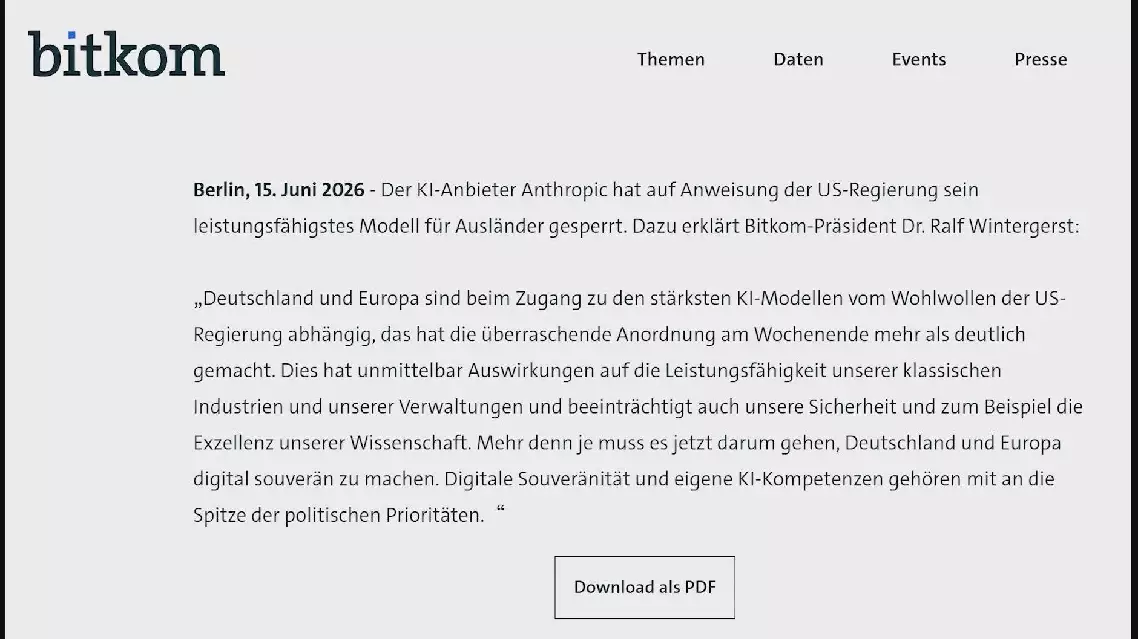
Germany and Europe are completely dependent on the United States' attitude in obtaining advanced artificial intelligence models, Bitkom, a German digital industry association, said in a statement released on Monday.
The statement came after San Francisco-based AI company Anthropic announced on June 12 that it had suspended access to two of its most powerful AI models following an order from the U.S. Department of Commerce on national security grounds, affecting users in Europe and elsewhere.
The restriction directly affects the operational efficiency of Germany's industrial and administrative sectors, as well as its security and scientific research competitiveness, the statement said.
The association calls on Germany and Europe to give higher political priority to digital sovereignty and the building of autonomous artificial intelligence capabilities.
Katharina Erhardt, an expert with the Kiel Institute for the World Economy, said the restrictions indicate that even close allies may not be able to consistently access the latest artificial intelligence technologies from the United States.
"It undoubtedly sets a precedent, as it is the first such kind of restriction in the advanced technology field. Moreover, the restricted objects include the partner countries of the United States, which actually affects all non-US citizens," she said.
Erhardt further pointed out that advanced AI models require huge investments and high entry barriers, which can easily lead to a situation in which only a few enterprises and countries possess core capabilities. It is difficult for Europe to automatically form its own technological foundation merely through market competition.
Therefore, more proactive policies are needed to develop local AI capabilities, including those for strengthening the construction of computing power and data centers, reducing energy costs, better balancing regulation and innovation, and investing more funds in this field, she said.
"Germany, or even Europe, can no longer be naive. We must realize that we live in a geopolitical world, meaning that in some core technologies and core fields, Europe cannot rely on the outside but must build its own capabilities," the expert said.
U.S. AI access cut discloses Europe's reliance on US: Bitkom
China's influence in global governance is becoming increasingly prominent, and its vision of building a community with a shared future for mankind is highly consistent with the purposes and principles of the United Nations, newly appointed UN Resident Coordinator in China Stephan Jackson said.
In a recent interview with China Media Group (CMG), he also said that a series of global initiatives proposed by China are of great significance to advancing the United Nations Sustainable Development Goals (SDGs) and upholding multilateralism.
Jackson officially assumed office in April. In more than two months since taking up the post, he has been impressed by China hosting an influx of political leaders from various countries and heads of UN agencies, which underscores its important and growing influence in global governance.
"It is a complicated moment. China's engagement is very prominent. It's very constructive and it's very multilateral. I think it is a constructive voice in global affairs, a voice that says dialogue is better than confrontation. Sitting down together and discussing and trying to reach consensus amongst member states is important. I welcome that. I think we're better off as a planet with multilateralism," he said.
In the interview, Jackson highly commended China's vision of building a community with a shared future for mankind, saying that the concept is fundamentally in line with the spirit of the UN Charter and closely aligned with the SDGs.
"We're better together, we're worse off apart. A better future awaits if we work together. And I think the language of the sustainable development goals of leaving no one behind, that is absolutely about, well, a shared future, is about a shared present as well of course," he said.
Since 2021, China has put forward four major global initiatives, namely the Global Development Initiative, the Global Security Initiative, the Global Civilization Initiative and the Global Governance Initiative.
The UN official said these initiatives provide practical solutions for the international community to jointly address common challenges, including development gaps, climate change and regional conflicts.
"All four of those -- climate, conflict, elimination of poverty and narrowing of inequality, and dealing with the governance of AI -- are things on which I think China's voice is, we can't do without it. China is really central to that. Whether we are talking about the pressing problem of climate change, and I think GDI particularly is already contributing in a very significant way there. Whether we are talking about the problem of resurgent global conflict, the emphasis that the Global Civilization Initiative has on dialogue. If you think about sustainable development goal No. 1, which is the alleviation of poverty, China over recent decades has lifted an astronomical number of people out of absolute poverty, just in and of itself as a contribution to achieving the SDGs. The balance of influence is shifting in this 21st century. Well, China has long been one of the most prominent countries of the Global South, and with China a leading voice amongst those is being heard much more loudly in multilateral affairs than ever before. We need China. China's thoughts on what the UN should look like going forward are invaluable," said Jackson.

UN Official hails China's contributions to global governance