U.S. stocks ended substantially lower on Wednesday after the Federal Reserve concluded its two-day policy meeting with a more hawkish outlook.
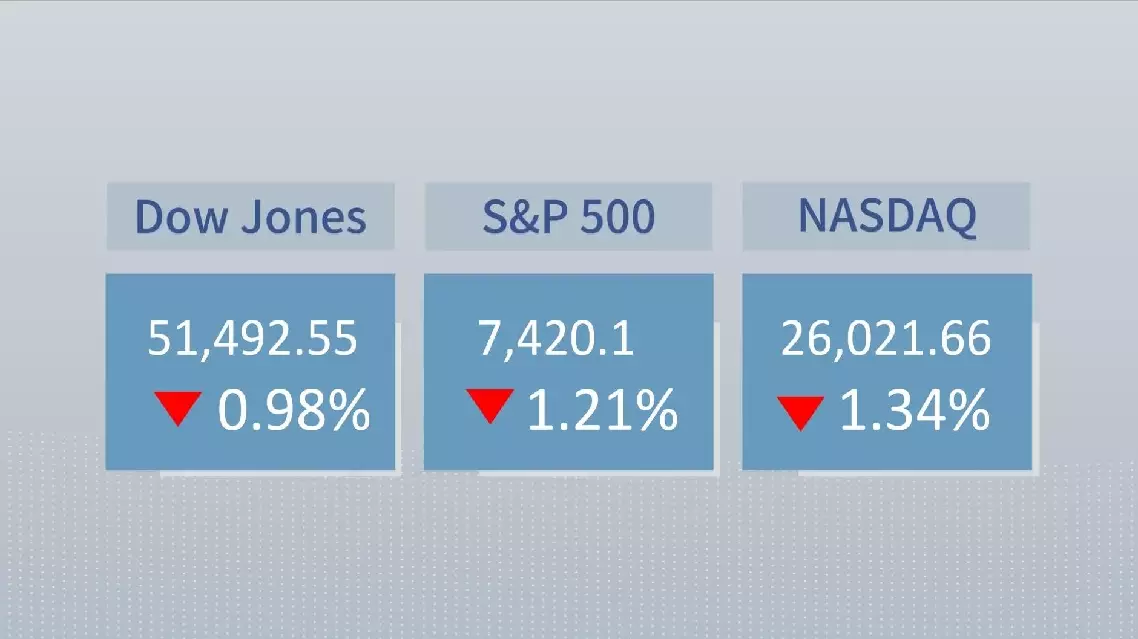
The Dow Jones Industrial Average fell 507.12 points, or 0.98 percent, to 51,492.55. The S&P 500 sank 91.25 points, or 1.21 percent, to 7,420.1. The Nasdaq Composite Index shed 354.69 points, or 1.34 percent, to 26,021.66.
All 11 primary S&P 500 sectors closed in negative territory, with communication services and consumer discretionary leading the declines at 2.98 percent and 2.69 percent, respectively. Industrials posted the smallest loss, down 0.12 percent.
At the conclusion of its first meeting under new Fed Chairman Kevin Warsh, the Fed left the target range for the federal funds rate unchanged at 3.5 to 3.75 percent as expected. "Economic activity is expanding at a solid pace despite elevated uncertainty that owes, in part, to the conflict in the Middle East. Productivity growth and capital investment are strong," the statement read. "Job gains have kept pace with the workforce, and the unemployment rate has changed little."
However, Fed's updated Summary of Economic Projections showed a notably more hawkish shift, with the median estimate for the fed funds rate at year-end 2026 rising to 3.8 percent from 3.4 percent in March. Nine of 18 participants now project one possible rate hike this year, compared to none in the previous projections. Warsh abstained from submitting his own forecast.
"A clear hawkish shift from the Fed sees the committee split down the middle on whether they will hike rates or not this year," wrote James Knightley, chief international economist at ING. "Sharp energy price falls are good news though, and we think an extended pause is the most likely outcome."
The U.S. Treasury yields jumped following the decision, with the 2-year yield rising more than 16 basis points to as high as 4.216 percent at one point. The 2-year Treasury yield reached its highest level since January of last year, when U.S. President Donald Trump took office.
SpaceX fell for the first time since its public debut, declining nearly 5 percent and trimming earlier gains that had reached roughly 58 percent above the IPO price. Mega-cap technology stocks faced broad pressure, with all members of the "Magnificent Seven" falling at least 1 percent.
U.S. stocks sink after hawkish signals from Fed
U.S. stocks sink after hawkish signals from Fed