Deep in the Tengger Desert in north China's Inner Mongolia Autonomous Region, a hardy shrub called Hedysarum scoparium has slowly turned the yellow sand into patches of green over the past eight years, and playing a key role in the local desertification control efforts is a herdsman-turned-shrub grower, Lei Xinguang. Hedysarum scoparium, also known by its Chinese name "Huabang", is a fast-growing, drought-resistant shrub extensively used for desertification control, grassland restoration, and sand-binding in the arid and semiarid regions of northwestern China. It is highly valued for stabilizing shifting sand dunes and creating ecological buffer zones to protect vulnerable environments.
The Mongolian name for Huabang means "seventy layers of bark" owing to the way its bark peels off layer by layer after being scorched by the sun's ultraviolet rays. In the 43,000-square kilometer Tengger Desert, one of China's largest deserts where the annual rainfall is less than 150 millimeters, most plants struggle to survive. But Huabang has flourished here, thanks to Lei Xinguang, a local of Inner Mongolia's Alxa Left Banner, who has since 2018 dedicated his life into turning the sandy land of the Tengger Desert by growing the deep-rooted shrub.
Years of efforts have seen him from planting the very first sapling to overseeing over 7,300 hectares of the plant today, and from working alone to now running a cooperative joined by many other locals also devoted to the greening efforts of their local land.
"I was born right here in the heart of the Tengger Desert. Back then, sandstorms would blot out the sky and the sun, making it difficult to open our eyes when stepping outside. Turning the Tengger Desert into an oasis has been a dream of mine since I was a child," he said an interview with the China Media Group (CMG).
According to Lei, even when buried by sand, Huabang can sprout new shoots from beneath the surface, and its roots can stretch more than 10 meters outward, forming an underground web that firmly lock down the shifting sand.
"It has pointed leaves, and this is its neck. Each Huabang plant grows on a small mound of sand. In autumn, the leaves fall and gather right over here. When the wind blows, the sand gets trapped," said Lei.
Despite Huabang's ability to survive the harsh desert environment, growing it on a large scale still presents formidable challenges. Through years of battling sandstorms, Lei gradually improved his planting methods. He learned that Huabang cannot be planted too densely -- spacing must be controlled at three meters between plants and five meters between rows in order to ensure enough moisture. On windward slopes, the plant cannot be grown too high in order to prevent it from being blown away.
"When I started planting in 2018, I used hand-held augers, but the survival rate was really low. In 2019 and 2020, I switched to pit-digging machines, but still failed to improve the survival rate. From 2023 onward, I began adopting a method called water-jet planting. Since then, I have never needed to replant," Li recalled.
In 2018 when Lei Xinguang founded his cooperative, two of the five herder families who joined were classified as households in extreme poverty. Today, their lives have changed dramatically from growing Huabang.
"Their incomes are now five or six times higher than in 2018. One of the families made over 100,000 yuan (over 14,600 U.S. dollars) last year just from selling Huabang seeds," Lei told CMG.
Over the past eight years, Lei, along with other members of his cooperative, have grown more than 5 million Huabang plants across over 7,300 hectares of desert.
And they are far from alone. Across the area designated for desertification control on the southeastern edge of the Tengger Desert, people like Lei have planted more than 220,000 hectares of drought-tolerant vegetation to date, effectively curbing the spread of the desert.
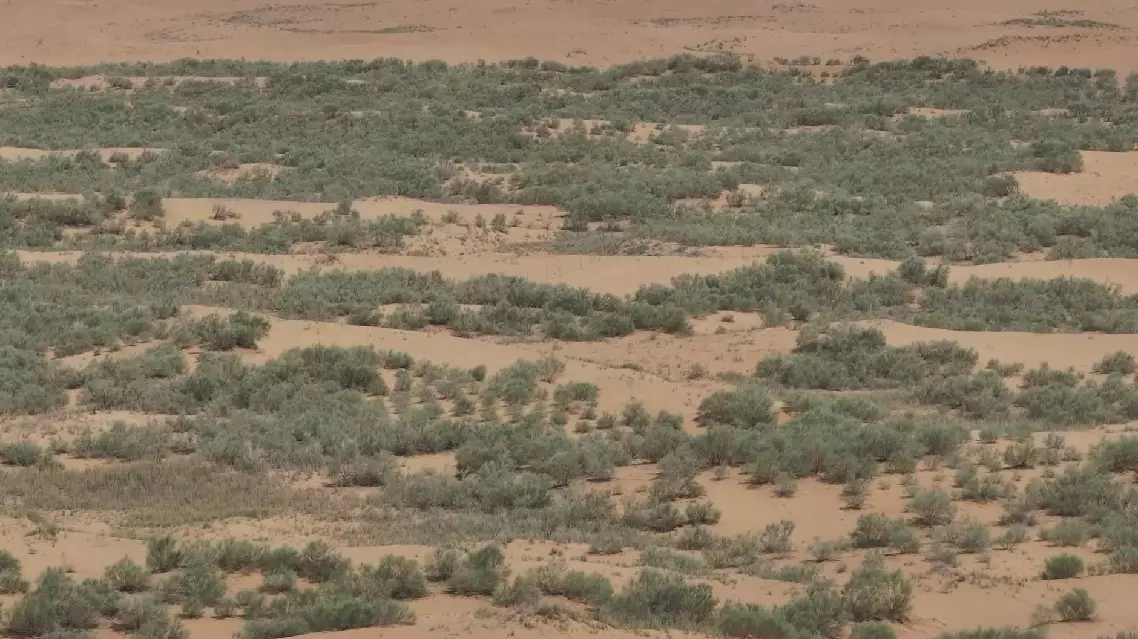
Inner Mongolian grower dedicated to greening desert with drought-resistant plants