China had completed 96 percent of the annual workload for the summer harvest as of Thursday, according to the Ministry of Agriculture and Rural Affairs.
Data from the ministry shows that, apart from northwestern regions including Xinjiang and Gansu where harvesting is still underway, all major wheat-producing regions such as the southwest and the Huang-Huai-Hai region that encompasses parts of the Yellow River, Huaihe River and Haihe River basins have wrapped up their harvesting. This year's large-scale mechanized wheat harvest across China has essentially come to an end.
The nationwide mechanized summer wheat harvest kicked off on May 28, progressing swiftly from south to north. The bulk of the operation was completed within 22 days, two days faster than last year.
During the peak period from May 31 to June 13, the country averaged more than 16 million mu (about 1.07 million hectares) of daily harvest. In central China's Henan Province, one of the major wheat-producing regions, farmers harvested more than 10 million mu a day for three consecutive days, getting the crucial phase of the rush done in roughly a week.
Technology has been a key driver behind this efficiency. Beyond the use of BeiDou-based operation monitoring systems, this year's summer harvest has also seen the deployment of upgraded domestically produced combine harvesters, with wheeled models achieving a feed rate of 12 kilograms per second and tracked models reaching 9 kilograms per second.
Moreover, the loss rate for grain harvested by machines was kept within a favorable range of below 1 percent across most regions. In some fields across Henan and Anhui provinces, loss rates were even held to around 0.5 percent, providing strong support for securing a bumper summer grain harvest and ensuring China's stable annual food production.
This year, a number of wheat-producing regions received more rainfall than usual, posing challenges to harvest operations, while cross-regional coordination of harvest equipment and other resources helped mitigate the impact.
In mid-May, central Hubei province was hit by persistent heavy rains, leaving a harvest window of only about three days. In response, the Ministry of Agriculture and Rural Affairs dispatched 13,000 combine harvesters from other regions to support the emergency effort.
Starting June 1, China officially entered its flood season. With the Huang-Huai-Hai region facing frequent showers and severe convection weather at the time, the ministry promptly issued early warnings and mobilized agricultural machinery service centers, regional emergency response centers, as well as emergency service teams to race against the rain and secure the harvest.

China's summer wheat harvest nears completion
Bulgarian Prime Minister Rumen Radev met with visiting Chinese Foreign Minister Wang Yi in Sofia, Bulgaria on Monday, expressing willingness to elevate the positioning of bilateral relations and expand cooperation with China across the board.
Asking Wang, also a member of the Political Bureau of the Communist Party of China Central Committee, to convey his sincere greetings to Chinese leaders, Radev said that Bulgaria cherishes its traditional friendship with China, admires China's tremendous development achievements, and regards China as an important stabilizing force for safeguarding peace in today's world.
Radev said that Bulgaria firmly adheres to the one-China principle and will not conduct any official exchanges with Taiwan. Bulgaria-China relations have a long history and bright prospects, and Bulgaria is ready to further elevate the positioning of bilateral relations and expand cooperation with China across the board, he said, adding his belief that Wang's visit will inject new impetus into this endeavor.
He also said that Bulgaria warmly welcomes Chinese enterprises to invest in the country, and will increase government support, ensure policy stability and provide a sound business environment.
Radev said that, historically, Western countries actively supported economic globalization and trade liberalization and viewed China as somewhat conservative and closed, but today China has become a staunch supporter of globalization and free trade.
He also said Europe has concerns about its trade deficit with China, but Chinese goods with high quality and competitive prices have helped curb inflation in Europe; in reality, neither side can do without the other. Bulgaria-China cooperation on connectivity enjoys good prospects, and Bulgaria is willing to serve as a gateway and bridge connecting Eurasia and linking Europe and China, Radev added.
For his part, Wang conveyed Chinese leaders' warm greetings to Radev, saying that forging a new future for China-Bulgaria relations requires consolidating the political foundation and deepening political mutual trust so as to create better conditions for bilateral cooperation in various fields.
China appreciates Bulgaria's continued adherence to the one-China policy and its understanding and support for China's legitimate position of safeguarding national sovereignty and territorial integrity, Wang said.
Noting that China and Bulgaria enjoy traditional friendship, with bilateral relations on a solid foundation and having broad prospects, Wang said that upgrading the positioning of bilateral relations is a natural and logical step.
Wang said China is ready to deepen political mutual trust, expand practical cooperation and achieve mutually beneficial and win-win results with Bulgaria, and that China will be Bulgaria's most reliable and long-term strategic partner in its development and revitalization.
He stressed that China is committed to advancing modernization and building a community with a shared future for humanity together with all countries. China is willing to work with Bulgaria to advocate multilateralism and free trade and promote the democratization of international relations.
Wang noted that the Belt and Road Initiative and the China-Europe Railway Express have boosted transcontinental and trans-regional connectivity, and these, together with Europe's Middle Corridor vision, can complement and reinforce each other, rather than exclude or offset one another.
China is ready to strengthen strategic alignment with Bulgaria, support Bulgaria in playing a bridging role in Eurasian connectivity, and achieve mutually beneficial and win-win outcomes for China and Bulgaria as well as for China and Europe, Wang said.
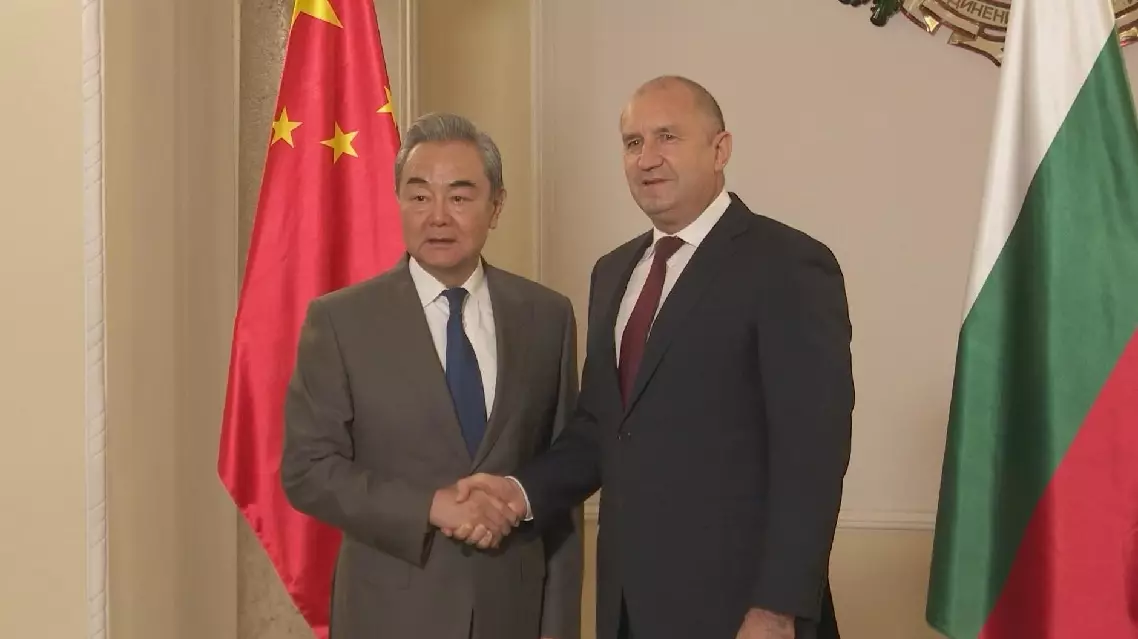
Bulgarian PM meets Chinese FM, voices willingness to expand cooperation with China